
CI/CD for MES and Plant Applications
Standardized pipelines for MES extensions, ERP connectors and quality systems. Our DevOps for manufacturing builds share one branch strategy, one artefact store and one promotion path.
See: DevOps Automation →DevOps & Cloud for Manufacturing
We automate how plant software is built, tested and shipped: MES connectors, edge gateways, OEE dashboards and the cloud behind them. Every release respects production, OT security zones and planned downtime.
14
Deploys today
38 min
Lead time
0
Failed changes
DevOps for manufacturing is how plants ship software as reliably as they ship product. Factory code now runs everywhere: MES integrations, historian connectors, edge gateways, quality vision services and cloud analytics. Yet many plants still release it by hand, on a laptop, during a weekend shutdown.
Our team builds DevOps for manufacturing that fits the realities of the floor. Pipelines test against simulated PLC and OPC UA endpoints before anything reaches a line. Releases wait for approved change windows. Edge devices update themselves, verify health and roll back without a technician on site.
The goal is simple. Engineers ship improvements every week, not twice a year, and production never becomes the test environment.
DevOps for manufacturing applies continuous integration, continuous delivery and infrastructure as code to the software that runs a plant. That covers IT systems like ERP connectors and reporting, and OT-adjacent systems like MES, SCADA interfaces and edge compute.
The difference from web DevOps is the cost of failure. A bad deploy on a website shows an error page. A bad deploy on a line can stop a machine, scrap a batch or break traceability. So every pipeline stage is designed around safety, validation and fast, rehearsed rollback.
It also means working across two cultures. IT teams want speed and automation. Controls engineers want stability and proof. Good DevOps for manufacturing gives both groups the same pipeline, the same evidence and the same veto.
Working definition
“DevOps for manufacturing is the practice of building, testing, securing and releasing plant software through automated, auditable pipelines that respect OT security zones, production schedules and the need to recover instantly.”
Foundations
Every build runs against simulated PLC tags, OPC UA servers and recorded historian data. Faults show up in the lab, not on a running press.
Pipelines follow the plant's network segmentation. Cloud runners never reach control networks directly. Edge devices pull signed releases instead.
Deployments to production cells are gated on approved change windows, shift handovers or planned downtime, set by operations, not by developers.
Every release keeps the previous version ready. A failed health check triggers automatic rollback, and the line keeps running.
Core capabilities
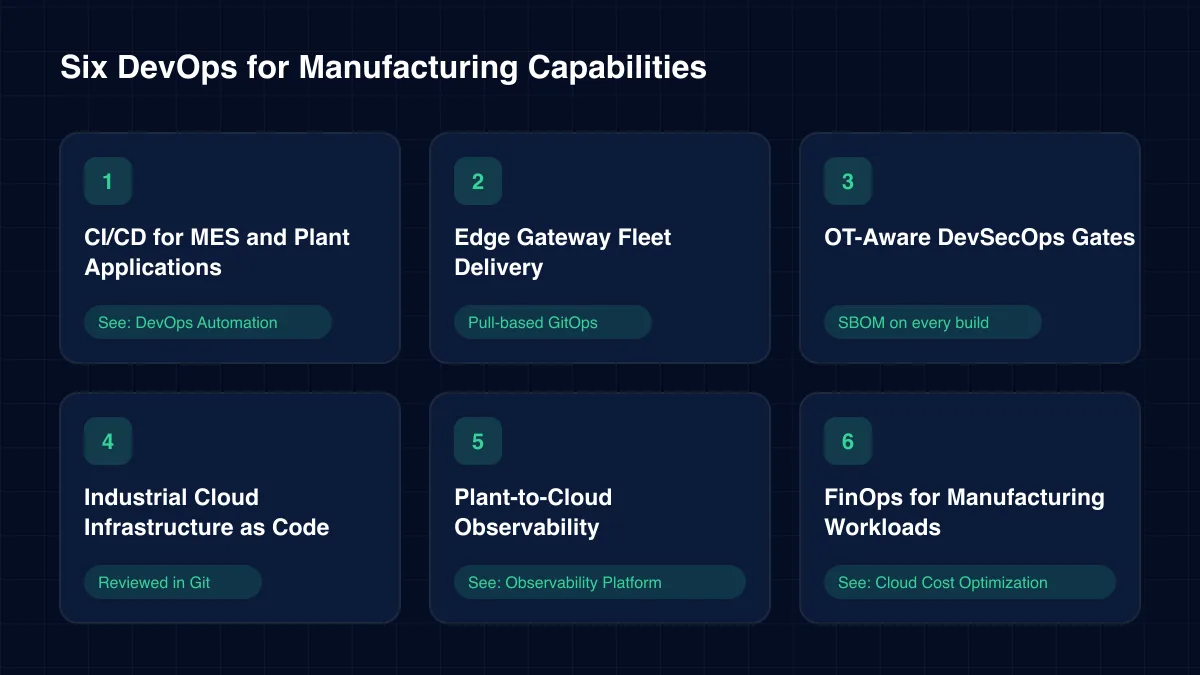
Each capability below is a building block we deliver on real engagements. Together they form a complete DevOps for manufacturing platform, from source control to the plant floor.
Standardized pipelines for MES extensions, ERP connectors and quality systems. Our DevOps for manufacturing builds share one branch strategy, one artefact store and one promotion path.
See: DevOps Automation →Multi-architecture container builds for x86 and arm64 industrial PCs, signed and delivered over the air. Devices pull updates, report health and roll back on failure.
Pull-based GitOps
Dependency, container and IaC scanning with an SBOM for every release. Policies map to IEC 62443 zones and conduits, so nothing crosses a boundary it should not.
SBOM on every build
Terraform modules for the cloud side of the plant: data lakes, analytics clusters and site VPN links. Every environment is reproducible, reviewed and drift-checked.
Reviewed in Git →Metrics, logs and traces from edge devices, connectors and cloud services in one view. Alerts flag a stalled MES interface before operators notice missing data.
See: Observability Platform →Rightsizing, tagging by plant and line, and scheduled shutdown of non-production stacks. Cost becomes visible per site, which makes DevOps for manufacturing easier to fund.
See: Cloud Cost Optimization →Architecture
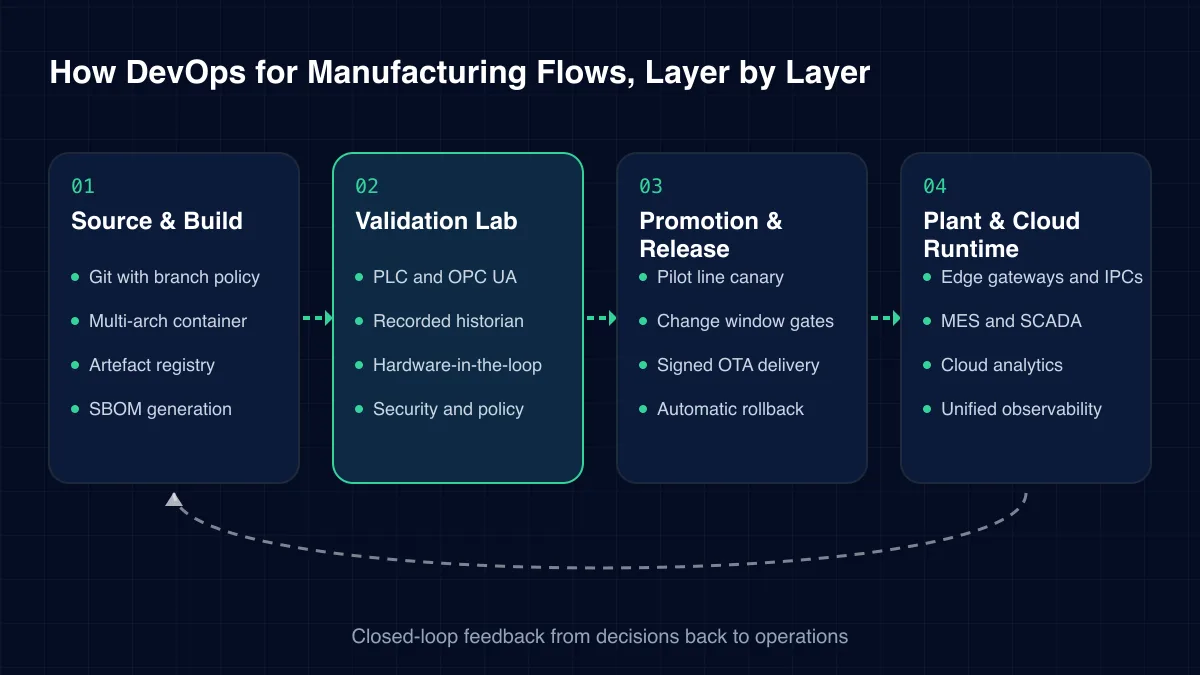
Our DevOps for manufacturing reference architecture has four layers. Code moves down from developers to the floor. Health and usage data moves back up to guide the next release.
01
02
03
04
Challenges we solve
These are the failure modes we see most often before a DevOps for manufacturing programme starts.
An engineer copies files to a server on the plant network. Nobody else knows exactly what changed. When something breaks, the rollback is a guess.
Test systems do not talk to real equipment, so bugs appear only in production. Teams respond by releasing less often, which makes each release riskier.
Every site runs a slightly different version of the same MES extension. Fixes made at one plant never reach the others, and support costs climb.
Vulnerability scans happen once a year, if at all. Unpatched edge devices sit on flat networks and become the easiest path into OT.
Gateways installed years ago still run their original image. Updating them means a truck roll to each site, so it never happens.
Analytics clusters and test stacks grow with every project. Without tags per plant or line, nobody can say which workloads are worth their cost.
Plants run four kinds of software, and each needs a different release rhythm.
Generic web pipelines are a start, but they miss what plants need. Here is how the approaches compare.
| Capability | Manual release | Generic CI/CD | Plant-ready DevOps |
|---|---|---|---|
| Tests against simulated equipment | No | No | ✓ Yes |
| Respects change windows | Partial | No | ✓ Yes |
| Edge OTA with rollback | No | Partial | ✓ Yes |
| OT zone-aware security gates | No | Partial | ✓ Yes |
| Same version across plants | No | Partial | ✓ Yes |
The benefits of DevOps for manufacturing grow as more sites and applications join the same pipeline.
Delivery
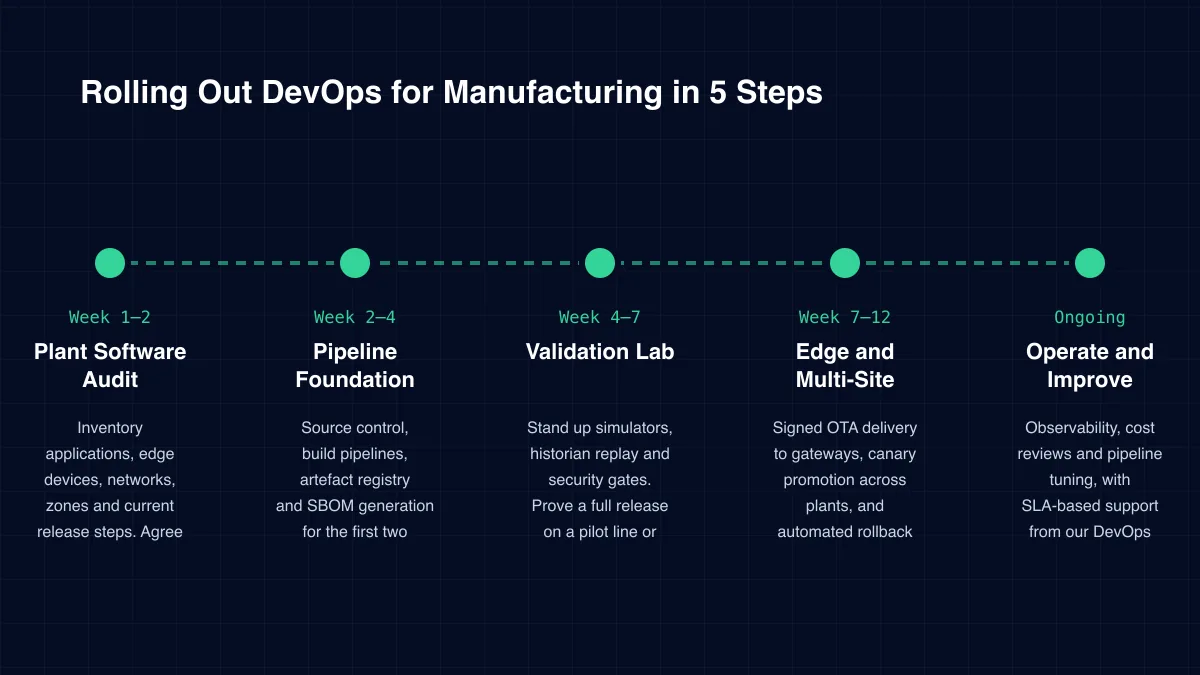
Week 1–2
Inventory applications, edge devices, networks, zones and current release steps. Agree on change windows with operations.
Week 2–4
Source control, build pipelines, artefact registry and SBOM generation for the first two applications.
Week 4–7
Stand up simulators, historian replay and security gates. Prove a full release on a pilot line or cell.
Week 7–12
Signed OTA delivery to gateways, canary promotion across plants, and automated rollback drills.
Ongoing
Observability, cost reviews and pipeline tuning, with SLA-based support from our DevOps engineers.
Case study
An enterprise partner was slowed by manual builds, tests and deployments across many environments. Our team built one CI/CD framework with Bitbucket, Nexus and automated testing. Product release time-to-market fell by 40%, and release failure risk dropped by 30%. This is the same release backbone we adapt for plant software.
“A deployment that only works because one engineer remembers the manual steps is not a process, it is a single point of failure wearing a runbook.”Read the full case study →
Bitbucket · Branch strategy
One consistent way for every team to manage code changes.
Nexus · Artifactory · Automated suites
A reliable record of what was deployed, with integration, regression and UAT coverage.
Ansible · Helm · ArgoCD
Standard releases to every environment, with monitoring closing the feedback loop.
Many firms can set up a pipeline. Few have shipped code near running equipment. We recommend checking five things.
In our experience, the validation lab decides success. If teams trust the lab, they release often. If they do not, they go back to weekend deploys.
ICANIO works under ISO 9001 and ISO 27001 certified processes. We design DevOps for manufacturing so that pipelines never become a new attack path into operational technology.
Cloud build runners stay in IT zones. Edge devices pull signed images through defined conduits. Secrets live in a vault, not in scripts. Every artefact carries an SBOM, so a new vulnerability can be traced to affected sites in minutes. We align controls with the IEC 62443 series and your own site policies.
Start with release-related downtime. Count the stoppages and weekend shutdowns caused by software changes last year, and price them. That is the risk DevOps for manufacturing removes.
Then add engineering hours spent on manual deploys, truck rolls to update devices, and cloud spend without an owner. We baseline these numbers with you during discovery and report against them after each phase.
Technology stack
We choose tools that fit your plants and existing licences. These are the ones we use most often.
Source & CI
Build & Artefacts
SBOM tooling
Infrastructure as Code
OPA policy
Edge Runtime
K3sContainer OTA agentsIndustrial PCsarm64 gateways
Delivery
ArgoCDCanary releasesBlue-greenAutomated rollback
Observability
 Free white paper · DevOps & CloudDevOps & Cloud EngineeringBuilding Resilient, Scalable, and Cost-Efficient Enterprise Cloud InfrastructureGet the white paper →
 Free white paper · ManufacturingSmart Manufacturing SolutionsIndustry 4.0 Transformation & Digital Manufacturing ExcellenceGet the white paper →
DevOps for manufacturing is an automated, repeatable way to build, test and release plant software. It replaces manual copying of files with pipelines that test changes on simulated equipment, scan for security issues and deploy only in approved windows.
Yes. We use pull-based delivery. A registry mirror inside the plant receives signed releases through a controlled conduit, and devices pull from it. No cloud system needs a direct path into the control network.
We build a validation lab with PLC and OPC UA simulators, recorded historian data and, where useful, hardware-in-the-loop rigs. Releases then go to a pilot line or cell as a canary before wider rollout.
No. Controls engineers keep ownership of PLC logic and safety systems. DevOps for manufacturing covers the software around them, and it gives controls teams an approval gate on anything that touches their zone.
We align with the IEC 62443 series for industrial security, the ISA-95 model for system levels, and your own site policies. Every build also produces an SBOM for vulnerability tracking.
Most programmes reach a first production release in four to seven weeks, covering the pipeline foundation and validation lab. Multi-site and edge rollout usually follows within about twelve weeks, depending on the number of plants.
Plants already run on software. The question is whether it ships safely. DevOps for manufacturing turns risky weekend deploys into small, tested, reversible releases.
ICANIO brings CI/CD, edge delivery, OT-aware security and observability in one team. We start with your most painful release, prove it on a pilot line, and then extend DevOps for manufacturing to every site you run.
By ICANIO DevOps & Cloud Engineering Team · Published · Updated
Book a free 30-minute discovery call. We will map your plant applications, edge devices and release steps. You will leave with a clear pipeline plan and first milestones.
Contact Our DevOps Team


