CI/CD for Storefront and Checkout
Standard pipelines for headless frontends, cart, checkout and OMS services. Our DevOps for retail pipelines include preview environments for every pull request.
See: DevOps Automation →DevOps & Cloud for Retail
We automate delivery for commerce platforms: storefronts, checkout, order management, product data and store POS. Every release is load-tested for peak, hidden behind feature flags, and priced so cloud spend tracks revenue.
14
Deploys today
38 min
Lead time
0
Failed changes
DevOps for retail is about one uncomfortable truth. Your busiest hour is also your riskiest hour to change anything. Flash sales, holiday peaks and viral products push traffic far past normal, and a slow checkout loses orders every second it stays slow.
Our team builds DevOps for retail that lets merchants keep shipping through those moments. Every checkout and cart change runs a load test at a multiple of your last peak. New features launch dark behind flags. Canary releases watch conversion and payment errors, then roll back on their own if either slips.
Behind it, cloud capacity scales up for events and back down after, so the bill follows revenue instead of fear.
DevOps for retail applies continuous delivery, infrastructure as code and site reliability practice to commerce software. That includes headless storefronts, checkout and payment services, order management, product information systems, search, loyalty and the point of sale in every store.
Retail adds three pressures. Traffic is spiky and predictable only in part. Money moves on every order, so checkout falls under PCI DSS scope. And change never stops: prices, promotions and catalogs update daily across web, app, marketplace and store.
DevOps for retail answers with load testing before events, feature flags for safe launches, scoped security for payment flows, and ring deployments for store fleets. The platform team gets speed without betting the weekend's revenue.
Working definition
“DevOps for retail is the practice of releasing commerce and store software through automated pipelines that prove peak capacity, protect payment flows, and let teams launch, measure and roll back changes without disrupting sales.”
Foundations
Load tests replay real traffic shapes at several times last year's peak. A release that cannot handle Black Friday never ships.
New features deploy behind flags. Merchandising turns them on for a slice of shoppers, and engineering watches the numbers.
Payment paths get stricter gates, PCI-scoped scans and separate canaries. Checkout changes move slowest and safest.
Autoscaling and scheduled capacity cut spend after events. Cost is tagged by channel and brand, so it has an owner.
Core capabilities
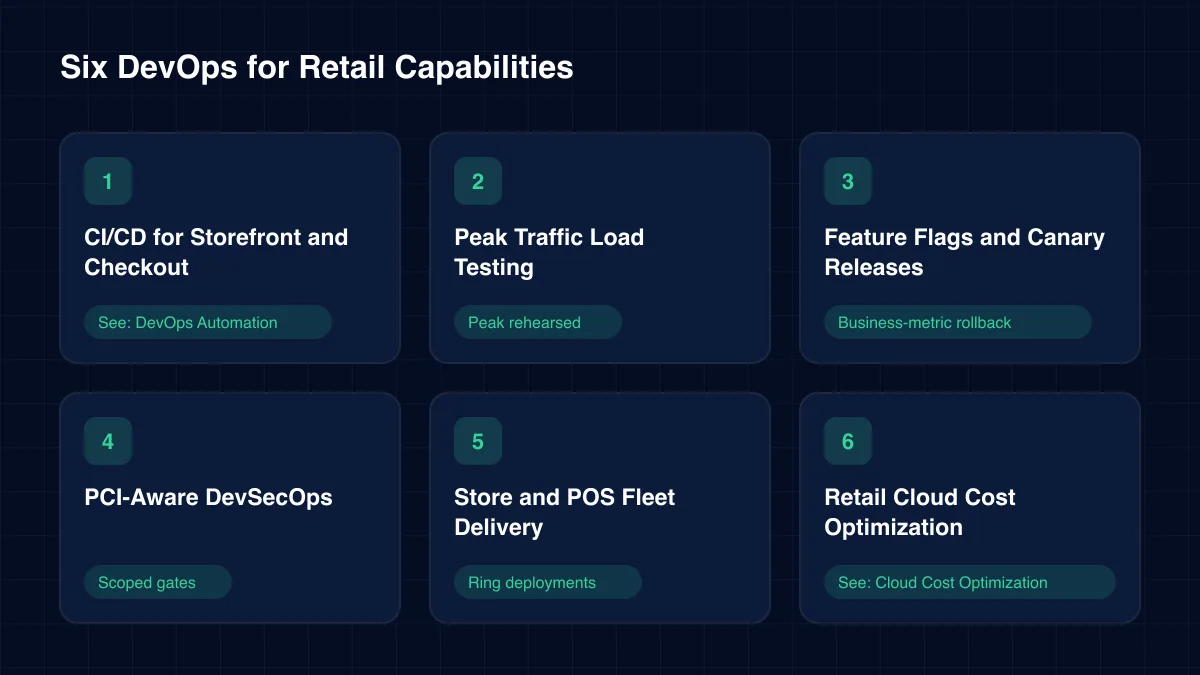
Each capability is a proven building block. Together they make a complete DevOps for retail platform from code to checkout.
Standard pipelines for headless frontends, cart, checkout and OMS services. Our DevOps for retail pipelines include preview environments for every pull request.
See: DevOps Automation →Scripted shopper journeys at multiples of your record traffic, run before every major event and on checkout changes. Bottlenecks surface in staging, not on sale day.
Peak rehearsed
Progressive delivery with flags, canaries and automatic rollback on conversion drops or payment errors. Merchants test ideas without a full release.
Business-metric rollback
Code, dependency and container scans on every build, with stricter gates for services in cardholder data scope. DevOps for retail keeps that scope as small as possible.
Scoped gates
Ring-based rollouts to lab tills, pilot stores and then the whole estate. Offline mode and receipt printing are tested before a single store updates.
Ring deployments
Rightsizing, tagging by brand and channel, and scheduled scale-down after events. This part of DevOps for retail keeps margins healthy between peaks.
See: Cloud Cost Optimization →Architecture
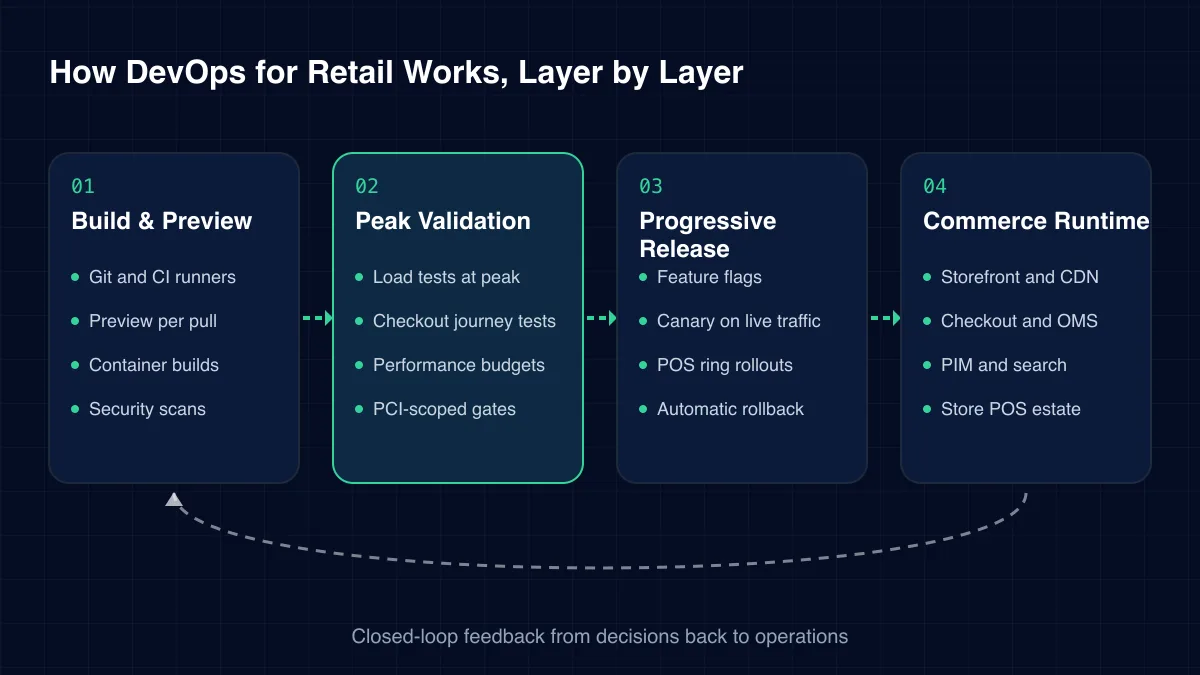
Our DevOps for retail reference design has four layers. Changes move from commit to shoppers and stores. Sales and performance data flow back to steer every release.
01
02
03
04
Challenges we solve
Before a DevOps for retail programme, we usually find a mix of these six problems.
Teams freeze releases for weeks before peak because they do not trust the pipeline. Bugs found during the freeze stay live.
Systems pass normal tests but queue up at peak. Payment timeouts rise, carts are abandoned, and nobody saw it coming.
New features ship to every shopper at once. When conversion dips, the only fix is another emergency release.
POS software reaches stores slowly and unevenly. Different stores run different versions, and support tickets multiply.
Card data flows touch more services than they should. Every one of them then needs the heaviest controls and audits.
Infrastructure sized for Black Friday runs all year. The cloud bill stays high in quiet months with no owner to challenge it.
Commerce estates have four main software groups. Each has its own release rhythm.
Generic pipelines speed up delivery but do not protect revenue at peak. Here is how the options compare.
| Capability | Manual ops | Generic CI/CD | Retail-ready DevOps |
|---|---|---|---|
| Load test at peak multiples | No | Partial | ✓ Yes |
| Rollback on conversion drop | No | No | ✓ Yes |
| Feature flags for launches | No | Partial | ✓ Yes |
| PCI-scoped pipeline gates | Partial | No | ✓ Yes |
| Ring rollout to stores | No | No | ✓ Yes |
The benefits of DevOps for retail show up in conversion, uptime and margin.
Delivery
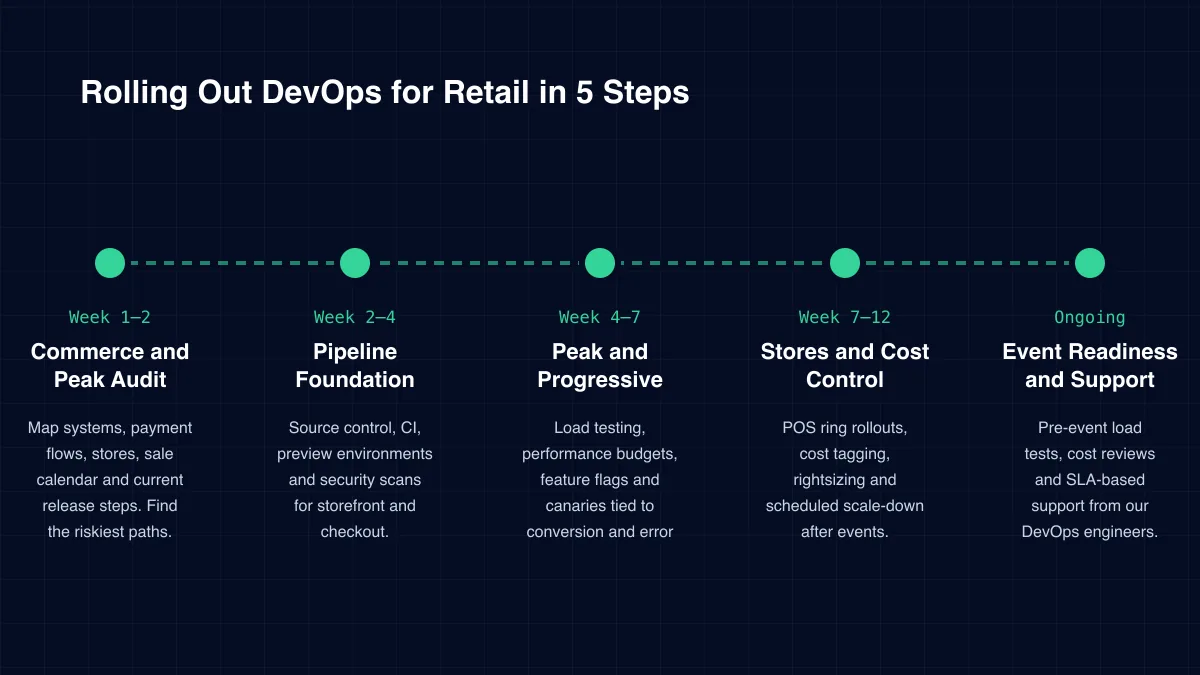
Week 1–2
Map systems, payment flows, stores, sale calendar and current release steps. Find the riskiest paths.
Week 2–4
Source control, CI, preview environments and security scans for storefront and checkout.
Week 4–7
Load testing, performance budgets, feature flags and canaries tied to conversion and error rates.
Week 7–12
POS ring rollouts, cost tagging, rightsizing and scheduled scale-down after events.
Ongoing
Pre-event load tests, cost reviews and SLA-based support from our DevOps engineers.
Case study
An organization faced rising cloud bills across many resources, with poor visibility and no clear owners. Our team ran a baseline analysis, rightsized compute, removed orphaned infrastructure and set tagging standards. Monthly infrastructure costs fell by 15-25% with zero production disruption. Retailers who size for peak all year can apply the same governance.
“A cloud bill that only gets reviewed once it becomes a surprise is not being managed, it is being tolerated.”Read the full case study →
Cost and usage analysis
A clear starting point, then compute matched to real usage.
Orphaned resources · Dev and test sizing
Spend removed where nothing useful was running.
Tagging standards · Periodic reviews
Every resource has an owner, and cost control became ongoing.
Every vendor says they scale. Few have rehearsed a real peak. We recommend checking five things.
In our experience, shorter code freezes are the clearest sign of success. When teams trust the pipeline, they keep shipping into peak.
ICANIO operates under ISO 9001 and ISO 27001 certified processes. Our DevOps for retail pipelines scan code, dependencies, containers and infrastructure on every build.
We design to keep cardholder data scope small, often by using tokenized payments so most services never see a card number. Services that remain in scope get stricter gates, change approvals and logging aligned with PCI DSS. Secrets live in a vault, and customer data is encrypted in transit and at rest.
Start with revenue at risk during peak. Estimate the orders lost to slow pages or failed checkouts in your last big event. That is the first gap DevOps for retail closes.
Then add weeks lost to code freezes, engineering hours on manual releases, and cloud capacity paid for but idle between events. We baseline these numbers during discovery and report against them after each phase.
Technology stack
We work with your commerce platform and cloud. These are the tools we use most often.
Source & CI
Testing
Playwright
Progressive Delivery
Feature flagsCanary analysisBlue-green
Infrastructure as Code
OPA policy
Runtime
CDN and edge cachingManaged databasesAutoscaling
Observability & Cost
Cost tagging
 Free white paper · DevOps & CloudDevOps & Cloud EngineeringBuilding Resilient, Scalable, and Cost-Efficient Enterprise Cloud InfrastructureGet the white paper →
 Free white paper · RetailRetail & E-Commerce SolutionsTransforming Modern Retail Through Technology, AI, and Digital InnovationGet the white paper →
DevOps for retail covers CI/CD, load testing, progressive delivery, security scanning, infrastructure as code and cost control for storefronts, checkout, OMS, PIM, search and store POS.
We script real shopper journeys, from browse to payment, and replay them at several times your record traffic in a production-like environment. Tests run weeks before the event, and again on any checkout change.
Often, yes. With feature flags, canaries and automatic rollback, many teams shorten or drop the long code freeze. Checkout changes can still follow stricter rules during the busiest days.
We keep cardholder data scope small, usually through tokenized payments. In-scope services get stricter gates, approvals and logging. DevOps for retail pipelines then produce evidence your assessor can review.
We use ring deployments. Changes reach lab tills first, then a few pilot stores, then the wider estate. Health checks at each ring decide whether the rollout continues or rolls back.
It usually helps. Our cloud cost optimization platform work cut monthly infrastructure costs by 15-25% through rightsizing, cleanup and tagging. Scheduled scale-down after events adds further savings for retailers.
Retail rewards teams that move fast and punishes outages at the worst moments. DevOps for retail lets you do both: ship daily and stay standing when traffic spikes.
ICANIO brings pipelines, peak load testing, progressive delivery, PCI-aware security and FinOps in one team. We start with your riskiest checkout path, prove it before your next event, and expand DevOps for retail across every channel.
By ICANIO DevOps & Cloud Engineering Team · Published · Updated
Book a free 30-minute discovery call. We will review your commerce stack, sale calendar and release process. You will leave with a peak-ready pipeline plan.
Contact Our DevOps Team