Cluster Architecture and Design
Cluster topology, node pools, networking, ingress and storage choices for EKS, AKS or GKE. Kubernetes consulting starts with the decisions that are hardest to change later.
Fit for scale →DevOps & Cloud · Kubernetes
We design and harden container platforms on EKS, AKS and GKE. Your developers get a simple path to deploy, and your operators get clusters that scale, heal and stay patched.
14
Deploys today
38 min
Lead time
0
Failed changes
Kubernetes consulting helps teams get the benefits of containers without drowning in cluster complexity. Kubernetes is powerful, but a default install is not a production platform. Networking, security, upgrades and cost all need deliberate design.
Our team builds clusters on Amazon EKS, Azure AKS and Google GKE, then wraps them in GitOps, policy and observability. Developers deploy with a Helm chart and a pull request. Operators get clusters that are reproducible, patched and right-sized.
This guide covers what Kubernetes consulting includes, a reference platform design, common engagement types and how to pick a partner. It includes an ICANIO SaaS modernisation on AKS that cut deployment and CI/CD complexity by 60%.
Kubernetes is an open-source system for running containers across a fleet of machines. It schedules workloads, restarts failed pods, balances traffic and scales capacity. It is now the standard runtime for cloud-native software and is governed by the Cloud Native Computing Foundation.
Kubernetes consulting is expert help to design, build, secure and operate that runtime. It covers cluster architecture, networking, ingress, storage, identity, policy, autoscaling, upgrades and the developer workflow on top.
The need is real because Kubernetes has many moving parts. A cluster can run for months and then fail during an upgrade, a certificate expiry or a noisy neighbour. Good Kubernetes consulting designs those risks out before they reach production.
Most clients come to Kubernetes consulting at one of two moments. Either they are about to adopt containers and want to avoid early mistakes, or they already run clusters that have grown fragile. Both need the same thing: a clear target platform and a safe path to reach it.
It is also about saying no. Not every workload needs a cluster. A small app may be better on a managed container service or serverless. We recommend Kubernetes when you run many services, need portability or have platform scale to justify it.
Working definition
“Kubernetes consulting is the design, hardening and operation of container platforms on Kubernetes, so applications deploy consistently, scale automatically and stay secure across clusters and clouds.”
Foundations
Clusters, add-ons and apps are defined in Git and applied by controllers, never by hand-run kubectl commands.
Namespaces, RBAC, network policies and quotas keep teams isolated on shared clusters.
Pods and nodes scale with real demand, and idle capacity shrinks back without manual tickets.
Version upgrades follow a tested runbook, cluster by cluster, with no surprise downtime.
Core capabilities
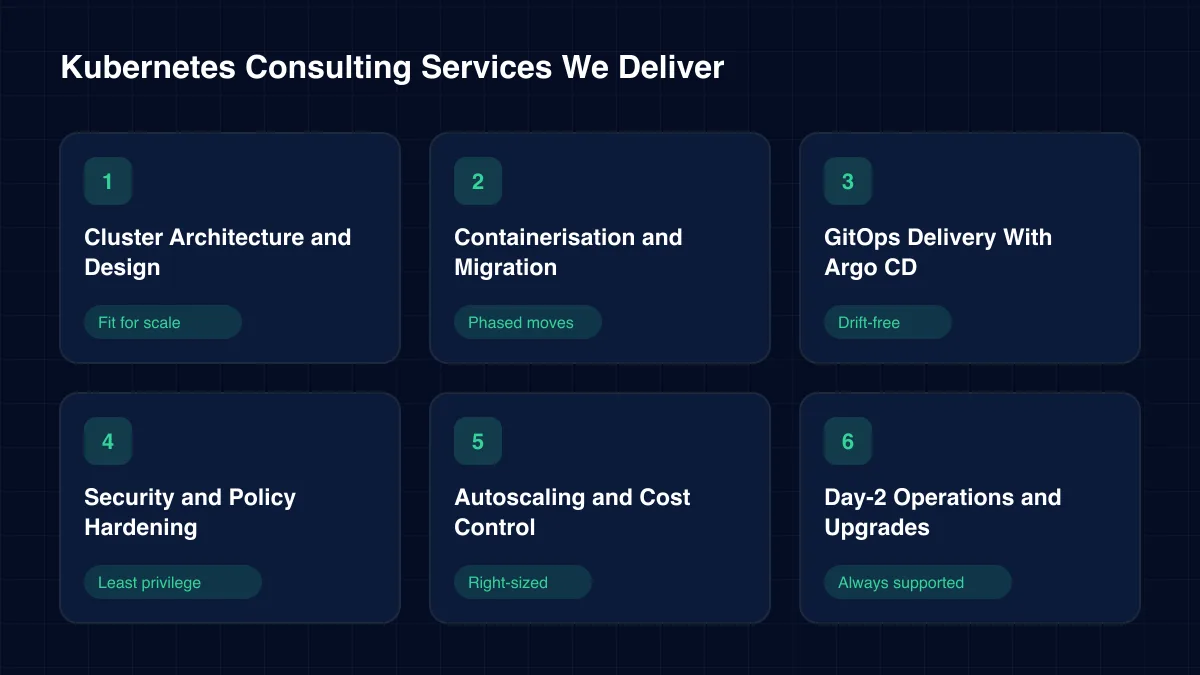
Our Kubernetes consulting covers the whole life of a platform, from the first cluster to the hundredth service.
Cluster topology, node pools, networking, ingress and storage choices for EKS, AKS or GKE. Kubernetes consulting starts with the decisions that are hardest to change later.
Fit for scale →Dockerfiles, multi-arch images and Helm charts for existing apps, then a phased move onto the cluster. Our SaaS modernisation moved a legacy desktop tool onto AKS.
Phased moves →Argo CD or Flux reconcile clusters from Git. Kubernetes consulting here means one review flow for apps, add-ons and cluster config alike.
Drift-free
Pod Security Standards, RBAC, network policies, image signing and admission control with Kyverno or OPA Gatekeeper. Benchmarked against CIS guidance.
Least privilege →HPA, KEDA and Karpenter or Cluster Autoscaler, with requests and limits set from real usage. Our Kubernetes consulting ties every namespace to a cost owner.
Right-sized →Monitoring, certificate management, backups with Velero and planned version upgrades. We keep clusters current so support windows never lapse.
Always supported →Architecture
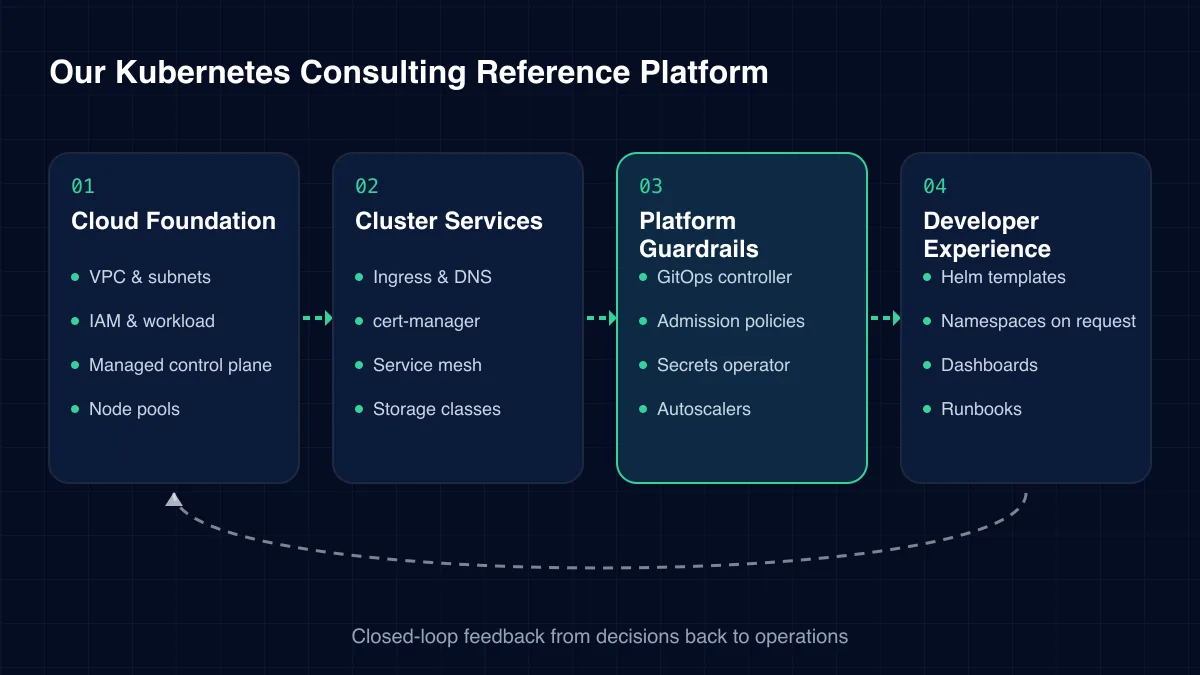
Every Kubernetes consulting engagement maps to this four-layer platform. Teams consume the top layer and rarely need to touch the ones below.
01
02
03
04
Challenges we solve
These issues show up in almost every cluster we review for the first time.
Each cluster was built by hand and differs from the others. Rebuilding them from code makes them identical and replaceable.
Clusters sit several versions behind and drift toward end of support. A tested upgrade path brings them current.
Requests are guessed high and nodes run half empty. Usage-based sizing and autoscaling reclaim that capacity.
Pods run as root with broad service accounts. Policy and RBAC hardening shrink the attack surface.
TLS breaks on a Sunday because renewal was manual. cert-manager and alerts automate the whole cycle.
Teams need YAML expertise to ship a service. Templates and golden paths hide the complexity.
Clients arrive at different stages. These four engagement shapes cover most of them.
Choosing the runtime is the first Kubernetes consulting decision. Here is how the options compare.
| Factor | Self-managed | EKS / AKS / GKE | Serverless containers |
|---|---|---|---|
| Control plane upkeep | Yours | Provider | Provider |
| Workload flexibility | Full | Full | Limited |
| Operational effort | High | Medium | Low |
| Portability | High | High | Low |
| Best for | Edge and on-prem | Most teams | Simple services |
A well-built platform pays back every time a team ships a service.
Delivery
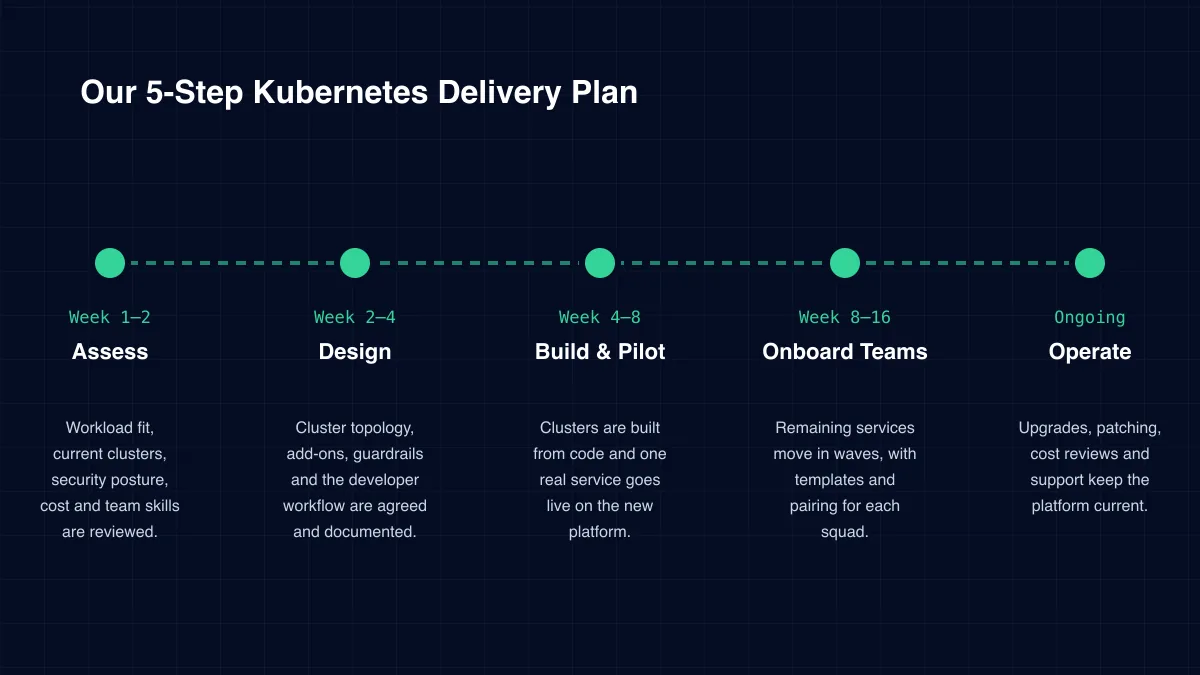
Week 1–2
Workload fit, current clusters, security posture, cost and team skills are reviewed.
Week 2–4
Cluster topology, add-ons, guardrails and the developer workflow are agreed and documented.
Week 4–8
Clusters are built from code and one real service goes live on the new platform.
Week 8–16
Remaining services move in waves, with templates and pairing for each squad.
Ongoing
Upgrades, patching, cost reviews and support keep the platform current.
Case study
A pharma-focused compliance partner ran a legacy desktop tool that could not scale and fragmented DevOps that made each release a multi-week effort. ICANIO rebuilt the core as multi-tenant microservices on Azure Kubernetes Service, with automated CI/CD and infrastructure as code. Deployment and CI/CD complexity fell by 60%, infrastructure cost fell by 40% and release cycles shrank from weeks to hours.
“Scalability and compliance were one programme, not a scaling project followed by a retrofit.”Read the full case study →
Azure Kubernetes Service
Containerised, multi-tenant workloads gave the platform elastic capacity across customers and regions.
Azure DevOps · Repos
Automated pipelines replaced manual releases with repeatable, auditable deployments.
Infrastructure as Code
Every environment was provisioned consistently for HIPAA and GDPR requirements.
Specialist services within our devops & cloud engineering practice.
Kubernetes skills are easy to claim and hard to prove. We recommend asking these five questions.
Strong Kubernetes consulting makes the platform feel smaller than it is. Developers see a simple path, while the complexity stays managed underneath.
We apply the Kubernetes Pod Security Standards and check clusters against the CIS Kubernetes Benchmark. Workloads run as non-root with read-only file systems where possible.
Workload identity replaces static cloud keys. Secrets come from a vault through an operator. Network policies deny traffic by default, and only signed images from approved registries pass admission.
Runtime protection completes the picture. API server audit logs, container runtime alerts and regular image rescans catch threats that slip past build-time checks. Findings route to the owning team with clear severity and a fix deadline.
ICANIO works under ISO 9001 and ISO 27001 certified processes. For healthcare and fintech clients we map cluster controls to HIPAA, PCI DSS or SOC 2 evidence, and keep audit logs from the API server.
We track deployment frequency, lead time and failure rate for teams on the platform. We also track cluster utilisation, cost per namespace and time spent on platform tickets.
Utilisation is often the quickest win. Clusters that run at low average usage can usually be packed tighter once requests reflect reality, which lowers the node bill without touching code.
Kubernetes also opens doors. The same platform can run batch jobs, machine learning training, IoT data ingestion or digital twin services for manufacturing clients, so later projects start on solid ground.
Technology stack
We favour CNCF projects and managed cloud services, and avoid lock-in where an open option works.
Managed Clusters
Google GKEk3s at the edge
Packaging
Kustomize
Delivery
Networking
NGINX IngressGateway APIcert-managerIstio or Linkerd
Security
KyvernoOPA GatekeeperExternal Secrets
Scale & Observe
KEDAKarpenter
Kubernetes consulting covers platform design, cluster builds, containerisation, GitOps, security hardening, autoscaling, cost control, upgrades and ongoing operations support.
Usually the cloud you already run on. All three are mature. Our Kubernetes consulting compares networking, identity and upgrade models against your needs before recommending one.
Not always. For a few simple services, a managed container service may be enough. Kubernetes pays off with many services, portability needs or a shared platform for several teams.
We check for removed APIs, upgrade non-production clusters first and roll node pools gradually with disruption budgets. Each upgrade follows a written, rehearsed runbook.
Often, yes. Right-sizing requests, packing nodes, using spot capacity and scaling to zero for idle workloads all cut cost. We measure the result per namespace.
Yes. We start with a health assessment, fix urgent risks and then take on upgrades, patching and monitoring under an agreed support model.
How we deliver kubernetes consulting and the wider devops & cloud practice in each sector.
Kubernetes rewards careful design and punishes shortcuts. The difference between a fragile cluster and a dependable platform is the work done on security, upgrades, scaling and developer experience.
ICANIO Kubernetes consulting delivers that work on EKS, AKS and GKE, then helps your team run it with confidence. Contact us to review your clusters or plan your first production platform.
By ICANIO DevOps & Cloud Engineering Team · Published · Updated
Book a free 30-minute discovery call. We will look at your clusters or plans, flag the biggest risks and outline a platform roadmap with clear goals.
Contact Our Kubernetes Team