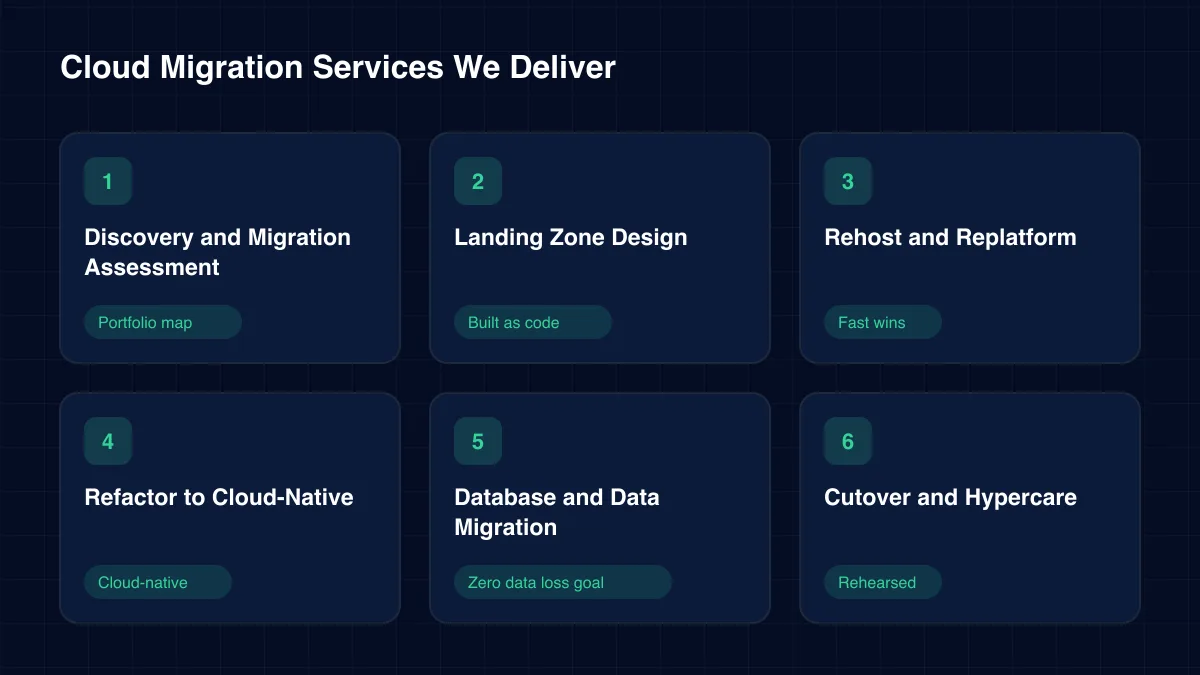
Discovery and Migration Assessment
Automated discovery of servers, dependencies and usage, plus a business case per application. Cloud migration services start here, because good plans need real data.
Portfolio map →DevOps & Cloud · Cloud Migration
We move applications, databases and file shares from data centres or other clouds to AWS, Azure or Google Cloud. Each workload gets the right strategy, a rehearsed cutover and a tested way back.
14
Deploys today
38 min
Lead time
0
Failed changes
Cloud migration services move workloads off ageing hardware or an expensive platform without breaking the business that runs on them. The hard part is rarely copying data. It is choosing the right path for each application and switching over without surprises.
Our team starts with discovery. We map servers, dependencies, licences and data flows, then group workloads into waves. Each wave has a landing zone ready, a rehearsed cutover and a rollback plan that has actually been tested.
This guide explains what cloud migration services cover, the strategies we use, the risks to plan for and how to compare providers. It includes an ICANIO JIRA Data Center migration to AWS that cut licensing cost by 50% at 99.9% uptime.
Cloud migration services are the assessment, planning, engineering and cutover work needed to run existing systems in a public cloud. The source can be a private data centre, a colocation rack, a hosted platform or another cloud provider.
A migration is a portfolio exercise, not one big move. A typical estate holds dozens or hundreds of applications. Some should move as they are. Others need a new database engine, a container platform or a full redesign. A few should simply be retired.
The industry groups these choices as the 7 Rs: retire, retain, rehost, relocate, repurchase, replatform and refactor. Good cloud migration services apply them per workload, based on business value, technical debt and how much change the team can absorb.
Migration also changes how systems are run. Backups, monitoring, identity and cost control all work differently in the cloud. We plan those operating changes as part of the move, not after it.
Working definition
“Cloud migration services are the structured assessment, planning and execution work that moves applications and data to a cloud platform in controlled waves, with each workload matched to the right migration strategy.”
Foundations
Dependency maps and utilisation data come first. Assumptions about what talks to what are the top cause of failed cutovers.
Accounts, networks, identity and guardrails are built as code before the first workload arrives.
Low-risk systems go first. Each wave teaches lessons that make the next one faster and safer.
Every cutover has a rollback trigger, an owner and a time limit, agreed before the change window opens.
Core capabilities
Our cloud migration services cover the full journey, from first inventory to the day the old hardware is switched off.
Automated discovery of servers, dependencies and usage, plus a business case per application. Cloud migration services start here, because good plans need real data.
Portfolio map →Multi-account structure, network topology, identity, logging and guardrails written as infrastructure as code. New workloads land in a secure, governed home.
Built as code
Virtual machines move with replication tools, and databases shift to managed services where it pays. Our cloud migration services keep code changes small for these waves.
Fast wins →Monoliths split into services and containers where scale or speed demands it. Our SaaS modernisation work moved a legacy desktop tool onto Azure Kubernetes Service.
Cloud-native →Change data capture, replication and validation for large databases and search clusters. Cloud migration services must prove every row arrived intact.
Zero data loss goal →Runbooks, rehearsals, DNS switching and a hypercare window with our engineers on call. We stay until the new environment is stable and handed over.
Rehearsed
Architecture
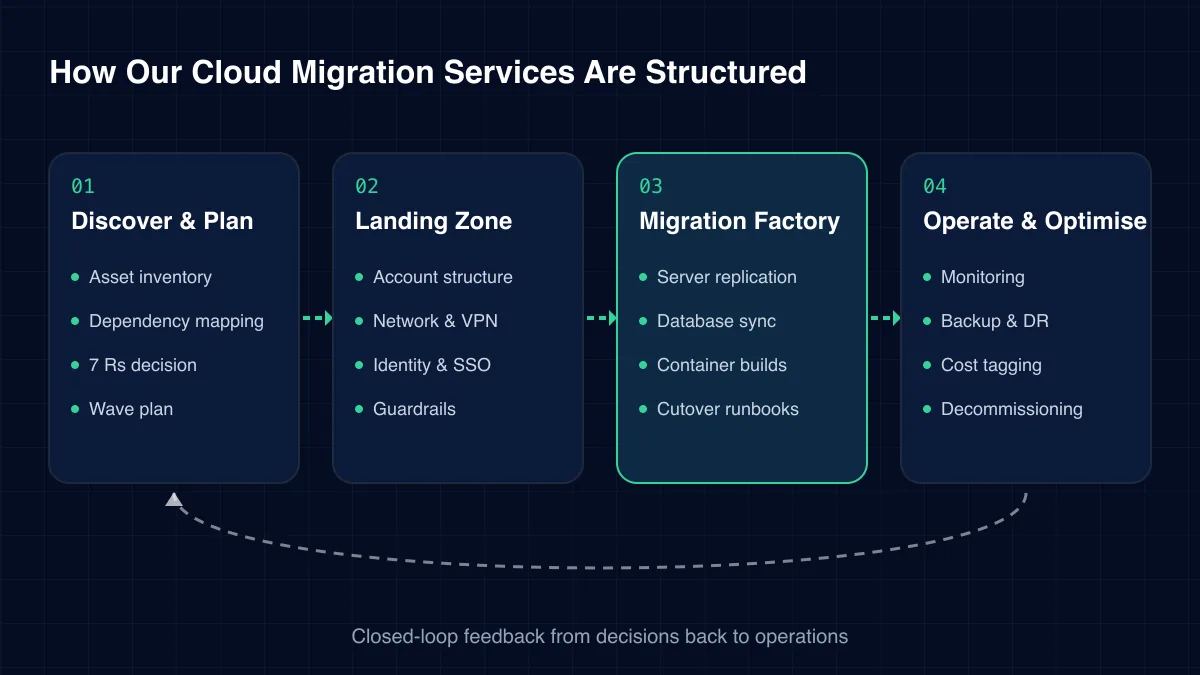
We run cloud migration services as a factory with four layers. Insight from each wave flows back into planning for the next.
01
02
03
04
Challenges we solve
Most migration projects stall for the same handful of reasons.
Support contracts expire and refresh quotes arrive. A planned move avoids buying another five years of servers.
Per-user or per-core pricing climbs with every hire. Re-architecting on cloud can change that cost curve.
An old batch job or hard-coded IP breaks after cutover. Discovery tools and traffic analysis find them first.
Big-bang moves need a whole weekend offline. Continuous replication shrinks the switch to minutes.
In-house teams know the old stack well and the new one less. Pairing during migration builds that skill.
Lifted servers run 24x7 at full size. Rightsizing and tagging from day one keep the first bills sane.
Most estates use several strategies at once. These four cover the bulk of real workloads.
Each strategy trades speed against long-term benefit. We usually combine them across waves.
| Factor | Rehost | Replatform | Refactor |
|---|---|---|---|
| Speed to migrate | Fastest | Moderate | Slowest |
| Code changes | None | Minor | Major |
| Uses managed services | No | Partial | ✓ Yes |
| Ongoing cost benefit | Low | Medium | High |
| Best for | Exit deadlines | Quick wins | Core products |
A well-run migration pays off long after the last server is switched off.
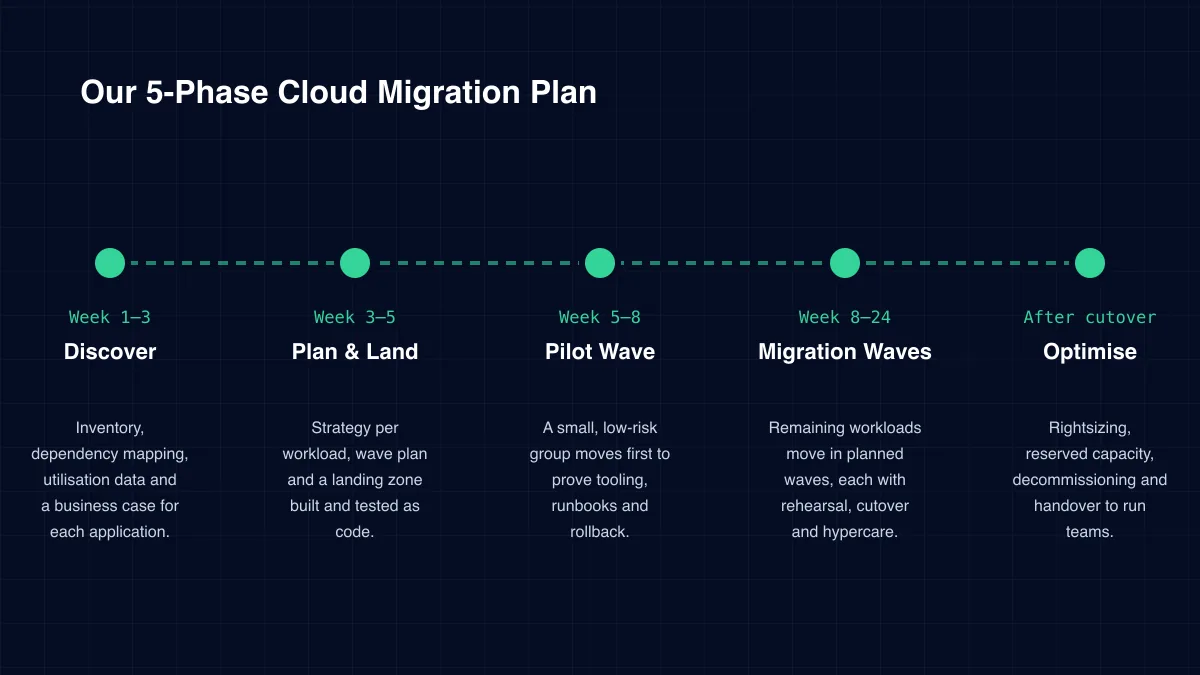
Delivery
Week 1–3
Inventory, dependency mapping, utilisation data and a business case for each application.
Week 3–5
Strategy per workload, wave plan and a landing zone built and tested as code.
Week 5–8
A small, low-risk group moves first to prove tooling, runbooks and rollback.
Week 8–24
Remaining workloads move in planned waves, each with rehearsal, cutover and hypercare.
After cutover
Rightsizing, reserved capacity, decommissioning and handover to run teams.
Case study
A growing engineering organisation faced rising per-user JIRA Cloud licensing and limited control over its environment and data residency. ICANIO moved it to a self-hosted, highly available JIRA Data Center on AWS, provisioned through infrastructure as code. Licensing cost fell by 50%, uptime reached 99.9% and infrastructure scaling became 3x faster.
“Per-user licensing costs more as a team grows and caps how much control that team has.”Read the full case study →
AWS CloudFormation
The whole environment was provisioned from templates, not by hand.
ALB · Multi-AZ RDS · EFS
Load balancing, a multi-zone database and shared storage across nodes kept the service online.
AWS WAF · VPC isolation
Web filtering and network isolation hardened the new self-hosted setup.
Specialist services within our devops & cloud engineering practice.
Migration partners vary widely in method and honesty. We recommend testing them on five points.
The best cloud migration services leave you with fewer systems, clearer costs and a team that knows the new platform. That is how ICANIO measures a finished migration.
Data is most exposed while it moves. We encrypt in transit and at rest, use private links or VPNs for replication and restrict who can reach the transfer tooling.
Landing zones enforce guardrails from the start: logging to a central account, blocked public storage, and least-privilege roles. Identity is federated with your directory, so leavers lose access everywhere at once.
ICANIO works under ISO 9001 and ISO 27001 certified processes. For regulated data we check region choices against residency needs and map controls to frameworks such as HIPAA, PCI DSS or GDPR before moving a byte.
We compare today's full cost, including hardware, power, space, licences and staff time, with a rightsized cloud estimate per wave. The model uses your utilisation data, not vendor averages.
Then we add the benefits that are harder to price: faster environment setup, better disaster recovery and the option to adopt managed analytics or machine learning services later. These often decide the case.
After cutover we track actual spend against the model each month. Gaps trigger rightsizing or commitment changes, so the promised savings from cloud migration services turn into real ones.
Technology stack
We use native provider tools where they work well and proven third-party tools where they do not.
Clouds
Discovery
Dependency mappingUtilisation exports
Server Moves
Migrate to Virtual Machines
Data Moves
Native replicationSnapshot restore
Landing Zone
Operations
Backup policies
Our cloud migration services include discovery, business case, strategy per workload, landing zone build, data and server migration, cutover, hypercare and early cost optimisation.
A pilot wave usually moves within eight weeks of kick-off. Full estates take several months, depending on the number of applications and how much refactoring they need.
We aim for minimal downtime. Continuous replication keeps the target in sync, so the final switch often takes minutes. Each cutover window is agreed with you in advance.
It depends on your workloads, skills, contracts and data rules. Our cloud migration services compare AWS, Azure and Google Cloud for your case and recommend one or a mix.
Yes, with care. Plant systems, IoT gateways and digital twin back ends often need low latency, so we keep edge pieces on site and move analytics and history to the cloud.
Not always on day one. Lifted servers can cost more until they are rightsized. We build tagging and rightsizing into every wave, so savings arrive within the first billing cycles.
How we deliver cloud migration services and the wider devops & cloud practice in each sector.
A migration succeeds when users barely notice it happened. That takes honest discovery, the right strategy per workload and cutovers that have been practised before the real night.
ICANIO cloud migration services bring that discipline to AWS, Azure and Google Cloud moves of any size. Contact us to map your estate and plan a first wave with clear success measures.
By ICANIO DevOps & Cloud Engineering Team · Published · Updated
Book a free 30-minute discovery call. We will review your estate, flag the riskiest dependencies and outline a first migration wave with a clear rollback plan.
Contact Our Cloud Team