Custom Software Development
Bespoke platforms that fit your process instead of forcing a workaround. Our internal employee portal unified HR, finance and project data in one place for its users.
50% faster onboarding →Application Development
ICANIO builds web, mobile and SaaS products on secure, cloud-native architecture. We design, engineer, modernise and integrate the software your business runs on.
CareConnect
My appointments
CareConnect
My appointments
⟳ Design in progress
Good software disappears into the work. Staff stop fighting spreadsheets, customers stop phoning for updates, and leaders see the numbers in real time. That is the goal of every application development project at ICANIO.
Our team plans, designs and builds custom web apps, mobile apps and SaaS platforms. We also rescue ageing systems through legacy modernization, and we connect everything through clean APIs. Security, performance and maintainability are part of the first sprint, not an afterthought.
This guide covers what modern application development involves, the architecture we use, common failure points and how to choose a delivery partner. It also shares real results from Icanio builds across real estate, insurance, HR and fintech.
Enterprise application development is the process of designing, building, testing and running software that supports a business process. It spans customer-facing apps, internal tools, partner portals and full SaaS products.
Unlike a simple website, an enterprise app holds business rules, user roles and sensitive data. It must connect to ERP, CRM, payment and identity systems. It also has to stay fast and secure as users and data grow.
Today most application development is cloud-native. Teams build in small services, release through automated pipelines and measure real usage. Increasingly, apps also carry AI features such as smart search, recommendations and document reading.
Good application development balances three forces. Users want speed and simplicity. The business wants control, reporting and compliance. Engineers want code that stays easy to change. Our job is to keep all three in view, sprint after sprint, so the product never drifts into a costly rewrite.
Working definition
“Application development is the engineering of software products that encode business workflows, integrate with surrounding systems and evolve safely through continuous delivery over many years of use.”
Foundations
We start with users and outcomes, then shape features around the jobs people need to get done.
Modular services, managed databases and autoscaling keep apps responsive as demand grows.
Role-based access, encryption and secure coding practice are built in from the first commit.
Automated tests, CI/CD and clear documentation make every future change cheaper and safer.
Core capabilities
Each service draws on the same engineering standards. You can engage one team for a single product or several for a wider application development programme.
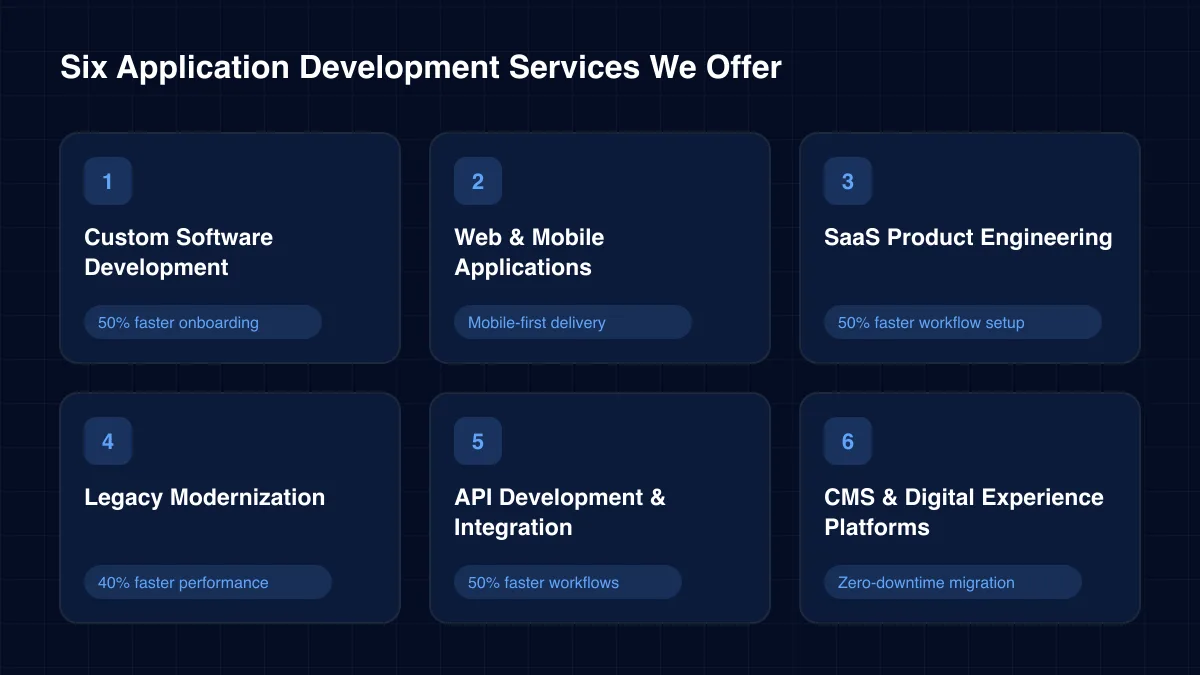
Bespoke platforms that fit your process instead of forcing a workaround. Our internal employee portal unified HR, finance and project data in one place for its users.
50% faster onboarding →Responsive web apps, progressive web apps and native or cross-platform mobile apps. Our AI job matching platform brought personalised job discovery to a mobile-first audience.
Mobile-first delivery →Multi-tenant architecture, subscription billing, tenant isolation and self-service onboarding. We rebuilt a monolithic payroll product as a multi-tenant SaaS platform on microservices.
50% faster workflow setup →Framework upgrades, re-platforming and phased rewrites that keep the business running. Our Java modernization moved a legacy app from JDK 8 to JDK 17 with better performance.
40% faster performance →REST and event-driven APIs that connect apps with ERP, CRM, payment and identity systems. Our ERP integration automation linked an ERP with MagOffice to remove manual data entry.
50% faster workflows →Enterprise content platforms such as TYPO3 and Liferay DXP, with governed publishing workflows. Our TYPO3 upgrade to v14 LTS ran with zero downtime and full WCAG compliance.
Zero-downtime migration →Architecture
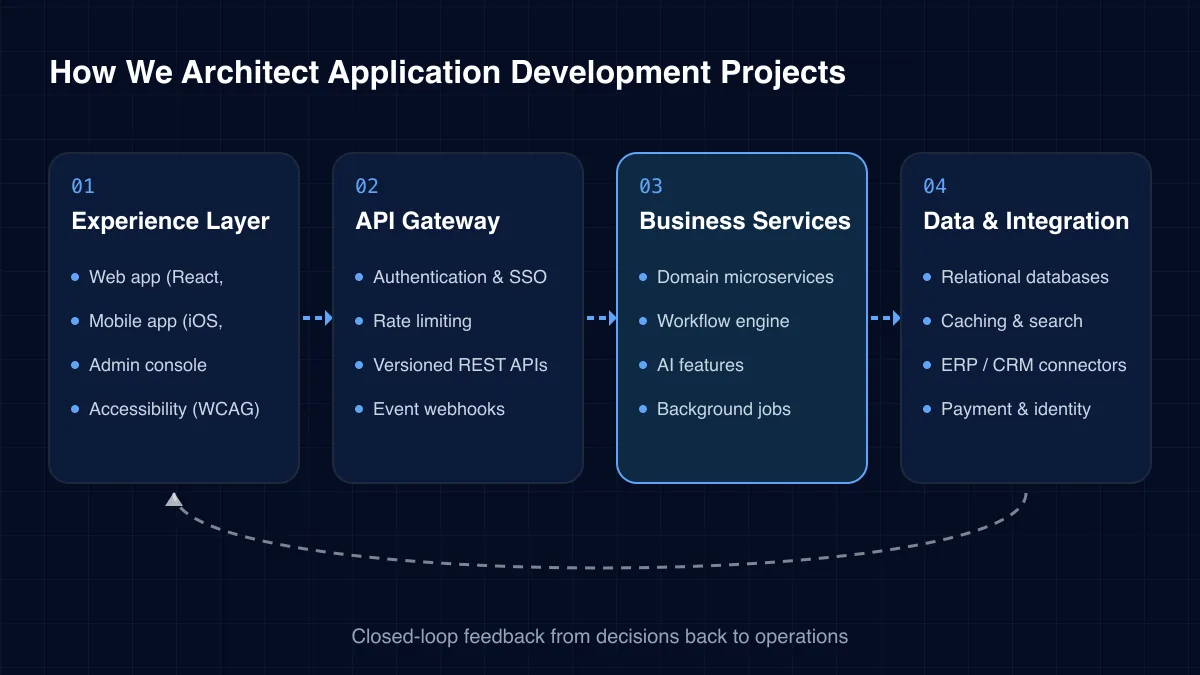
Most of our builds share a four-layer shape. It keeps the user experience fast while business logic and data stay clean and testable.
01
02
03
04
Challenges we solve
Software projects rarely fail on code alone. They fail on scope, architecture and what happens after launch.
Without a clear first release, features pile up and launch dates slip. We cut scope to a usable core and ship it early.
Old frameworks become security risks and hiring problems. We modernise in phases so operations never stop.
Apps that cannot talk to ERP, CRM or payments create double entry. We design integration contracts in week one.
An app that works for fifty users can stall at five thousand. We load test early and design for horizontal scale.
Late security reviews cause costly rework. We apply OWASP guidance and automated scans in every pipeline run.
Launch is the start of a product's life. We hand over documentation, tests and runbooks, or support the app ourselves.
Application development covers four main product types. Each has its own design and scaling needs.
Custom application development is not always the answer. This table shows where each approach fits.
| Criterion | Off-the-shelf | Low-code | Custom build |
|---|---|---|---|
| Fits unique workflows | Partial | Partial | ✓ Yes |
| Time to first release | Fast | Fast | Medium |
| Owns the IP | No | Partial | ✓ Yes |
| Deep integration | Partial | Partial | ✓ Yes |
| Best for | Standard processes | Simple internal apps | Core differentiators |
Well-engineered software keeps paying back long after launch.
Delivery
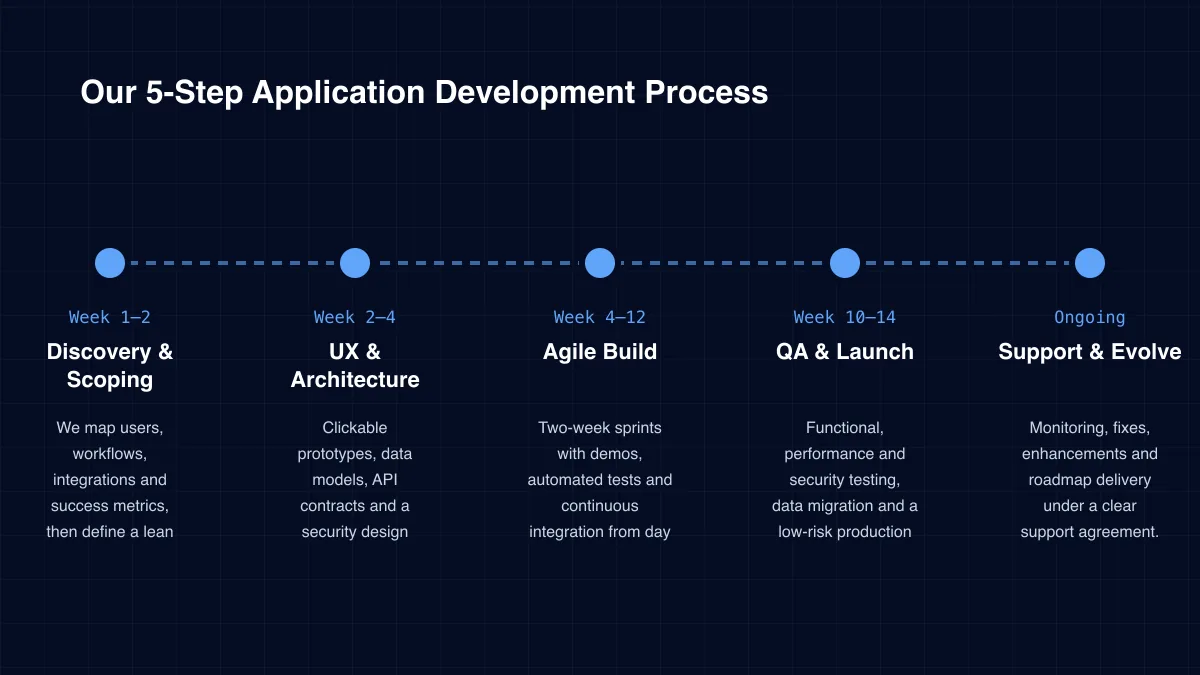
Week 1–2
We map users, workflows, integrations and success metrics, then define a lean first release.
Week 2–4
Clickable prototypes, data models, API contracts and a security design approved by your team.
Week 4–12
Two-week sprints with demos, automated tests and continuous integration from day one.
Week 10–14
Functional, performance and security testing, data migration and a low-risk production release.
Ongoing
Monitoring, fixes, enhancements and roadmap delivery under a clear support agreement.
Case study
A property management partner ran high-volume portfolios on legacy systems that caused calculation errors and slow maintenance. ICANIO built a full-stack, cloud-native platform with automated rent collection and lease workflows. It delivered a 40% boost in operational efficiency, zero errors in automated financial calculations and 3x faster maintenance response.
Read the full case study →Rent & lease automation
Rent collection and lease processes run automatically across every property.
QuickBooks · Plaid
Financial tracking syncs with accounting and banking data for accurate reporting.
Real-time dashboards
Managers see rent, maintenance and finance status across all locations in one view.
See how we apply app development in each sector we serve.
Rates and portfolios only tell part of the story. We recommend checking these five things.
In our experience the teams who ask the hardest questions in discovery ship the smoothest launches. That is where every ICANIO engagement begins.
ICANIO follows ISO 9001 and ISO 27001 certified processes. We apply OWASP guidance, dependency scanning and secrets management in every pipeline.
For regulated sectors we design for the rules that apply, such as HIPAA for health data or PCI DSS for card payments. You own the source code, the infrastructure and the data from the first commit.
Quality is part of security. Every pull request passes code review, unit tests and static analysis before it merges. Release candidates go through performance and penetration testing when the risk profile calls for it. Production access is limited, logged and reviewed, so a stable app stays that way after launch.
List the manual steps the new app removes and the hours they take each week. Add the cost of errors, delays and licence fees for tools it replaces. That gives a clear baseline.
Then track adoption, task time and error rates after launch. We agree these measures in discovery, so the value of the application development work is visible in your own numbers.
Remember the cost of standing still. Unsupported frameworks, slow pages and manual workarounds all carry a price. Modernization often pays back through lower hosting bills and fewer incidents alone.
Technology stack
We choose technology to fit your team, your cloud and your long-term plans.
Frontend
Mobile
Backend
Data
Content Platforms
Liferay DXPHeadless CMS
Cloud & Delivery
CI/CD pipelines
We provide custom software, web and mobile apps, SaaS product engineering, legacy modernization, API integration and CMS platforms. Engagements can cover one product or a full portfolio of business applications.
A focused first release usually takes ten to fourteen weeks. Larger platforms are delivered in phases, with a usable version early and new features every sprint. Discovery gives you a firm plan before the build starts. Integration depth and data migration are the two factors that move timelines most.
Both. Cross-platform frameworks suit most business apps and cut cost. Native builds make sense when you need deep device features or maximum performance. We recommend the option that fits your users and budget. Progressive web apps are a third path when offline access and installability matter but app store release cycles do not.
Yes. We use phased migration, parallel running and careful data moves. Our TYPO3 and Java modernization projects kept services live while frameworks were upgraded underneath.
You do. Source code, infrastructure definitions and documentation are yours from the start. We can hand over to your team or keep supporting the app under an agreed service level.
Yes. As an AI-native engineering company, we add search, recommendations, document reading and assistants where they help users. We only add machine learning where it improves a real task.
Focused services within our mobile & web application development practice.
Application development is a long-term investment in how your business works. The right app removes friction for staff and customers, and it keeps adapting as your needs change.
ICANIO brings product design, engineering, cloud and AI skills into one team. We ship a lean first release, prove its value and grow it sprint by sprint. Contact us to scope your next application development project.
Whether you need a new customer app, a faster internal tool or a safe route off a legacy platform, the approach is the same. Understand the work, design for change and measure what improves. That discipline is what turns application development into lasting business value.
By ICANIO Application Engineering Team · Published · Updated
Book a free 30-minute discovery call. We will review your goals, systems and users, then outline a scoped first release with clear milestones.
Contact Our Engineering Team