Skip to content

Data & Artificial Intelligence

Production Artificial Intelligence Built on Data You Trust

ICANIO turns scattered business data into working models. We engineer data platforms, machine learning, generative AI, computer vision and MLOps that run inside your real systems.

  • 100+ global brands served
  • ISO 9001 & ISO 27001 certified
  • India · Singapore · USA
Live AI pipeline
simulated demo
IN

Discharge summary, ward 4B.docx

  1. Ingest

  2. De-identify

  3. Summarise

  4. Code

DiagnosisType 2 diabetes
--
Medications3 changes found
--
Follow-upReview in 14 days
--

⟳ Model running…

Faster decisions with an enterprise AI chatbot
40%
Faster decisions with an enterprise AI chatbot
Better search relevance with SmartSearch
3x
Better search relevance with SmartSearch
Less clinical documentation effort
70%
Less clinical documentation effort
Faster medical image analysis
60%
Faster medical image analysis
Global brands served
100+
Global brands served

Most companies already own the raw material for artificial intelligence. They have years of transactions, documents, images and logs. What they lack is a path from that data to a model that people use every day. ICANIO builds that path.

Our team designs the data platform, trains the models and wires them into the tools your staff already open. We treat artificial intelligence as an engineering discipline, not a demo. Every model ships with monitoring, access control and a plan for retraining.

This page explains what the service covers, how it works layer by layer, and how to judge a partner. It also shows real results from Icanio projects in healthcare, fintech, recruitment and enterprise search.

What Is Enterprise Artificial Intelligence?

Enterprise artificial intelligence is software that learns patterns from data and uses them to predict, classify, generate or decide. It covers classic machine learning, natural language processing, computer vision and generative AI built on large language models.

The model is only one part. A working system also needs clean data pipelines, secure access to source systems, a serving layer and constant monitoring. Without those, even an accurate model fails once it meets real traffic.

ICANIO delivers the whole chain. We start with the business question, map the data that can answer it, and then choose the simplest technique that works. Sometimes that is a large language model. Often it is a well-tuned classifier or a forecast.

Working definition

“Artificial intelligence in the enterprise is the practice of turning governed business data into models that make or support decisions inside live workflows, with measurable accuracy and clear human oversight.”

Artificial intelligence platform turning enterprise data into live predictions

Foundations

Four Foundations of Production AI

  1. 01 →

    Data You Can Trust

    Pipelines that clean, join and version data from ERP, CRM, documents and devices. Models are only as good as their inputs.

  2. 02 →

    Fit-for-Purpose Models

    The right technique for each task: gradient boosting, deep learning, retrieval-augmented generation or fine-tuned language models.

  3. 03 →

    Integration Into Workflows

    Predictions land where work happens: inside the EHR, the core banking screen, the LMS or the warehouse app.

  4. 04 ↺

    Operations and Governance

    MLOps pipelines, evaluation gates, drift alerts and audit logs keep models accurate and accountable after launch.

Core capabilities

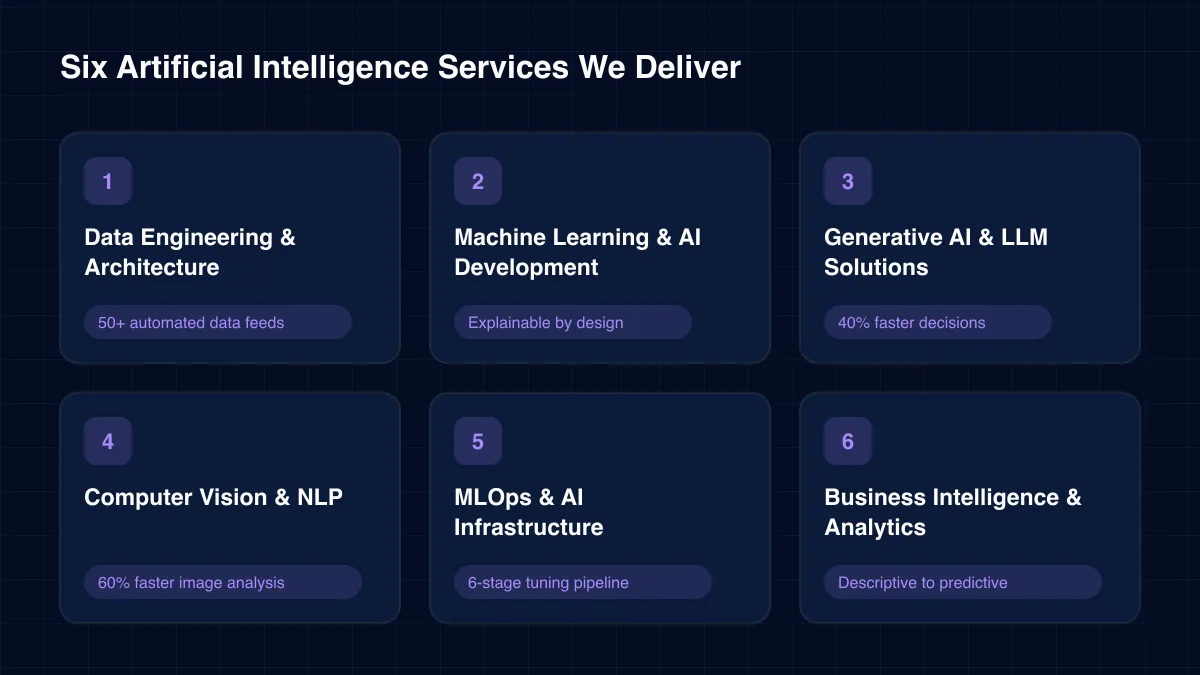
Six Artificial Intelligence Services We Deliver

Each service can stand alone or combine into one programme. All six follow the same engineering standards for artificial intelligence in production.

Data Engineering & Architecture

We build lakes, warehouses and streaming pipelines that feed artificial intelligence with governed, versioned data. Our data lake work for a wealth platform automated 50+ secure feeds into AWS.

50+ automated data feeds →

Machine Learning & AI Development

Forecasting, classification, anomaly detection and recommendation models trained on your own history. We favour explainable models when decisions affect people or money.

Explainable by design

Generative AI & LLM Solutions

Assistants, retrieval-augmented generation and fine-tuned language models that answer from your documents and databases. Our enterprise AI chatbot gave business teams plain-language access to data.

40% faster decisions →

Computer Vision & NLP

Image, video and text understanding for inspection, diagnostics, document processing and search. Our medical image system uses deep learning to flag abnormalities for review.

60% faster image analysis →

MLOps & AI Infrastructure

Training pipelines, model registries, evaluation gates and GPU serving on your cloud. Our multi-tenant fine-tuning pipeline isolates each client model and gates releases with automated evaluation.

6-stage tuning pipeline →

Business Intelligence & Analytics

Dashboards and self-service analytics that pair classic reporting with artificial intelligence for forecasts and root-cause hints. Leaders see what happened and what is likely next.

Descriptive to predictive

Architecture

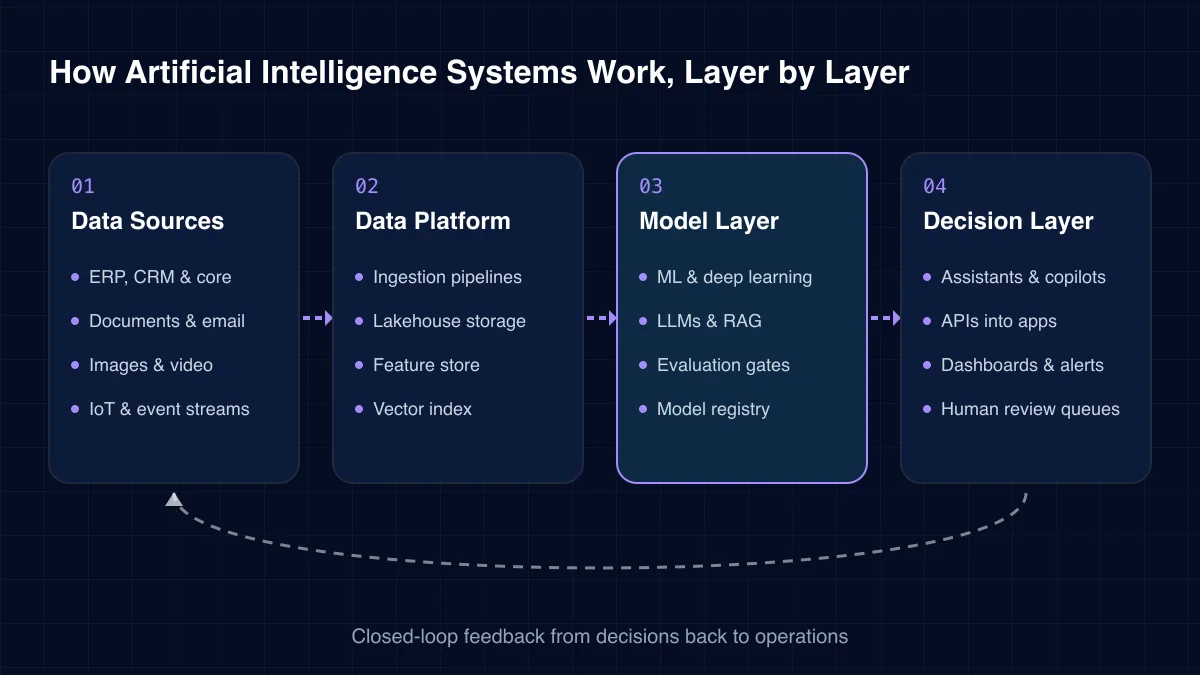
How Artificial Intelligence Systems Work, Layer by Layer

Every build follows four layers. Data moves up from source systems, and decisions move back down into daily work.

01

Data Sources

  • ERP, CRM & core systems
  • Documents & email
  • Images & video
  • IoT & event streams

02

Data Platform

  • Ingestion pipelines
  • Lakehouse storage
  • Feature store
  • Vector index

03

Model Layer

  • ML & deep learning
  • LLMs & RAG
  • Evaluation gates
  • Model registry

04

Decision Layer

  • Assistants & copilots
  • APIs into apps
  • Dashboards & alerts
  • Human review queues
Closed-loop feedback: User feedback, corrections and outcomes flow back into the data platform. Models retrain on real results, so accuracy improves instead of decaying.

Challenges we solve

Why Artificial Intelligence Projects Stall

Most failures have little to do with the algorithm. They come from data, integration and ownership gaps.

  1. 01

    Pilots That Never Reach Production

    A notebook model works on a clean sample. It then meets messy live data, security reviews and missing APIs. We plan the production path on day one.

  2. 02

    Fragmented, Low-Quality Data

    Customer, product and operations data sit in separate systems with conflicting keys. We fix lineage and quality before training anything.

  3. 03

    Hallucinating Language Models

    Generic chatbots invent answers. Retrieval from approved sources, citation display and automated evaluation keep responses grounded.

  4. 04

    Silent Model Drift

    Customer behaviour and markets change. Without monitoring, accuracy decays quietly for months. We alert on drift and retrain on schedule.

  5. 05

    No Clear Owner After Launch

    Data science builds it, IT inherits it and nobody tunes it. We define ownership, runbooks and support levels before go-live.

  6. 06

    Compliance and Privacy Risk

    Health, financial and student data carry legal duties. We design access control, masking and audit trails into the pipeline itself.

Types of Artificial Intelligence Solutions

Artificial intelligence covers four broad families of solutions. Most programmes combine two or more.

  • 1Predictive models: Forecast demand, churn, risk or failure from historical patterns. They are the backbone of planning and prioritisation.
  • 2Perception models: Read images, video, speech and scanned documents. They power inspection, triage and document automation.
  • 3Generative models: Draft text, summarise records and answer questions from company knowledge. They need grounding and evaluation.
  • 4Decision and agent systems: Chain models with rules and tools to act on a workflow, with a human approving high-impact steps.

Rules vs Machine Learning vs Generative AI

Choosing the right artificial intelligence technique matters more than choosing the newest one. This table compares the main options.

CriterionRules engineMachine learningGenerative AI
Learns from dataNo✓ Yes✓ Yes
Handles free text and imagesNoPartial✓ Yes
Easy to explain✓ YesPartialPartial
Needs labelled dataNo✓ YesOptional
Best forFixed policiesForecasts, scoringLanguage tasks

Business Benefits of Artificial Intelligence

The benefits grow as more workflows share one governed data platform.

  • Faster decisionsBecause people ask questions in plain language instead of filing report requests.
  • Lower manual effortBecause documents, images and forms are read and routed automatically.
  • Earlier warningsBecause models spot risk, fraud or failure before a human would.
  • Better customer experienceBecause answers and recommendations arrive in seconds.
  • Reusable data assetsBecause every pipeline and feature serves the next use case.
  • Stronger governanceBecause every prediction is logged, explained and reviewable.

Delivery

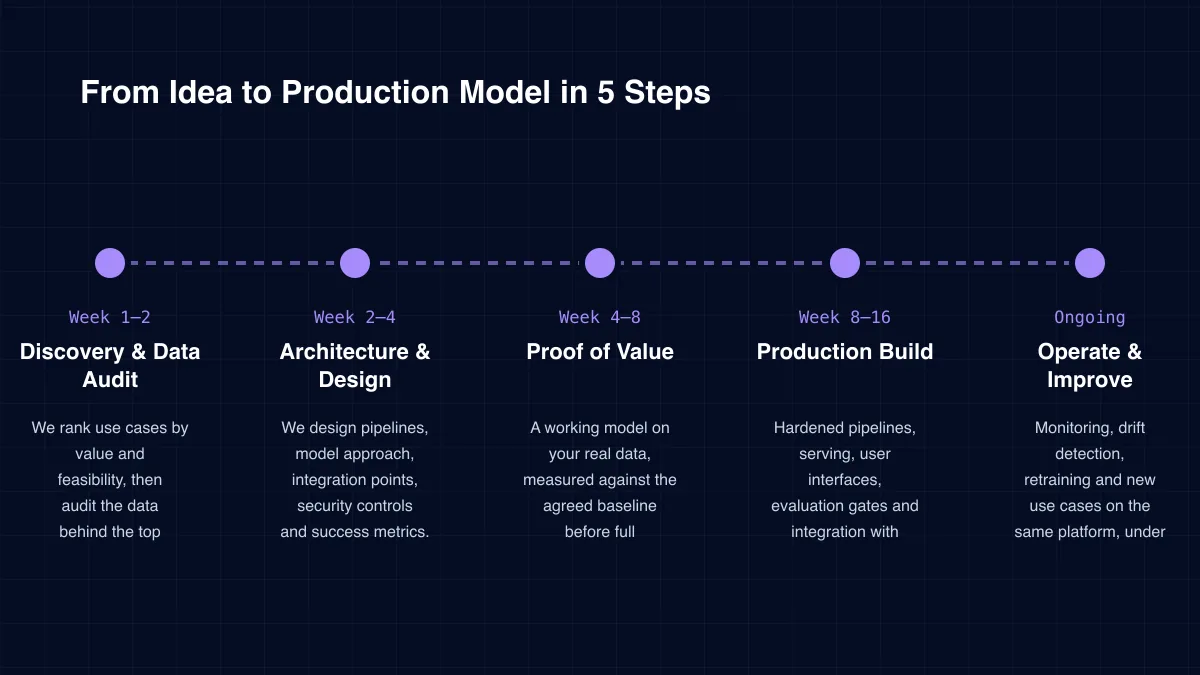
From Idea to Production Model in 5 Steps

  1. Week 1–2

    Discovery & Data Audit

    We rank use cases by value and feasibility, then audit the data behind the top candidates.

  2. Week 2–4

    Architecture & Design

    We design pipelines, model approach, integration points, security controls and success metrics.

  3. Week 4–8

    Proof of Value

    A working model on your real data, measured against the agreed baseline before full investment.

  4. Week 8–16

    Production Build

    Hardened pipelines, serving, user interfaces, evaluation gates and integration with live systems.

  5. Ongoing

    Operate & Improve

    Monitoring, drift detection, retraining and new use cases on the same platform, under SLA-based support.

Case study

Case Study: Enterprise AI Chatbot

Business teams depended on technical staff for every data question. ICANIO built an LLM-powered chatbot with retrieval-augmented generation and direct database access. Data accessibility rose by 30%, decisions became 40% faster, and employee productivity increased threefold.

“The fastest database query in the world is still too slow if a business user has to file a ticket and wait.”
Read the full case study →
01

Conversational Core

LLM · Intent understanding

Understands plain-language questions and user intent, even when phrasing is vague.

02

Unified Retrieval

SQL & NoSQL · RAG

Answers from live databases and from PDFs, emails and reports in one search.

03

Governed Access

Role-based access control

Opens data to more users without bypassing existing permissions.

How to Choose an Artificial Intelligence Partner

Plenty of firms can build a demo. We recommend testing a partner on five points before you commit.

  1. 1Production references. Ask for systems that run today, not slides or hackathon prototypes.
  2. 2Data engineering depth. The partner should own pipelines and quality, not expect perfect data.
  3. 3Evaluation discipline. Every model needs measurable release gates and a baseline to beat.
  4. 4Security posture. Look for certified processes, private deployment options and audit logging.
  5. 5Life after launch. Retraining, monitoring and support must be in the plan and the price.

In our experience the last point separates lasting value from shelfware. That is why every ICANIO engagement includes post-launch operations.

Security, Privacy and Responsible AI

ICANIO works under ISO 9001 and ISO 27001 certified processes. Models can run in your own cloud tenancy, so sensitive data never leaves your control.

We apply role-based access, masking and encryption across the pipeline. For regulated work we align controls with frameworks such as the NIST AI Risk Management Framework and the EU AI Act. Every prediction and prompt is logged for review.

Responsible use also means knowing when not to automate. For decisions about patients, credit or hiring, our designs keep a person in the loop. The model recommends, explains its reasons and records the final human choice.

Measuring the ROI of Artificial Intelligence

Start with one costly, repetitive decision. Count how many times it happens each month and what each one costs in time or error. That total is the ceiling your model works against.

Then add second-order gains, such as fewer escalations, faster onboarding or lower stock-outs. We agree the baseline with you in discovery and report against it after launch.

Costs matter too. Model hosting, GPU time and data storage grow with usage. We size infrastructure to real demand, cache frequent answers and use smaller models where they perform well. That keeps the running cost of artificial intelligence predictable as adoption spreads across teams.

Technology stack

Our Data and AI Engineering Toolchain

We pick tools for each problem and your existing cloud. These are the ones we use most.

  • Data Engineering

    • Python
    • Apache Spark
    • Airflow

    dbt

  • Storage & Search

    • AWS S3
    • Athena
    • PostgreSQL

    Vector databases

  • Machine Learning

    • scikit-learn
    • PyTorch
    • TensorFlow

    XGBoost

  • Generative AI

    • Gemini
    • LangChain

    OpenAI GPT modelsRAG pipelines

  • Computer Vision

    • OpenCV

    YOLOOCR enginesDeep learning

  • MLOps

    • MLflow
    • Docker
    • Kubernetes

    DeepEval

Inside Our Data and AI Builds

Artificial intelligence architecture from data sources to decision layer
Four-layer architecture with a feedback loop
Six artificial intelligence services from data engineering to MLOps
Six services, one engineering standard
Artificial intelligence delivery timeline from discovery to production
From discovery to a production model

Artificial Intelligence FAQs

What artificial intelligence services does ICANIO offer?

We offer six connected services. They are data engineering, machine learning development, generative AI and LLM solutions, computer vision and NLP, MLOps and AI infrastructure, and business intelligence. You can start with one and add others on the same platform.

How long does an artificial intelligence project take?

A proof of value usually lands within four to eight weeks. A production build typically follows by week sixteen. Timelines depend on data readiness and the number of systems we integrate with.

Do we need perfect data before we start?

No. Almost nobody has perfect data. Our discovery phase audits what you have, fixes the gaps that matter and shows which use cases are ready now. Data engineering is part of the service, not a prerequisite.

How do you stop generative AI from making things up?

We ground answers in your approved sources with retrieval-augmented generation. Responses show citations, and automated evaluation checks accuracy before each release. For high-stakes answers, a human reviews before anything is sent.

Can artificial intelligence run inside our own cloud?

Yes. We deploy on AWS, Azure, Google Cloud or on premises. Private model hosting keeps sensitive data inside your tenancy. We also use smaller open models when cost, latency or privacy make that the better choice.

Which industries use your artificial intelligence work?

Our artificial intelligence work spans healthcare, fintech and banking, retail, manufacturing, logistics and education. Each has its own data, systems and regulations. We staff projects with engineers who know that context.

Key Takeaways

  • Artificial intelligence pays off when it runs inside real workflows, not in a separate demo.
  • Data engineering and integration decide success more often than the choice of model.
  • Generative AI needs grounding, evaluation gates and human review for high-impact answers.
  • Plan monitoring, retraining and ownership before launch, so models keep their accuracy.

Conclusion

Artificial intelligence is now a practical tool for every industry. The winners are not the teams with the biggest models. They are the teams that connect good data, the right technique and real workflows.

ICANIO brings data engineering, machine learning, generative AI and MLOps into one delivery team. We start small, prove value on your data, and scale what works. Contact us to find your first high-value use case.

By ICANIO Data & AI Engineering Team · Published · Updated

Ready to Put Your Data to Work?

Book a free 30-minute discovery call. We will review your data, rank your best use cases and outline a path to a production model with clear milestones.

Contact Our Data & AI Team