HIPAA-Ready CI/CD Pipelines
Automated build, test and deploy pipelines with approval gates and audit trails. Our DevOps for healthcare pipelines turn multi-week releases into same-day ones.
See: HIPAA-Ready SaaS Modernization →DevOps & Cloud for Healthcare
We build delivery pipelines for clinical and life sciences software: FHIR APIs, patient portals, telehealth and compliance platforms. PHI stays protected, every change leaves audit evidence, and releases ship in hours instead of weeks.
14
Deploys today
38 min
Lead time
0
Failed changes
DevOps for healthcare has to solve a hard trade-off. Clinicians and patients need new features and fixes quickly. Regulators need proof that protected health information stays safe through every change. Most health IT teams end up choosing one, and slow release cycles become the norm.
Our team builds DevOps for healthcare that delivers both. Pipelines never touch real PHI in test. Security and compliance checks run on every commit. Each deploy produces the evidence auditors ask for, so a release can go out in hours and still pass review.
We have done this for a pharma-focused compliance platform, and we bring the same patterns to providers, payers and digital health companies.
DevOps for healthcare is continuous integration, continuous delivery and infrastructure as code, adapted to regulated clinical and life sciences software. It covers EHR integrations, FHIR APIs, patient apps, telehealth, imaging workflows and the cloud platforms behind them.
Three things make it different. First, data: test environments must use synthetic or de-identified records, and logs must never leak PHI. Second, evidence: HIPAA security rule safeguards, and for life sciences systems 21 CFR Part 11, require traceable controls. Third, uptime: a portal or telehealth outage affects care, not just revenue.
Good DevOps for healthcare builds these needs into the pipeline itself. Compliance becomes a set of automated gates rather than a quarterly scramble.
Working definition
“DevOps for healthcare is the practice of shipping clinical and life sciences software through automated pipelines that protect PHI, enforce HIPAA-aligned controls, and generate audit evidence with every release.”
Foundations
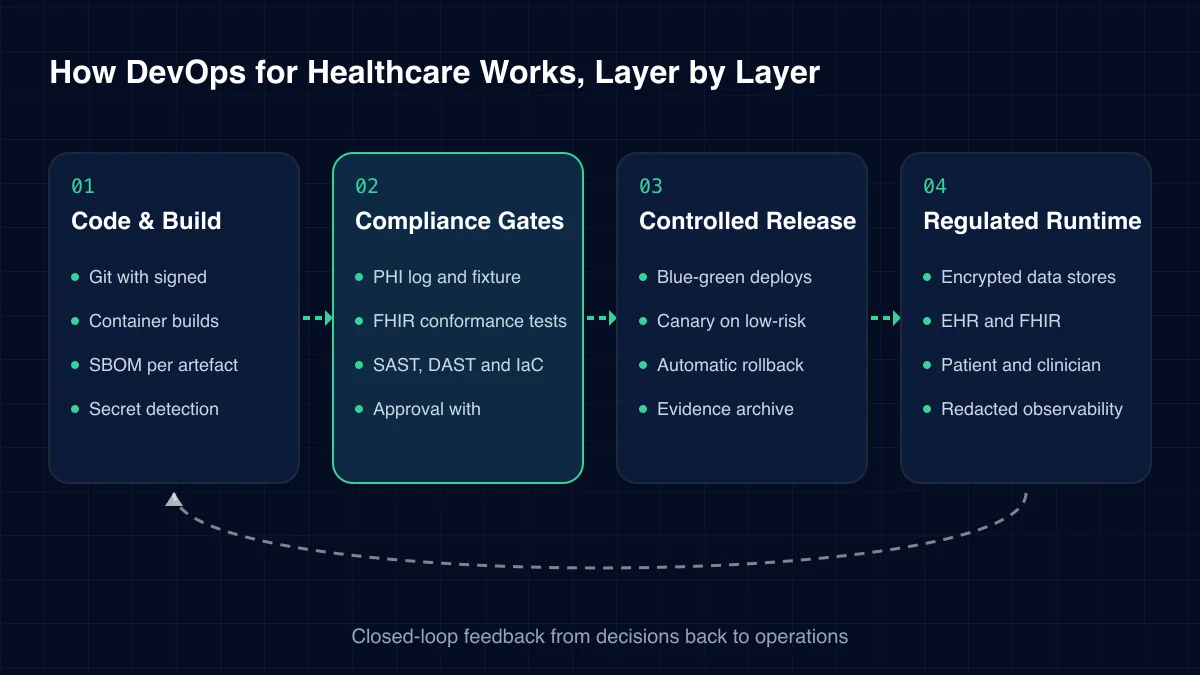
Development and test environments run on synthetic or de-identified data. Pipelines check for PHI patterns in fixtures and logs.
Encryption, access rules, network isolation and logging are defined in infrastructure code and checked by policy on every change.
Every build records tests run, scans passed, approvers and artefact hashes. Audit packages assemble themselves.
Zero-downtime deploys, health checks and rehearsed rollback keep portals, APIs and telehealth online during releases.
Core capabilities
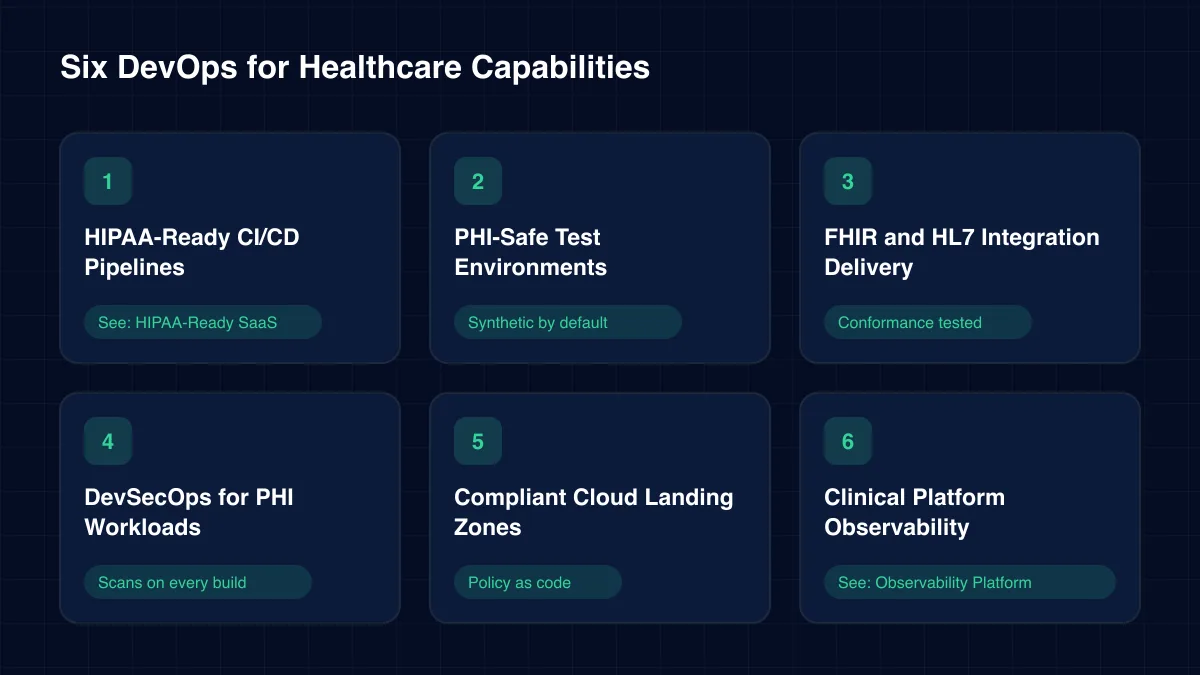
These capabilities form a complete DevOps for healthcare platform, from commit to audited production release.
Automated build, test and deploy pipelines with approval gates and audit trails. Our DevOps for healthcare pipelines turn multi-week releases into same-day ones.
See: HIPAA-Ready SaaS Modernization →Synthetic patient data, de-identification jobs and ephemeral environments per pull request. Engineers test realistic workflows without touching real records.
Synthetic by default
Pipelines for interface engines and FHIR APIs, with conformance tests against published profiles. Breaking changes to EHR integrations stop at the gate.
Conformance tested
SAST, dependency, container and DAST scans, plus secret detection and PHI log checks. DevOps for healthcare means security runs on every commit, not once a year.
Scans on every build
Infrastructure as code for encrypted, segmented AWS or Azure environments under your business associate agreement. Policy checks catch drift from approved baselines.
Policy as code
Metrics, logs and traces with PHI redaction built in. Alerts watch appointment booking, message delivery and interface queues, not only servers.
See: Observability Platform →Architecture
Our DevOps for healthcare reference design has four layers. Changes flow down into regulated environments. Evidence and health signals flow back up.
01
02
03
04
Challenges we solve
These six problems appear in almost every health IT team before a DevOps for healthcare programme.
Manual testing, change boards and hand-built environments stretch each release. Regulatory features and security patches wait in the queue.
Copies of production data end up in test databases and laptops. Each copy is a breach waiting to happen.
Debug logs capture names, record numbers or clinical notes. Nobody notices until an audit or an incident.
Before every audit, engineers rebuild screenshots and approvals by hand. The evidence is incomplete and costly to produce.
A small change breaks an HL7 feed or a FHIR resource mapping. Clinicians see missing results before engineers see an error.
Desktop or single-tenant systems cannot grow with customers or regions, and every upgrade is a project.
Healthcare software falls into four broad groups. Each carries different release risks.
Generic CI/CD speeds up delivery but leaves compliance gaps. Here is how the options compare.
| Capability | Manual release | Generic CI/CD | Healthcare-ready DevOps |
|---|---|---|---|
| PHI kept out of test | Partial | No | ✓ Yes |
| Automated audit evidence | No | Partial | ✓ Yes |
| FHIR conformance gates | No | No | ✓ Yes |
| PHI-redacted logging | No | No | ✓ Yes |
| Release in hours | No | ✓ Yes | ✓ Yes |
The benefits of DevOps for healthcare reach engineers, compliance officers and patients alike.
Delivery
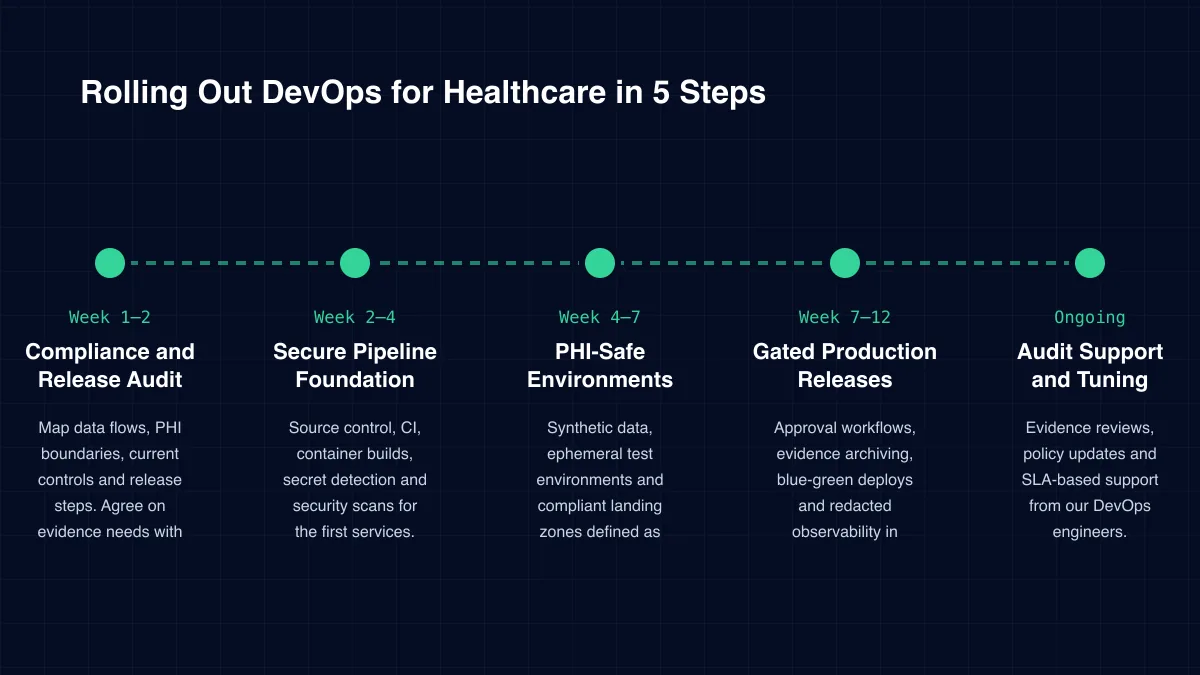
Week 1–2
Map data flows, PHI boundaries, current controls and release steps. Agree on evidence needs with your compliance lead.
Week 2–4
Source control, CI, container builds, secret detection and security scans for the first services.
Week 4–7
Synthetic data, ephemeral test environments and compliant landing zones defined as code.
Week 7–12
Approval workflows, evidence archiving, blue-green deploys and redacted observability in production.
Ongoing
Evidence reviews, policy updates and SLA-based support from our DevOps engineers.
Case study
A pharma-focused compliance partner relied on a legacy desktop tool and fragmented DevOps, so every release took weeks. Our team moved it to a multi-tenant microservices platform on Azure Kubernetes Service with automated CI/CD. CI/CD complexity fell by 60%, infrastructure costs fell by 40%, and release cycles shrank from weeks to hours.
“A legacy desktop tool that cannot scale is not just a technical constraint, in a regulated life sciences environment, it is a compliance risk that compounds with every delayed release.”Read the full case study →
Azure DevOps · Azure Repos
Repeatable, auditable deployments replaced manual release processes.
Azure Kubernetes Service
Multi-tenant microservices that scale across customers and regions.
Infrastructure as Code · Azure Security Center
HIPAA and GDPR controls built into the infrastructure itself.
Many teams can automate a deploy. Fewer can defend it in an audit. We recommend checking five things.
In our experience, evidence automation is what wins over compliance teams. Once audits get easier, release frequency follows.
ICANIO operates under ISO 9001 and ISO 27001 certified processes. We design DevOps for healthcare so that security and privacy controls are enforced by code, not by memory.
Data is encrypted in transit and at rest. Access follows least privilege, with short-lived credentials for pipelines. Workloads run in accounts covered by your cloud provider's business associate agreement. We map pipeline controls to HIPAA security rule safeguards, and for FDA-regulated systems we support 21 CFR Part 11 needs for electronic records and signatures.
Start with release lead time. How long does a regulatory fix take to reach production today? Each week of delay has a cost in risk, customer trust and staff time. DevOps for healthcare attacks that number first.
Then add hours spent preparing audit evidence, infrastructure running at fixed peak size, and incidents caused by manual changes. We baseline these with you in discovery and track them after each phase.
Technology stack
We fit the stack to your cloud, your EHR vendors and your compliance model. These are common choices.
Source & CI
Security Scanning
SASTDASTContainer scanningSecret detection
Infrastructure as Code
BicepOPA policy
Runtime
Managed databasesKey vaults
Healthcare Integration
HL7 FHIRHL7 v2 interfacesDICOMInterface engines
Observability
Log redaction
 Free white paper · DevOps & CloudDevOps & Cloud EngineeringBuilding Resilient, Scalable, and Cost-Efficient Enterprise Cloud InfrastructureGet the white paper →
 Free white paper · HealthcareHealthcare Technology SolutionsDigital Transformation, Clinical Excellence, and Patient-Centric InnovationGet the white paper →
DevOps for healthcare adds controls for protected health information, audit evidence and clinical uptime. Test data is synthetic, logs are redacted, and every release records who approved it and which checks passed.
HIPAA applies to how you protect PHI, not to a tool. Pipelines support compliance when they keep PHI out of non-production systems, enforce encryption and access rules as code, and keep audit trails. That is how we design them.
We generate synthetic patient records that match your data shapes and FHIR profiles. Where historic data is needed, we use de-identification jobs. Pipelines also scan fixtures and logs for PHI patterns.
Yes. For FDA-regulated systems we add validation evidence, controlled approvals and electronic record support aligned with 21 CFR Part 11. Our pharma compliance platform work used the same approach.
We work on AWS and Azure most often, in accounts covered by the provider's business associate agreement. The choice depends on your existing contracts, EHR vendors and team skills.
Results vary by starting point. In our HIPAA-ready SaaS modernization, release cycles moved from weeks to hours. Most teams see a first gated production release within four to seven weeks.
Healthcare teams do not have to choose between speed and compliance. DevOps for healthcare makes safe releases the easy path and turns audit evidence into a by-product of shipping.
ICANIO brings secure pipelines, PHI-safe environments, compliant cloud and observability in one team. We start with your slowest release path, prove it under review, and expand DevOps for healthcare from there.
By ICANIO DevOps & Cloud Engineering Team · Published · Updated
Book a free 30-minute discovery call. We will review your release process, PHI boundaries and audit needs. You will leave with a compliant pipeline plan and clear milestones.
Contact Our DevOps Team