API DEVOPS · INFRASTRUCTURE AS CODE · AUTOMATED DEPLOYMENT
This DevOps API support platform streamlines CI/CD, monitoring, and infrastructure management for enterprise API services. Icanio built the platform to improve release speed, reliability, and scalability across feature-rich, multi-environment APIs.

Quick Answer
What Is a DevOps API Support Platform?
A DevOps API support platform automates CI/CD pipelines, infrastructure as code, and monitoring specifically for enterprise API services, replacing manual, ad hoc deployment with repeatable, observable releases. ICANIO built this DevOps API support platform to deliver 3x faster safe and reliable releases and a 40% reduction in deployment failure risk.
Executive Summary
Turning Manual API Deployments Into Automated DevOps Practice
Manual deployments and ad hoc environment management caused slow, risky API releases. Lack of standardized pipelines, monitoring, and repeatable infrastructure limited reliability, scalability, and release velocity for growing feature sets. ICANIO’s partner was facing exactly that gap: manual builds and deployments increasing errors and release risk, no standardized CI/CD pipeline hindering repeatable processes, limited visibility into API performance and system failures, and infrastructure provisioning that lacked consistency across development, staging, and production.
ICANIO addressed this by implementing automated CI/CD pipelines, infrastructure-as-code, centralized monitoring, and secure configuration management rather than patching deployments one environment at a time. The objective was to automate build, test, and deployment through CI/CD pipelines, standardize environments with infrastructure as code, add centralized monitoring and logging for real-time performance visibility, secure configuration management to reduce operational and compliance risk, automate rollouts for faster, safer releases, and enable scaling and onboarding of new services through the DevOps platform.
The result was 3x faster safe and reliable releases, with improved system reliability and observability, operational platform scalability readiness, a 40% reduction in deployment failure risk, enhanced performance monitoring insights, and twice the standardized DevOps delivery practices.
“An API that scales in traffic but not in deployment process doesn’t become more reliable, it just fails in more places at once.”
The Challenge
Five Risks of Manual, Ad Hoc API Deployment
Manual deployments and ad hoc environment management caused slow, risky API releases. Lack of standardized pipelines, monitoring, and repeatable infrastructure limited reliability, scalability, and release velocity for growing feature sets.
The DevOps API Support Platform Gap
Manual builds and deployments increased errors and release risk, with every API release depending on steps executed correctly by hand.
No Standardized CI/CD Pipeline
No standardized CI/CD pipeline hindered repeatable processes, so every release followed a slightly different path to production.
Limited API Performance Visibility
Limited visibility into API performance and system failures meant problems were often discovered by users before the team noticed.
Inconsistent Infrastructure and Ad Hoc Configuration
Infrastructure provisioning lacked consistency across development, staging, and production, and operational risk increased due to ad hoc configuration handling on top of that.
Why This DevOps API Support Platform Was Needed
Scaling services for growing API usage was difficult, leaving the platform unprepared for traffic growth it should have been able to absorb.
DevOps API Support Platform Solutions
A Six-Part DevOps API Support Platform
Icanio implemented automated CI/CD pipelines, infrastructure-as-code, centralized monitoring, and secure configuration management, improving API reliability, observability, deployment speed, and operational scalability for feature-rich, multi-environment enterprise API services. The solutions included:
The DevOps API Support Platform Core
Automated CI/CD pipelines handled build, test, and deployment, removing the manual steps that previously introduced release risk.
Infrastructure as Code Standardization
Infrastructure as code standardized environments for development, staging, and production, so every environment was provisioned the same repeatable way.
Centralized Performance Monitoring
Centralized monitoring and logging provided real-time performance visibility, surfacing API issues before they reached users.
Secure Configuration Management
Secure configuration management reduced operational and compliance risks, replacing ad hoc handling with a controlled, auditable process.
Automated, Safer Rollouts
Automated rollouts ensured faster, safer feature releases, cutting the risk that came with manual deployment steps.
This DevOps API Support Platform's Onboarding
The DevOps platform enabled scaling and onboarding of new services, so growth never meant rebuilding the deployment process from scratch.
Business Outcomes
Measurable Results Across Speed, Reliability, and Scale
This DevOps API support platform delivered outcomes across every dimension of the original manual-deployment problem, converting slow, ad hoc API releases into a fast, observable, and scalable delivery practice.
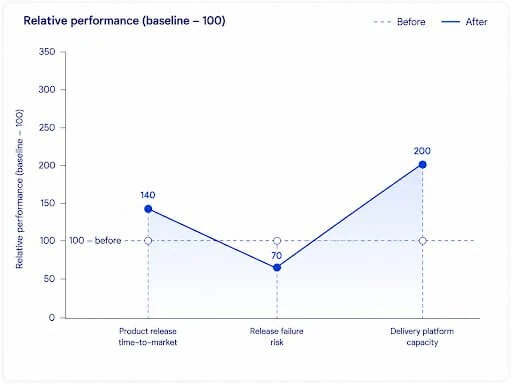
DevOps API support platform outcomes: releases three times faster, 40% lower deployment failure risk and improved reliability and observability.
3xFaster
Safe and reliable releases
Improved System
Reliability and observability
Operational
Platform scalability readiness
40%Reduced
Deployment failure risk
Enhanced
Performance monitoring insights
2xStandardized
DevOps delivery practices
Key learnings
What This Engagement Proves for Enterprise API Delivery
This DevOps API Support Platform Removes Environment Drift
Infrastructure provisioning lacking consistency across development, staging, and production was the root cause behind many release failures. Standardizing environments with infrastructure as code is what let the same deployment behave identically everywhere.
Observability Has to Precede Automation, Not Follow It
Automating deployments without centralized monitoring would have just made failures happen faster. Building real-time performance visibility into the pipeline first is what let automated rollouts stay safe rather than risky.
This DevOps API Support Platform Makes Scaling Safe
Scaling services for growing API usage was difficult partly because ad hoc configuration handling made every new service a manual, error-prone setup. Secure, standardized configuration management is what let the platform onboard new services without accumulating operational risk.
Conclusion
From Manual API Deployments to Automated DevOps Delivery
Manual deployments and ad hoc environment management might have been workable for a single API, but for an organization running feature-rich, multi-environment enterprise API services, they had become a real source of risk and slow delivery. This engagement demonstrates that a single DevOps API support platform can resolve deployment risk, visibility, and scalability gaps within one structured programme rather than three separate initiatives.
By automating CI/CD pipelines, standardizing infrastructure as code, adding API monitoring through centralized logging, and enforcing secure configuration management, ICANIO helped this partner reach 3x faster safe and reliable releases and a 40% reduction in deployment failure risk. The enterprise API reliability and standardized delivery practices delivered through this engagement are the foundation every future API service this platform onboards will run on.
Related Resources
This platform belongs to ICANIO's DevOps and cloud engineering services, focused on release automation. Our team also keeps API services healthy through support engineering services for software development teams. Related work includes DevOps automation and the DevOps observability platform. To plan a similar pipeline, contact ICANIO.
- DevOps and Cloud Engineering Services
- Industries We Serve
- DevOps Automation: 40% Faster Releases
- DevOps Observability Platform: 99.9% Uptime
- Continuous Testing for CI/CD: Enterprise Guide 2026
References
- DevOps: overview of the practices that combine software development and IT operations.
- CI/CD: background on continuous integration and continuous delivery pipelines.
- Infrastructure as code: how environments are provisioned from versioned definition files.
- The Twelve-Factor App: Config: guidance on keeping configuration separate from application code.
Frequently asked questions
Common Questions About This DevOps API Support Platform
What is a DevOps API support platform and why do APIs need one?
A DevOps API support platform automates CI/CD, infrastructure as code, and monitoring specifically for API services, which enterprise APIs need to replace manual, risky deployments with repeatable, observable releases.
How does infrastructure as code prevent environment inconsistency?
Infrastructure as code standardizes environments for development, staging, and production, so every environment is provisioned identically instead of drifting apart through manual configuration.
What does API monitoring actually surface for engineering teams?
API monitoring through centralized logging provides real-time performance visibility, surfacing failures and bottlenecks before they reach end users instead of after.
Why does secure configuration management matter for API deployments?
Secure configuration management replaces ad hoc, manual configuration handling with a controlled, auditable process, directly reducing the operational and compliance risk that comes with inconsistent setups.
How does this platform support enterprise API reliability at scale?
Enterprise API reliability is supported through automated rollouts, centralized monitoring, and standardized infrastructure, so scaling to new services doesn't introduce the ad hoc risk that used to come with manual setup.
How much faster are releases with this DevOps API support platform?
This DevOps API support platform delivers 3x faster safe and reliable releases and a 40% reduction in deployment failure risk compared to manual, ad hoc deployment processes.