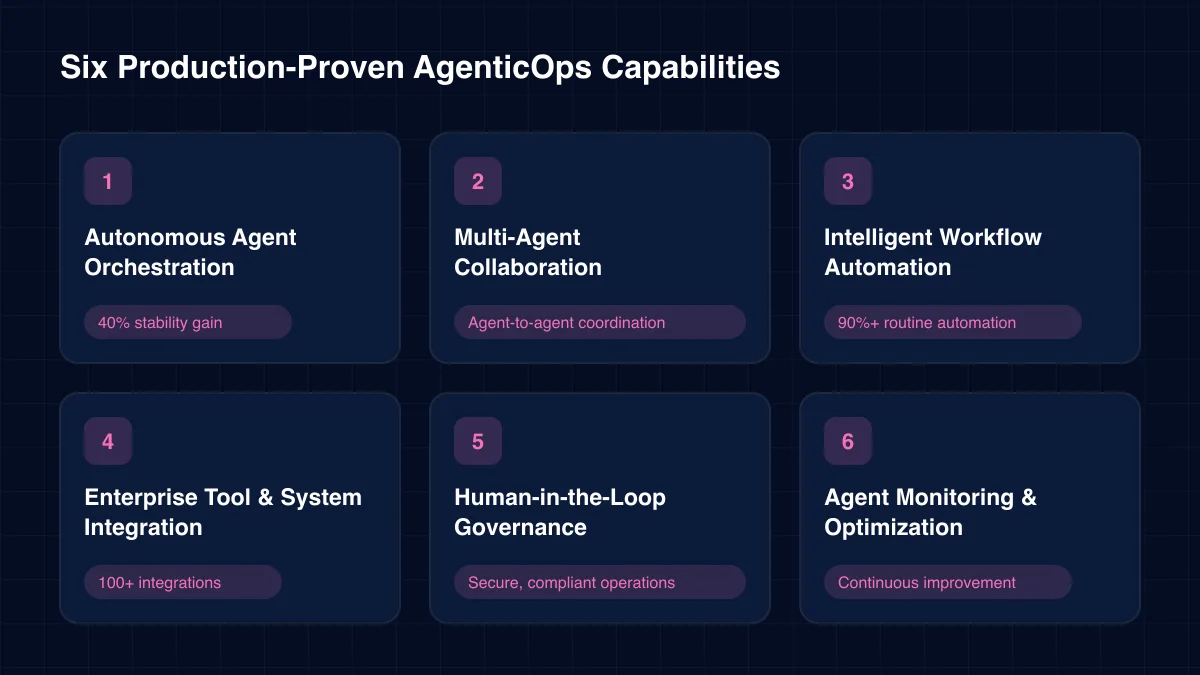
Autonomous Agent Orchestration
Agents that plan, reason and execute complex workflows with minimal intervention. Our agentic AI framework work stabilised and extended multi-agent workflows across local and cloud LLMs.
40% stability gain →AgenticOps · AI Agent Operations
Most agentic systems work in demos. Few survive production. ICANIO covers the full lifecycle: architecture, orchestration, observability and reliability, so your agents hold up at 3 a.m.
⟳ Orchestrating agents…
every step traced · guardrails on · reversible
AI agents can now plan, call tools and finish multi-step work. The hard part is keeping them reliable once real users, real data and real APIs arrive. AgenticOps is the discipline that makes that possible.
Our team designs agent architectures, orchestrates multi-agent workflows and connects agents to your enterprise systems. We add decision tracing, failure recovery and human approval gates, so autonomy never outruns governance.
This guide explains what the term means, how it differs from AIOps and classic automation, and how we deliver it. It also shares measured results from an Icanio engagement that stabilised an enterprise agentic AI framework.
AgenticOps is the operational discipline of designing, deploying and sustaining multi-agent AI systems in production. It covers agent decision tracing, tool-use failure recovery, inter-agent coordination and escalation to humans when autonomy reaches its limit.
AIOps helped IT teams see problems sooner. It detects anomalies and raises alerts for people to act on. AgenticOps goes further. Agents reason through the problem and take action directly, while humans stay in the loop for approval and oversight.
Think of it as DevOps and MLOps for autonomous software. The same ideas apply: version everything, test before release, observe in production and improve from real outcomes. The difference is that the thing being operated can make its own decisions.
That changes what teams must watch. A normal service either returns the right response or throws an error. An agent can return a confident, well-formatted answer that is simply wrong, or take a valid action at the wrong time. Operating agents therefore means checking reasoning and outcomes, not just uptime and latency.
Industry 5.0 definition
“AgenticOps is the evolution of AI operations where autonomous AI agents perceive, reason, collaborate and act across enterprise workflows, while humans provide strategic direction, governance and oversight.”
Foundations
Coordinate multiple AI agents to plan, execute and optimise complex enterprise workflows.
Automate end-to-end processes with agents that reason, adapt and act in real time.
Connect agents to applications, APIs, databases and cloud platforms securely.
Approvals, policy enforcement, monitoring and audit trails keep every action accountable.
Core capabilities
Each capability is built for enterprises adopting autonomous agents, with security, scale and governance at the core.
Agents that plan, reason and execute complex workflows with minimal intervention. Our agentic AI framework work stabilised and extended multi-agent workflows across local and cloud LLMs.
40% stability gain →Specialised agents that share context, delegate tasks and negotiate priorities. Supervisor, pipeline and debate patterns are chosen per workflow, not by habit.
Agent-to-agent coordination →Manual, multi-step processes rebuilt as adaptive agent workflows. Agents handle the routine path, and exceptions go to people with full context attached.
90%+ routine automation
Secure connections to ERP, CRM, ticketing, databases and cloud platforms, including Model Context Protocol servers. Each tool call is scoped, logged and rate limited.
100+ integrations →Approval gates, policy enforcement, audit logs and kill switches. High-impact actions always wait for a named person, and every decision is traceable.
Secure, compliant operations →Traces for every step, cost and latency dashboards, and automated evaluation of agent outputs. Prompts, tools and models improve from real production data.
Continuous improvement →Architecture
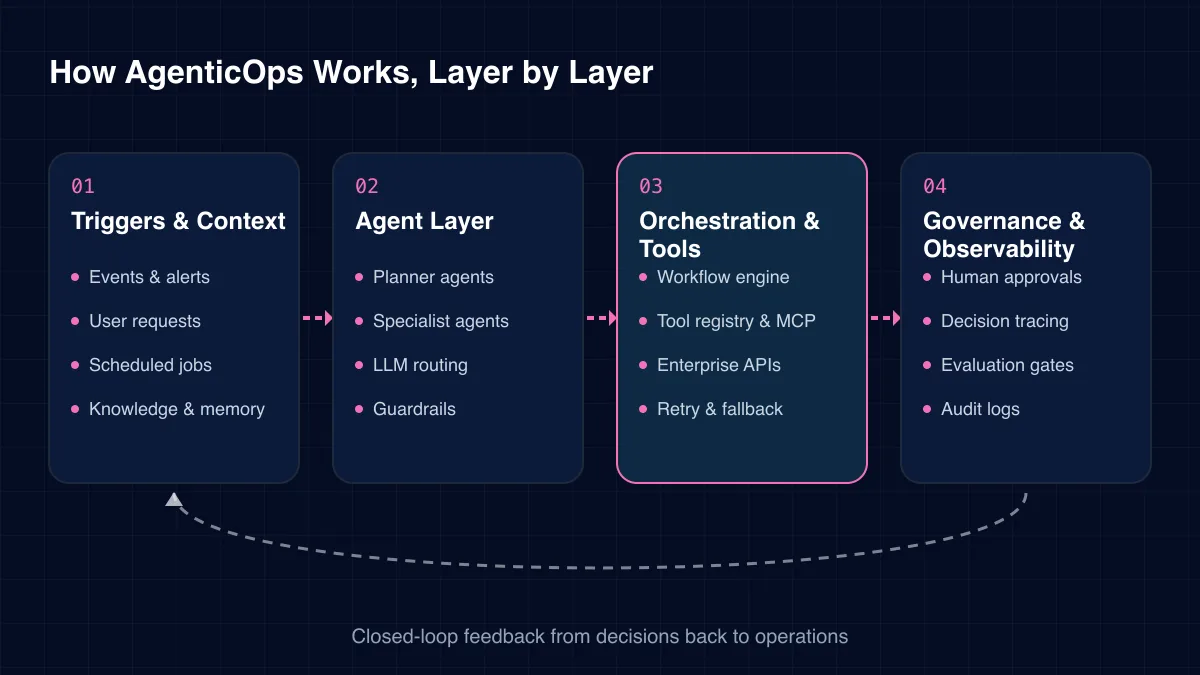
Every build follows four layers. Events trigger agents, agents act through governed tools, and outcomes feed back into evaluation.
01
02
03
04
Challenges we solve
Enterprises face dynamic workflows, fragmented systems and rising complexity. Agent operations close the gaps that rule-based tools leave behind.
Rule-based bots break when conditions change. Agents read context, decide and adapt the workflow in real time.
Key data sits across ERP, CRM, databases and SaaS tools. Agents connect them into one end-to-end process.
Approvals, checks and handoffs slow work down. Multiple agents collaborate to move each step forward.
Demos run on clean inputs. Production brings shifting data and changing APIs. Tracing and recovery catch failures early.
Manual processes grow with headcount. Agent workflows scale across teams without the same growth in resources.
Autonomous AI must be safe and transparent. Oversight, policy checks and audit trails are designed in from the start.
Engagements usually start in one of four places, depending on your maturity. Many clients move through several of them over time.
These three approaches are often confused. The table shows how AgenticOps differs.
| Capability | RPA | AIOps | AgenticOps |
|---|---|---|---|
| Handles changing inputs | No | Partial | ✓ Yes |
| Takes action on its own | ✓ Yes | No | ✓ Yes |
| Reasons across steps | No | No | ✓ Yes |
| Human approval gates | Partial | Partial | ✓ Yes |
| Best for | Fixed UI tasks | Alert detection | Multi-step decisions |
The benefits grow as more workflows share the same agents, tools and guardrails.
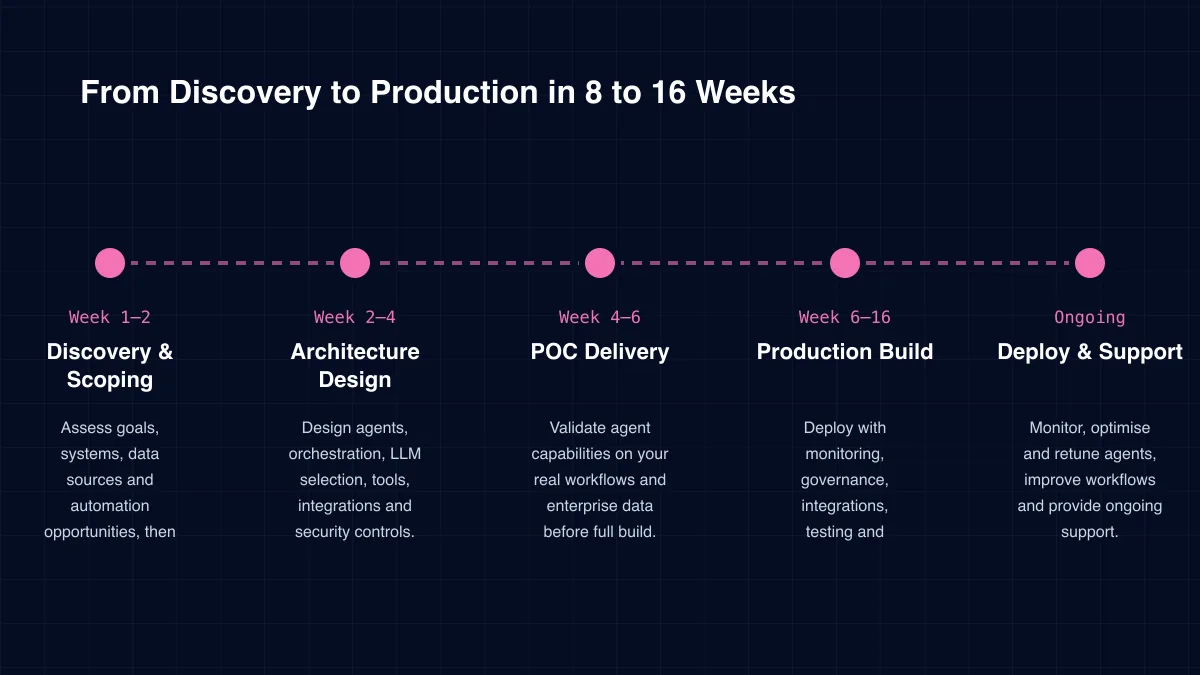
Delivery
Week 1–2
Assess goals, systems, data sources and automation opportunities, then define a clear roadmap.
Week 2–4
Design agents, orchestration, LLM selection, tools, integrations and security controls.
Week 4–6
Validate agent capabilities on your real workflows and enterprise data before full build.
Week 6–16
Deploy with monitoring, governance, integrations, testing and enterprise-grade security.
Ongoing
Monitor, optimise and retune agents, improve workflows and provide ongoing support.
Case study
An enterprise AI platform had agent workflows with unresolved stability issues and inconsistent reasoning. ICANIO audited every workflow, designed collaborative and reflective reasoning agents and built a scalable deployment architecture. The result was 40% better stability, 3x stronger agent reasoning and compatibility across local and cloud LLM environments.
“A framework that works in isolation but fails in production is an architecture and workflow engineering problem.”Read the full case study →
Stability debugging
Found and fixed reliability failures across existing agent reasoning chains.
Collaborative · Reflective
New agents reason together and check their own work before acting.
Local & cloud LLMs
One architecture runs across several model environments as needs change.
See how we apply agenticops in each sector we serve.
Agent demos are easy to find. Production experience is not. We recommend checking five things.
In our experience the second point decides whether agents earn trust. That is why our work starts with how agents fail, not how they succeed.
ICANIO operates under ISO 9001 and ISO 27001 certified processes. Agents receive least-privilege credentials, and each tool is scoped to the actions a workflow truly needs.
We defend against prompt injection, data leakage and runaway loops with input filtering, output checks, budgets and kill switches. Controls align with guidance such as the NIST AI Risk Management Framework and the OWASP Top 10 for LLM applications.
Every deployment keeps a complete decision trail. You can see what an agent saw, which tools it called, what it proposed and who approved it. That record supports audits and speeds up any investigation.
Pick one workflow and measure it today: volume per month, minutes per case, error rate and time to completion. That baseline shows what agents need to beat.
After launch, track the same numbers plus approval rates and override rates. We agree these measures during discovery, so value is shown in your own data rather than vendor estimates.
Watch running costs as well. Model calls, tool usage and hosting all add up. We route simple steps to smaller models and cache repeated lookups, so cost per case stays predictable as volume grows.
Finally, count the hidden savings. Staff spend less time copying data between systems and chasing approvals. Customers wait less. Auditors find complete records instead of scattered emails. These gains are real, even when they are harder to put in a spreadsheet.
Technology stack
We choose models, frameworks and infrastructure for each use case. These are the building blocks we use most.
LLMs
OpenAI GPT modelsOpen-source LLMsLocal models
Agent Frameworks
Open-source agent frameworksGraph-based orchestrationCustom orchestrators
Tools & Integration
REST APIsERP & CRM connectors
Memory & Retrieval
Vector databasesRAG pipelinesSession memory
Observability
Agent tracingCost dashboardsDeepEval
Cloud & Runtime
AgenticOps is the discipline of designing, deploying and sustaining multi-agent AI systems in production. It covers decision tracing, tool-use failure recovery, inter-agent coordination and human escalation when autonomy reaches its limit.
AIOps detects problems and surfaces alerts for humans to act on. With AgenticOps, agents reason through problems and act on them directly. Humans stay in the loop for approval and oversight instead of handling every step. In practice, the two work well together: monitoring detects the issue and agents help resolve it.
Demos run on clean, predictable inputs. Production brings shifting data, changing APIs and edge cases nobody planned for. Without reliability engineering, observability and escalation paths, failures compound quietly until something breaks.
Both. We design agent architecture from scratch where needed. We also take over reliability, observability and orchestration for agent systems built in-house or by other vendors.
Architecture and design typically take two to four weeks. A production-ready multi-agent system with observability and human-in-the-loop workflows takes six to twelve weeks, depending on complexity.
Any industry with multi-step, data-heavy work benefits. We apply agent operations in logistics, healthcare, fintech, retail, manufacturing and education, always with approval gates matched to each sector's rules.
Focused services within our agenticops practice.
AI agents are ready to take on real work. What they need is an operating discipline that keeps them reliable, observable and governed. AgenticOps provides exactly that.
ICANIO designs, builds and runs agent systems across the full lifecycle. We start with one workflow, prove value on your data and grow from there with guardrails in place. Contact us for a straight assessment of where AgenticOps fits your business.
By ICANIO AgenticOps Engineering Team · Published · Updated
Tell us what you are building or where you are stuck. Book a free discovery call and get a straight assessment, with no pitch deck and no vague roadmap.
Contact Our AgenticOps Team