
CI/CD PIPELINE · RELEASE AUTOMATION · DEVOPS ENGINEERING
This DevOps automation framework streamlines CI/CD, testing, and deployments for enterprise applications and development teams. Icanio built the framework on Bitbucket, Nexus/Artifactory, and Ansible/Helm/ArgoCD to improve release speed, quality, consistency, and scalability.
Quick Answer
What Is DevOps Automation?
DevOps automation replaces manual builds, testing, and deployments with a standardized CI/CD framework covering source control, automated testing, artefact management, and continuous deployment. ICANIO implemented DevOps automation built on Bitbucket, Nexus/Artifactory, and ArgoCD, cutting product release time-to-market by 40%.
Executive Summary
Turning Manual Releases Into a Standardized CI/CD Framework
Application teams worked in silos with manual builds, testing, and deployments, causing delays, inconsistent releases, limited traceability, delayed feedback, reduced quality, and operational inefficiencies across multiple environments. ICANIO’s partner was facing exactly that gap: manual build, test, and deployment processes causing release delays, a lack of standardized processes leading to inconsistent deployments, difficult-to-manage artefact tracking and rollback processes, and long release cycles that delayed feature delivery to end-users.
ICANIO addressed this by implementing a CI/CD automation framework rather than patching individual pipeline steps. The objective was to centralize source code management in Bitbucket with a defined branch strategy, automate unit tests, analysis, and builds through Continuous Integration, store artefacts in Nexus/Artifactory for traceability and reuse, automate integration, functional, regression, and UAT testing, and deploy continuously through Ansible, Helm, ArgoCD, or Azure Pipelines, all backed by integrated monitoring for feedback loops.
The result was 40% faster product release time-to-market, with higher-quality stable release cycles, consistent deployments across environments, improved developer productivity, a 30% reduction in release failure risk, and twice the scalable delivery platform capacity.
“A deployment that only works because one engineer remembers the manual steps is not a process, it is a single point of failure wearing a runbook.”
The Challenge
Five Failures of Manual Build, Test, and Deployment
Application teams worked in silos with manual builds, testing, and deployments, causing delays, inconsistent releases, limited traceability, delayed feedback, reduced quality, and operational inefficiencies across multiple environments.
The DevOps Automation Gap
Manual build, test, and deployment processes caused release delays, with every step depending on someone remembering to run it correctly.
No Standardized Deployment Processes
A lack of standardized processes led to inconsistent deployments, so the same release could behave differently depending on who ran it.
Difficult Artefact Tracking and Rollbacks
Artefact tracking and rollback processes were difficult to manage, leaving teams exposed when a release needed to be reverted quickly.
Long Release Cycles Delayed Delivery
Long release cycles delayed feature delivery to end-users, and the business struggled overall to deliver updates quickly and reliably as a result.
Why This DevOps Automation Framework Was Needed
Feedback loops for developers were slow and inefficient, leaving issues undetected until well after the code that caused them had shipped.
DevOps Automation Solutions Provided
A Six-Part DevOps Automation Framework
Icanio implemented a CI/CD automation framework with source control, automated builds, testing, deployments, monitoring, and feedback loops, ensuring faster, reliable, and consistent delivery across all development environments. The solutions included:
The DevOps Automation Core
Centralized source code management in Bitbucket with a defined branch strategy gave every team one consistent way to manage code changes.
Automated Continuous Integration
Continuous Integration automated unit tests, analysis, and builds, catching problems the moment code was committed instead of after release.
Artefact Traceability With Nexus and Artifactory
Artefacts stored in Nexus/Artifactory for traceability and reuse gave teams a reliable record of exactly what was deployed and when.
Automated Testing Framework
Automated testing for integration, functional, regression, and UAT replaced manual test cycles with consistent, repeatable coverage.
Continuous Deployment With ArgoCD and Ansible
Continuous Deployment with Ansible, Helm, ArgoCD, or Azure Pipelines standardized how releases reached every environment.
This DevOps Automation Framework's Feedback Loops
Monitoring integrated for feedback loops and continuous improvements closed the gap between deploying a change and knowing how it performed.
Business Outcomes
Measurable Results Across Speed, Quality, and Scale
This DevOps automation framework delivered outcomes across every dimension of the original manual release problem, converting siloed, inconsistent deployments into a fast, standardized, and scalable delivery practice.
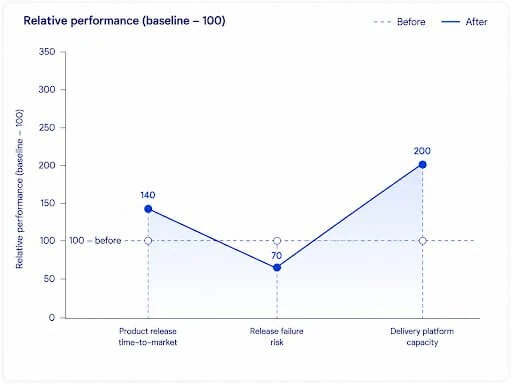
DevOps automation outcomes: 40% faster product releases, 30% lower release failure risk and consistent deployments across every environment.
40%Faster
Product release time-to-market
Higher Quality
Stable release cycles
Consistent
Deployments across environments
Improved
Developer productivity efficiency
30%Reduced
Release failure risk
2xScalable
Delivery platform capacity
Key learnings
What This Engagement Proves for Enterprise Release Engineering
This DevOps Automation Framework Makes Speed Sustainable
Speeding up individual manual steps would only have made an inconsistent process faster. Standardizing source control, testing, and deployment through one CI/CD automation framework is what made the 40% faster release time-to-market durable rather than a one-time win.
Artefact Traceability Prevents Rollback Panic
Difficult artefact tracking and rollback processes weren’t just an inconvenience, they were a risk multiplier during incidents. Storing artefacts in Nexus/Artifactory for traceability is what turned rollback from a scramble into a routine operation.
This DevOps Automation Framework Closes Feedback Loops
Slow developer feedback loops persisted even after automating builds and tests, until monitoring was integrated directly into the pipeline. Closing that loop automatically is what let continuous improvement actually happen continuously.
Conclusion
From Manual Releases to a Standardized CI/CD Framework
Manual build, test, and deployment processes might have been workable for a single application team, but for an organization running multiple environments and release cycles, they had become a real source of delay and inconsistency. This engagement demonstrates that a single DevOps automation framework can resolve release speed, consistency, and feedback gaps within one structured programme rather than three separate initiatives.
By centralizing source control in Bitbucket, standardizing automated build deployment through Continuous Integration, and adopting continuous integration tools and an automated testing framework across every environment, ICANIO helped this partner reach 40% faster product release time-to-market and a 30% reduction in release failure risk. The release management practices and cloud deployment automation delivered through this engagement are the foundation every future release this organization ships will run on.
Related Resources
This DevOps automation work belongs to ICANIO's DevOps and cloud engineering practice. Our team delivers CI/CD programs through DevOps and cloud engineering services. It supports faster software development across every environment. More pipeline work appears in our software development case studies. To plan a similar framework, contact ICANIO.
- DevOps and Cloud Engineering Services
- Industries We Serve
- Best DevOps Automation Platform in 2026
- DevOps Observability Platform: 99.9% Uptime
- Continuous Testing for CI/CD: Enterprise Guide 2026
References
- Continuous integration: Wikipedia overview of CI practices.
- Continuous deployment: Wikipedia overview of automated release to production.
- Argo CD documentation: official docs for GitOps continuous delivery on Kubernetes.
- Ansible documentation: official docs for Ansible automation.
- Helm documentation: official docs for the Kubernetes package manager.
Frequently asked questions
Common Questions About This DevOps Automation Framework
What is DevOps automation and why replace manual releases with it?
DevOps automation replaces manual builds, testing, and deployments with a standardized CI/CD framework, which matters because manual release processes cause delays, inconsistent deployments, and slow developer feedback.
How does automated build deployment reduce release delays?
Automated build deployment through Continuous Integration catches build and test failures the moment code is committed, instead of discovering problems during a manual release process.
What role do continuous integration tools play in this framework?
Continuous integration tools automate unit tests, static analysis, and builds on every commit, giving developers fast feedback instead of waiting for a scheduled manual build.
How does an automated testing framework improve release quality?
An automated testing framework covers integration, functional, regression, and UAT testing consistently on every release, replacing the gaps that manual testing cycles previously left behind.
What does release management look like with this CI/CD framework?
Release management becomes standardized and repeatable, with Continuous Deployment through Ansible, Helm, ArgoCD, or Azure Pipelines replacing ad hoc, manual deployment steps across every environment.
How much faster is time-to-market with DevOps automation?
This DevOps automation framework delivers 40% faster product release time-to-market and a 30% reduction in release failure risk compared to manual build, test, and deployment processes.