CI/CD for LMS and LTI Tools
Standard pipelines for LMS plugins, LTI 1.3 tools and course content services. Our DevOps for education pipelines test launches against your LMS before release.
See: DevOps Automation →DevOps & Cloud for Education
We automate delivery for learning platforms: LMS extensions, LTI tools, assessment engines, virtual classrooms and student systems. Releases follow the academic calendar, scale for enrollment and exams, and protect student data.
14
Deploys today
38 min
Lead time
0
Failed changes
DevOps for education starts with the academic calendar. Learning platforms sit quiet for weeks, then face thousands of students logging in at once for enrollment, a live class or a timed exam. A release that goes wrong on a Tuesday in July is an inconvenience. The same failure during finals becomes a crisis.
Our team builds DevOps for education around those rhythms. Pipelines test LTI launches, accessibility and student data handling on every change. Exam engines are load-tested at many times normal traffic. Deploys pause automatically during exam windows, and capacity scales down again over breaks.
The outcome is a platform that improves every week of term without surprising teachers or students.
DevOps for education applies continuous delivery, infrastructure as code and reliability engineering to learning and campus software. That includes the learning management system, student information system, LTI tools, assessment and proctoring engines, video classrooms, content delivery and admissions portals.
Education brings its own constraints. Traffic follows the calendar, with sharp peaks at enrollment, term start and exams. Student records carry privacy duties, such as FERPA in the United States and COPPA for services aimed at children under 13. Accessibility is expected, often against WCAG. And budgets are tight, so idle capacity hurts.
DevOps for education treats these as pipeline rules: calendar-aware releases, privacy and accessibility gates, and cost controls that follow the term.
Working definition
“DevOps for education is the practice of releasing learning and campus software through automated pipelines that follow the academic calendar, scale for exam and enrollment peaks, and enforce student privacy and accessibility on every change.”
Foundations
Release windows track terms, enrollment and exam weeks. Pipelines pause non-urgent deploys when students need stability most.
Assessment and login paths are load-tested at many times normal traffic, with autosave and timer checks under pressure.
Test environments use synthetic student data. Access to real records is role-based and logged.
Automated accessibility scans run on every build, so new features do not lock out learners using assistive technology.
Core capabilities
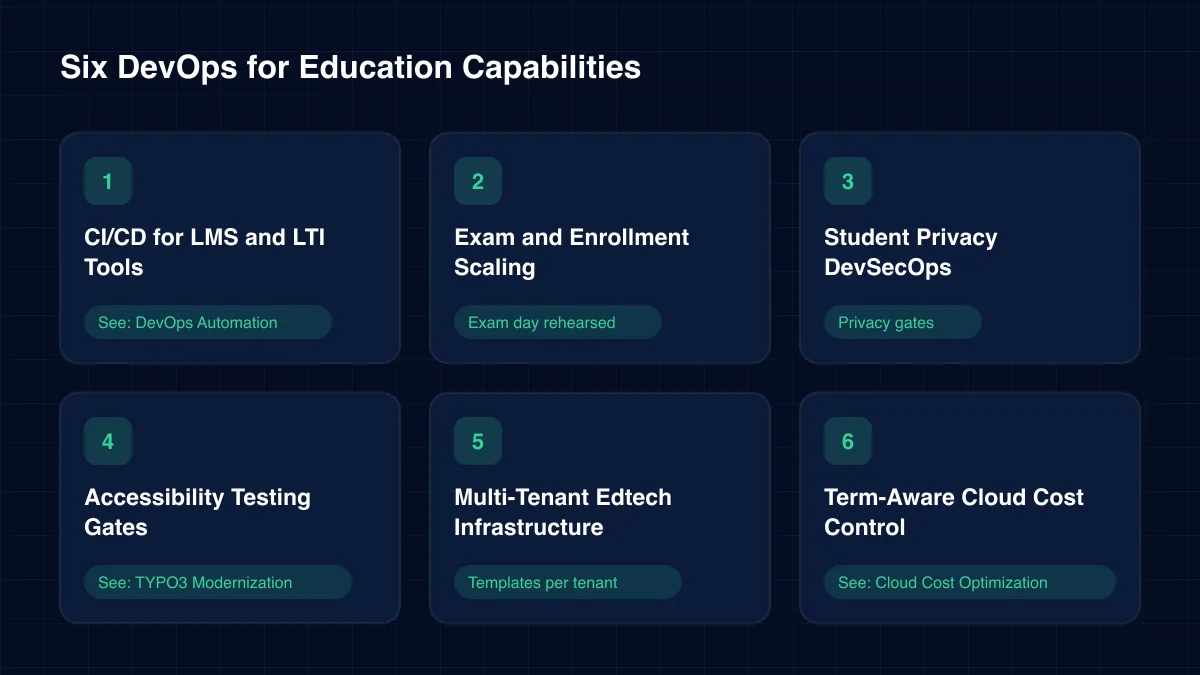
These capabilities combine into one DevOps for education platform, from pull request to the classroom.
Standard pipelines for LMS plugins, LTI 1.3 tools and course content services. Our DevOps for education pipelines test launches against your LMS before release.
See: DevOps Automation →Load tests, autoscaling and queue buffering for login, registration and timed assessments. Capacity is proven before the first exam of the season.
Exam day rehearsed
Code, dependency and container scans, secret detection and checks for student data in logs and fixtures. DevOps for education keeps FERPA duties visible in the pipeline.
Privacy gates
Automated WCAG checks on key learner journeys, with manual review for new patterns. Accessibility regressions stop at the gate.
See: TYPO3 Modernization →Infrastructure as code for tenant onboarding, regional hosting and SSO configuration. New schools or districts come online from the same tested templates.
Templates per tenant
Scheduled scale-down over breaks, rightsizing and tagging by institution or product. This side of DevOps for education keeps budgets predictable.
See: Cloud Cost Optimization →Architecture
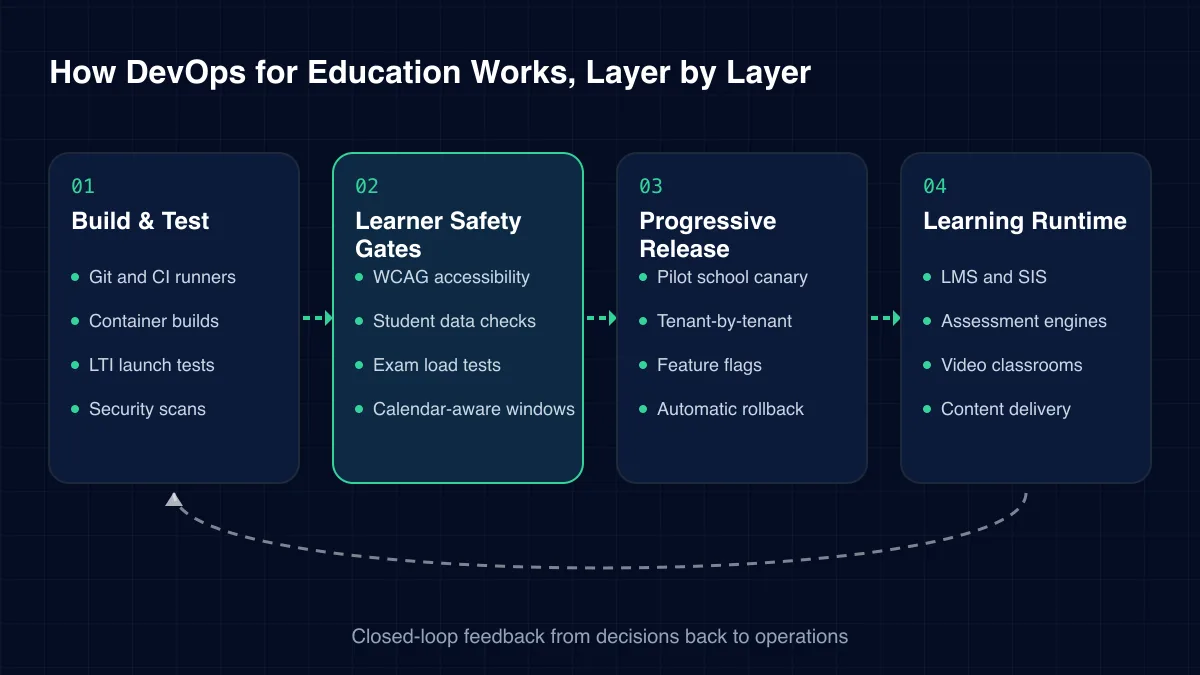
Our DevOps for education reference design has four layers. Changes flow from developers to learners. Usage and health signals flow back to shape the next release and the next term.
01
02
03
04
Challenges we solve
Before a DevOps for education programme, we usually find a mix of these six problems.
Assessment engines pass normal tests but fail when a whole cohort starts at once. Students lose answers and trust.
An LMS upgrade or plugin change breaks an LTI launch. Teachers find out mid-lesson when a tool will not open.
Real student records get copied into test systems and logs. Each copy creates a privacy risk.
A new feature ships without accessibility checks. Learners using screen readers lose access to coursework.
Every new school or district is configured by hand. Settings drift, and fixes do not reach every tenant.
Infrastructure sized for exams runs through every break. The cloud bill ignores the academic calendar.
Learning organizations run four main kinds of software. Each needs a different release rhythm.
Generic pipelines speed up delivery but ignore the calendar and learners. Here is how the options compare.
| Capability | Manual ops | Generic CI/CD | Education-ready DevOps |
|---|---|---|---|
| Exam-window release freezes | Partial | No | ✓ Yes |
| LTI integration tests | No | No | ✓ Yes |
| Accessibility gates | No | Partial | ✓ Yes |
| Student data checks | No | No | ✓ Yes |
| Term-aware scale-down | No | Partial | ✓ Yes |
The benefits of DevOps for education reach learners, teachers, IT teams and finance offices.
Delivery
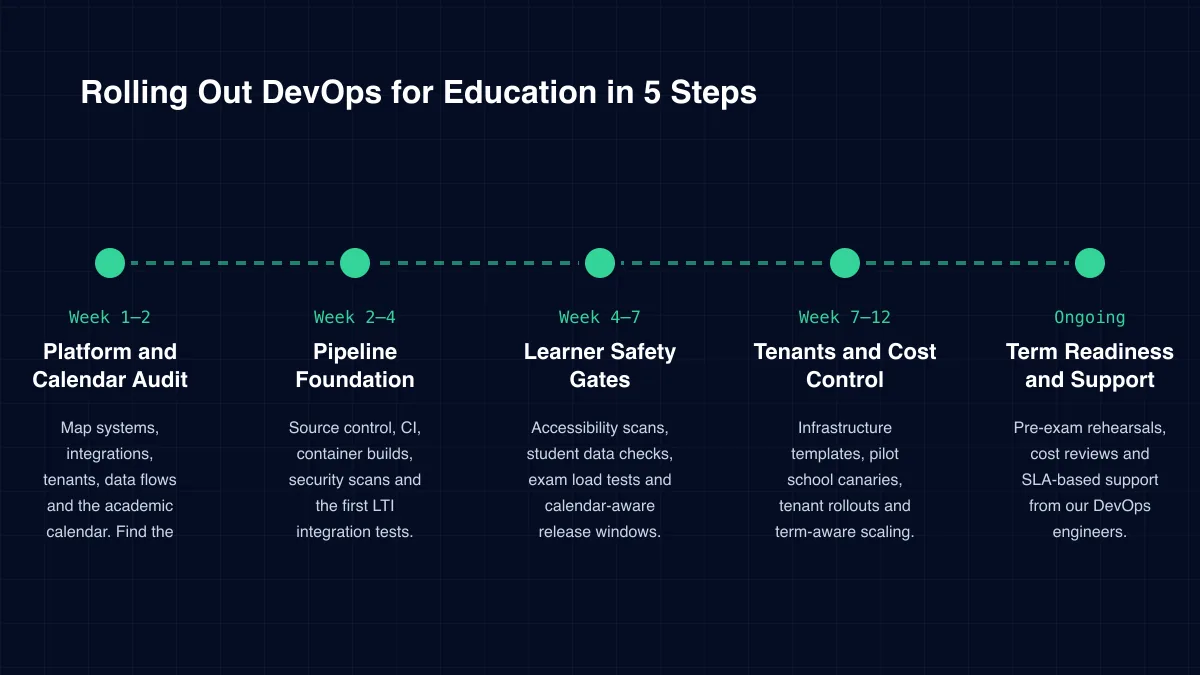
Week 1–2
Map systems, integrations, tenants, data flows and the academic calendar. Find the riskiest release paths.
Week 2–4
Source control, CI, container builds, security scans and the first LTI integration tests.
Week 4–7
Accessibility scans, student data checks, exam load tests and calendar-aware release windows.
Week 7–12
Infrastructure templates, pilot school canaries, tenant rollouts and term-aware scaling.
Ongoing
Pre-exam rehearsals, cost reviews and SLA-based support from our DevOps engineers.
Case study
A global enterprise partner ran an aging TYPO3 v12 platform with fragmented DevOps and non-standard frontend performance. Our team upgraded it to TYPO3 v14 LTS with full data preservation, rebuilt the frontend for WCAG 2.1 AA, and replaced manual releases with automated CI/CD. The whole migration ran with zero downtime. Many institutions run content platforms like this one.
“An aging CMS core does not just slow a release, for a global enterprise it is also the reason accessibility and security compliance keep slipping to the next sprint.”Read the full case study →
TYPO3 v12 to v14 LTS
Complete data preservation with schema optimization.
WCAG 2.1 AA
Frontend rebuilt to meet modern accessibility standards.
Containerized CI/CD · OWASP-aligned VAPT
Manual releases replaced by security-hardened pipelines.
Many vendors can run a pipeline. Few plan around a school year. We recommend checking five things.
In our experience, the first calm exam season wins the argument. After that, faculty and IT both ask for more frequent releases.
ICANIO operates under ISO 9001 and ISO 27001 certified processes. Our DevOps for education pipelines scan code, dependencies, containers and infrastructure on every build.
Student data is encrypted in transit and at rest, with role-based access and audit logs. Test systems use synthetic records. SSO is managed as code, so access changes are reviewed. We design controls with FERPA and, where relevant, COPPA in mind, and we check key journeys against WCAG so every learner can take part.
Start with peak-time incidents. Count the outages, slow logins and failed exam sessions from last year, and the staff hours spent handling them. That is the first cost DevOps for education cuts.
Then add engineering time on manual releases and tenant setup, plus cloud spend during breaks. We baseline these numbers with you in discovery and report against them after each phase.
Technology stack
We work with your LMS, identity provider and cloud. These are the tools we use most often.
Source & CI
Testing
Playwrightaxe accessibilityLTI launch tests
Infrastructure as Code
OPA policy
Runtime
Autoscaling groupsCDNManaged databases
Identity
SAML SSORole-based accessSecrets vault
Observability
DevOps for education is automated, repeatable software delivery for learning and campus systems. It adds calendar-aware releases, exam load testing, student privacy checks and accessibility gates to standard CI/CD.
We load-test assessment and login paths at many times normal traffic before each exam season. During exam windows, the pipeline pauses non-urgent releases. Urgent fixes still go through with explicit approval.
Yes. Test environments use synthetic student data, and pipelines check logs and fixtures for real records. Production access is role-based and logged, supporting your FERPA obligations.
Yes. Every change runs LTI 1.3 launch tests against a staging copy of your LMS. If a change would break a tool launch or grade passback, the pipeline stops it.
Infrastructure templates let new schools or districts come online the same tested way. Tenant-by-tenant rollouts and pilot school canaries keep releases safe as the customer base grows.
Most teams reach a first automated production release in four to seven weeks. A full rollout with tenants, safety gates and cost controls usually takes about twelve weeks. We plan it around your term dates.
Learners and teachers notice platform failures at the worst moments. DevOps for education makes those moments calm by testing for them, planning around them and recovering fast.
ICANIO brings pipelines, exam-scale load testing, privacy and accessibility gates, and term-aware FinOps in one team. We start with your riskiest term event, prove it ahead of time, and grow DevOps for education from there.
By ICANIO DevOps & Cloud Engineering Team · Published · Updated
Book a free 30-minute discovery call. We will review your learning platforms, integrations and term calendar. You will leave with a release plan built around your school year.
Contact Our DevOps Team