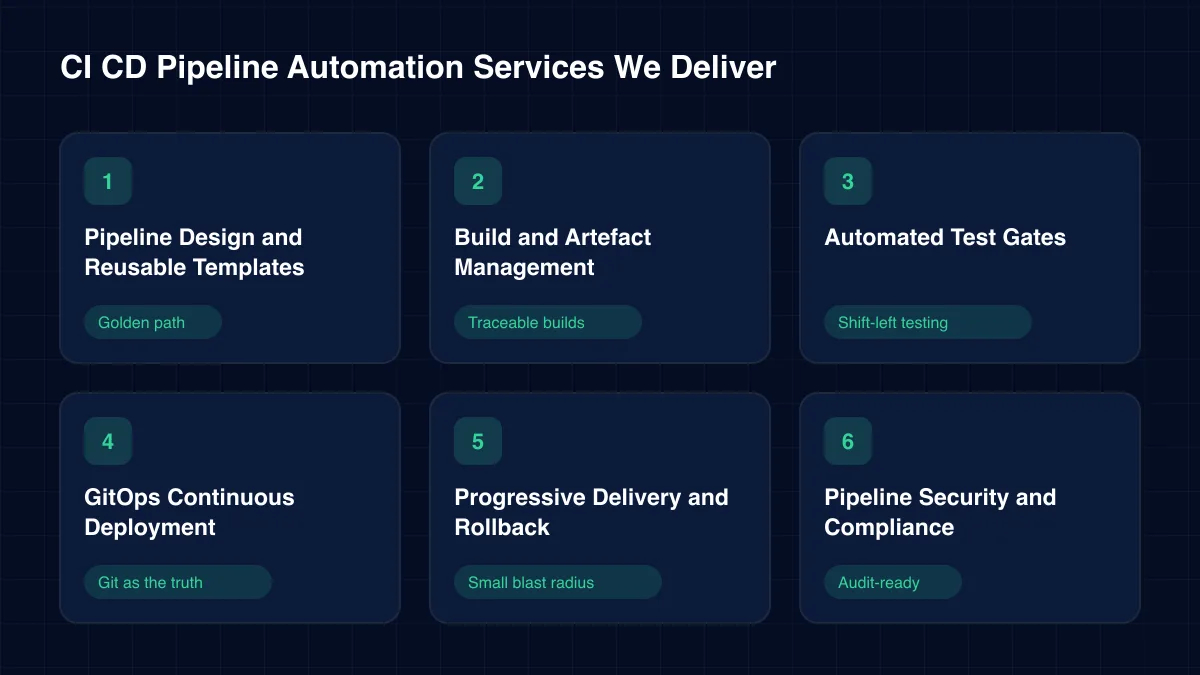
Pipeline Design and Reusable Templates
We design shared pipeline templates so every repository inherits the same stages. CI CD pipeline automation then scales by configuration, not copy and paste.
Golden path →DevOps & Cloud · CI/CD Automation
We turn manual builds, hand-run tests and weekend deployments into one automated path from pull request to production. Every change is built once, tested, scanned, promoted and easy to roll back.
14
Deploys today
38 min
Lead time
0
Failed changes
CI CD pipeline automation replaces the manual steps between a merged pull request and a live release. If shipping still needs a checklist, a senior engineer and a quiet Friday, the pipeline is the bottleneck, not your developers.
Our team designs pipelines that compile, test, package, scan and deploy every change the same way. Artefacts are built once and promoted, not rebuilt per environment. Quality gates stop bad changes early, and a rollback is a single revert.
This guide covers what CI CD pipeline automation really includes, the architecture we use, the main pipeline patterns and how to choose a partner. It draws on ICANIO release work, including a CI/CD framework that cut release time-to-market by 40%.
Continuous integration merges small changes into a shared branch many times a day. Each merge triggers an automatic build and a fast test suite. Broken code is caught within minutes, while the author still remembers the change.
Continuous delivery keeps every passing build ready to release. Continuous deployment goes one step further and ships it to production with no human click. Most regulated teams stop at delivery and keep an approval gate before production.
CI CD pipeline automation is the engineering that makes both work at scale. It covers pipeline code, runners, artefact storage, test orchestration, environment promotion and release strategies such as canary or blue-green. It also covers the quiet details: caching, secrets, notifications and audit logs.
Tools matter less than design. Jenkins, GitHub Actions, GitLab CI, Azure Pipelines and Bitbucket Pipelines can all run a good pipeline. The difference comes from templates, clear stage contracts and fast feedback. That is where CI CD pipeline automation earns its value.
Working definition
“CI CD pipeline automation is the practice of defining build, test, security and deployment steps as versioned code, so every change reaches production through the same repeatable, observable and reversible path.”
Foundations
Pipeline definitions live in the repository next to the app, so changes are reviewed, versioned and easy to reuse.
One immutable artefact moves from dev to staging to production, so what you tested is exactly what you ship.
Cheap checks run first and in parallel. Developers hear about a failure in minutes, not after lunch.
Progressive rollouts, health checks and automatic rollback make a bad release a small event, not an outage.
Core capabilities
Each service below removes a specific manual step. Most clients start with two or three, then extend the same templates across every team.
We design shared pipeline templates so every repository inherits the same stages. CI CD pipeline automation then scales by configuration, not copy and paste.
Golden path →Cached, reproducible builds with versioned artefacts in Nexus, Artifactory or a container registry. Rolling back becomes a pointer change, not a rebuild.
Traceable builds →Unit, contract, integration and end-to-end suites wired into the pipeline in the right order. Our CI CD pipeline automation keeps slow suites parallel and flaky tests quarantined.
Shift-left testing →Argo CD or Flux sync the desired state from Git to Kubernetes. Every deployment is a commit, so the audit trail and the rollback path come for free.
Git as the truth
Canary, blue-green and feature-flag releases with automated health analysis. If error rates rise, CI CD pipeline automation shifts traffic back before users notice.
Small blast radius
Secrets from a vault, least-privilege runners, signed artefacts and an approval step for production. Every run leaves an audit record your assessors can read.
Audit-ready →Architecture
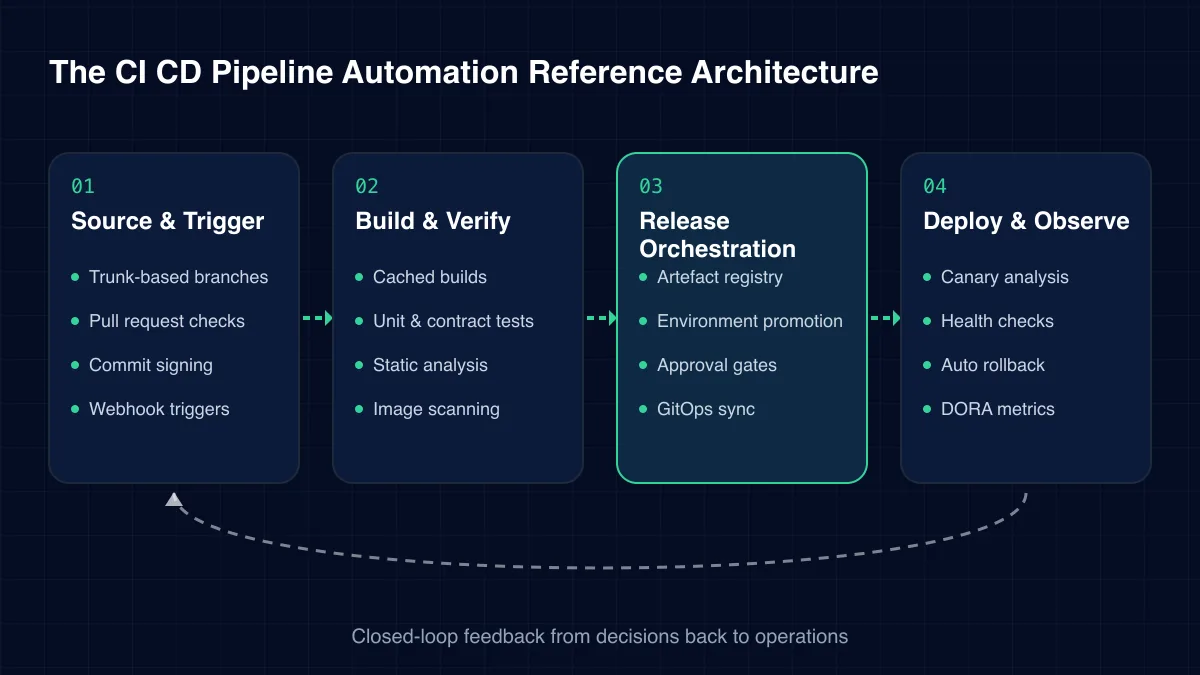
Our CI CD pipeline automation uses four layers. A change enters as a pull request and leaves as a monitored release, with a clear contract between each layer.
01
02
03
04
Challenges we solve
These are the patterns we find most often in the first week of an assessment.
Only one engineer knows the deployment steps. When they are on leave, releases stop. Pipelines as code spread that knowledge to everyone.
Builds differ between laptops and servers. Containerised, reproducible builds give the same output wherever they run.
Serial test suites keep developers waiting. Parallel stages, caching and test selection bring feedback back to minutes.
Each environment gets a fresh build, so production runs code nobody tested. Promoting one artefact removes that gap.
Undoing a release means a hotfix under pressure. Versioned artefacts and GitOps make rollback a single revert.
Every team maintains its own scripts with its own bugs. Shared templates cut maintenance and raise the baseline for all.
No single pattern fits every product. We pick the model that matches your risk, team size and release rhythm.
Most teams sit in the middle column. This is what changes when you move to full CI CD pipeline automation.
| Capability | Manual releases | Scripted CI | Full automation |
|---|---|---|---|
| Build on every commit | No | ✓ Yes | ✓ Yes |
| Same artefact in every stage | No | Partial | ✓ Yes |
| Automated rollback | No | No | ✓ Yes |
| Audit trail per release | Partial | Partial | ✓ Yes |
| Typical lead time | Weeks | Days | Hours |
The value grows as more services adopt the same templates.
Delivery
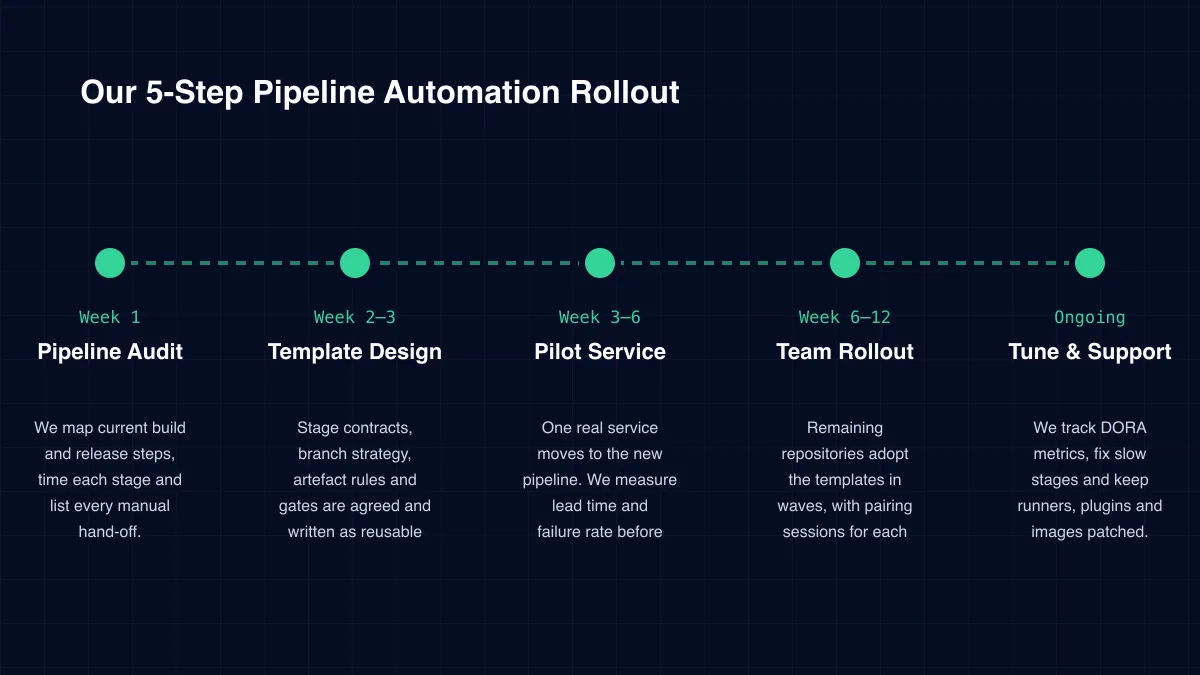
Week 1
We map current build and release steps, time each stage and list every manual hand-off.
Week 2–3
Stage contracts, branch strategy, artefact rules and gates are agreed and written as reusable code.
Week 3–6
One real service moves to the new pipeline. We measure lead time and failure rate before and after.
Week 6–12
Remaining repositories adopt the templates in waves, with pairing sessions for each squad.
Ongoing
We track DORA metrics, fix slow stages and keep runners, plugins and images patched.
Case study
Application teams worked in silos with manual builds, tests and deployments. Releases were inconsistent and rollbacks were hard to manage. ICANIO built one CI/CD automation framework with a defined branch strategy, automated testing and artefact traceability. It cut product release time-to-market by 40% and reduced release failure risk by 30%.
“A deployment that works only because one engineer remembers the steps is a single point of failure.”Read the full case study →
Bitbucket · branch strategy
Centralised source control, with automated unit tests, analysis and builds on every commit.
Nexus · Artifactory
Versioned artefacts gave a clear record of what was deployed and made rollback routine.
Ansible · Helm · Argo CD
Standard deployment to every environment, with monitoring feeding results back to teams.
Specialist services within our devops & cloud engineering practice.
A partner should leave you with pipelines your team understands and owns. We recommend checking five things.
Good CI CD pipeline automation is invisible once it works. Developers merge, the pipeline does the rest and nobody talks about release day anymore.
A pipeline holds keys to production, so we treat it as a critical system. Runners are ephemeral and isolated. Credentials come from a vault or short-lived OIDC tokens, never from long-lived stored variables.
Every artefact is signed, and the deploy stage checks the signature before release. We follow the SLSA framework to record build provenance. Protected branches and required reviews stop anyone from shipping unreviewed code.
ICANIO works under ISO 9001 and ISO 27001 certified processes. For regulated clients we map pipeline controls to SOC 2, PCI DSS or HIPAA evidence needs, so audits pull reports rather than screenshots.
We baseline the four DORA metrics before any change: deployment frequency, lead time for changes, change failure rate and time to restore. These show whether CI CD pipeline automation is working in your context.
We also count the hidden cost of manual releases. That includes engineer hours per release, weekend overtime, hotfix effort and time lost waiting for builds. These numbers usually justify the work within the pilot.
Some returns are softer but real. New hires ship early because the pipeline explains itself. Product managers plan launches with confidence. Security teams get evidence without chasing people.
Technology stack
We extend what you already run where it fits and add new tools only when they remove real friction.
CI Servers
Artefacts
Amazon ECR
Testing
JUnit & pytestPlaywrightPact contracts
Deployment
Release Safety
Feature flagsBlue-green switchHealth probes
Supply Chain
Sigstore cosignSBOM generation
CI CD pipeline automation covers build, test, scan, package, promote and deploy stages written as code. It also includes artefact storage, secrets handling, approval gates, rollback and pipeline metrics.
Usually not. We automate on Jenkins, GitHub Actions, GitLab CI, Azure Pipelines or Bitbucket. We only suggest a change when the current tool blocks a clear goal, such as ephemeral runners.
A pilot service typically runs on the new pipeline within three to six weeks. Rolling the templates out to other teams follows in waves, depending on how many repositories you have.
Yes. We keep a human approval gate before production and log every run. Signed artefacts and change records give auditors the evidence that SOC 2, PCI DSS or HIPAA programmes expect.
Yes. The same CI CD pipeline automation patterns apply to IoT firmware for manufacturing devices, digital twin services and machine learning models. Only the test and packaging stages change.
We track test results over time and quarantine tests that fail at random. Owners get a ticket to fix them. The pipeline stays trusted, and real failures never hide behind noise.
How we deliver ci/cd pipeline automation and the wider devops & cloud practice in each sector.
Release day should be a non-event. CI CD pipeline automation gets you there by replacing memory and manual effort with versioned, tested code that every team shares across cloud and on-premises targets.
ICANIO designs the templates, wires in the tests and safety nets, and proves the result on a pilot service before scaling out. Contact us to plan CI CD pipeline automation for your next release.
By ICANIO DevOps & Cloud Engineering Team · Published · Updated
Book a free 30-minute discovery call. We will review one of your pipelines, time every stage and outline a pilot with clear lead time and failure rate goals.
Contact Our DevOps Team