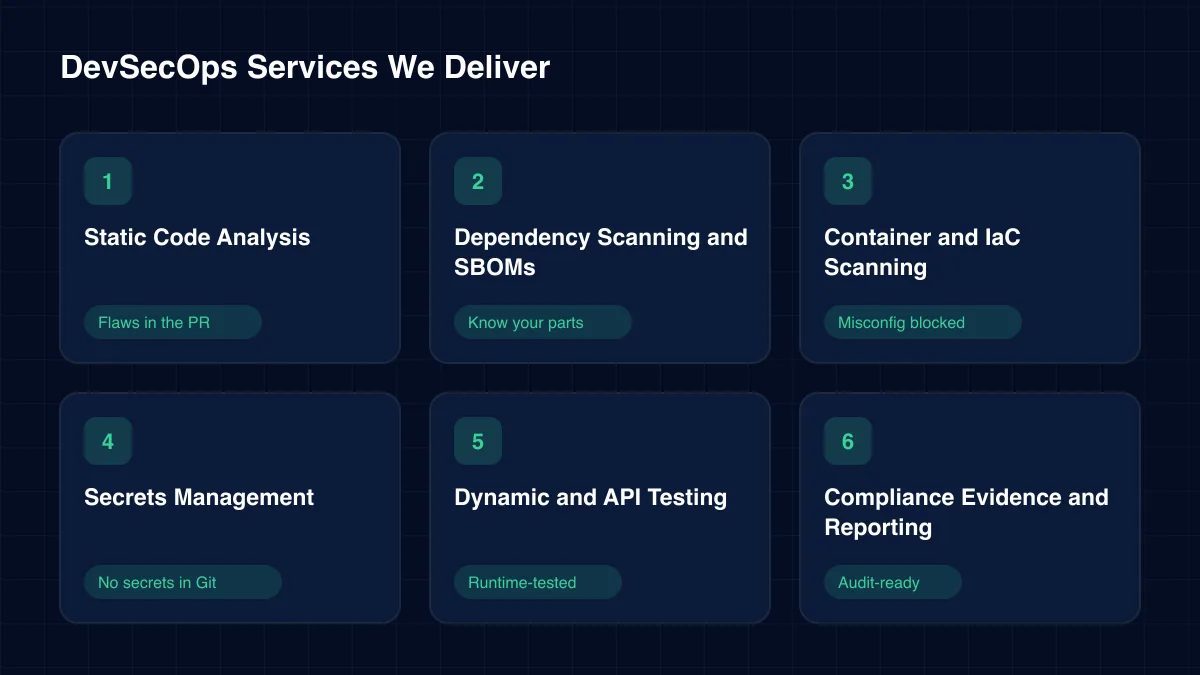
Static Code Analysis
SAST with Semgrep, SonarQube or CodeQL runs on every pull request. Our DevSecOps services tune rules to your languages and frameworks so results stay relevant.
Flaws in the PR →DevOps & Cloud · DevSecOps
We build security checks, policy and secrets control into the pipelines your developers already use. Issues surface in the pull request, minutes after they are written, instead of weeks later in an audit.
14
Deploys today
38 min
Lead time
0
Failed changes
DevSecOps services move security from the end of the release cycle into every step of it. When a penetration test is the first security check, findings arrive late, fixes are expensive and releases slip. Automated controls in the pipeline catch most issues while the code is still fresh.
Our team adds static analysis, dependency and container scanning, infrastructure checks and secrets detection to your CI/CD. We tune the rules so developers see a few real findings, not hundreds of false alarms. Policy gates then block only what truly matters.
This guide covers what DevSecOps services include, the control layers we use, common maturity models and how to pick a partner. It draws on ICANIO work for a financial services partner, where scanning ran inside a platform that delivered 70% faster deployments.
DevSecOps is the practice of treating security as a shared, automated part of software delivery. Developers, operations and security teams share the same pipeline and the same definition of done. Security becomes a property of the process, not a gate at the end.
DevSecOps services put that idea into practice. They select and wire up scanners, write policy as code, manage secrets, harden build systems and create the dashboards that show risk over time. They also train developers to read and fix findings.
The scope now includes the software supply chain. Modern apps are mostly open-source packages and base images. Software bills of materials, signed artefacts and build provenance show exactly what was shipped and where it came from.
Frameworks guide the work. The OWASP Top 10 lists the most common web risks. The NIST Secure Software Development Framework describes secure practices. SLSA defines levels of build integrity. Good DevSecOps services map controls to these, rather than inventing their own.
Working definition
“DevSecOps services embed automated security testing, policy enforcement, secrets management and supply chain controls into CI/CD pipelines, so every change is checked for risk before it reaches production.”
Foundations
Catch flaws early in code and dependencies, and still monitor and protect what runs in production.
Tuned rules and risk-based triage, so developers trust the findings they see.
Security rules live in version control and run automatically, with clear exceptions and expiry dates.
SBOMs, signatures and provenance show exactly what each release contains.
Core capabilities
Each of our DevSecOps services covers one layer of risk. Together they protect code, dependencies, infrastructure and runtime.
SAST with Semgrep, SonarQube or CodeQL runs on every pull request. Our DevSecOps services tune rules to your languages and frameworks so results stay relevant.
Flaws in the PR →Software composition analysis flags vulnerable and risky-licence packages. CycloneDX or SPDX SBOMs are created and stored for every build.
Know your parts
Trivy, Grype and Checkov scan images and Terraform before deployment. DevSecOps services stop a public bucket or a root container long before go-live.
Misconfig blocked
Secret scanning on every commit, plus vault-based delivery of credentials to apps and pipelines. Leaked keys are revoked and rotated through a runbook.
No secrets in Git →OWASP ZAP and API fuzzing run against review environments. Findings link back to the change that introduced them.
Runtime-tested →Dashboards and reports map controls to SOC 2, PCI DSS, HIPAA or ISO 27001. Our DevSecOps services make audit evidence a by-product of shipping.
Audit-ready →Architecture
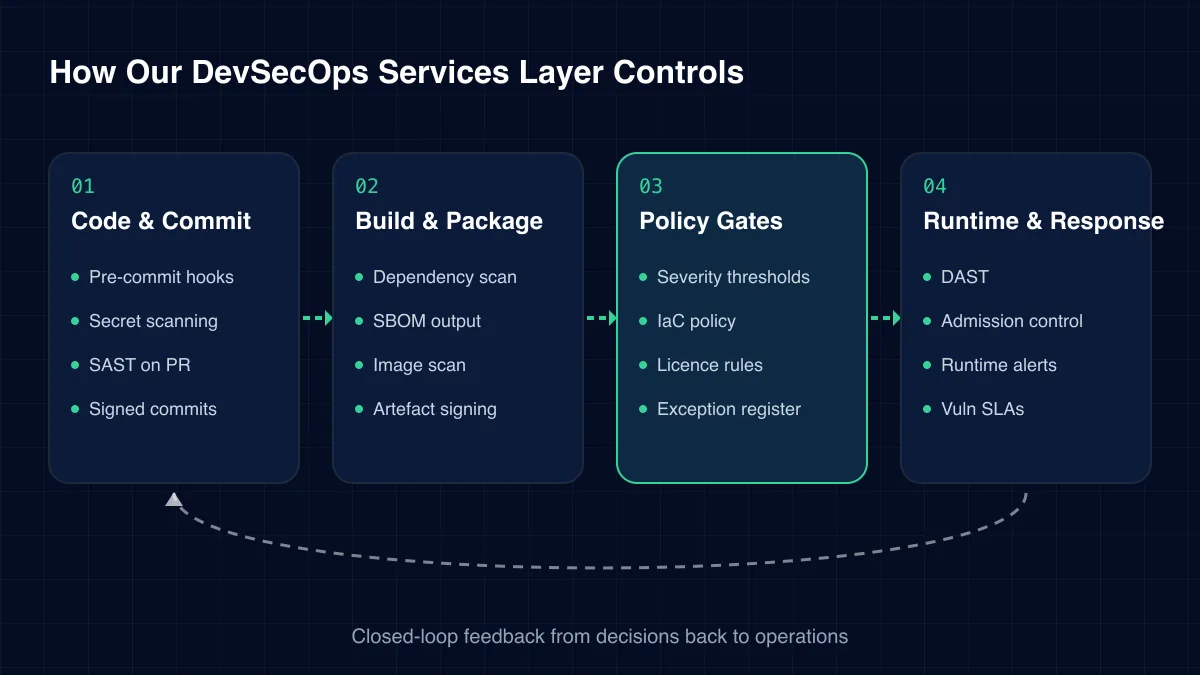
We apply DevSecOps services in four layers that follow a change from the developer's laptop to production.
01
02
03
04
Challenges we solve
These issues appear again and again when security sits outside the delivery process.
A test a week before launch finds critical issues. Earlier automated checks shrink that list to near zero.
Tools produce thousands of findings and developers stop reading them. Tuning and risk ranking restore trust.
API keys and passwords sit in Git history. Scanning, vaults and rotation close the gap for good.
A new CVE lands and nobody knows which apps are affected. SBOMs answer that in minutes.
A storage bucket goes public by mistake. IaC scanning and policy stop it before creation.
Evidence is gathered by hand from many tools. Central reporting turns it into an export.
Teams start from different places. These four engagement types match the most common needs.
Moving security into the pipeline changes when and how risk is found. Here is the difference.
| Aspect | Gate at the end | Tools bolted on | Full DevSecOps |
|---|---|---|---|
| When issues are found | Before launch | Sometimes in CI | Every commit |
| Who fixes them | Security team | Mixed | Code owner |
| False positive handling | Manual | Rarely tuned | Tuned and tracked |
| Supply chain visibility | No | Partial | ✓ Yes |
| Audit evidence | Manual | Partial | Automated |
Security and speed stop competing once controls are automated.
Delivery
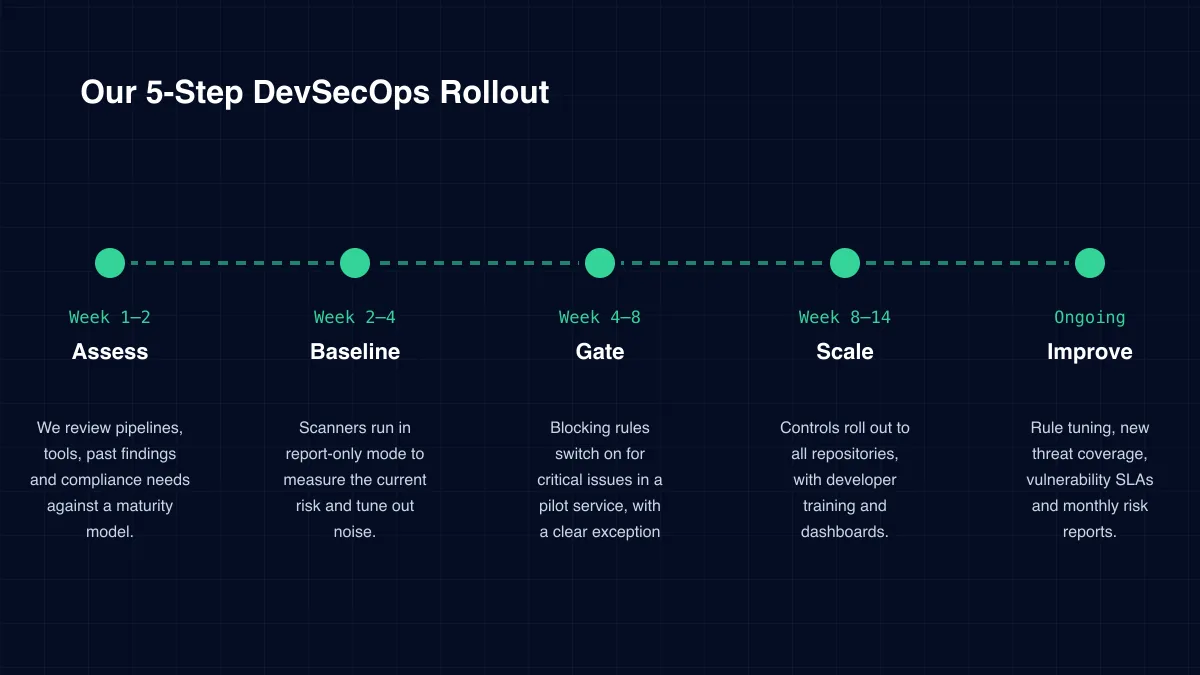
Week 1–2
We review pipelines, tools, past findings and compliance needs against a maturity model.
Week 2–4
Scanners run in report-only mode to measure the current risk and tune out noise.
Week 4–8
Blocking rules switch on for critical issues in a pilot service, with a clear exception process.
Week 8–14
Controls roll out to all repositories, with developer training and dashboards.
Ongoing
Rule tuning, new threat coverage, vulnerability SLAs and monthly risk reports.
Case study
Disconnected tools and fragmented governance left a financial services partner with security and compliance gaps at every manual handoff. ICANIO built one DevOps automation platform with unified CI/CD, infrastructure as code and automated security scanning and governance inside the pipeline. It delivered 70% faster deployments, a 30% cut in cloud costs and 99.9% uptime.
“In financial services, every manual handoff between disconnected tools is an unaudited governance gap.”Read the full case study →
Jenkins · GitHub Actions
One standard release process replaced a patchwork of disconnected delivery tools.
Automated scans · governance
Security scanning and governance ran inside every pipeline, closing earlier compliance gaps.
Terraform · CloudFormation
Provisioning from templates removed the manual step behind configuration errors.
Specialist services within our devops & cloud engineering practice.
Buying scanners is easy. Making developers trust them is the hard part. We recommend checking five points.
The best DevSecOps services make the secure path the easy path. When that is true, developers follow it without being told.
Attackers increasingly target build systems, because one compromised pipeline can ship malware to every customer. We run builds on ephemeral, isolated runners with least-privilege identities.
Pipelines authenticate to clouds with short-lived OIDC tokens rather than stored keys. Artefacts are signed with Sigstore cosign, and deployments verify signatures and provenance before release.
Access to the pipeline is reviewed like access to production. Branch protection, required reviews and two-person approval for workflow changes stop a single account from altering how code is built. Pipeline logs go to a central, tamper-evident store.
ICANIO works under ISO 9001 and ISO 27001 certified processes. We apply the same controls to our own delivery tooling that we build for clients.
We track mean time to remediate by severity, the share of findings fixed before merge, open critical issues and false positive rates. Each starts from the baseline taken in report-only mode.
Release impact matters too. Fewer late security blocks mean steadier delivery dates. We report how many releases were delayed by security before and after DevSecOps services went live.
The approach scales beyond web apps. The same controls protect machine learning model pipelines, IoT firmware for manufacturing devices and digital twin services in the cloud, where tampered inputs carry real-world risk.
Technology stack
We prefer open standards and proven tools, and integrate with the platforms you already pay for.
Code Analysis
SemgrepCodeQL
Dependencies
Syft
Containers & IaC
GrypeCheckovtfsec
Secrets
GitleaksHashiCorp Vault
Runtime Testing
Burp SuiteAPI fuzzing
Supply Chain
CycloneDXSPDXSigstore cosignKyverno
DevSecOps services include SAST, dependency and container scanning, IaC checks, secrets management, DAST, SBOMs, artefact signing, policy gates and compliance reporting.
Not much, if designed well. Fast checks run on each pull request, heavier scans run in parallel or nightly. We keep total pipeline time close to what developers have today.
We start in report-only mode, tune rules to your stack and suppress known non-issues with documented reasons. Only confirmed high-risk findings block a merge.
A software bill of materials lists every component in a release. When a new vulnerability appears, it shows which apps are affected. Many customers and regulators now ask for one.
No. Automated controls catch most common issues early. Periodic expert penetration tests still find logic flaws and chained attacks. We recommend both, with pen tests on a lighter backlog.
Yes. Pipeline logs, scan results and approvals are stored per release. We map them to SOC 2, PCI DSS, HIPAA or ISO 27001 controls so evidence is ready on request.
How we deliver devsecops services and the wider devops & cloud practice in each sector.
Security that waits until the end of a release will always feel like a blocker. Built into the pipeline, it becomes a quiet, constant safety net that developers barely notice.
ICANIO DevSecOps services design that safety net across code, dependencies, cloud infrastructure and runtime, then tune it until your team trusts it. Contact us to assess your pipelines and plan the first controls.
By ICANIO DevOps & Cloud Engineering Team · Published · Updated
Book a free 30-minute discovery call. We will review one pipeline, run a quick baseline scan and outline the first controls worth switching on.
Contact Our DevSecOps Team