Cost Visibility and Allocation
Tagging standards, account structure and dashboards that split spend by team, product and environment. Cloud cost optimization starts with knowing who spends what.
Every line owned →DevOps & Cloud · FinOps
We find the idle, oversized and untagged resources behind a rising cloud bill, remove waste safely and set up the FinOps habits that stop it coming back.
14
Deploys today
38 min
Lead time
0
Failed changes
Cloud cost optimization is about paying only for the capacity your products actually use. Most cloud bills grow quietly. Servers sized for a launch peak keep running, test environments stay on at weekends, and old snapshots pile up. Nobody owns the total.
Our team brings engineering and finance together around clear data. We tag and allocate spend, rightsize and clean up safely, and plan commitments where usage is steady. Then we set up the reviews and guardrails that keep savings in place.
This guide explains what cloud cost optimization covers, how the FinOps framework shapes it, the main levers and how to choose a partner. It includes an ICANIO engagement that cut monthly infrastructure costs by 15 to 25 percent with zero disruption to production.
Cloud cost optimization is the ongoing work of reducing cloud spend while protecting performance and reliability. It covers what you run, how big it is, when it runs and how you pay for it.
The FinOps Foundation describes the discipline in three phases: inform, optimise and operate. First you make costs visible and allocated. Then you act on waste and pricing. Finally you build the habits and automation that keep spend aligned with value.
Good cloud cost optimization is not a one-off cleanup. Usage changes every sprint. New services launch, traffic shifts and providers change prices. Without regular review and clear ownership, savings fade within months.
It is also not about spending as little as possible. Some workloads should cost more because they earn more. The goal is a clear link between spend and business value, measured in unit costs such as cost per customer or per transaction.
Working definition
“Cloud cost optimization is the continuous practice of making cloud spend visible, allocating it to owners, removing waste and choosing the right pricing, so every dollar supports a clear business outcome.”
Foundations
Every resource carries owner, product and environment tags, so each line on the bill has a name.
The people who build systems see their costs and make the trade-offs, with finance as a partner.
Schedules, lifecycle rules and cleanup jobs handle routine waste without meetings.
Monthly cost reviews track trends, anomalies and unit costs against agreed targets.
Core capabilities
Our cloud cost optimization work spans quick wins and the long-term practice that protects them.
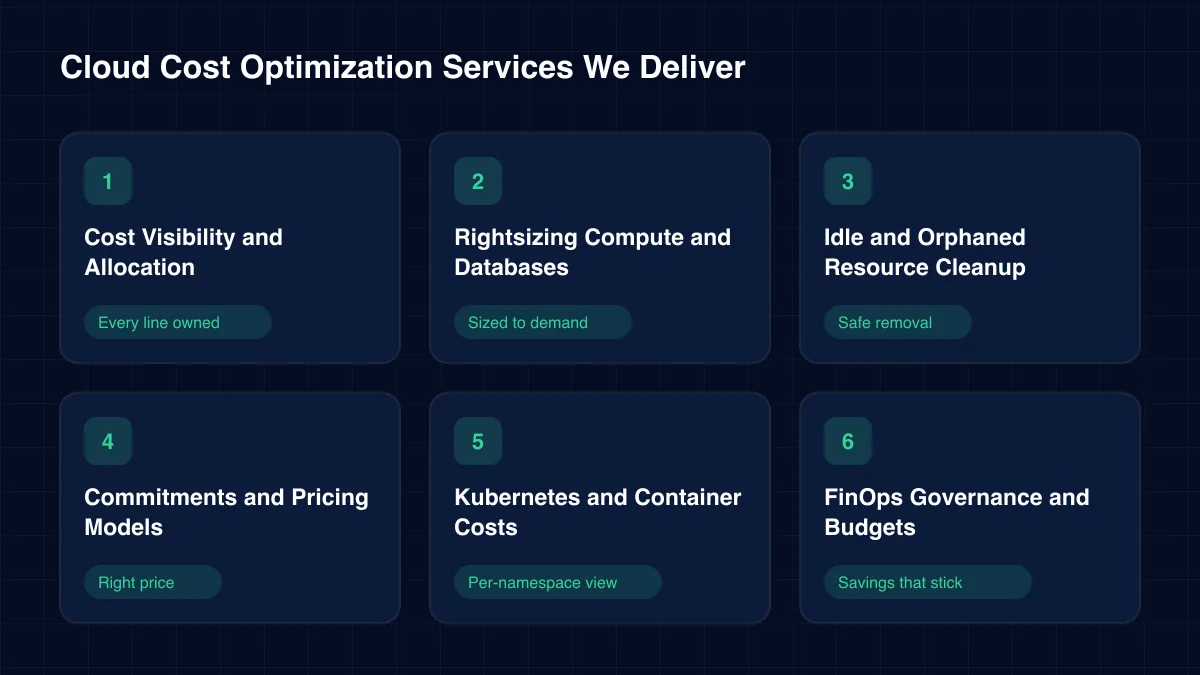
Tagging standards, account structure and dashboards that split spend by team, product and environment. Cloud cost optimization starts with knowing who spends what.
Every line owned →Instances, databases and containers resized from real utilisation data. Changes roll out with owner approval and a clear rollback.
Sized to demand →Unattached disks, old snapshots, idle load balancers and forgotten test stacks found and removed. Our cloud cost optimization runbooks snapshot before deleting.
Safe removal
Savings Plans, reserved instances, committed use discounts and spot capacity matched to steady and flexible workloads. We size commitments to avoid paying for unused capacity.
Right price
Pod requests, node packing, autoscaling and cost per namespace with OpenCost. Cloud cost optimization for clusters often finds the largest hidden waste.
Per-namespace view →Budgets, anomaly alerts, policy guardrails and a monthly review cadence that keeps engineering and finance aligned after the project ends.
Savings that stick →Architecture
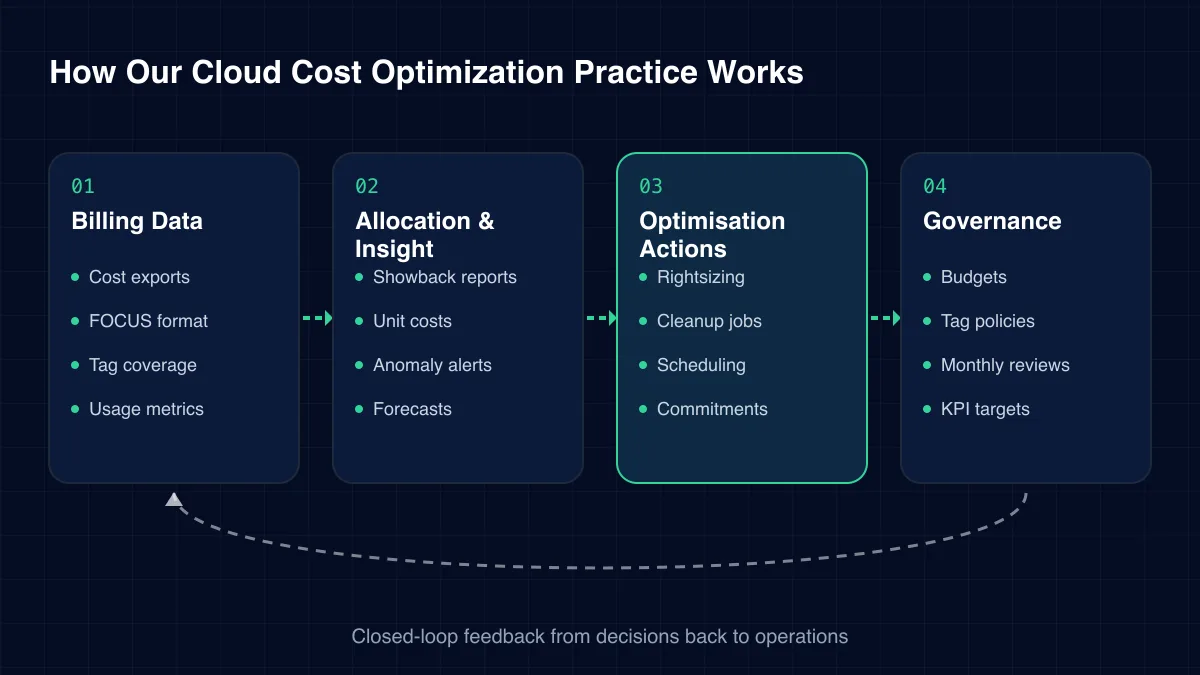
We run cloud cost optimization as a loop with four layers. Data flows up into decisions, and decisions flow back into the platform as code and policy.
01
02
03
04
Challenges we solve
These are the most common sources of waste we find in a first cost review.
Spend sits in shared accounts with no tags. Allocation turns one big number into owned team budgets.
Servers sized for a peak that never came run at low utilisation. Rightsizing matches them to real load.
Dev and QA run nights and weekends. Schedules switch them off when nobody is working.
Unattached volumes and years of snapshots keep billing. Lifecycle rules and cleanup jobs stop the build-up.
Predictable workloads pay full list price. Commitments cut the rate for usage you know will stay.
A misconfigured job runs up a large bill overnight. Anomaly alerts flag it within hours, not at month end.
Savings come from four kinds of change. Most programmes use all of them in sequence.
Many teams try a cleanup or buy a dashboard. Here is why a FinOps practice lasts longer.
| Aspect | One-off cleanup | Tool only | FinOps practice |
|---|---|---|---|
| Spend visibility | Snapshot | ✓ Yes | ✓ Yes |
| Team ownership | No | Partial | ✓ Yes |
| Waste removed | Once | Flagged only | Continuously |
| Commitment planning | No | Partial | ✓ Yes |
| Savings after a year | Faded | Mixed | Sustained |
Lower bills are only the first gain. The bigger change is how teams think about cost.
Delivery
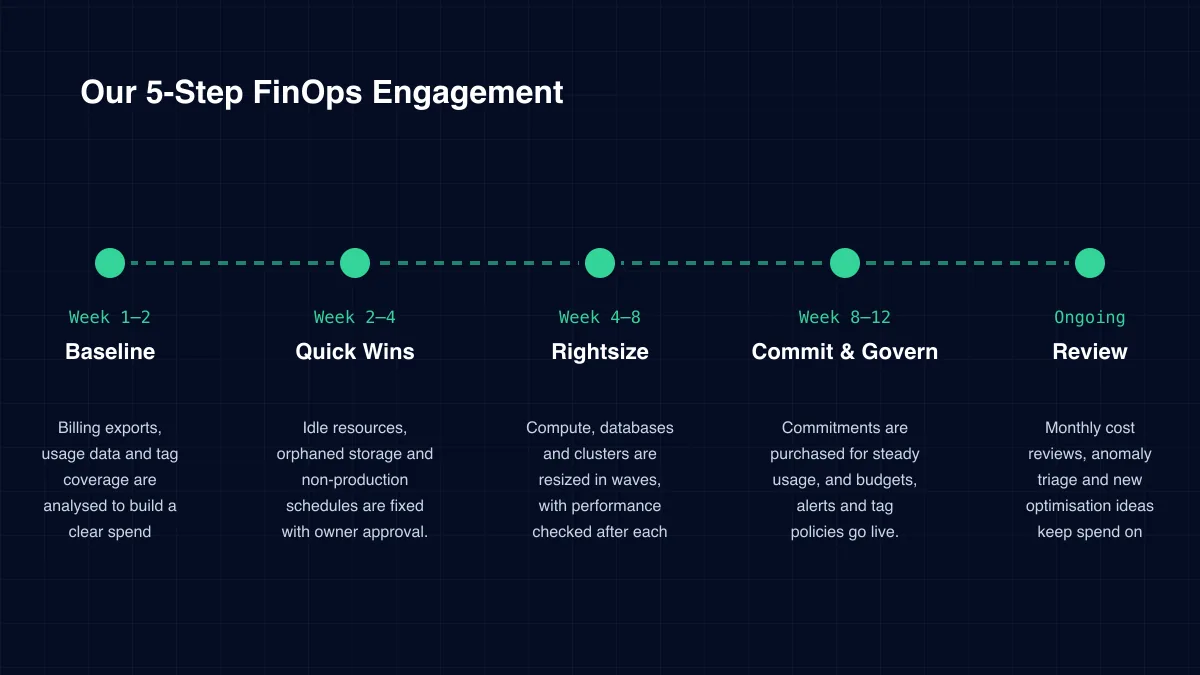
Week 1–2
Billing exports, usage data and tag coverage are analysed to build a clear spend baseline.
Week 2–4
Idle resources, orphaned storage and non-production schedules are fixed with owner approval.
Week 4–8
Compute, databases and clusters are resized in waves, with performance checked after each change.
Week 8–12
Commitments are purchased for steady usage, and budgets, alerts and tag policies go live.
Ongoing
Monthly cost reviews, anomaly triage and new optimisation ideas keep spend on target.
Case study
An enterprise client faced rising cloud costs, limited visibility, over-provisioned virtual machines and idle disks and snapshots. ICANIO ran a cost and usage baseline, rightsized compute, removed orphaned resources, optimised non-production environments and set tagging standards with periodic reviews. Monthly infrastructure costs fell by 15 to 25 percent with zero disruption to production.
“A cloud bill reviewed only once it becomes a surprise is not being managed, just tolerated.”Read the full case study →
Cost and usage analysis
A detailed baseline showed where money went across resources and services.
Rightsizing · cleanup
Oversized compute was resized, and unused disks, snapshots and network parts were removed safely.
Tagging · cost reviews
Tagging standards and periodic reviews gave each team ownership of its spend.
Specialist services within our devops & cloud engineering practice.
Cost work touches production, so method matters as much as savings claims. We recommend checking five things.
The best cloud cost optimization changes behaviour, not just a bill. When teams see their own costs, waste shrinks without anyone asking.
Cost data reveals a lot about your architecture, so we use read-only billing roles and keep exports in your own accounts. No production change happens without the owner's approval.
Cleanup is careful by design. Resources are tagged for deletion, owners are notified and snapshots are kept before anything is removed. Deletion of shared or regulated data follows your retention rules.
ICANIO works under ISO 9001 and ISO 27001 certified processes. Tag policies and budgets are enforced as code, so cost governance sits alongside security controls in the same pipeline.
We track total monthly spend, savings realised versus forecast, tag coverage, commitment utilisation and waste found per review. Unit costs, such as cost per active user, show efficiency as the business grows.
AI workloads need special care. GPU instances, model training and inference for machine learning can dominate a bill fast. We apply batch scheduling, model and instance choice, and per-team attribution to keep them in check.
Industrial clients bring their own patterns. IoT telemetry, digital twin simulations and manufacturing analytics generate heavy storage and data transfer. Tiering, retention rules and regional design are often where cloud cost optimization pays off most.
Technology stack
We start with native provider tools and add open-source or third-party tools where they add clear value.
AWS
Cost ExplorerCost and Usage ReportCompute OptimizerSavings Plans
Azure
Cost ManagementReservationsBudgets
Google Cloud
Billing exportRecommenderCommitted use discounts
Kubernetes
OpenCostKubecostKarpenterKEDA
Governance
Tag policiesAnomaly alerts
Reporting
FOCUS exportsPower BIUnit cost dashboards
Cloud cost optimization includes cost visibility and tagging, rightsizing, idle resource cleanup, scheduling, commitment planning, Kubernetes cost control, budgets, anomaly alerts and regular reviews.
It depends on your starting point. In one ICANIO engagement, monthly infrastructure costs fell by 15 to 25 percent. We estimate your range after the baseline phase, using your own data.
It should not. We resize from real utilisation data, keep headroom for peaks, change one wave at a time and watch performance after each step. Rollback plans are ready for every change.
FinOps is the operating model for cloud financial management, defined by the FinOps Foundation. Cloud cost optimization is one part of it, alongside allocation, forecasting and governance.
Only for usage that is steady and likely to stay. We analyse history, rightsize first and then commit to a safe share, so you avoid paying for capacity you no longer need.
We leave tag policies, budgets, anomaly alerts, dashboards and a monthly review routine. Many clients keep our team on for those reviews and new optimisation ideas.
How we deliver cloud cost optimization and the wider devops & cloud practice in each sector.
Cloud bills do not grow by accident. They grow through small, unowned decisions that add up. A FinOps practice makes those decisions visible and gives each team the data to make better ones.
ICANIO cloud cost optimization combines safe engineering changes with lasting governance across AWS, Azure and Google Cloud. Contact us to baseline your spend and find the first savings within weeks.
By ICANIO DevOps & Cloud Engineering Team · Published · Updated
Book a free 30-minute discovery call. We will look at your billing data, spot the biggest sources of waste and outline a savings plan with clear owners.
Contact Our FinOps Team