
CI/CD for TMS and WMS Extensions
Standard pipelines for rating engines, dock scheduling, slotting logic and custom WMS rules. Every change reaches a pilot facility before the full network.
See: DevOps API Support Platform →DevOps & Cloud for Logistics
We automate delivery for the software that moves goods: tracking APIs, TMS and WMS extensions, driver apps and carrier integrations. Releases land between cutoffs, scale for peak, and roll back before a shipment is missed.
14
Deploys today
38 min
Lead time
0
Failed changes
DevOps for logistics exists because freight does not wait for a deploy. A tracking API that fails at 6 a.m. floods customer service. A WMS change pushed before a wave cutoff can strand trucks at the dock. Most carriers and 3PLs feel this pain every week.
Our team builds DevOps for logistics around the rhythm of the network. Pipelines test against carrier and EDI mocks. Load tests replay last year's peak. Releases avoid cutoff windows, reach one pilot warehouse first, and roll back automatically if scan rates or API latency drift.
The result is a platform team that ships every day while the network runs around the clock.
DevOps for logistics is continuous delivery, infrastructure as code and site reliability practice applied to transport and warehouse software. It spans the transportation management system, the warehouse management system, visibility platforms, telematics pipelines and the mobile apps drivers and pickers carry.
Logistics software has an unusual shape. It is event-heavy, partner-heavy and time-bound. Thousands of tracking events arrive every minute. Dozens of carriers and shippers connect through APIs and EDI. And each facility has cutoffs that a release must never cross.
DevOps for logistics treats those facts as design inputs. Integration contracts get tested on every build. Capacity gets tested before peak. And every deploy is scheduled around the operation, not the other way round.
Working definition
“DevOps for logistics is the practice of delivering transport, warehouse and visibility software through automated pipelines that protect partner integrations, scale for seasonal peaks and schedule releases around operational cutoffs.”
Foundations
Carrier APIs and EDI messages are mocked and validated on every build. A schema change never surprises a shipper in production.
Load tests replay real seasonal volumes against staging. Autoscaling rules are proven before the holiday rush, not during it.
Deploy windows follow facility schedules. Pipelines pause automatically when a wave, linehaul departure or billing run is in progress.
Health checks track scan rates, ETA accuracy and event lag, not only CPU. Rollback triggers on business impact.
Core capabilities
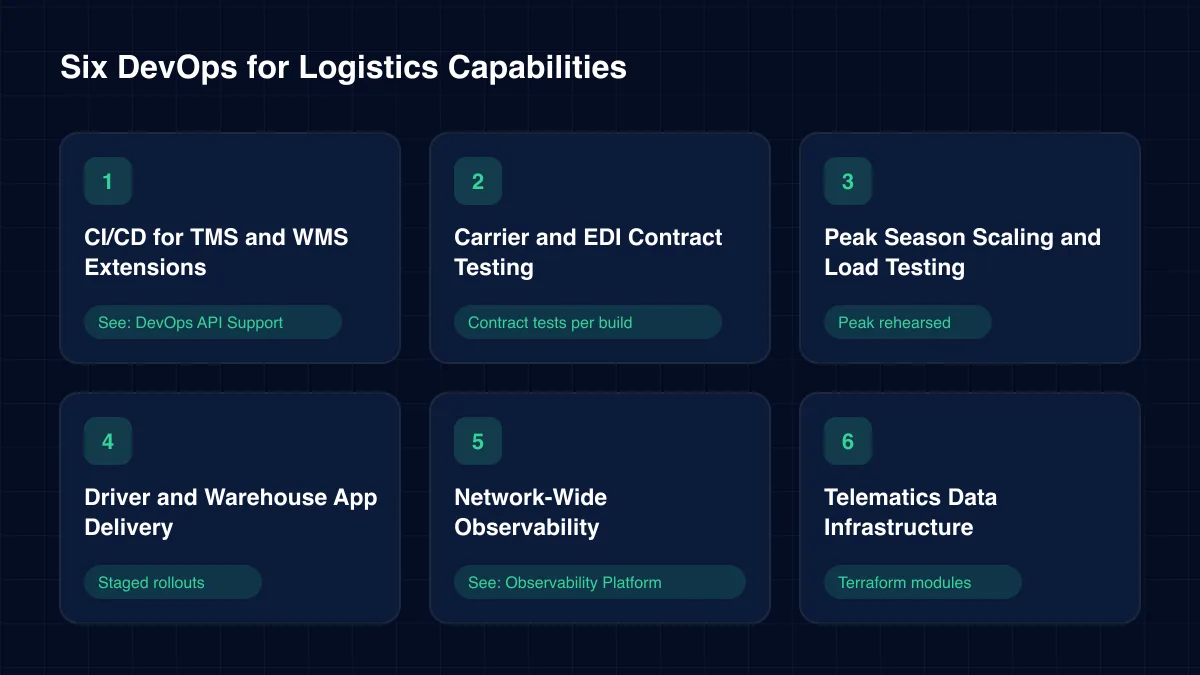
These capabilities combine into one DevOps for logistics platform that covers cloud, warehouse and road.
Standard pipelines for rating engines, dock scheduling, slotting logic and custom WMS rules. Every change reaches a pilot facility before the full network.
See: DevOps API Support Platform →Automated tests for EDI 204, 214 and 210 flows and partner REST APIs. Our DevOps for logistics pipelines block any release that breaks a partner contract.
Contract tests per build
Kubernetes autoscaling, queue-based buffering and load tests at multiples of last year's peak. Capacity is proven weeks before the rush.
Peak rehearsed
Build, device testing and staged store releases for driver apps, plus managed rollout to handheld scanners. Offline sync is tested on every build.
Staged rollouts
Metrics, logs and traces from APIs, event streams and facilities in one place. Alerts fire on tracking lag or ETA drift before customers call.
See: Observability Platform →Infrastructure as code for streaming pipelines that ingest GPS, ELD and sensor data. DevOps for logistics keeps these pipelines reproducible across regions.
Terraform modules
Architecture
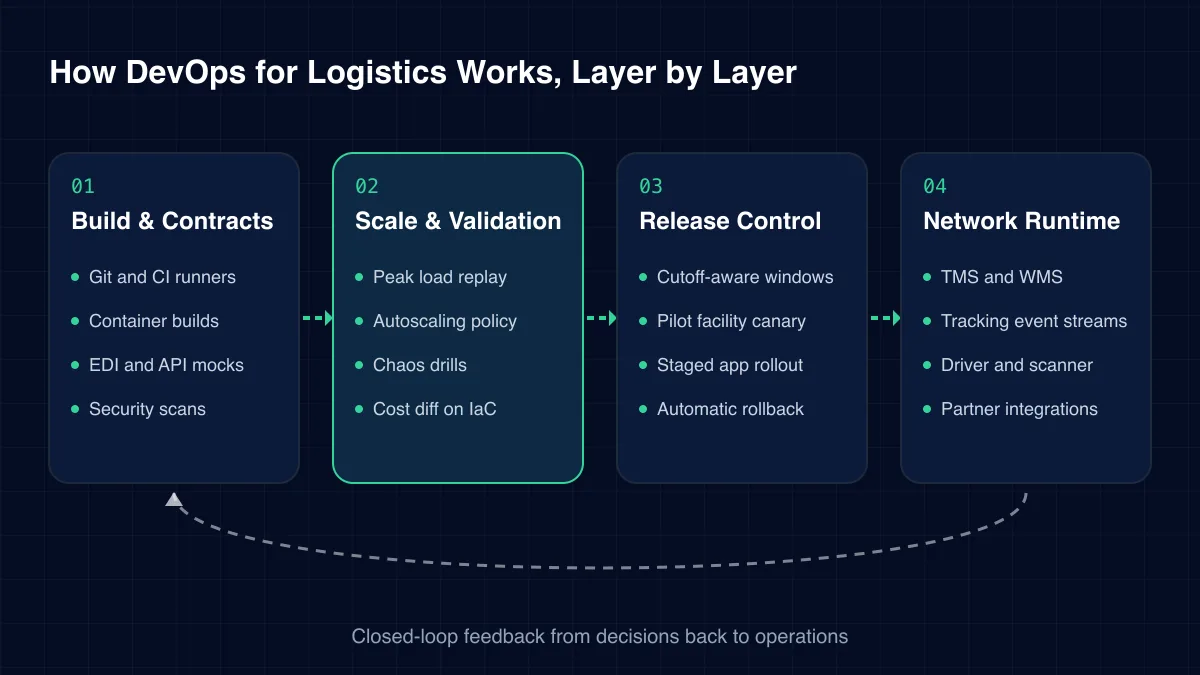
Our DevOps for logistics reference design has four layers. Code flows from developers to facilities and vehicles. Operational signals flow back to decide the next release.
01
02
03
04
Challenges we solve
Before a DevOps for logistics programme, we usually find some mix of these six problems.
A release lands during a wave or a linehaul departure. Pickers lose their queues, trucks wait at the dock, and nobody knows whether to roll back.
A small change to a tracking payload breaks a large shipper's EDI parser. The error surfaces days later as missing status updates.
Systems that cope in March fall over in November. Capacity planning is a spreadsheet, and scaling happens by emergency ticket.
Monitoring watches servers, not shipments. Teams get hundreds of CPU alerts but no warning that ETAs are drifting.
Drivers skip updates, so bugs live for months. Offline sync issues only appear in rural areas nobody tested.
New countries or facilities get a hand-built environment. Configuration drifts, and fixes do not travel between regions.
Four groups of systems make up most logistics platforms. Each needs its own release approach.
Generic pipelines help, but they ignore cutoffs, partners and peak. Here is how the options compare.
| Capability | Manual ops | Generic CI/CD | Logistics-ready DevOps |
|---|---|---|---|
| Cutoff-aware release windows | Partial | No | ✓ Yes |
| EDI and carrier contract tests | No | No | ✓ Yes |
| Peak load rehearsal | No | Partial | ✓ Yes |
| Business-signal rollback | No | No | ✓ Yes |
| Staged driver app rollout | No | Partial | ✓ Yes |
The benefits of DevOps for logistics show up on the dock, on the road and in the customer inbox.
Delivery
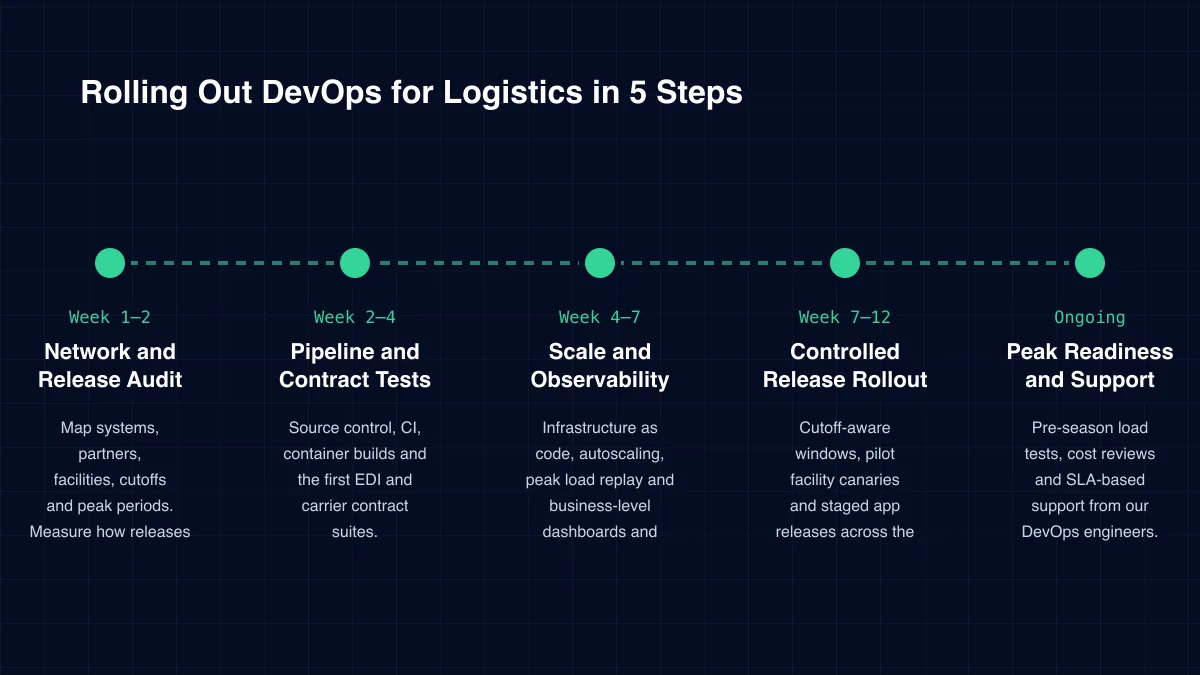
Week 1–2
Map systems, partners, facilities, cutoffs and peak periods. Measure how releases happen today.
Week 2–4
Source control, CI, container builds and the first EDI and carrier contract suites.
Week 4–7
Infrastructure as code, autoscaling, peak load replay and business-level dashboards and alerts.
Week 7–12
Cutoff-aware windows, pilot facility canaries and staged app releases across the network.
Ongoing
Pre-season load tests, cost reviews and SLA-based support from our DevOps engineers.
Case study
An enterprise partner ran feature-rich API services across several environments, with manual deployments and ad hoc configuration. Our team automated CI/CD, standardized environments with infrastructure as code and centralized monitoring. Releases became 3x faster and deployment failure risk fell by 40%. API-heavy platforms like tracking and carrier integration benefit from the same model.
“An API that scales in traffic but not in deployment process doesn't become more reliable, it just fails in more places at once.”Read the full case study →
Build · Test · Deploy pipelines
Removed the manual steps that previously introduced release risk.
Dev · Staging · Production
Every environment provisioned the same repeatable way, ending drift.
Centralized logging · Secure config
Real-time API visibility and controlled, auditable configuration.
Uptime claims are easy. Protecting a live freight network is harder. We recommend checking five things.
In our experience, integration testing is where most logistics teams gain the most. Broken partner feeds cost more trust than any outage.
ICANIO operates under ISO 9001 and ISO 27001 certified processes. Our DevOps for logistics pipelines scan code, containers and infrastructure on every build.
Partner credentials and API keys live in a secrets manager and rotate on schedule. Shipment and driver location data is encrypted in transit and at rest, with access limited by role. Audit logs show who deployed what and when. Where hours-of-service or ELD data flows through your platform, we keep its handling traceable for your compliance team.
Start with incidents caused by releases. Count the delayed trucks, missed status updates and support calls they created last year. That is the first cost DevOps for logistics reduces.
Then add engineering time spent on manual deploys, emergency scaling during peak and idle cloud capacity outside it. We agree these baselines with you at discovery and report progress against them.
Technology stack
We work with the tools you already run where possible. These are the ones we use most.
Source & CI
Integration Testing
EDI validatorsContract testsAPI mocks
Infrastructure as Code
OPA policy
Runtime
Managed queues
Mobile Delivery
Device farmsStaged store rolloutMDM for scanners
Observability
 Free white paper · DevOps & CloudDevOps & Cloud EngineeringBuilding Resilient, Scalable, and Cost-Efficient Enterprise Cloud InfrastructureGet the white paper →
 Free white paper · LogisticsTransportation & Logistics Technology SolutionsTransforming Modern Supply Chains with AI, Cloud, and IoT IntegrationGet the white paper →
DevOps for logistics covers CI/CD, infrastructure as code, testing, security scanning and observability for TMS, WMS, tracking, telematics and mobile apps. It also adds logistics-specific controls like cutoff-aware release windows and partner contract tests.
We connect the pipeline to facility schedules. Production deploys pause automatically while a wave, linehaul departure or billing run is active. Emergency fixes still go through, with an explicit approval.
Yes. Every build runs contract tests for your key EDI transactions and partner APIs. If a change would alter a field a shipper depends on, the pipeline stops and flags it before release.
We replay real seasonal volumes against staging, tune autoscaling and queues, and run failure drills. Capacity limits are found and fixed weeks before the rush instead of during it.
Yes. DevOps for logistics includes mobile pipelines with device testing, offline sync checks and staged store rollouts. Handheld scanners receive updates through your device management platform in controlled waves.
Most teams see a first automated production release within four to seven weeks. Full rollout across facilities and apps usually takes about twelve weeks, depending on network size.
Freight networks run every hour of every day, and their software must keep pace. DevOps for logistics lets teams ship fixes and features often without putting a single shipment at risk.
ICANIO brings pipelines, contract testing, peak scaling and observability together in one team. We start with your riskiest release path, prove it at a pilot facility, and grow DevOps for logistics from there.
By ICANIO DevOps & Cloud Engineering Team · Published · Updated
Book a free 30-minute discovery call. We will review your systems, partners and peak calendar. You will leave with a release plan built around your network.
Contact Our DevOps Team