24/7 Production Support
L1 to L3 coverage with monitoring, triage and resolution around the clock. Our managed support for a customer data platform removed the L1 alert burden from its engineers.
99.9% uptime →Support Engineering
ICANIO keeps business-critical applications and infrastructure available, fast and secure. Our multi-tier L1 to L3 model resolves incidents quickly, handles maintenance and protects business continuity.
128
Resolved today
100%
Within SLA
24/7
On shift
Every minute of downtime costs revenue, trust and team focus. Yet many companies still rely on developers to answer alerts at night. Our support engineering services take that load off your builders and put a trained, 24/7 team in its place.
Our team runs a multi-tier model. L1 engineers watch dashboards and follow playbooks. L2 engineers diagnose and fix application issues. L3 engineers handle deep code, data and infrastructure problems. Clear escalation paths connect all three. Every level works from the same ticket history, so nothing is lost at handover and customers never repeat their story.
This guide explains what support engineering covers, how we structure it and what to look for in a partner. It also shares measured results from Icanio support work for data platforms, financial services and enterprise infrastructure.
Support engineering services keep production software healthy after launch. They combine monitoring, incident response, maintenance, database care and user support into one accountable operation.
The work goes beyond a help desk. Support engineers read logs, trace errors to code, patch systems and tune databases. They also improve the platform over time, so the same incident does not come back.
Modern support engineering services borrow from two disciplines. ITIL brings structured incident, problem and change management. Site reliability engineering brings service level objectives, error budgets and automation. Together they turn support from firefighting into steady, measurable reliability.
The need is the same in every industry. A hospital cannot lose its patient portal during clinic hours. A bank cannot let card payments fail at month end. A retailer cannot stall during a sale. Support engineering services give each of them the same promise: fast, skilled help at any hour.
Working definition
“Support engineering services are the ongoing engineering work that monitors, maintains and improves live systems, resolving incidents within agreed service levels and preventing their return.”
Foundations
Follow-the-sun teams across India, Singapore and the USA watch your systems at every hour.
L1, L2 and L3 engineers handle the right issues at the right depth, with fast escalation.
Known issues follow tested runbooks, and repetitive fixes are automated away.
Every major incident gets a blameless review, a root cause and a permanent fix.
Core capabilities
Our support engineering services can cover one application or an entire estate. Each one runs to agreed service levels with transparent reporting.
L1 to L3 coverage with monitoring, triage and resolution around the clock. Our managed support for a customer data platform removed the L1 alert burden from its engineers.
99.9% uptime →Service level objectives, error budgets, capacity planning and toil reduction. Our observability platform consolidated metrics, alerts and dashboards in one place.
60% faster detection →Clear severity levels, on-call rotas, war rooms and status updates. Blameless reviews turn each major incident into a lasting fix and a better runbook. Status updates keep business owners informed while engineers work.
Structured escalation →Prometheus, Grafana and automated alerting, with correlation that groups noisy alerts into real incidents. Our infrastructure monitoring platform sped up recovery sharply.
80% faster recovery →Bug fixes, patches, framework upgrades and small features on a steady cadence. Our wealth management console replaced Excel bottlenecks with real-time dashboards.
75% productivity lift →Backups, tuning, replication, upgrades and capacity checks. Our phased Elasticsearch upgrade moved a fintech firm to v8.8.1 with zero data loss across 1000GB.
Zero data loss →Architecture
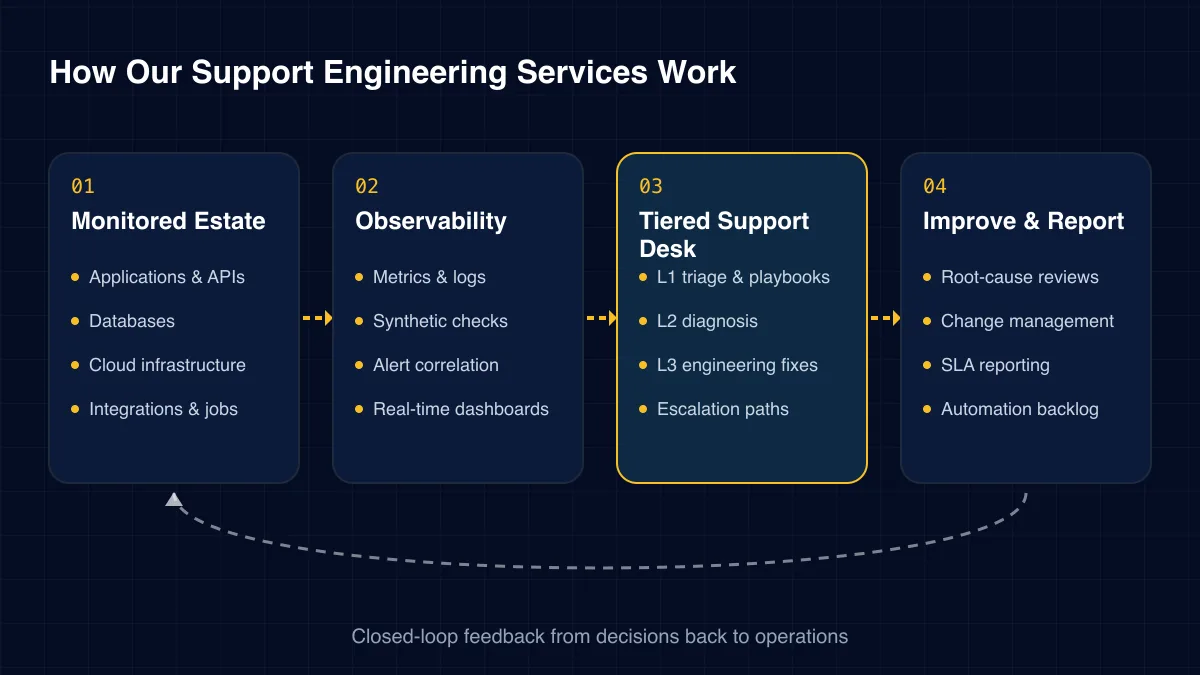
Our support engineering services follow a four-layer model. Signals flow in from your systems, and fixes flow back out through controlled change.
01
02
03
04
Challenges we solve
Support gaps rarely show up on a roadmap. They show up at 2 a.m. as an outage nobody owns.
Product engineers lose days to triage and night calls. A dedicated L1 layer gives them their focus back.
Alerts pile up overnight and small issues grow into outages. 24/7 coverage acts on them in minutes.
Hundreds of alerts hide the few that matter. Correlation and tuning cut noise so real incidents stand out.
Critical issues bounce between teams while customers wait. Defined paths route each issue to the right expert.
Old frameworks and missed patches create security risk. Planned maintenance keeps software current and safe.
The same fault returns every month. Problem management finds the root cause and removes it for good.
Support engineering services come in four common shapes. Many clients combine them.
Here is how the main support models compare on the points that matter most in production.
| Capability | In-house only | Basic help desk | Managed support |
|---|---|---|---|
| 24/7 coverage | Partial | ✓ Yes | ✓ Yes |
| Code-level fixes | ✓ Yes | No | ✓ Yes |
| Playbooks and SLAs | Partial | Partial | ✓ Yes |
| Root-cause analysis | Partial | No | ✓ Yes |
| Frees product engineers | No | Partial | ✓ Yes |
The benefits of support engineering services grow each month as playbooks mature and repeat issues disappear.
Delivery
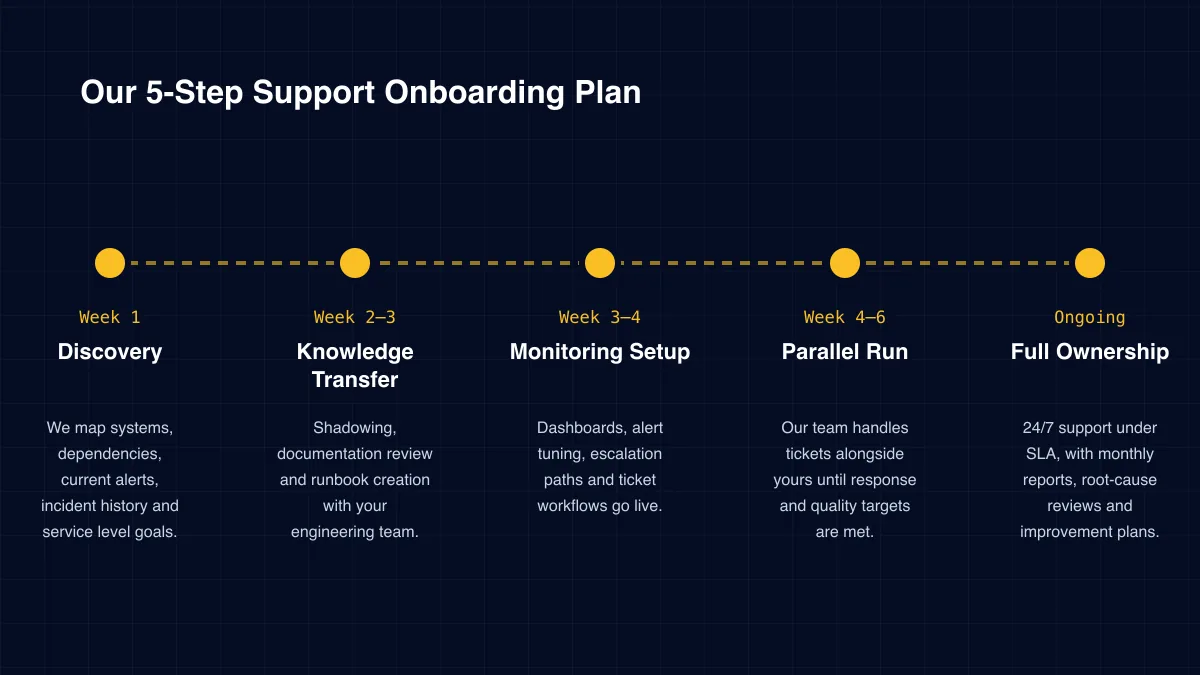
Week 1
We map systems, dependencies, current alerts, incident history and service level goals.
Week 2–3
Shadowing, documentation review and runbook creation with your engineering team.
Week 3–4
Dashboards, alert tuning, escalation paths and ticket workflows go live.
Week 4–6
Our team handles tickets alongside yours until response and quality targets are met.
Ongoing
24/7 support under SLA, with monthly reports, root-cause reviews and improvement plans.
Case study
A high-growth customer data platform faced constant global alerts, and its engineers were doing L1 triage. ICANIO set up a 24x7 support framework with 23+ real-time dashboards, standard playbooks and defined escalation paths. The result was 99.9% uptime, improved MTTR and zero L1 alert burden on the internal team.
“Alert fatigue in a high-growth platform is not a monitoring problem. It is a structural gap.”Read the full case study →
23+ real-time dashboards
Covers infrastructure, data pipelines and campaign delivery systems.
Standard playbooks
Known alert patterns get consistent, fast responses at any hour.
L1 to L3 routing
Complex issues reach the right engineering team without delay.
See how we apply support engineering in each sector we serve.
Response times on paper mean little without the right people and process. We recommend checking five things.
In our experience the best support engineering services make themselves quieter each quarter. That is the standard we hold ourselves to at ICANIO.
ICANIO operates under ISO 9001 and ISO 27001 certified processes. Support engineers get least-privilege, time-bound access, and every production action is logged.
We follow your change management rules and can align with frameworks such as SOC 2, HIPAA and PCI DSS. Our NOC and SOC monitoring watches for security events alongside performance issues.
Data handling rules travel with every ticket. Sensitive fields stay masked in logs and screenshots. Access is reviewed on a set schedule, and leavers lose credentials the same day.
Start with the cost of one hour of downtime on your most important system. Add the engineering hours your developers spend on alerts and night calls. Together they show what support engineering services must beat.
Then track uptime, mean time to resolution, ticket volume and repeat incidents each month. We baseline these during onboarding and report against them, so value is visible in your own data.
Include the hidden gains too. Features ship sooner when developers sleep through the night. Customer complaints fall when incidents are fixed before they spread. These effects often outweigh the direct savings.
Technology stack
We plug into your existing tools where possible and add proven ones where gaps exist.
Monitoring
Synthetic checks
Alerting & On-Call
Alert routingEscalation policiesOn-call rotas
Ticketing & ITSM
Service desk toolingSLA trackingKnowledge base
Databases
Cloud & Runtime
IIS & Nginx
Automation
Runbook scriptsAIOps correlationAuto-remediation
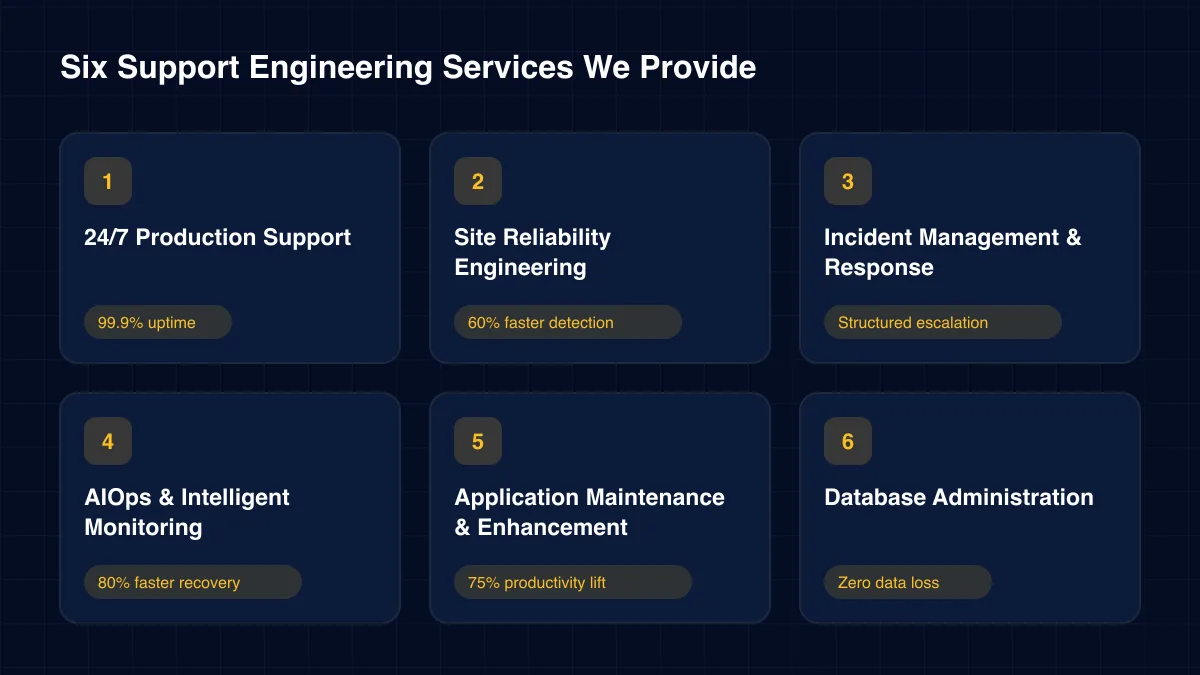
Our support engineering services cover 24/7 production support, SRE, incident management, AIOps monitoring, application maintenance and database administration. We also provide NOC and SOC monitoring and help desk support.
L1 monitors, triages and resolves known issues with playbooks. L2 diagnoses application and configuration problems. L3 fixes deep code, data or infrastructure faults. Clear rules decide when each ticket moves up. Good support engineering services resolve most tickets at L1 and L2, which keeps senior engineers free for the hardest problems.
Most onboarding takes four to six weeks. That includes discovery, knowledge transfer, monitoring setup and a parallel run with your team. Urgent L1 coverage can often start sooner. We agree a start date and success criteria before onboarding begins.
Yes. Much of our work is on systems built by other teams. Knowledge transfer and runbook creation are part of onboarding, so we learn your code and architecture before taking ownership.
You receive monthly reports on uptime, ticket volume, response and resolution times, SLA compliance and root causes. Live dashboards show current status at any time.
Yes. With teams in India, Singapore and the USA, we provide follow-the-sun coverage. Critical incidents are handled at any hour under agreed response targets.
Focused services within our technical support engineering practice.
Reliable software is not only built. It is looked after every hour of every day. Support engineering services provide that care with the right people, tools and processes.
ICANIO brings 24/7 coverage, deep engineering skill and a habit of continuous improvement. We learn your systems, take ownership in weeks and make them steadier each month. Contact us to discuss support engineering services for your platform.
Start small if you prefer. Many clients begin with overnight L1 coverage for one product, then extend our support engineering services to more systems once the results are clear. Either way, you keep full visibility and control.
By ICANIO Support Engineering Team · Published · Updated
Book a free 30-minute discovery call. We will review your systems, alerts and incident history, then propose a support model with clear service levels.
Contact Our Support Team