
Maintenance Triage and Work Orders
Agents group related alarms, pull failure history from the CMMS and check spare parts. They then draft a complete work order. The maintenance supervisor reviews and releases it in one step.
CMMS + SCADA
AgenticOps · Manufacturing
We design, deploy and operate multi-agent systems that work across your MES, ERP, CMMS and quality systems. Agents handle the paperwork and the cross-checking. Your supervisors keep the final say on every line stop, work order and disposition.
⟳ Orchestrating agents…
every step traced · guardrails on · reversible
AI agents in manufacturing are software workers that read plant data, reason about it and prepare the next action. They connect alarms, maintenance history, quality records and schedules that normally live in separate screens. Then they hand a supervisor a ready decision instead of a pile of tabs.
Most plants already have the data. The MES knows what ran, the CMMS knows what broke, and the ERP knows what is on order. What is missing is the glue between them. Today that glue is a shift lead with a spreadsheet, a phone and very little time.
Our team builds AI agents in manufacturing that act as that glue, with strict limits. Agents draft, cross-check and recommend. People approve anything that stops a line, releases a lot or changes a schedule. This page explains how we design those systems, where they pay off and how to start safely.
An AI agent is a program that pursues a goal by planning steps, calling tools and checking its own results. A single agent might read a SCADA alarm, query the historian and write a summary. A multi-agent system splits the work between specialists that pass context to each other.
AI agents in manufacturing differ from classic automation in one important way. A PLC program or an RPA bot follows fixed rules and stops when conditions change. An agent reasons about the situation, so it can handle a new alarm pattern or a missing field without a new script.
That flexibility is also the risk. An agent that reasons can reason wrongly. AgenticOps is the discipline that keeps agents observable, bounded and accountable in production. In a plant, that means agents never write to control systems directly and every consequential step passes a human gate.
Plant-floor definition
“AI agents in manufacturing are governed software agents that perceive plant events, reason across MES, ERP, CMMS and quality data, and prepare actions that a qualified person approves before anything changes on the floor.”
Foundations
AI agents in manufacturing should recommend and draft. They do not change PLC setpoints, recipes or machine states. Control stays with your OT systems and your operators.
Every claim an agent makes links back to a record: an MES event, a CMMS work order, a lot in the ERP or a sample in the QMS.
Line stops, lot holds, scrap decisions and schedule changes need a named approver, even when AI agents in manufacturing prepared the case. The agent waits, and the approval is logged.
Each run is traced step by step. Engineers can replay why an agent chose a part, a lot or a sequence, weeks after it happened.
Core capabilities
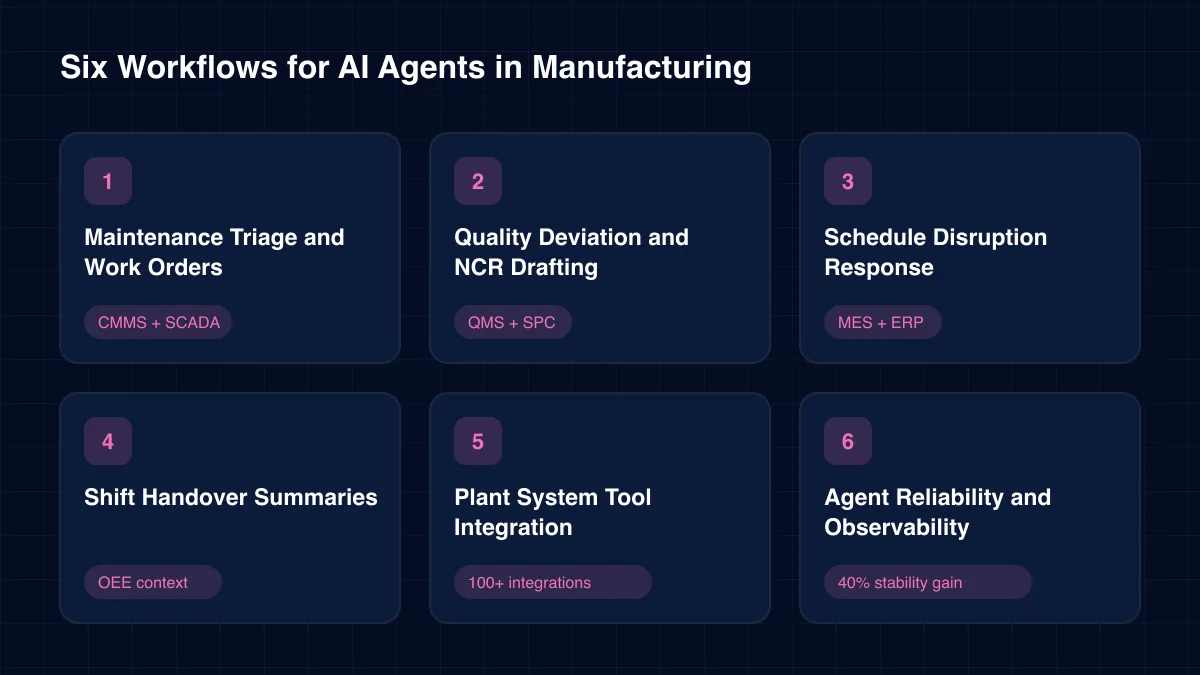
These are the workflows where we see AI agents in manufacturing earn their place first. Each one keeps a supervisor in the loop.
Agents group related alarms, pull failure history from the CMMS and check spare parts. They then draft a complete work order. The maintenance supervisor reviews and releases it in one step.
CMMS + SCADA
When SPC flags a drift, AI agents in manufacturing trace the affected lots, gather inspection data and suggest a likely cause. The quality engineer approves the NCR and any hold.
QMS + SPC
A late delivery or a down machine triggers agents that test resequencing options against capacity and due dates. The planner picks one, and the agent updates the MES.
MES + ERP
Agents compile OEE losses, open work orders and quality holds into a plain-language handover. Incoming leads start the shift with context instead of a hunt through systems.
OEE context
We connect agents to MES, ERP, CMMS, historians and document stores through typed, permissioned tools. Read access is broad. Write access is narrow and gated.
100+ integrations →We trace every tool call, score output quality and recover from failed steps. This is the same audit-first practice behind our agentic AI framework work.
40% stability gain →Architecture
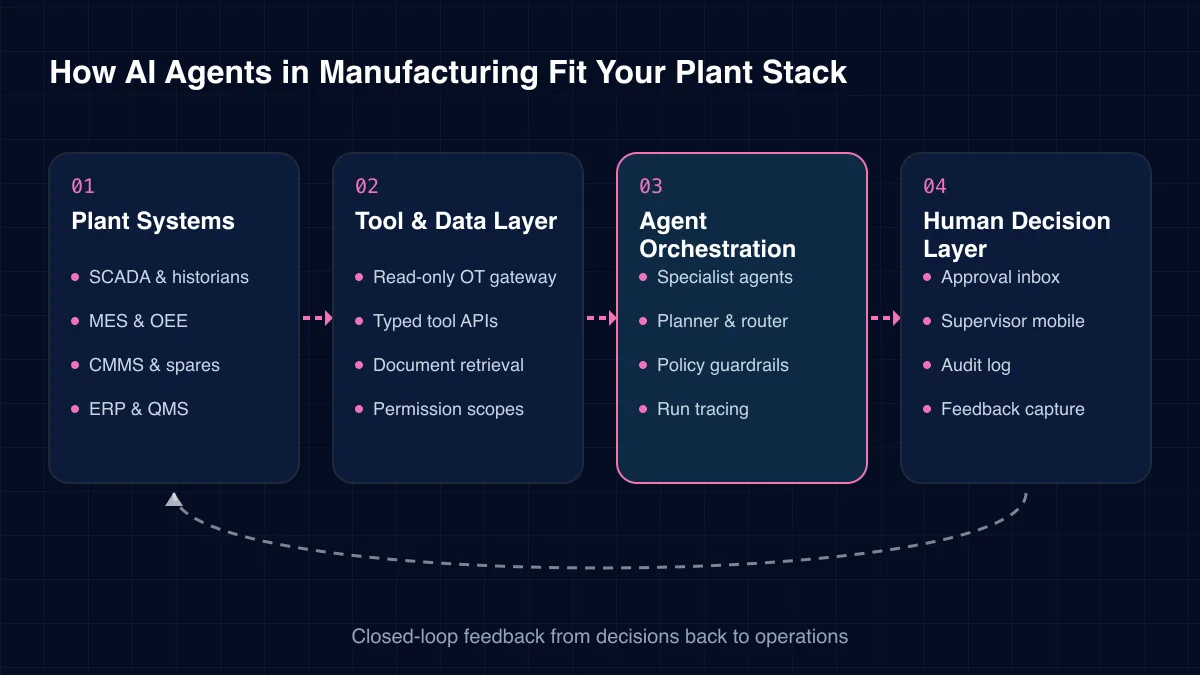
Plant agents sit above your control systems, never inside them. The four layers below follow the ISA-95 split between control and business systems.
01
02
03
04
Challenges we solve
Plants have automated control for decades. The coordination work around it is still manual, and that is where AI agents in manufacturing help most.
A single fault can trigger dozens of alarms. Operators silence them to keep running. Agents cluster related alarms and attach the likely cause, so the real signal is not lost.
The fix for a recurring fault often lives in one technician's head or a free-text note. Agents search CMMS history and manuals, then surface what worked last time.
Tracing a bad lot across work orders, shipments and stock takes hours of manual lookups. Agents run that trace in minutes and hand the engineer a ready containment list.
Late materials and machine stops force replanning several times a shift. Rules cannot weigh every trade-off. Agents test options and let the planner choose.
Shop floor and business systems rarely agree in real time. Agents read both, spot mismatches and draft the correction for someone to confirm.
Plant leaders rightly worry about software acting on machines. We keep agents advisory, keep OT access read-only and put a named person at every risk point.
AI agents in manufacturing grow in scope as trust builds. Most plants move through these four stages.
Plants often ask why they need agents when they already run MES rules and RPA bots. The table shows where each approach fits.
| Capability | MES rules | RPA bots | AI agents |
|---|---|---|---|
| Handles new alarm patterns | No | No | ✓ Yes |
| Reads free-text maintenance notes | No | Partial | ✓ Yes |
| Works across MES, ERP and CMMS | Partial | Partial | ✓ Yes |
| Explains its recommendation | No | No | ✓ Yes |
| Needs human approval gates | Rarely | Rarely | Always |
The benefits compound as more workflows share the same agent platform and approval inbox.
Delivery
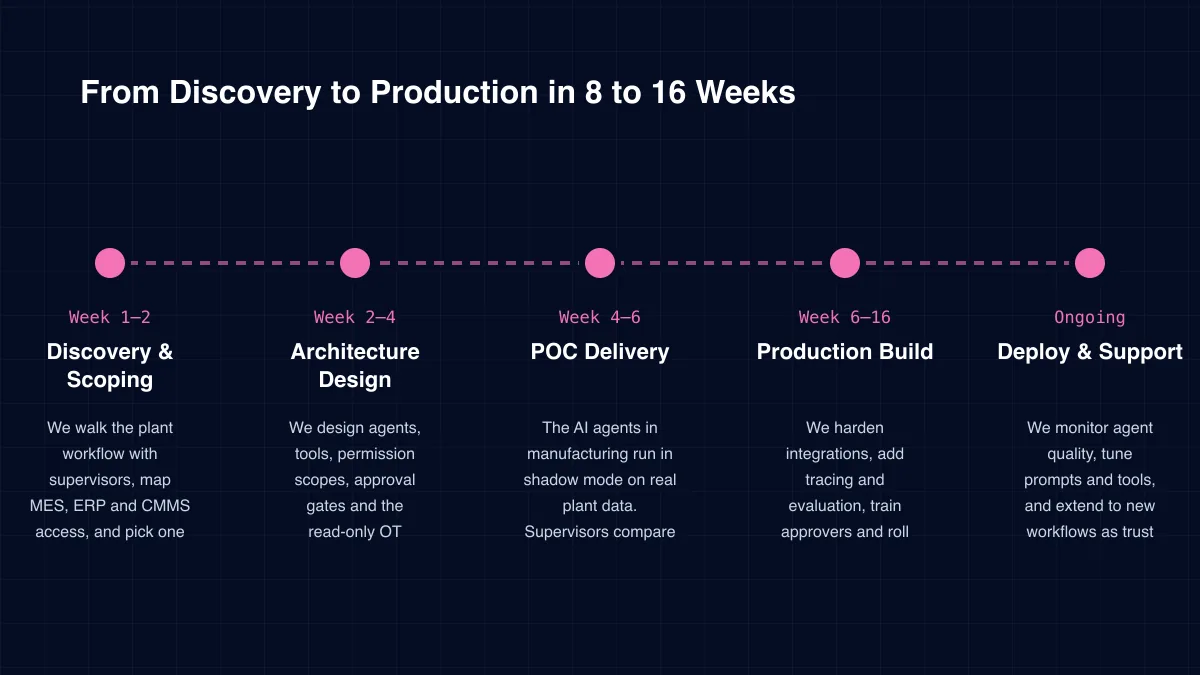
Week 1–2
We walk the plant workflow with supervisors, map MES, ERP and CMMS access, and pick one high-friction workflow.
Week 2–4
We design agents, tools, permission scopes, approval gates and the read-only OT boundary with your controls team.
Week 4–6
The AI agents in manufacturing run in shadow mode on real plant data. Supervisors compare agent drafts with their own decisions.
Week 6–16
We harden integrations, add tracing and evaluation, train approvers and roll out line by line.
Ongoing
We monitor agent quality, tune prompts and tools, and extend to new workflows as trust grows.
Case study
An enterprise AI platform had agent workflows that worked in isolation but failed under production load. Our team audited and debugged every workflow, redesigned reasoning and tool use, and added collaborative agents. The result was a 40% stability improvement, 3x enhanced reasoning and multi-LLM compatibility. AI agents in manufacturing need exactly this reliability before they touch maintenance or quality work.
“Validate framework stability before extending capability.”Read the full case study →
Stability debugging
Every existing agent workflow was reviewed and fixed before new features were added.
Collaborative, reflective agents
Reasoning chains and tool calls were redesigned for consistent, self-correcting results.
Local & cloud models
Agents run against local or cloud models, which suits plants that keep data on site.
Many vendors can demo an agent on clean data. Far fewer can run one next to a live line. We recommend checking five things.
In our experience the approval design decides adoption. Supervisors adopt AI agents in manufacturing that respect how the plant already signs things off.
ICANIO delivers under ISO 9001 and ISO 27001 certified processes. For plant work we design to the zone and conduit model in ISA/IEC 62443, so agent traffic never crosses into control zones unmanaged.
Agents read OT data through a one-way gateway or historian replica. Write actions go only to business systems such as the CMMS or MES, and only after approval. Models can run on premises when data must stay inside the plant.
We map the risks of AI agents in manufacturing against the NIST AI Risk Management Framework. Each workflow has a documented owner, a failure plan and a way to switch the agent off.
Start with one workflow and its current cost. For maintenance, that is the time from alarm to released work order, multiplied by the cost of the downtime. For quality, it is the time to contain a bad lot and the parts that ship meanwhile.
We baseline those numbers with your team during discovery. Then shadow mode shows how close agent drafts are to supervisor decisions before any go-live. Returns for AI agents in manufacturing are measured against your data, not a vendor benchmark.
Technology stack
We select tools for AI agents in manufacturing per plant and per workflow. These are typical choices, not a fixed bundle.
Plant Systems
Siemens MESCMMS platformsHistorians
Connectivity
OPC UARead-only OT gatewayMessage queues
Agent Frameworks
Custom orchestrators
Models
Cloud LLMsOn-premise LLMsEmbedding models
Retrieval
Vector databasesSOP & manual indexesMaintenance history
Observability
Evaluation suitesApproval audit log
 Free white paper · AgenticOpsThe AgenticOps PlaybookA practical, framework-neutral guide to engineering, governing and running AI agents in production, from the first workflow to a trusted agent estate.Get the white paper →
 Free white paper · ManufacturingSmart Manufacturing SolutionsIndustry 4.0 Transformation & Digital Manufacturing ExcellenceGet the white paper →
Not in our designs. AI agents in manufacturing read OT data through a read-only path and act only on business systems like the CMMS or MES. Machine control stays with PLCs, SCADA and your operators. This keeps safety cases and change control unchanged.
Typical targets are the MES, ERP, CMMS, QMS, historians and document stores for SOPs and manuals. We use existing APIs where they exist and build typed connectors where they do not. Each tool has its own permission scope.
Anywhere an action stops a line, holds or releases a lot, scraps material or changes a schedule. The approver is the person who signs it off today, such as a maintenance supervisor or quality engineer. Low-risk, reversible steps can run without a gate once trust is proven.
Every output cites its sources, so reviewers can check it quickly. Evaluation suites score agent drafts against past decisions. When confidence is low, the agent escalates instead of guessing. Rejected drafts feed back into prompt and tool tuning.
Yes. Our agentic framework work already supports both local and cloud LLMs. Plants with strict data rules can keep models and retrieval inside their own network, with only approved summaries leaving site.
Most engagements reach production in eight to sixteen weeks. The first six weeks cover discovery, architecture and a shadow-mode proof of concept on real data. The production build then hardens integrations, approvals and monitoring.
AI agents in manufacturing are most valuable in the gaps between systems. They do the lookups, cross-checks and drafting that eat supervisor time, then step aside for a human decision.
ICANIO brings AgenticOps discipline to that work: bounded tools, tested approvals and full tracing. We take plants from one workflow in shadow mode to production agents in eight to sixteen weeks, then keep them reliable as lines and systems change.
By ICANIO AgenticOps Engineering Team · Published · Updated
Book a free 30-minute discovery call. We will map one plant workflow, its systems and its sign-off rules to an agent design. You will leave with a clear scope and a shadow-mode plan.
Contact Our AgenticOps Team


