Skip to content

Support Engineering · Manufacturing

Manufacturing IT Support That Keeps Every Shift Running

Round-the-clock L1–L3 engineers for the systems your plant cannot pause: MES, SCADA, historians, label printers, ERP interfaces and the OT network that ties them together.

  • 24/7 L1–L3 support model
  • ISO 9001 & ISO 27001 certified
  • 100+ global brands served
Live NOC console
simulated demo

128

Resolved today

100%

Within SLA

24/7

On shift

  • L2MES work orders not syncing from ERPMFG-4102
    In progress · SLA 30m
  • L2Historian tag gaps on Line 3MFG-4103
    Triaged · SLA 45m
  • L3SCADA HMI frozen at packing cellMFG-4104
    New · SLA 15m
  • L1Label printer queue stuck, shippingMFG-4105
    New · SLA 20m
  • MES99.95%
  • SCADA / HMI99.98%
  • Historian99.9%
  • ERP link99.92%
L1–L3 coverage across every shift
24/7
L1–L3 coverage across every shift
Certified security operations
ISO 27001
Certified security operations
Monitoring that respects the control layer
OT-aware
Monitoring that respects the control layer
Triage for recurring plant incidents
Runbook-led
Triage for recurring plant incidents
Global brands served by ICANIO
100+
Global brands served by ICANIO

A stalled MES screen at 3 a.m. is not an IT ticket. It is a line that stops shipping. Manufacturing IT support exists to make sure that screen is back before the shift supervisor has to call anyone.

Our team runs manufacturing IT support as a 24/7, multi-tier operation. L1 engineers handle operator access, printers and terminals. L2 engineers own MES, historian and ERP interfaces. L3 engineers go deep on SCADA servers, databases and the OT network, working inside your change windows.

This page explains how that model works, what it covers, how it differs from a generic helpdesk, and how to judge a partner before you hand over the keys to the plant.

What Is Manufacturing IT Support?

Manufacturing IT support is the ongoing operation of the software, servers and networks that run a factory. It covers the enterprise side, such as ERP, email and identity. It also covers the plant side, such as MES, SCADA, historians, quality systems and shop-floor terminals.

The hard part is the boundary between IT and operational technology. A patch that is routine on an office laptop can halt a PLC gateway. Good manufacturing IT support knows which assets can be touched live and which need a planned outage.

It also runs on production time, not office time. Plants work nights, weekends and holidays. Support has to match the shift pattern, with escalation paths that reach a senior engineer in minutes.

Working definition

“Manufacturing IT support is a tiered, always-on service that monitors, maintains and restores the IT and OT-adjacent systems a plant depends on, with response targets tied to production impact rather than office hours.”

Manufacturing IT support engineers monitoring MES and SCADA systems for a plant

Foundations

Four Principles Behind Our Plant Support Model

  1. 01 →

    Production Impact First

    Tickets are ranked by what they stop. A frozen HMI on a bottleneck cell outranks a slow office printer, every time.

  2. 02 →

    Respect the OT Boundary

    We follow your zones and conduits. Changes near the control layer go through approved windows and named approvers.

  3. 03 →

    Runbooks Over Heroics

    Known failures get written playbooks. Night-shift engineers resolve them the same way the day shift would.

  4. 04 ↺

    Close the Loop

    Every major incident ends with a root-cause note and a fix owner. Repeat alarms become engineering work, not noise.

Core capabilities

Six Manufacturing IT Support Capabilities

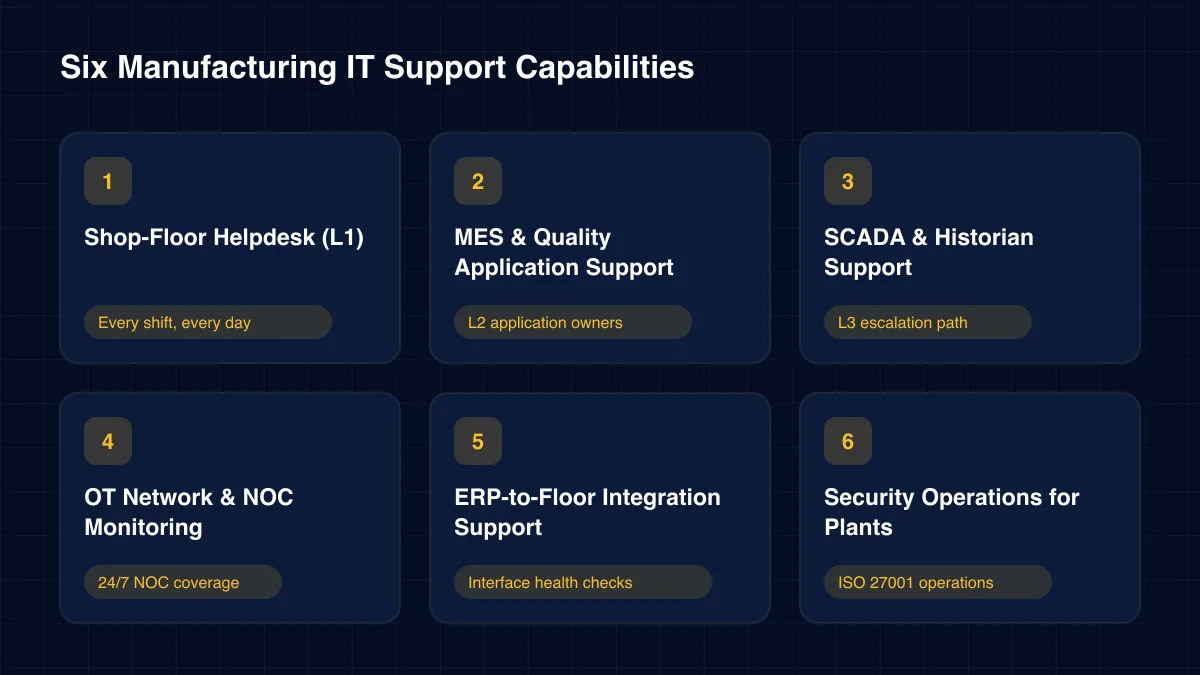
Each capability is delivered by engineers who understand that a plant is a production system first and an IT estate second.

Shop-Floor Helpdesk (L1)

Our L1 desk handles operator logins, badge resets, terminal faults, scanners and label printers. This is the manufacturing IT support that operators touch every day, so we keep it fast and plain-spoken.

Every shift, every day

MES & Quality Application Support

L2 engineers maintain MES, quality and traceability applications. They clear stuck work orders, fix recipe sync issues and restore genealogy records without corrupting batch history.

L2 application owners

SCADA & Historian Support

We monitor SCADA servers, HMI clients and process historians for tag gaps, disk pressure and service stops. L3 engineers work with your controls team on anything close to the PLC layer.

L3 escalation path

OT Network & NOC Monitoring

A NOC watches switches, firewalls and wireless across the plant. Alerts are tuned so a flapping port on a critical cell pages someone, while routine noise stays in the report.

24/7 NOC coverage →

ERP-to-Floor Integration Support

Work orders, bills of materials and goods receipts move between ERP and MES. We watch those interfaces, replay failed messages and fix mapping errors before inventory drifts.

Interface health checks

Security Operations for Plants

SOC coverage for the IT side of the plant: endpoint alerts, remote access reviews and patch planning. Manufacturing IT support here means tight coordination with OT owners before any change.

ISO 27001 operations →

Architecture

How Manufacturing IT Support Is Structured

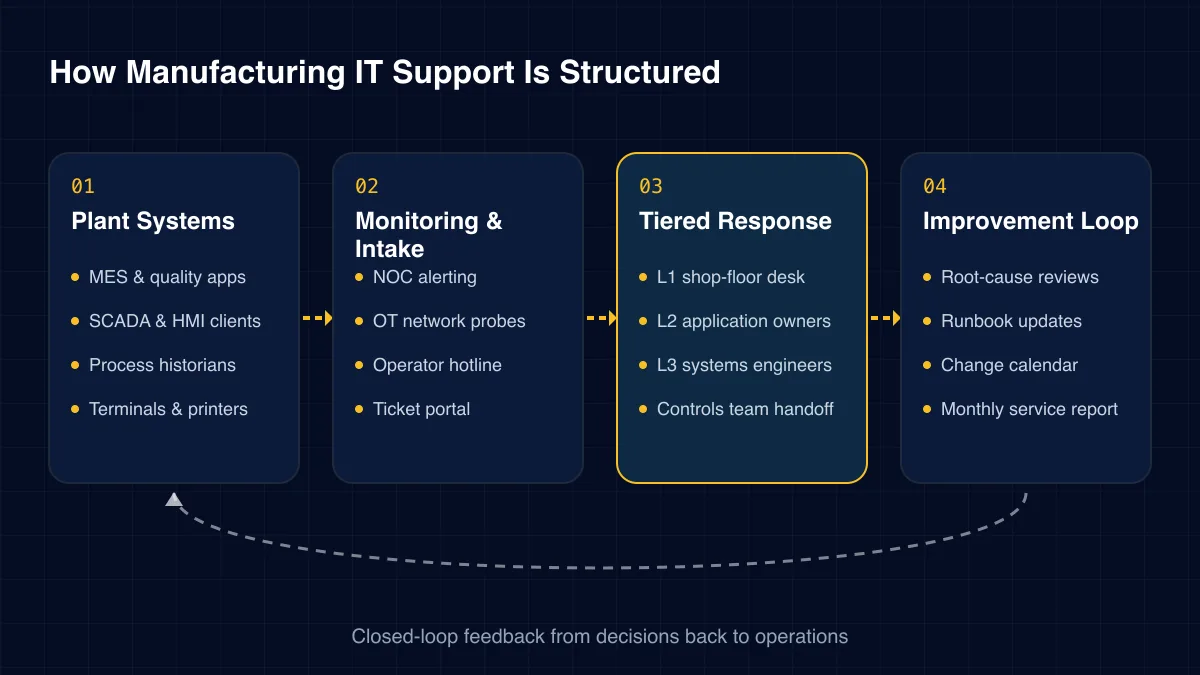
Our manufacturing IT support model has four layers. Signals rise from the plant, get triaged by tier, and turn into fixes and lasting improvements.

01

Plant Systems

  • MES & quality apps
  • SCADA & HMI clients
  • Process historians
  • Terminals & printers

02

Monitoring & Intake

  • NOC alerting
  • OT network probes
  • Operator hotline
  • Ticket portal

03

Tiered Response

  • L1 shop-floor desk
  • L2 application owners
  • L3 systems engineers
  • Controls team handoff

04

Improvement Loop

  • Root-cause reviews
  • Runbook updates
  • Change calendar
  • Monthly service report
Closed-loop feedback: Every resolved incident feeds back into monitoring rules and runbooks, so the next occurrence is caught earlier or prevented outright.

Challenges we solve

Plant Problems a Generic Helpdesk Cannot Solve

Most factories already have some form of helpdesk. The gaps show up at night, near the control layer, and between systems.

  1. 01

    Night Shifts Without Real Cover

    Many providers staff nights with a call-logging service. The ticket waits until morning while the line runs slow or stops.

  2. 02

    Patches That Break Production

    Office patch cycles pushed to plant PCs can reboot an HMI mid-batch. Plants need patching that follows their change windows.

  3. 03

    ERP and MES Drift Apart

    A failed interface message leaves a work order in ERP but not on the floor. Nobody notices until the schedule is wrong.

  4. 04

    Alarm Floods Hide Real Faults

    Untuned monitoring sends hundreds of alerts per shift. The one that matters, a historian disk filling up, gets lost.

  5. 05

    Knowledge Held by One Person

    Often a single engineer knows how the MES server really works. When they are on leave, every outage takes longer.

  6. 06

    IT and OT Blame Each Other

    Without a shared incident process, IT says it is a controls issue and controls says it is the network. Downtime grows.

Types of Manufacturing IT Support Engagement

Plants start in different places. We shape manufacturing IT support around four common engagement types.

  • 1Shop-floor helpdesk only: L1 coverage for operators and supervisors, with escalation back to your in-house team. A low-risk way to start.
  • 2Application support: L2 ownership of MES, quality and traceability systems, including releases, fixes and vendor liaison.
  • 3Full managed support: L1–L3 across plant IT, NOC monitoring and SOC coverage. One team, one queue, one set of service levels.
  • 4Multi-plant shared service: A central desk serving several sites, with local runbooks per plant and one reporting view for operations leaders.

Plant Support vs Office Helpdesk vs In-House

Teams often ask how dedicated manufacturing IT support differs from what they already have. This table sets out the main differences.

CapabilityOffice helpdeskIn-house onlyICANIO plant support
24/7 engineer coveragePartialRarely✓ Yes
MES and historian skillsNoPartial✓ Yes
Change windows respectedNo✓ Yes✓ Yes
Written runbooksPartialRarely✓ Yes
Root-cause reportingNoPartial✓ Yes

Benefits of Dedicated Manufacturing IT Support

The gains from manufacturing IT support show up on the shop floor first, then in the monthly numbers.

  • Shorter stoppagesBecause an engineer with MES context picks up the call at any hour.
  • Safer changeBecause patches and upgrades follow the plant calendar rather than the office one.
  • Cleaner dataBecause ERP and MES interface failures are caught and replayed quickly.
  • Less alarm fatigueBecause monitoring is tuned to production impact.
  • Lower key-person riskBecause knowledge lives in runbooks and not in one head.
  • Better auditsBecause every incident and change leaves a traceable record.

Delivery

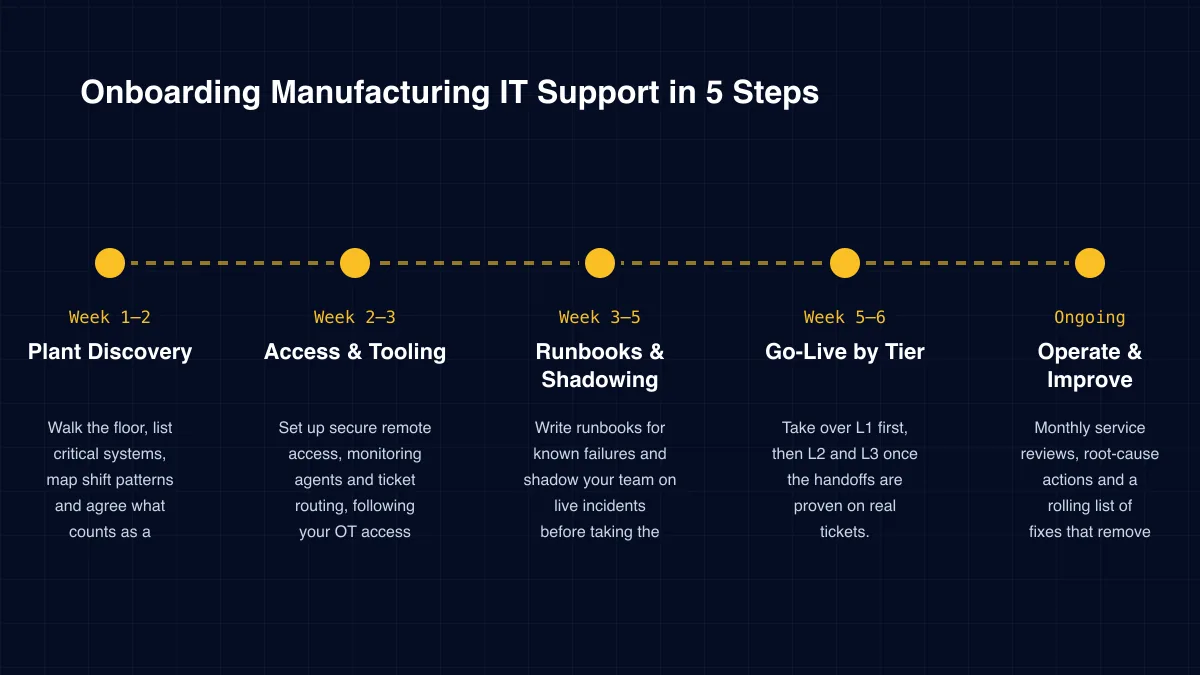
Onboarding Manufacturing IT Support in 5 Steps

  1. Week 1–2

    Plant Discovery

    Walk the floor, list critical systems, map shift patterns and agree what counts as a production-stopping incident.

  2. Week 2–3

    Access & Tooling

    Set up secure remote access, monitoring agents and ticket routing, following your OT access rules.

  3. Week 3–5

    Runbooks & Shadowing

    Write runbooks for known failures and shadow your team on live incidents before taking the lead.

  4. Week 5–6

    Go-Live by Tier

    Take over L1 first, then L2 and L3 once the handoffs are proven on real tickets.

  5. Ongoing

    Operate & Improve

    Monthly service reviews, root-cause actions and a rolling list of fixes that remove repeat incidents.

How to Choose a Manufacturing IT Support Partner

Many providers promise 24/7 support. Fewer can handle a plant at 2 a.m. We recommend checking five things before you sign.

  1. 1Real night coverage. Ask who answers at 3 a.m. and whether they can log in and fix the issue.
  2. 2Plant system skills. The team should know MES, historians and SCADA clients, not only Windows and email.
  3. 3OT discipline. Look for a clear process for change windows, approvals and remote access near the control layer.
  4. 4Runbook culture. Ask to see sample runbooks and how they are kept up to date after incidents.
  5. 5Honest reporting. Monthly reviews should show repeat incidents and what was done to stop them.

In our experience, the fourth point matters most over time. Strong runbooks turn manufacturing IT support from a cost into a steady source of plant improvements.

Security and OT Boundaries in Plant Support

ICANIO runs support under ISO 9001 and ISO 27001 certified processes. Access to plant systems is role-based, logged and time-bound.

Many plants organise their networks by the zones and conduits model in ISA/IEC 62443. Our manufacturing IT support respects that model. We use your approved remote access paths, never shortcuts. Changes near the control layer need a named approver from your side.

Security alerts from plant endpoints are triaged by our SOC and escalated with context. We do not isolate a production machine on our own. We call the owner first, because an unplanned isolation can be as costly as the threat.

Measuring the Return on Plant Support

Start with the cost of one hour of lost output on your bottleneck line. Then look at how many hours last year were lost to IT and systems issues rather than mechanical faults.

Add the overtime spent by your own engineers on night callouts, and the time spent fixing ERP and MES mismatches. Those are the baselines manufacturing IT support works against. We agree them with you during discovery and report against them each month.

Technology stack

Tools and Systems We Support on the Plant Floor

We work with the platforms you already run. These are the systems our manufacturing IT support covers most often.

  • Plant Applications

    MES platformsQuality & LIMSTraceabilityOEE dashboards

  • Control Adjacent

    SCADA serversHMI clientsProcess historiansOPC UA gateways

  • Enterprise

    • SAP
    • Oracle ERP

    Microsoft DynamicsActive Directory

  • Monitoring

    • Prometheus
    • Grafana

    AlertmanagerBlackbox probes

  • Service Management

    ITSM ticketingOn-call pagingRunbook libraryChange calendar

  • Security

    Endpoint protectionRemote access gatewaysPatch managementLog aggregation

Inside Our Plant Support Operation

Manufacturing IT support architecture from plant systems to tiered response
Four-layer plant support model with an improvement loop
Manufacturing IT support capabilities across MES, SCADA, OT network and ERP
Six capabilities, from shop-floor helpdesk to plant security
Manufacturing IT support onboarding timeline from plant discovery to go-live
Onboarding in five steps, tier by tier

Manufacturing IT Support FAQs

What does manufacturing IT support cover?

Manufacturing IT support covers the software, servers and networks a plant relies on. That includes MES, quality systems, historians, SCADA servers and HMI clients, shop-floor terminals and printers, and the ERP interfaces that feed the floor. It also covers identity, endpoints and security monitoring on the IT side of the plant.

Do you touch PLCs or control logic?

No, not on our own. PLC programming and control logic stay with your controls engineers or integrator. Our L3 team supports the servers and networks around them and works alongside your controls team during incidents. This keeps responsibility clear.

How does manufacturing IT support handle night shifts?

Our desk runs 24/7 with engineers who can log in and fix issues, not only log them. Production-stopping incidents page an L2 or L3 engineer directly. Response targets are agreed per system during onboarding.

Can you support plants in different countries?

Yes. ICANIO has offices in India, Singapore and the USA. A central desk can serve several plants, with local runbooks for each site and one reporting view for operations leaders.

How long does it take to onboard manufacturing IT support?

Most plants move to live manufacturing IT support in about six weeks. The first weeks cover discovery, access and runbooks. We then take over L1, followed by L2 and L3 once handoffs are proven.

Will you work with our existing MES vendor?

Yes. We act as the first line for your MES and handle known issues ourselves. When a fix needs the vendor, we open the case, supply logs and follow it through, so your team does not have to chase it.

Key Takeaways

  • Manufacturing IT support must run on production time, with real engineers on every shift.
  • The IT and OT boundary needs a clear process for access, change windows and approvals.
  • Runbooks and root-cause reviews turn repeat incidents into lasting fixes.
  • Start with L1, prove the handoffs, then extend manufacturing IT support to L2 and L3.

Conclusion

A plant cannot wait until Monday for a fix. Manufacturing IT support gives every shift access to engineers who understand MES, historians, SCADA clients and the networks behind them.

ICANIO delivers manufacturing IT support as a 24/7, L1–L3 operation under ISO 27001 certified processes. We onboard tier by tier, respect your OT boundaries and report honestly on what keeps breaking and why. If downtime from systems issues is costing you output, contact our team to talk it through.

By ICANIO Support Engineering Team · Published · Updated

Ready to Give Every Shift Real Support?

Book a free discovery call. We will map your critical plant systems, shift patterns and current gaps, then propose a support model with clear response targets.

Contact Our Support Team