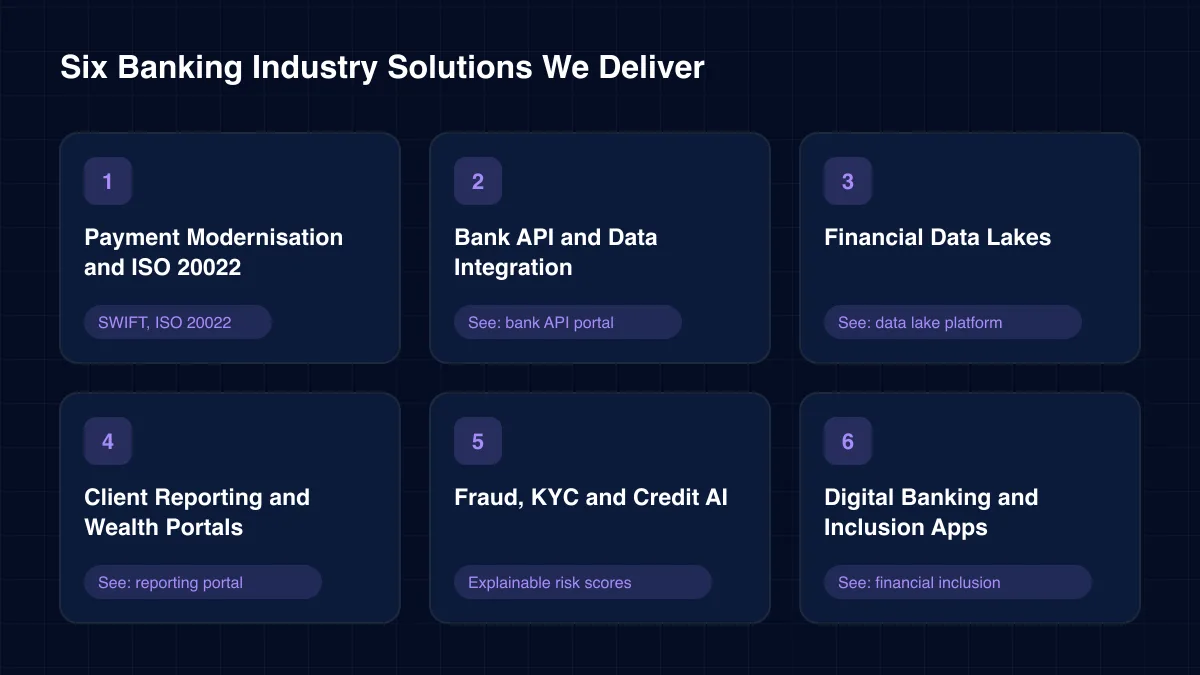
Payment Modernisation and ISO 20022
We help banks and payment processors move to ISO 20022 messaging and SWIFT connectivity. Richer data travels with each payment, and settlement gets faster.
SWIFT, ISO 20022 →Fintech & Banking
Customers expect instant payments and always-on apps, while regulators expect a perfect audit trail. We build payment, data, reporting and AI platforms that deliver both, on secure cloud foundations.
6 ways we build for Fintech
Digital Twin Solutions
Process and Infrastructure Twins
Model a payment flow, branch network or data centre. Stress-test peak volumes and failover plans for your banking industry solutions virtually.
Digital Twin for Fintech →Money moves in seconds, but many banks still reconcile it overnight. Legacy cores, manual reports and siloed data slow every product launch. Our banking industry solutions modernise that stack in safe steps, so you ship faster without putting a single transaction at risk.
We work with retail and commercial banks, payment companies, wealth managers, brokers and lending platforms. Each has its own regulator and its own risk appetite. What they share is a need for software that is secure, auditable and available around the clock.
This page covers the challenges financial institutions face, the systems and standards that shape the work, and how each ICANIO service applies to banking and fintech teams.
Banking industry solutions are the software systems that run accounts, move money, manage risk and serve customers. They span the core banking ledger, payment rails, onboarding and KYC, lending, wealth and the reporting that regulators demand.
The core systems are well known. The core banking system holds accounts and balances. Payment hubs connect to SWIFT, card networks and domestic real-time rails. KYC and AML platforms check identities and monitor transactions. Data platforms feed risk models, finance and regulatory reports.
Modern banking industry solutions surround the core with APIs and events rather than replacing it overnight. New digital products launch on top, while the ledger underneath stays stable and auditable.
Plain-English definition
“Banking industry solutions are secure, regulated software platforms for accounts, payments, compliance and data, built so financial institutions can launch digital products quickly while keeping every transaction auditable.”
Foundations
Controls for PCI DSS, SOC 2, GDPR and KYC/AML are mapped at architecture stage. Audits of our banking industry solutions confirm the design rather than exposing gaps.
Financial data moves through pipelines exactly as it was received. Every transform is logged, so numbers can be traced back to source.
Our banking industry solutions wrap legacy systems with APIs and events first. Risky big-bang migrations are replaced by phased, reversible steps.
AI scores fraud and credit risk, but people approve high-impact actions. Models are explainable and monitored for drift.
Core capabilities
These banking industry solutions are delivered by engineers who have built production systems for banks, brokers, wealth firms and payment companies.
We help banks and payment processors move to ISO 20022 messaging and SWIFT connectivity. Richer data travels with each payment, and settlement gets faster.
SWIFT, ISO 20022 →Portals and pipelines that pull client transactions from bank APIs into one place. These banking industry solutions stop re-keying, and processing speeds up.
See: bank API portal →Automated pipelines land 50+ secure Wealth Spectrum feeds in AWS with zero data manipulation. Analysts query history quickly with Athena.
See: data lake platform →Self-service portals for ledgers, portfolio reports and trade confirmations. Clients get answers instantly instead of emailing for statements.
See: reporting portal →Machine learning for real-time fraud scoring, document checks in KYC and credit risk models. Each model is tuned to your transaction patterns and retrained as fraud shifts.
Explainable risk scores →Mobile-first apps for payments, transfers and bill pay, including platforms that bring secure digital finance to underserved rural communities.
See: financial inclusion →Model a payment flow, branch network or data centre. Stress-test peak volumes and failover plans for your banking industry solutions virtually.
Digital Twin for Fintech →Real-time fraud scoring, KYC document checks, credit risk models and plain-language queries over financial data, all explainable.
Data & AI for Fintech →Mobile banking, wealth portals and payment apps with SSO, strong authentication and self-service flows clients actually use.
App Development for Fintech →Automated pipelines with security gates and zero-downtime deploys, plus cloud platforms engineered for 99.9% availability.
DevOps & Cloud for Fintech →Payments never sleep, so banking industry solutions need constant care. We monitor transaction services, integrations and reports, and resolve incidents within agreed SLAs.
Support Engineering for Fintech →Agents gather evidence for AML alerts, pre-check KYC files and draft reconciliations. An analyst approves every decision.
AgenticOps for Fintech →Architecture
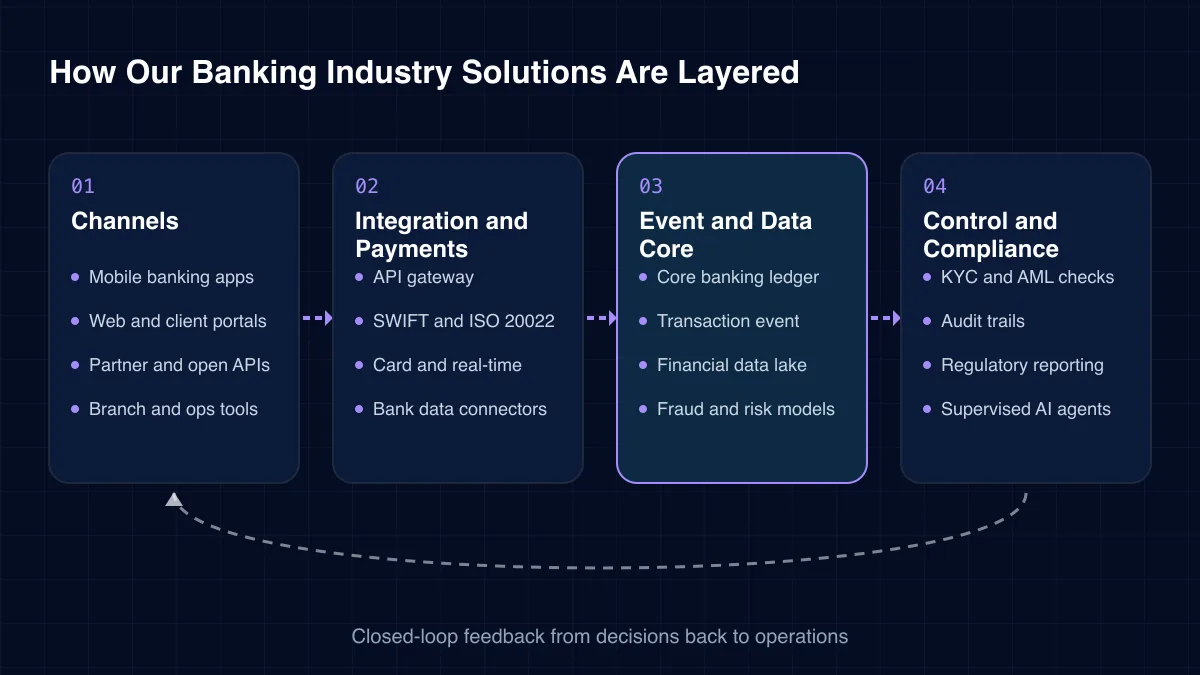
We keep the ledger safe and build around it. Channels call secure APIs, an event and data core joins the systems, and controls watch every step.
01
02
03
04
Challenges we solve
Financial institutions must innovate under heavy regulation and constant threat. These are the problems banking industry solutions most often need to solve.
Decades-old systems make every new product slow and risky. Teams fear touching code that nobody fully understands.
KYC reviews, AML alerts and regulatory reports still depend on spreadsheets. Manual work cannot keep pace with rule changes.
Transactions, holdings and client data live in separate stores. Reconciling them across asset classes takes days.
As every transaction goes digital, attack surfaces grow. Rule-based fraud checks miss new patterns and flag too many good customers.
Users expect instant payments and real-time balances in the app. A batch-based back office shows up as a poor front end.
An outage loses revenue and draws regulator attention. Transaction systems need resilience engineered in, not hoped for.
Banking industry solutions must fit each institution's model and regulator. We adapt our approach to four groups.
Institutions choose between three paths. The table shows why phased banking industry solutions carry the least risk.
| Factor | Status quo | Big-bang replacement | Phased modernisation |
|---|---|---|---|
| Service disruption risk | Low | High | Low |
| Speed of new products | Slow | Slow until done | Fast |
| Regulatory risk | Growing | High | Low |
| Reversible steps | N/A | No | ✓ Yes |
| Value before completion | No | No | ✓ Yes |
Gains from banking industry solutions build as more products, channels and data sources join the same secure core.
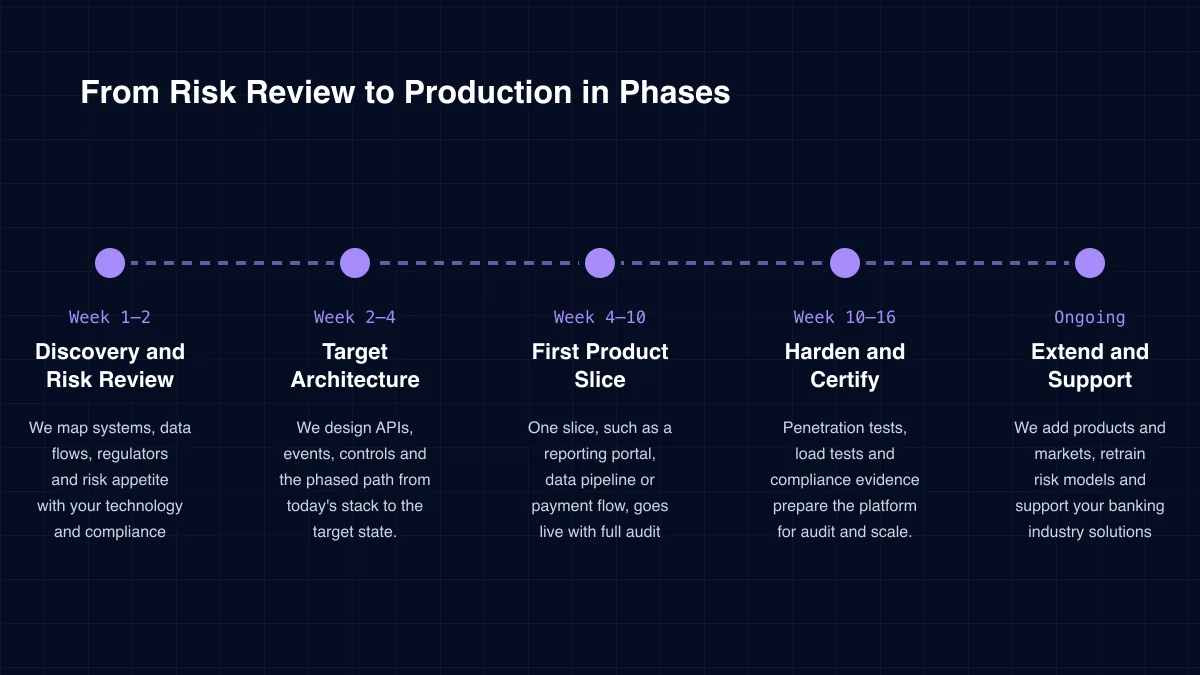
Delivery
Week 1–2
We map systems, data flows, regulators and risk appetite with your technology and compliance leads.
Week 2–4
We design APIs, events, controls and the phased path from today's stack to the target state.
Week 4–10
One slice, such as a reporting portal, data pipeline or payment flow, goes live with full audit trails.
Week 10–16
Penetration tests, load tests and compliance evidence prepare the platform for audit and scale.
Ongoing
We add products and markets, retrain risk models and support your banking industry solutions around the clock.
Case study
A financial services organisation relied on manual processes for client ledgers, portfolio reports and trade confirmations. Reconciling holdings across Equity, F&O, Currency and Commodities was hard. Our team built a secure reporting portal with real-time ledgers and self-service tools. Report retrieval became 60% faster and manual processing effort fell by 50%.
“A client who has to email and wait for a statement has started wondering what else about the relationship is manual.”Read the full case study →
Ledgers · Portfolio reports
Clients see ledgers, reports and trade confirmations the moment data changes.
PayIN · PayOut · Margin pledges
Clients update profiles and move funds without waiting on manual requests.
SSO · Reconciliation modules
Compliance-ready historical data and reconciliation meet financial services standards.
A partner who cuts corners on controls can cost you a licence. We recommend testing five things before you commit.
Our experience is that data integrity decides trust. Regulators and clients forgive slow; they do not forgive wrong numbers.
Security is the foundation of every engagement. We design to PCI DSS for card data, SOC 2 and ISO 27001 for controls, and GDPR for personal data. KYC and AML requirements shape onboarding and monitoring flows from the first sprint.
ICANIO operates under ISO 9001 and ISO 27001 certified processes. Data is encrypted in transit and at rest, access is least-privilege, and every change is logged. We also align with the specific rules of your market, from central bank guidance to Basel Committee principles.
Start with time to launch a new product, hours spent on manual compliance work and fraud losses per quarter. Most banking industry solutions show returns in these three areas first.
Then add avoided downtime, report retrieval time and client service requests. We baseline each figure with your team during discovery and report progress after every phase.
Technology stack
We select tools that satisfy your regulator and your engineers. These are the parts we use most in banking industry solutions.
Payments
SWIFTISO 20022Card gatewaysReal-time rails
Data
Wealth Spectrum
Compliance
KYC and AML toolsAudit loggingConsent recordsReport automation
AI
Fraud modelsCredit risk modelsLLM assistantsDocument AI
Apps
SSOStrong authentication
Cloud and Ops
CI/CD with security gates
We wrap the core with APIs and events, then move functions to cloud-native services in phases. Automated CI/CD and strict controls keep each step reversible. Service continues throughout, with no big-bang cutover.
AI spots patterns at a scale people cannot, such as real-time fraud signals, credit risk and personalised guidance. It only helps when deployed with monitoring, explainability and human oversight, which we build in by default.
We design to SOC 2, ISO 27001, PCI DSS, GDPR and KYC/AML from the architecture stage. The exact control set is tailored to the markets and regulators each client operates under.
We use redundant microservices, automated failover and continuous observability. Load and chaos tests run before peak events. That is how we target 99.9%+ uptime for systems where downtime costs revenue and regulatory standing.
Yes. We train and tune fraud models on your own transaction patterns and risk tolerance. Monitoring triggers retraining as fraud behaviour shifts, and analysts see why each alert fired.
Start where manual effort or risk is highest. For many firms that is client reporting, data consolidation or KYC review. A focused first slice proves value quickly and funds the next phase.
Financial institutions compete on trust as much as on features. The best banking industry solutions let you launch quickly while every transaction stays secure, traceable and available.
ICANIO brings digital twins, data and AI, app development, DevOps, support engineering and AgenticOps into one team. Our team modernises in safe phases, proves value early and supports your platform long after go-live.
By ICANIO Fintech & Banking Engineering Team · Published · Updated
Book a free 30-minute discovery call with our fintech engineers. We will review your systems, regulators and priorities, and suggest a safe first slice. Contact us to plan your next step.
Contact Our Fintech Team