Cloud Migration & Modernization
Assessment, landing zones and phased migration of workloads to AWS, Azure or Google Cloud. Our JIRA Data Center move to AWS replaced costly per-user licensing with a highly available setup.
50% lower cost →DevOps & Cloud Engineering
ICANIO architects resilient, auto-scaling infrastructure with automated CI/CD, infrastructure as code and built-in security. You ship faster, stay online and keep cloud spend under control.
14
Deploys today
38 min
Lead time
0
Failed changes
Slow releases, surprise outages and rising cloud bills usually share one cause. The delivery system around the code was never engineered. Our cloud engineering services fix that system from commit to production.
Our team designs cloud platforms, automates CI/CD pipelines and codifies infrastructure so every environment is repeatable. We add security scanning, observability and cost controls into the same workflow. The result is a platform that releases often and fails rarely.
This guide explains what modern cloud engineering services include, how the architecture fits together and how to pick a partner. It also shares measured results from Icanio DevOps projects in financial services, SaaS and enterprise IT.
Cloud engineering services design, build and run the infrastructure that applications depend on. They cover cloud architecture, migration, automation, security, monitoring and cost management across AWS, Azure and Google Cloud.
DevOps is the working model that ties these pieces together. Developers and operations share one pipeline, one set of tools and one definition of done. Code moves from commit to production through automated tests and approvals instead of manual handoffs.
Good cloud engineering services treat infrastructure as software. Servers, networks and policies live in version control. Changes are reviewed, tested and rolled back like any other code. That is what makes scale predictable.
The scope differs by company size. A startup may need one well-built pipeline and a secure AWS account. A global enterprise may need landing zones across regions, shared golden paths and a FinOps practice. Our cloud engineering services scale to either, using the same engineering standards.
Working definition
“Cloud engineering services are the practice of designing and automating cloud infrastructure, delivery pipelines and operations so software can be released quickly, securely and reliably at any scale.”
Foundations
Infrastructure, pipelines, policies and dashboards are versioned, reviewed and reproducible across environments.
Every commit is built, tested, scanned and deployed through the same standard pipeline, with no manual steps.
DevSecOps checks for code, containers, secrets and infrastructure run on every change, not once a quarter.
Metrics, logs and traces in one place, with alerts tied to user impact and clear runbooks.
Core capabilities
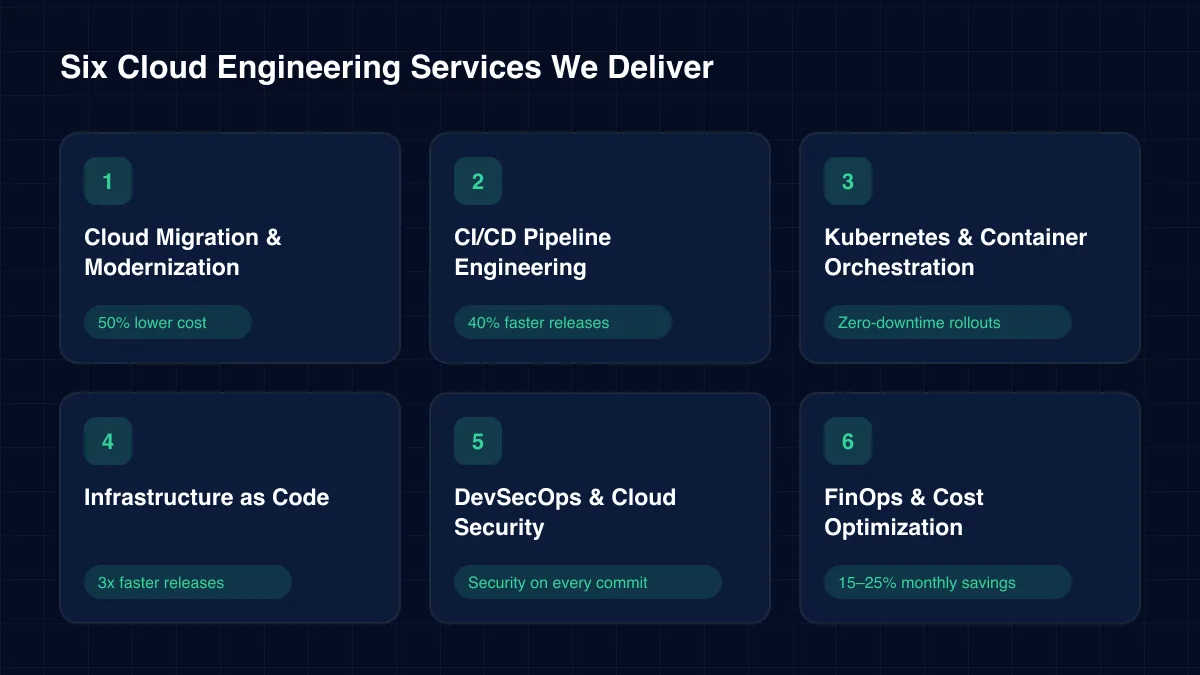
Each of our cloud engineering services solves a specific delivery or operations problem. Together they form one platform your teams can trust.
Assessment, landing zones and phased migration of workloads to AWS, Azure or Google Cloud. Our JIRA Data Center move to AWS replaced costly per-user licensing with a highly available setup.
50% lower cost →Standard pipelines with automated build, test, scan and deploy stages. Our DevOps automation framework used Bitbucket, Nexus and automated CI/CD across every environment.
40% faster releases →Container builds, Kubernetes clusters, autoscaling, service mesh and zero-downtime rollouts. We rightsize pods and nodes so capacity follows real demand.
Zero-downtime rollouts →Terraform and CloudFormation modules that create identical environments on demand. Our DevOps API support platform automated CI/CD and infrastructure as code end to end.
3x faster releases →Identity and access design, secrets management, policy as code and automated scanning in every pipeline. We assess misconfigurations and harden accounts across multi-cloud estates.
Security on every commit →Tagging, cost attribution, rightsizing and commitment planning with clear dashboards for finance and engineering. Our cloud cost optimization platform improved visibility and governance.
15–25% monthly savings →Architecture
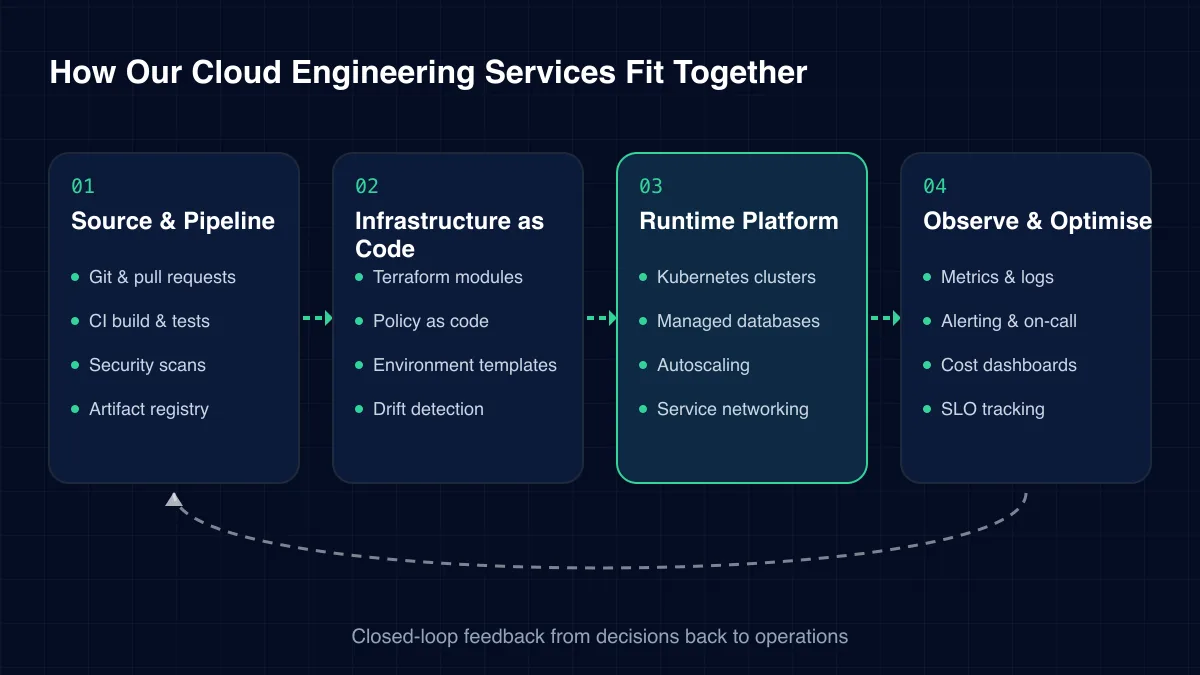
Our cloud engineering services follow a four-layer model. Code flows up through the pipeline, and signals from production flow back to the teams that own it.
01
02
03
04
Challenges we solve
Most delivery pain comes from manual steps and missing feedback, not from the cloud provider.
Releases wait on one engineer who knows the steps. Automated pipelines let any approved change ship in minutes.
Staging never quite matches production, so bugs appear only after launch. Infrastructure as code keeps them identical.
Without central monitoring, users report problems first. Observability and alerting catch issues before they spread.
Idle resources and oversized instances quietly add up. Tagging, dashboards and rightsizing make spend visible and owned.
A late penetration test blocks a release for weeks. Shift-left scanning finds issues when they are cheap to fix.
Every team runs its own toolchain and rules. A standard platform gives one audit trail and one way to ship.
Cloud engineering services usually start in one of four places, depending on where the pain is sharpest.
Teams move through three stages of maturity. This table shows what changes at each step.
| Capability | Manual ops | Scripted ops | Platform DevOps |
|---|---|---|---|
| Repeatable environments | No | Partial | ✓ Yes |
| Automated security checks | No | Partial | ✓ Yes |
| Self-service for developers | No | No | ✓ Yes |
| Cost visibility per team | No | Partial | ✓ Yes |
| Typical release rhythm | Monthly | Weekly | On demand |
The gains from cloud engineering services compound as more teams adopt the shared platform.
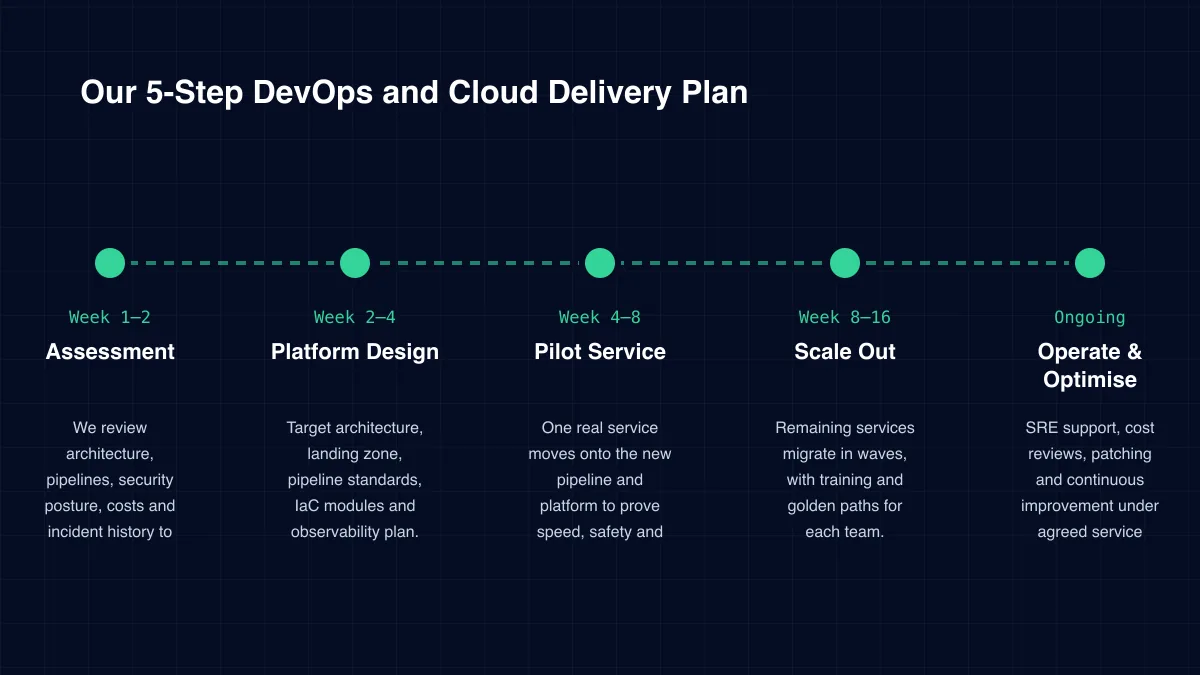
Delivery
Week 1–2
We review architecture, pipelines, security posture, costs and incident history to set priorities.
Week 2–4
Target architecture, landing zone, pipeline standards, IaC modules and observability plan.
Week 4–8
One real service moves onto the new pipeline and platform to prove speed, safety and cost.
Week 8–16
Remaining services migrate in waves, with training and golden paths for each team.
Ongoing
SRE support, cost reviews, patching and continuous improvement under agreed service levels.
Case study
A financial services partner struggled with disconnected tools, manual provisioning and fragmented governance. ICANIO built one DevOps automation platform with standard CI/CD, infrastructure as code and central observability. It delivered 70% faster deployments, a 30% cut in cloud costs and 99.9% uptime.
“In financial services, disconnected tools turn every manual handoff into an unaudited gap in governance.”Read the full case study →
Jenkins · GitHub Actions
One standard pipeline replaced inconsistent release processes across teams.
Terraform · CloudFormation
Automated provisioning removed slow, error-prone manual environment setup.
Prometheus · Grafana · ELK
Proactive alerts gave real-time visibility and faster incident response.
See how we apply devops & cloud in each sector we serve.
Certifications and logos only go so far. We recommend asking five practical questions.
In our experience the best cloud engineering services leave your team more capable, not more dependent. That is how we structure every ICANIO engagement.
ICANIO works under ISO 9001 and ISO 27001 certified processes. We design least-privilege access, encrypted storage and network segmentation into every environment.
Pipelines run static analysis, dependency checks, container scans and policy as code on each change. For regulated clients we map controls to standards such as SOC 2, HIPAA and PCI DSS, and keep an audit trail of every deployment.
Zero trust principles guide identity design. Humans and services receive only the access they need, for only as long as they need it. Secrets live in a managed vault, never in code or pipeline logs.
Track four delivery metrics before and after: deployment frequency, lead time for changes, change failure rate and time to restore service. These DORA measures show whether delivery really improved.
Add the monthly cloud bill, hours lost to incidents and engineer time spent on manual releases. We baseline these in the assessment, so the return on cloud engineering services is measured in your own numbers.
Some gains are harder to price but just as real. New engineers become productive faster when environments are self-service. Audits take days instead of weeks when every change is logged. Weekend releases stop being a team-wide event. We report these alongside the hard numbers.
Technology stack
We work with the tools you already have where they fit, and introduce new ones only where they add value.
Cloud Providers
CI/CD
Infrastructure as Code
Policy modules
Containers
AKS
Observability
cert-manager
Security & Cost
SAST & container scansPolicy as codeSecrets vaultsFinOps dashboards
Our cloud engineering services cover cloud migration, CI/CD pipelines, Kubernetes, infrastructure as code, DevSecOps and FinOps. We can take on one area or the full platform, then support it after launch.
We work across AWS, Microsoft Azure and Google Cloud, plus hybrid and on-premises setups. We recommend a provider based on your workloads, skills and contracts rather than a fixed preference.
Most clients see a pilot service releasing through the new pipeline within four to eight weeks. Wider rollout follows in waves. Our DevOps automation platform project delivered 70% faster deployments. Speed rises further as more teams adopt the shared pipeline and templates.
Usually, yes. Rightsizing, autoscaling, commitment planning and removing idle resources all reduce spend. Our cloud cost optimization platform cut monthly infrastructure spend by 15 to 25 percent.
Every change passes static analysis, dependency and container scans, secrets checks and policy rules before deployment. Failed checks block the release. All results are logged for audit.
Yes. We offer monitoring, incident response, patching and monthly cost reviews under agreed service levels. Our support engineering team can also run 24x7 on-call for production systems.
Focused services within our devops & cloud engineering practice.
Fast, safe releases are not luck. They come from a delivery platform designed as carefully as the product it ships. Cloud engineering services build that platform and keep improving it.
ICANIO brings cloud architecture, DevOps automation, security and cost engineering into one team. We prove the approach on a pilot service, then scale it across your estate. Contact us to plan your next step in cloud engineering services.
By ICANIO DevOps & Cloud Engineering Team · Published · Updated
Book a free 30-minute discovery call. We will review your pipelines, infrastructure and cloud costs, then outline a pilot with clear, measurable goals.
Contact Our DevOps Team