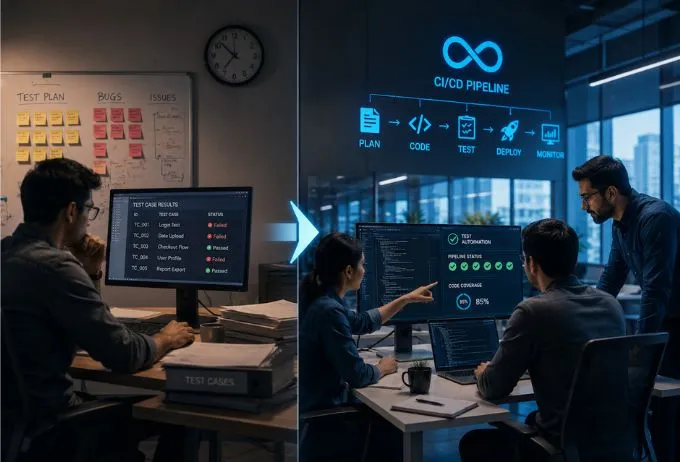
Continuous testing is how enterprises that deploy daily or hourly keep quality under control. They cannot treat testing as a final checkpoint. Handing code to a separate QA team at the end of a sprint is not just slow. It is a structural liability. The faster teams ship, the harder manual quality gates become, and the more each escaped defect costs in production.
ICANIO builds continuous testing programs that remove the handoff bottleneck between development and quality validation. Developers get fast, automated feedback at every commit instead of delayed sign-off at sprint end. Our Application Development practice covers automation strategy, security integration, quality gate enforcement and DORA metrics programs. This guide explains what continuous testing means in 2026, how it fits a CI/CD pipeline, how DevSecOps extends it and how to measure its impact.
Key Takeaways
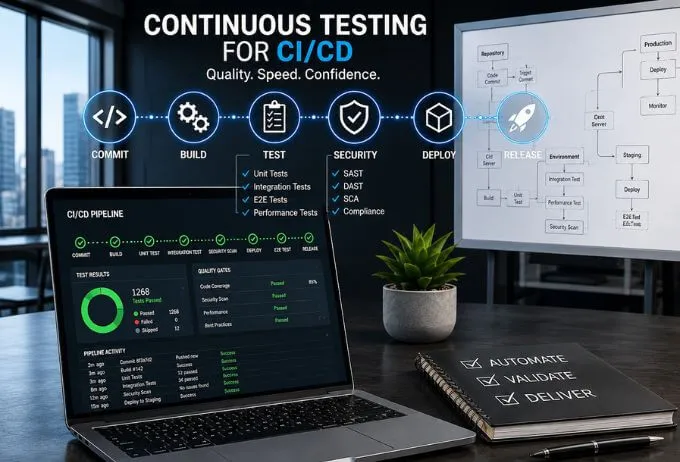
- Continuous testing runs a layered set of automated checks on every commit, with no manual trigger.
- A CI/CD pipeline without automated quality gates simply moves defects to production faster.
- Shift-left testing moves checks closer to code creation, where defects are cheapest to fix.
- DevSecOps adds SAST, DAST and software composition analysis to the same pipeline.
- DORA metrics give a clear, shared way to measure pipeline health over time.
What Continuous Testing Really Means in 2026
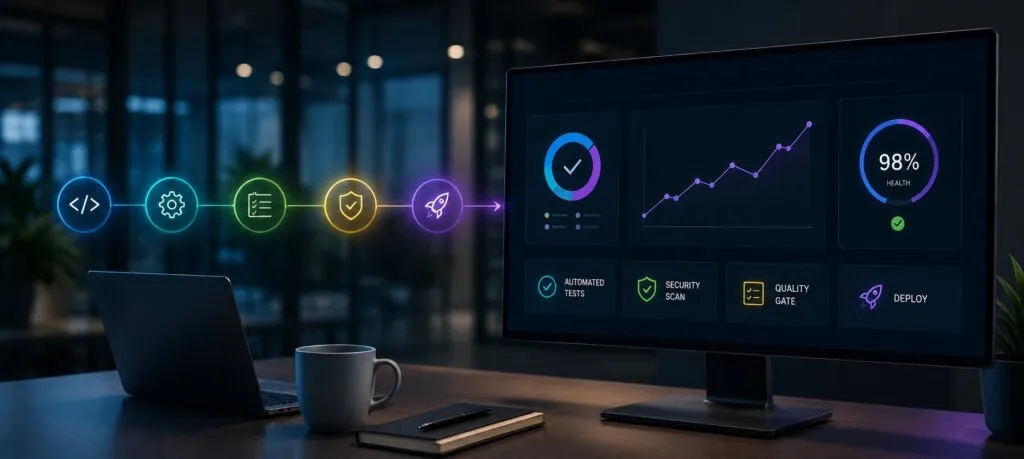
Continuous testing is not simply running tests automatically. It is a strategy where every commit triggers a structured, layered verification process. Developers get fast, accurate feedback before code reaches production.
The distinction matters. Many teams automate some tests without achieving real continuous testing. They run a subset of checks on merges to main. They do not test every commit, every relevant environment or every test type.
A mature continuous testing framework has four defining traits:
- Automated execution on every commit. No human decision starts a test run. Every push triggers the relevant suite.
- A layered test architecture. Unit, integration, end-to-end, performance and security tests each play a distinct role at a distinct stage.
- Parallel execution. Platforms such as GitHub Actions, GitLab CI and Azure DevOps return results in minutes rather than hours.
- Intelligent test selection. AI-powered tools pick the tests most likely to catch failures for a given change, reducing redundant runs.
Why CI/CD Pipeline Quality Depends on Continuous Testing
A CI/CD pipeline without automated checks is not a delivery accelerator. It is a failure accelerator with a faster clock. Every stage without automated validation lets defects move toward production undetected. The speed advantage of a CI/CD pipeline is only realised when quality gates sit at every stage.
| Dimension | Manual QA | Continuous testing |
|---|---|---|
| Trigger | End of sprint | Every commit |
| Feedback time | Hours to days | Minutes |
| Detection point | Before release | At the faulty commit |
| Coverage | Varies with time | Policy-enforced |
| Security checks | Periodic | Every build |
Distributed teams across time zones benefit most. When every commit is validated automatically, the sequential wait between development and testing disappears. Release cycles shorten without lowering confidence in quality.
Shift-Left Testing in the CI/CD Pipeline
Shift-left testing moves quality activities earlier in the lifecycle, closer to the point of code creation. In a CI/CD pipeline, it means three things. Developers write and run tests as part of daily work. Security scans run at commit time rather than before release. Contract tests verify microservice interactions before integration environments are needed.
The economic case is simple. A defect caught during development costs a fraction of the same defect found in production. The earlier the pipeline detects a failure, the less context the developer has lost.
Our team implements shift-left testing with a few concrete practices:
- Pre-commit hooks for formatting, linting and fast unit tests.
- Coverage enforcement on new code in every pull request.
- Static analysis integrated into the build.
- Contract tests between services that change independently.
Together, these make continuous testing begin before code even reaches the shared repository.
Building a Test Automation Strategy That Scales
Large enterprises handle many code changes every day. A test automation strategy that works for a small team can break as headcount grows. Early architecture decisions determine whether the suite stays a reliable signal. The alternative is a slow, brittle collection of flaky checks that teams learn to ignore.
A scalable strategy follows the test pyramid. It has a large base of fast unit tests, a moderate layer of integration tests and a thin layer of end-to-end tests. Each layer has a distinct pipeline role:
- Unit tests run on every commit and give feedback within minutes.
- Integration tests run on every pull request and validate cross-service behaviour before merge.
- End-to-end tests run on every staging deployment and cover critical paths only.
Choosing Tools for Continuous Testing
Tool selection is one of the most consequential continuous testing decisions. Playwright is a strong choice for UI and end-to-end testing. Postman or Karate suit API testing. For unit testing, use the framework native to the codebase, such as Jest, PyTest or JUnit. For performance testing, k6 or Gatling can run in the pipeline before production deployments.
Our teams build frameworks for long-term maintainability. Code review standards, naming conventions and refactoring discipline are built in from the start. They are not added after the suite becomes unmanageable. For more on tooling choices, see our guide to QA automation and time-to-market.
DevSecOps: Security Testing in the CI/CD Pipeline
DevSecOps embeds security testing into development and delivery instead of treating it as a separate pre-release step. It extends continuous testing to the security surface. In a mature DevSecOps framework, security is a first-class part of every pipeline stage. Critical findings block deployment automatically.
SAST in the CI/CD Pipeline
Static Application Security Testing (SAST) scans source code for issues such as SQL injection, insecure dependencies and hardcoded secrets. SAST runs at commit or pull request time, before the application is built or deployed. Tools such as SonarQube, Semgrep and Snyk integrate directly into pipeline workflows. Critical findings block the merge or deployment, using the same mechanism as functional quality gates.
DAST in the CI/CD Pipeline
Dynamic Application Security Testing (DAST) probes a running application for exploitable weaknesses, usually in staging. SAST catches code-level flaws at rest. DAST catches runtime and configuration issues that only appear when the application is live. Tools such as ZAP can run automatically against staging before promotion to production. The OWASP Web Security Testing Guide is a useful reference for what to test.
Software Composition Analysis
Modern applications depend on many open source libraries. Software Composition Analysis (SCA) tools monitor these dependencies and alert teams to known vulnerabilities. Projects such as OWASP Dependency-Check show how this works in practice. SCA in the build catches supply chain issues when new dependencies arrive, not during an annual review.
Where regulation requires documented, continuous security validation, this record matters. SAST, DAST and SCA together create an automated, auditable trail that supports compliance work. Our guide to security testing for QA teams goes deeper on this topic.
Measuring Pipeline Health with DORA Metrics
DORA metrics are a widely used way to quantify delivery performance. They measure how fast software ships, how quickly issues are fixed and how stable deployments are. Continuous testing can improve all four DORA metrics. That is why testing investment and engineering maturity are closely linked.
| DORA metric | What it measures | How continuous testing helps |
|---|---|---|
| Deployment frequency | How often you deploy | Removes manual sign-off delays |
| Lead time for changes | Commit to production time | Shortens the validation window |
| Change failure rate | Deployments causing failures | Catches defects before release |
| Time to restore | Recovery after incidents | Speeds diagnosis with regression checks |
The logic is direct. Faster automated feedback shortens lead time. Better coverage lowers change failure rates. Automated regression detection helps teams recover faster. Our team uses DORA metrics baselines to plan continuous testing roadmaps. We target the specific weaknesses that offer the biggest gain for each team's current maturity.
Contract Testing for Microservice Architectures
Microservice systems need tests that validate interactions between services, not just each service alone. Contract testing fills this gap. Tools such as Pact define the expected request and response schema between a consumer and a provider. Both sides are tested independently. Integration failures surface without spinning up the whole distributed system.
Contract testing in the CI/CD pipeline catches integration failures at the pull request stage, before merge. That greatly reduces the cost of integration defects compared with finding them in shared end-to-end environments or production. For organisations with many teams sharing service boundaries, contract testing becomes the main way to coordinate quality without central integration environments.
How to Roll Out Continuous Testing in Phases
Big-bang rollouts rarely work. Our team recommends a phased approach:
- Baseline. Measure current DORA metrics, test coverage and regression time.
- Automate the regression core. Cover the most critical paths with fast, stable tests.
- Add quality gates. Enforce pass rates and coverage floors in the CI/CD pipeline.
- Integrate DevSecOps. Add SAST, SCA and then DAST stages.
- Optimise. Introduce test selection, parallelism and contract testing.
Each phase delivers value on its own. It also gives leadership evidence to justify the next step. Teams can pick up the risk-based testing approach to decide what to automate first.
Environments and Test Data
Continuous testing depends on reliable environments. Provision them from code using containers and cloud templates, so each run starts clean. Version test data alongside the tests. Stub external services where possible. These DevOps practices reduce flaky results and keep the signal trustworthy.
Managing Flaky Tests in Continuous Testing
Flaky tests are the fastest way to lose trust in continuous testing. A test that fails at random teaches engineers to rerun pipelines and ignore red builds. Once that habit forms, real failures slip through.
Our team recommends treating flaky tests as defects with owners and deadlines. Practical steps include:
- Tracking failure history per test and flagging those that fail without code changes.
- Quarantining flaky tests from blocking gates while they are fixed, with a time limit.
- Fixing root causes such as shared state, timing assumptions and unstable test data.
- Reporting flakiness rates alongside DORA metrics so leaders see the trend.
A small, trusted suite is worth more than a large suite nobody believes.
Artificial Intelligence in Continuous Testing
Artificial intelligence and machine learning are changing how teams run continuous testing. Test impact analysis uses change history to select the tests most likely to fail for a given commit. That keeps feedback fast as suites grow. AI-assisted tools can also draft unit tests, suggest missing assertions and cluster similar failures for quicker triage.
These tools work best on top of a sound strategy. They cannot fix a suite built on the wrong layers or unstable environments. Engineers should review generated tests, because a test that mirrors current behaviour can lock in a bug. Used carefully, AI makes continuous testing cheaper to run and easier to maintain across large software development organisations. Our article on AI quality assurance explores this further.
Continuous Testing ROI and Business Case
Engineering leaders need a business case in measurable terms. The strongest cases focus on three outcomes:
- Lower defect leakage. Fewer defects reach production when checks run on every commit.
- Shorter release cycles. Parallel automated execution removes the sequential testing phase.
- Higher developer productivity. Fast feedback lets developers fix defects with full context.
In many organisations, a DORA metrics baseline shows that validation time, not development speed, is the main bottleneck. Manual validation does not scale with team size. A small manual QA team cannot keep pace with a much larger development team. Automated continuous testing can, consistently and at lower cost per release over time.
We structure engagements around clear milestones and documented evidence at each stage. Leadership can track progress from the first automated regression layer to full DevSecOps integration. That evidence trail matters for regulated industries, where quality investment must be documented for audit.
How ICANIO Supports Continuous Testing
ICANIO combines quality engineering with pipeline engineering. Our DevOps and cloud engineering services build the pipelines, environments and observability. Our application development services embed test engineers in product teams. For an example of delivery automation, see our DevOps automation case study.
Conclusion
Continuous testing turns a CI/CD pipeline from a fast route to production into a safe one. It validates every commit with layered automated checks, moves quality left and adds DevSecOps controls to the same flow. DORA metrics then show whether the investment is working.
Start small, measure honestly and expand in phases. If you want help designing continuous testing for your teams, contact ICANIO and our team will be glad to talk through your pipeline.
References
- Continuous testing (Wikipedia)
- CI/CD (Wikipedia)
- Shift-left testing (Wikipedia)
- GitHub Actions documentation
- ZAP
- OWASP Web Security Testing Guide
- OWASP Dependency-Check
- DORA's four keys
- Pact documentation
Frequently Asked Questions
What is continuous testing in a CI/CD pipeline?
Continuous testing in a CI/CD pipeline means automatically running a layered suite of tests on every code change. That includes unit, integration, end-to-end, performance and security tests. It shortens feedback loops from days to minutes and catches defects at the cheapest point. Teams can then deploy more often without taking on more risk.
What is DevSecOps and how does it relate to continuous testing?
DevSecOps embeds security testing into development and delivery rather than treating it as a periodic pre-release task. In a continuous testing framework, SAST runs at commit time, DAST runs against staging automatically and SCA monitors dependencies continuously. Security becomes a quality gate in the CI/CD pipeline, next to functional and performance standards.
How do DORA metrics measure the impact of continuous testing?
DORA metrics measure pipeline health across deployment frequency, lead time for changes, change failure rate and time to restore service. Continuous testing can improve all four. Faster automation shortens lead time, better coverage reduces failures, regression checks speed recovery and reliable quality gates support more frequent deployments with confidence.
What test automation tools are common in enterprise CI/CD pipelines?
Common choices include JUnit and TestNG for unit testing, and Selenium, Playwright or Cypress for end-to-end tests. Pact covers contract testing, while JMeter and k6 handle performance. SonarQube and Snyk support SAST and SCA, ZAP handles DAST, and GitHub Actions, GitLab CI or Azure DevOps orchestrate the pipeline.
What is the difference between SAST and DAST?
SAST analyses source code at rest, before the application runs. It finds insecure patterns, hardcoded secrets and known vulnerability signatures at commit or pull request time. DAST probes a running application in staging for exploitable weaknesses. A mature DevSecOps pipeline needs both, because each catches issues the other cannot see.
How does shift-left testing reduce costs?
Shift-left testing finds defects closer to the moment they are written. The developer still has full context, so fixes are quick and cheap. Later discovery means more people, more coordination and sometimes a production incident. Moving checks into pre-commit hooks and pull requests is one of the simplest ways to make continuous testing pay off.