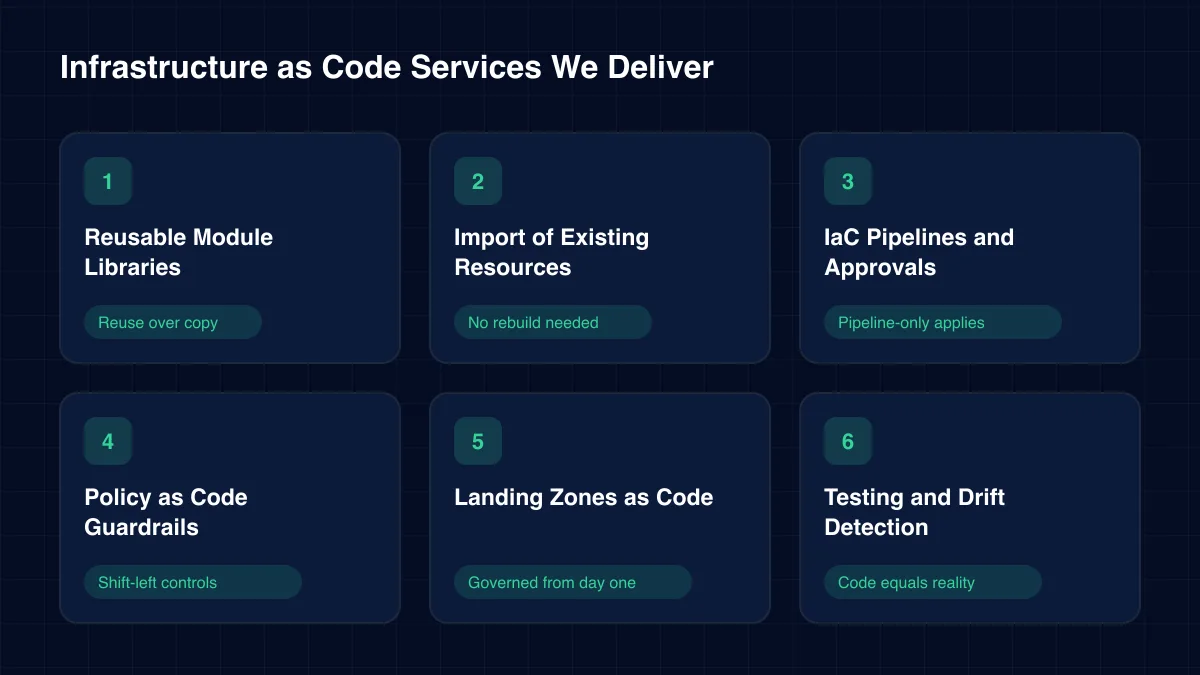
Reusable Module Libraries
Versioned Terraform and OpenTofu modules for networks, clusters, databases and identity. Infrastructure as code services start with a library teams can trust.
Reuse over copy →DevOps & Cloud · Infrastructure as Code
We replace console clicks and one-off scripts with versioned modules, reviewed plans and automated applies. Every network, database and permission is declared, tested and reproducible on demand.
14
Deploys today
38 min
Lead time
0
Failed changes
Infrastructure as code services turn cloud environments into reviewed, versioned software. Instead of clicking through a console, engineers describe networks, databases and permissions in files. A tool then creates or updates the real resources to match.
Our team writes reusable Terraform, OpenTofu and CloudFormation modules, then runs them through a pipeline with plans, policy checks and approvals. Dev, staging and production come from the same code, so they stop drifting apart.
This guide explains what infrastructure as code services include, how we structure modules and state, the main tool choices and how to judge a partner. It draws on ICANIO projects where codified environments delivered 3x faster, safer releases.
Infrastructure as code, or IaC, is the practice of managing infrastructure through machine-readable definition files. The files live in Git. Changes go through pull requests, and a tool applies them in a predictable order.
Most IaC tools are declarative. You state the end result, such as three subnets and a managed database, and the tool works out the steps. Terraform and OpenTofu do this across many clouds. CloudFormation and Bicep do it for AWS and Azure respectively.
Infrastructure as code services cover more than writing files. They include module design, remote state, secrets handling, testing, policy as code, pipeline automation and drift detection. Those pieces decide whether IaC stays trusted or slowly rots.
Done well, IaC changes how teams work. New environments take minutes. Reviews catch risky changes before they apply. Disaster recovery becomes a re-run of code rather than a scramble through old notes.
Working definition
“Infrastructure as code services design, write, test and automate the code that defines cloud resources, so every environment can be created, changed and audited through version control.”
Foundations
Each module does one job well, such as a VPC or a database, and is reused with inputs, not copied.
State lives in encrypted remote storage with locking, so two engineers never apply at once.
Every change produces a readable plan that a reviewer approves before anything is touched.
Write access in the console is removed, and drift checks flag anything changed outside code.
Core capabilities
Our infrastructure as code services cover greenfield builds, legacy imports and the guardrails that keep both healthy.
Versioned Terraform and OpenTofu modules for networks, clusters, databases and identity. Infrastructure as code services start with a library teams can trust.
Reuse over copy →Hand-built resources are imported into code without downtime. We refactor them into modules once state matches reality.
No rebuild needed
Plans run on every pull request, results post as comments and applies run from the pipeline only. Our infrastructure as code services remove local applies entirely.
Pipeline-only applies →OPA, Conftest, Checkov or Sentinel rules block public buckets, missing encryption and untagged resources before they exist.
Shift-left controls →Account structures, shared networking and logging built from code on AWS, Azure or Google Cloud. Our JIRA Data Center build on AWS used CloudFormation end to end.
Governed from day one →Terratest and native test frameworks prove modules work. Scheduled plans catch drift, so infrastructure as code services stay honest after handover.
Code equals reality
Architecture
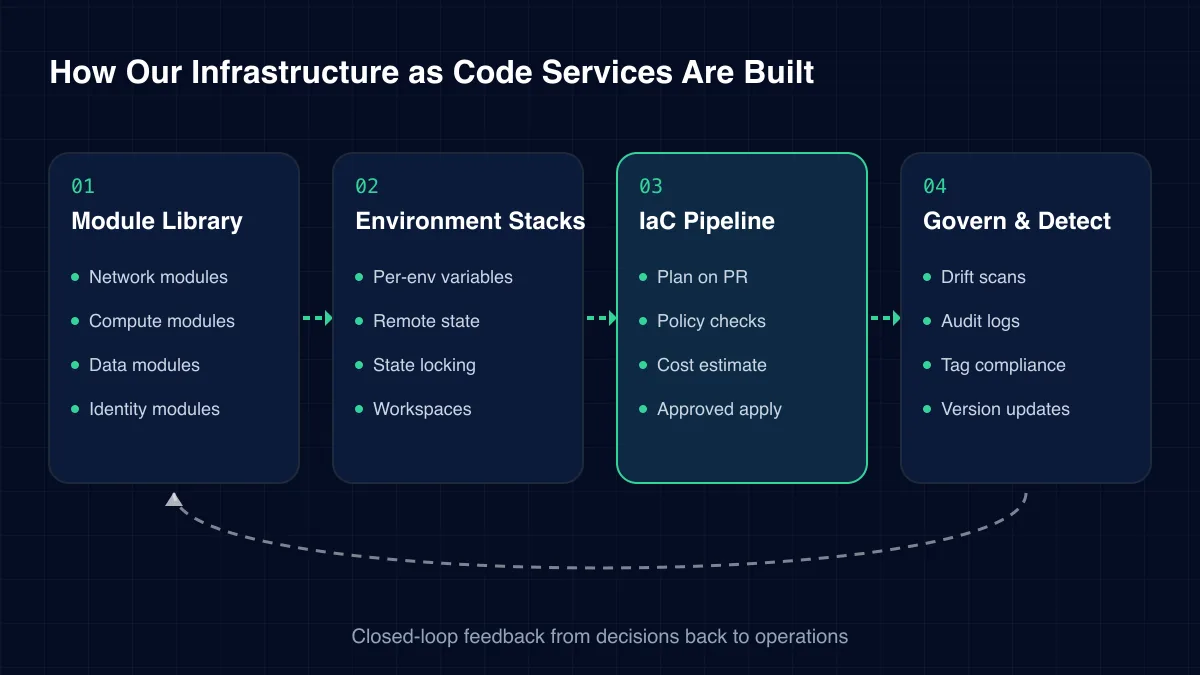
Infrastructure as code services follow four layers. Changes move upward through review and policy, and drift signals flow back down to the owners.
01
02
03
04
Challenges we solve
These are the signs that an estate has outgrown manual changes.
Resources were built in the console and nobody knows every setting. Importing them into code makes the setup visible.
Small differences cause releases that pass tests and still fail live. Shared modules make environments identical.
Each team copied old scripts and changed them. A module library replaces dozens of near-duplicates.
Engineers apply with personal credentials and stale code. Pipeline-only applies fix both problems.
A test environment takes weeks of tickets. Codified stacks spin one up in minutes.
Proving who changed what takes days. Git history and plan logs answer it instantly.
Tool choice depends on your clouds, skills and governance needs. These four approaches cover most estates.
All three are solid. The right pick depends on how many clouds you run and how your team likes to work.
| Factor | Terraform / OpenTofu | CloudFormation | Pulumi |
|---|---|---|---|
| Multi-cloud | ✓ Yes | No | ✓ Yes |
| Language | HCL | YAML / JSON | TS, Python, Go |
| State handling | Remote backend | Managed by AWS | Managed or self |
| Policy as code | OPA, Sentinel | Guard, hooks | CrossGuard |
| Best for | Mixed estates | AWS-only teams | Developer-led teams |
The gains grow with every environment and team that uses the shared modules.
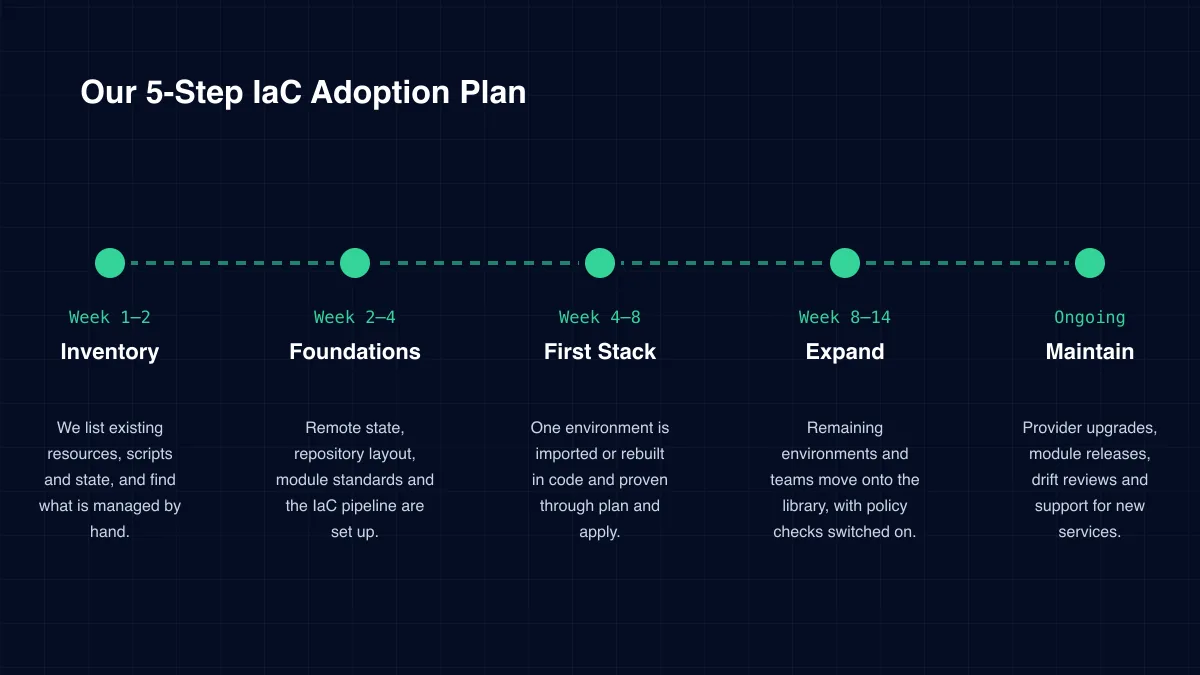
Delivery
Week 1–2
We list existing resources, scripts and state, and find what is managed by hand.
Week 2–4
Remote state, repository layout, module standards and the IaC pipeline are set up.
Week 4–8
One environment is imported or rebuilt in code and proven through plan and apply.
Week 8–14
Remaining environments and teams move onto the library, with policy checks switched on.
Ongoing
Provider upgrades, module releases, drift reviews and support for new services.
Case study
Manual deployments and ad hoc environment management made API releases slow and risky. Provisioning differed across development, staging and production. ICANIO standardised every environment with infrastructure as code, added automated CI/CD and centralised monitoring. The platform delivered 3x faster, safer releases and a 40% reduction in deployment failure risk.
“An API that scales in traffic but not in deployment process just fails in more places at once.”Read the full case study →
Standard environment code
Development, staging and production were provisioned the same repeatable way.
Build · test · deploy
Pipelines handled build, test and rollout, removing the manual steps behind release risk.
Monitoring · config control
Central monitoring and controlled configuration made each new service safe to onboard.
Specialist services within our devops & cloud engineering practice.
IaC written badly is just a new kind of legacy. We recommend checking five things.
Good infrastructure as code services leave you with less code than you expected, not more. Clear modules and strong conventions are what keep IaC maintainable.
State files can hold sensitive values, so we store them encrypted with tight access and versioning. Secrets are referenced from a vault, never written into code.
Static scanners such as Checkov or tfsec check every plan for misconfigurations. Policy as code enforces encryption, private networking and tagging, and blocks applies that break the rules.
ICANIO works under ISO 9001 and ISO 27001 certified processes. Codified controls map neatly to SOC 2, HIPAA or PCI DSS evidence, because each control is a file with a history and an owner.
We measure time to create a new environment, change failure rate for infrastructure, drift findings per month and engineer hours spent on manual provisioning. Each has a baseline from the inventory phase.
Infrastructure as code services also cut hidden risk. A codified estate can be rebuilt after an outage, cloned for testing or moved to a new region. That resilience is hard to price until the day you need it.
Codified stacks help new work, too. Teams can spin up an isolated stack for a machine learning experiment, an IoT ingestion pilot or a manufacturing digital twin proof of concept, then tear it down cleanly.
Technology stack
We work with the tools you have and suggest changes only where they solve a real problem.
Provisioning
OpenTofuPulumi
State & Runs
S3 & DynamoDB lockingAtlantis
Testing
TerratesttflintPre-commit hooks
Policy
OPA & ConftestCheckovtfsecSentinel
Configuration
cloud-initPacker images
Clouds
Infrastructure as code services include module design, environment stacks, state management, IaC pipelines, policy as code, importing existing resources, testing and drift detection.
Both share the same language and most providers. OpenTofu is open source under the Linux Foundation. We weigh licensing, features and your existing tooling before recommending one.
Yes. We import live resources into state, confirm the plan shows no changes and then refactor into modules. Running systems are not rebuilt.
Secrets stay in a vault such as AWS Secrets Manager, Azure Key Vault or HashiCorp Vault. Code references them at runtime, and state is encrypted with restricted access.
Drift is any difference between code and real infrastructure, usually from a manual change. Left alone, it breaks the next apply. Scheduled plans detect it early.
Not at first. Our infrastructure as code services set up the library and pipeline, then train your engineers. Many clients grow a small platform team once adoption spreads.
How we deliver infrastructure as code services and the wider devops & cloud practice in each sector.
Manual infrastructure does not scale with your team or your audits. Codified environments do. They turn infrastructure work into the same reviewed, tested flow your developers already trust.
ICANIO infrastructure as code services build the modules, pipelines and guardrails across AWS, Azure and Google Cloud, then hand them to your team. Contact us to start with a single environment and expand from there.
By ICANIO DevOps & Cloud Engineering Team · Published · Updated
Book a free 30-minute discovery call. We will review your current infrastructure, spot the riskiest manual areas and outline a first codified environment.
Contact Our DevOps Team