Skip to content

Digital Twin Solutions

Industrial-Grade Digital Twin Solutions for Operational Intelligence

ICANIO engineers digital twin solutions: real-time virtual replicas of physical assets, systems, and processes across manufacturing, transportation, healthcare, and beyond. Every deployment is production-validated.

  • 100+ global brands served
  • ISO 9001 & ISO 27001 certified
  • India · Singapore · USA
Live twin
simulated demo

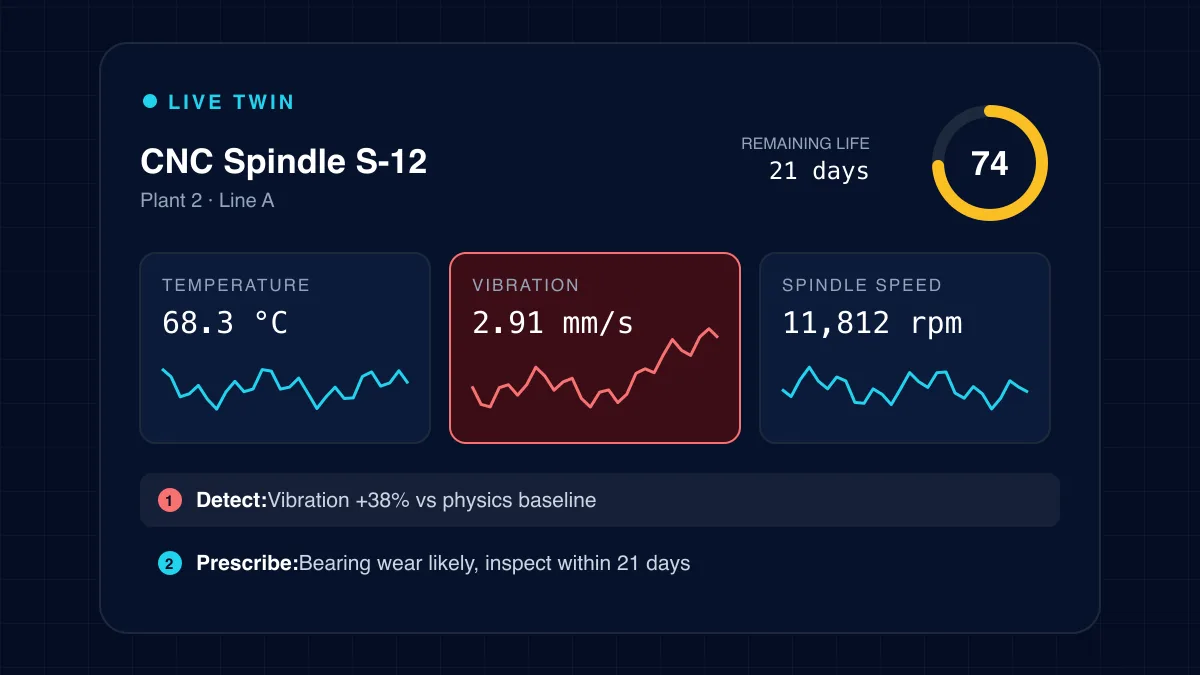
CNC Spindle S-12

Plant 2 · Line A

Remaining life

212 days

Temperature

68.4°C

Vibration

2.07mm/s

Spindle speed

11784rpm

  1. 1Detect: Vibration +38% vs physics baseline
  2. 2Prescribe: Bearing wear likely · inspect within 21 days
  3. 3Act: Work order pushed to ERP · feed rate reduced 8%

✓ All signals within physics baseline

Reduction in unplanned downtime
40%
Reduction in unplanned downtime
Faster anomaly detection
3x
Faster anomaly detection
Fewer physical inspection cycles
60%
Fewer physical inspection cycles
Industries with live implementations
6
Industries with live implementations
Countries with active deployments
9
Countries with active deployments

Unplanned downtime, blind spots between OT and IT, and costly physical trials all share one root cause. Teams cannot see what their assets are doing right now, or what they will do next. Digital twin solutions close that gap.

Our team builds digital twin solutions that stream live sensor data into physics-informed models and predictive AI. The result is a virtual copy of your operation that warns you early, tests changes safely, and feeds decisions back to the floor.

What Is a Digital Twin?

A Digital Twin is a live, data-driven virtual replica of a physical asset, system, or process. It ingests real-time sensor data, operational telemetry, and environmental inputs. It then mirrors the current state of its physical counterpart with precision.

Unlike static simulation models, a Digital Twin evolves continuously. Teams use it to monitor performance, predict failures, test changes virtually, and optimise operations without touching the physical environment.

In the Industry 4.0 and Industry 5.0 era, digital twin solutions have moved from research labs into production floors, hospital wards, vehicle fleets, and logistics networks. ICANIO builds digital twins that don’t just visualise. They actively drive decisions.

Industry 5.0 definition

“A Digital Twin is the convergence of physical operations and digital intelligence, where real-time data from physical systems feeds continuously updating virtual models that drive prediction, optimisation, and autonomous action at scale.”

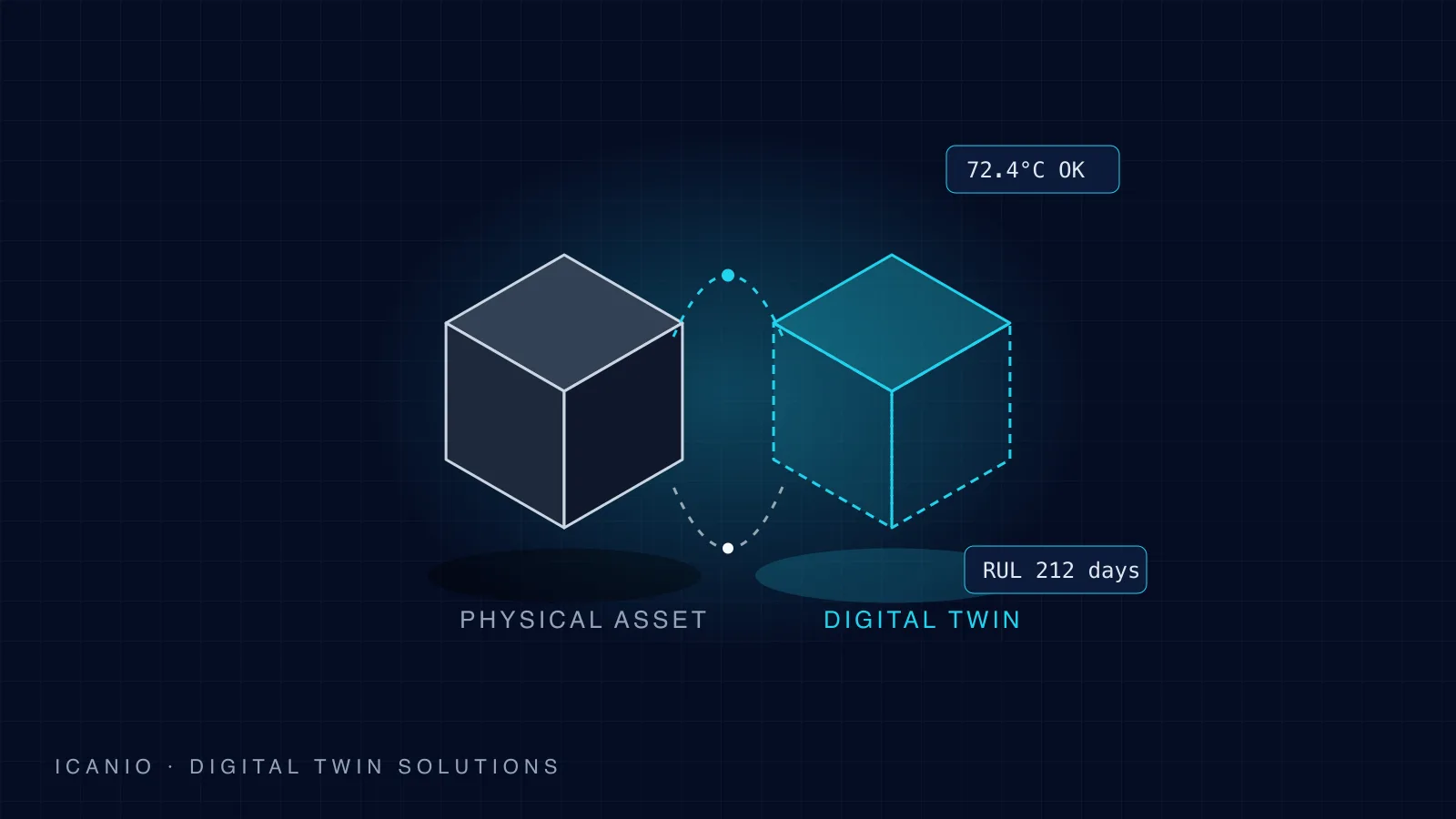
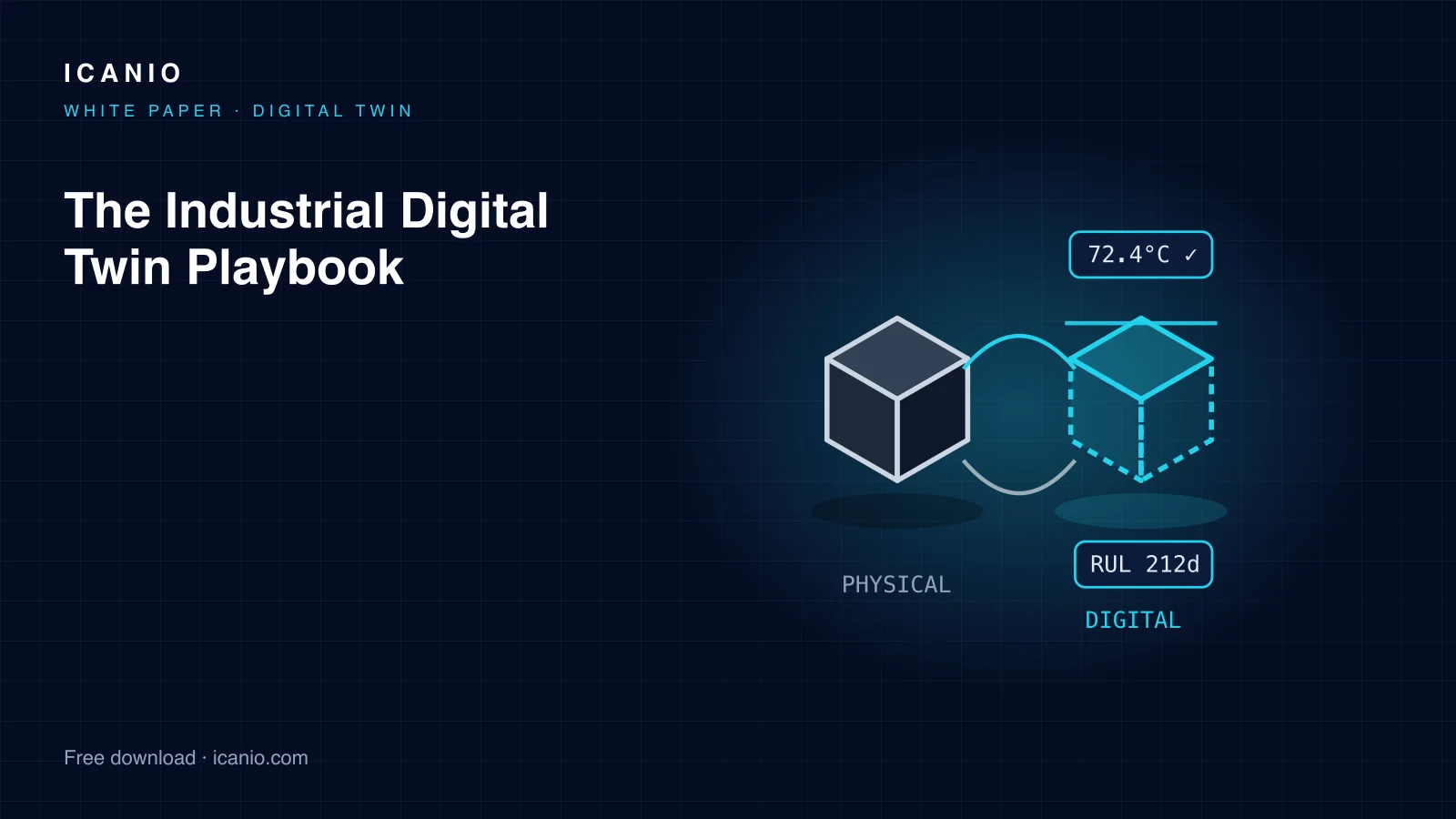
Digital twin solutions: a physical asset mirrored by its live virtual twin

Foundations

Four Core Concepts Behind Every Twin

  1. 01 →

    Real-Time Data Ingestion

    Continuous sensor streams, IoT telemetry, SCADA feeds, and operational logs flow into a unified data fabric with sub-second latency.

  2. 02 →

    Physics-Informed Modelling

    Virtual replicas combine physics-based models, machine learning, and domain expertise to reflect real-world behaviour accurately.

  3. 03 →

    Predictive & Prescriptive AI

    ML models trained on historical and live data power anomaly detection, failure prediction, and prescriptive recommendations.

  4. 04 ↺

    Closed-Loop Feedback

    Insights from the digital model feed back into physical operations through automated controls, alerts, or operator dashboards.

Core capabilities

Six Production-Proven Digital Twin Solutions

Each capability is staffed by engineers who have spent years building production-grade digital twin solutions.

Predictive Asset Health Monitoring

Real-time virtual replicas of critical physical assets, such as machinery, vehicles, and infrastructure. They continuously track health indicators, degradation patterns, and failure precursors.

See: Vehicular Health Monitoring →

Industrial Process Digital Twins

High-fidelity virtual models of manufacturing lines, production workflows, and operational processes. They simulate throughput, bottlenecks, and change scenarios before physical implementation.

30–45% reduction in process downtime

IoT Data Fabric & Edge Integration

End-to-end industrial IoT architecture that connects edge devices, SCADA systems, PLCs, and cloud platforms. It forms one real-time data layer that feeds the twin engine with low-latency telemetry.

Sub-100ms data latency

3D Spatial & Infrastructure Twins

Georeferenced 3D models of facilities, buildings, and campuses with real-time operational data overlays. They enable visual inspection, scenario simulation, and remote monitoring across sites.

Remote facility management

End-to-End Supply Chain Visibility

Digital replicas of logistics networks, warehouses, and supply chains. They provide real-time inventory visibility, demand signal propagation, and disruption simulation from tier-1 to last-mile.

60% faster exception resolution

AI Analytics & Decision Intelligence

Machine learning models and AI inference layers on top of the twin data fabric. They deliver anomaly scoring, root-cause recommendations, and operator-facing decision dashboards.

Proactive vs. reactive operations

Architecture

How Digital Twin Solutions Work, Layer by Layer

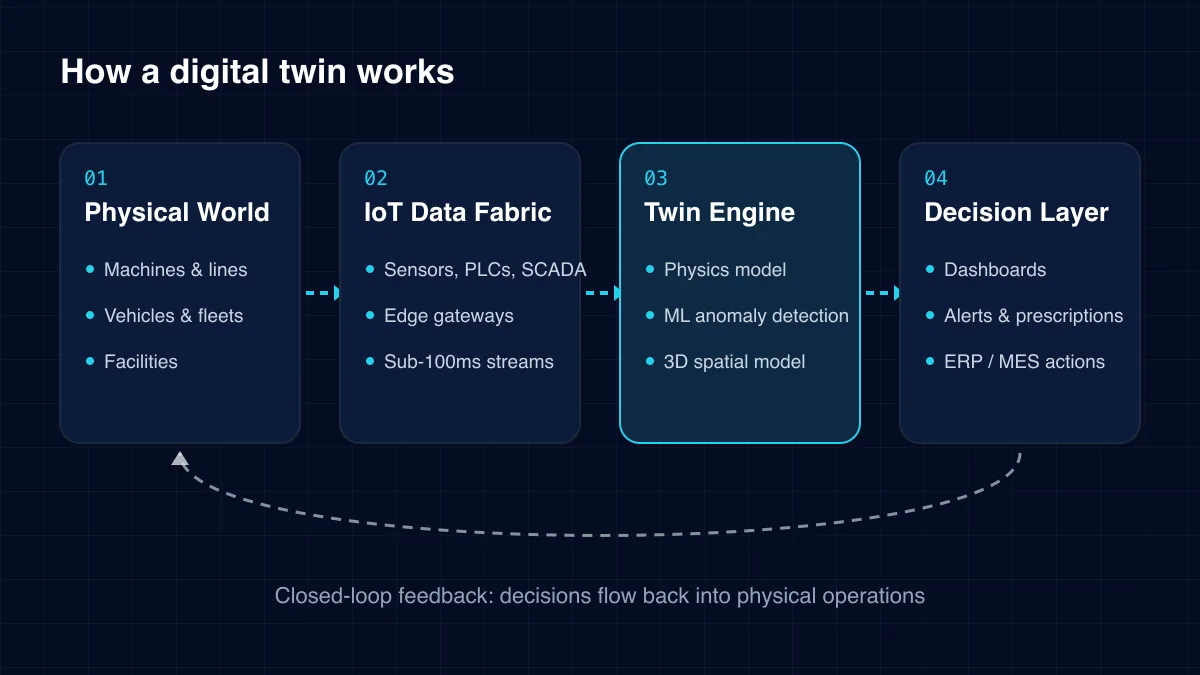
Every one of our digital twin solutions follows the same four-layer pattern. Data flows from the physical world into the twin, and decisions flow back out.

01

Physical World

  • Machines & production lines
  • Vehicles & fleets
  • Facilities & infrastructure
  • Warehouses & logistics

02

IoT Data Fabric

  • Sensors, PLCs & SCADA
  • Edge gateways
  • Sub-100ms streaming
  • Unified telemetry store

03

Twin Engine

  • Physics-informed model
  • ML anomaly detection
  • Scenario simulation
  • 3D spatial model

04

Decision Layer

  • Operator dashboards
  • Alerts & prescriptions
  • ERP / MES integration
  • Automated controls
Closed-loop feedback: Decisions flow back into physical operations through automated controls, alerts and work orders. The twin keeps learning from every outcome.

Challenges we solve

Problems Traditional Monitoring Cannot Address

Modern industrial operations face challenges that static dashboards and periodic reporting were never designed to handle.

  1. 01

    Reactive Maintenance Cycles

    Unplanned downtime is the most expensive operational failure in manufacturing, transportation, and healthcare. Digital twins shift maintenance from reactive repair to predictive intervention. They catch failures before they occur.

  2. 02

    No Real-Time Operational Visibility

    Physical assets generate more data than traditional systems can process in time. Actionable insights arrive too late. Digital twins close that gap with continuous, real-time intelligence.

  3. 03

    High Cost of Physical Testing

    Validating process changes or new configurations through physical trials is expensive and disruptive. Digital twins let teams simulate change impacts virtually, with zero production risk.

  4. 04

    Disconnected OT and IT Systems

    Operational technology and enterprise IT systems are usually siloed. Digital twins act as the integration layer. They connect SCADA, ERP, MES, and cloud platforms into a single source of truth.

  5. 05

    Supply Chain Blind Spots

    Global supply chains lack real-time visibility into inventory, logistics movements, and demand signals. Twin-powered supply chain models surface disruption risks before they become crises.

  6. 06

    Generic Analytics That Miss Context

    Off-the-shelf analytics tools lack the domain models needed to read industrial telemetry accurately. ICANIO trains domain-aware AI on your asset types, operational context, and compliance needs.

Types of Digital Twin Solutions

Digital twin solutions come in four levels of scope. Most programmes start small and grow outward as confidence builds.

  • 1Component twins: Mirror a single part, such as a bearing, motor or battery cell. They are the fastest way to prove value.
  • 2Asset twins: Combine components into a complete machine, vehicle or pump. This is where predictive maintenance pays off first.
  • 3System twins: Link many assets into a production line, fleet or building. They reveal how one failure ripples through the rest.
  • 4Process twins: Model a whole workflow or supply chain end to end. They answer what-if questions about capacity, cost and risk.

Digital Twin vs Simulation vs Dashboards

Teams often ask why they need digital twin solutions when they already run simulations and dashboards. The table shows the difference.

CapabilityDashboardSimulationDigital twin
Live data connection✓ YesNo✓ Yes
Predicts future stateNo✓ Yes✓ Yes
Updates itself from realityNoNo✓ Yes
Tests changes safelyNo✓ Yes✓ Yes
Acts on physical systemsNoNo✓ Yes

Benefits of Digital Twin Solutions

The benefits of digital twin solutions compound as more assets join the model.

  • Less unplanned downtimeBecause faults surface weeks before a breakdown.
  • Lower maintenance costBecause work is scheduled by condition instead of the calendar.
  • Safer changeBecause new settings are tested on the twin before the floor.
  • Faster root-cause analysisBecause every signal is in one timeline.
  • Better capital planningBecause remaining useful life is measured, not guessed.
  • Stronger complianceBecause every alert and action leaves an audit trail.

Delivery

From Discovery to Production in 8 to 16 Weeks

  1. Week 1–2

    Discovery & Scoping

    Map physical assets, existing sensor infrastructure, data sources, and operational objectives to a precise twin scope.

  2. Week 2–4

    Architecture Design

    Design the twin architecture: IoT data fabric, physics model, ML layers, cloud infrastructure, and integration points.

  3. Week 4–6

    POC Delivery

    A proof of concept validates the core twin capability on your real asset data before full build commitment.

  4. Week 6–16

    Production Build

    Full system build: data pipelines, twin models, AI analytics, dashboards, integrations, and compliance controls.

  5. Ongoing

    Deploy & Support

    Live deployment with model retraining pipelines, performance monitoring, alert management, and SLA-based support.

Case study

Case Study: Vehicular Health Monitoring Twin

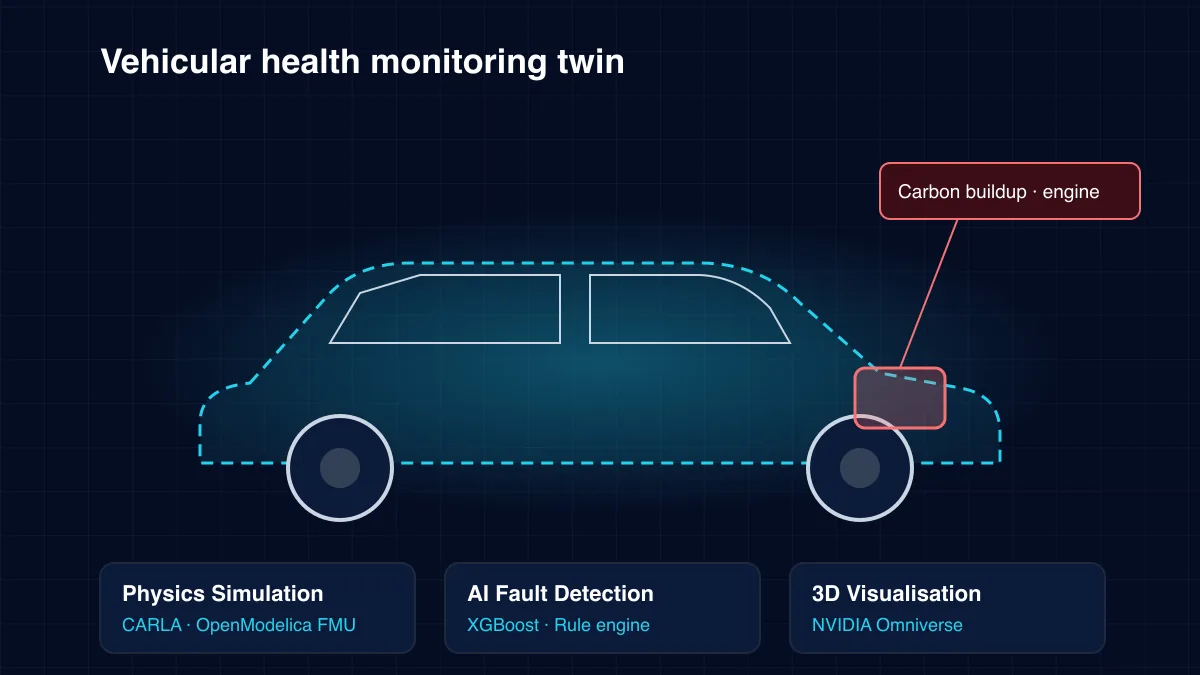
A fleet management technology partner needed to see engine faults before breakdowns. Our team built a live, physics-based mirror of a vehicle engine. The proof of concept validated the full pipeline end to end and detected two distinct real-world engine faults.

“The goal was never just an alert. It was an alert an operator could actually trust and act on.”
Read the full case study →
01

Physics Simulation

CARLA · OpenModelica FMU

Models how a healthy engine should behave under current driving conditions.

02

AI Fault Detection

XGBoost · Rule engine

Compares live sensor readings with the healthy baseline and alerts on sustained deviation.

03

3D Visualisation

NVIDIA Omniverse

Pinpoints the affected component on an interactive 3D vehicle model.

How to Choose a Digital Twin Solutions Partner

Many vendors can draw a 3D model. Far fewer can keep a twin accurate in production. We recommend checking five things before you sign.

  1. 1Proof on real data. Ask for a proof of concept on your own assets, not a canned demo.
  2. 2Physics plus AI. Pure ML drifts without a physics baseline, and pure physics misses wear.
  3. 3OT integration depth. The partner should speak SCADA, PLC and MES, not only cloud APIs.
  4. 4Explainable alerts. Operators must see why an alert fired, or they will ignore it.
  5. 5Life after launch. Models need retraining, sensors fail, and assets change. Plan for it.

Our experience is that the fifth point decides long-term ROI. That is why every ICANIO engagement includes structured post-launch support.

Security, Data Ownership and Compliance

Industrial data is sensitive. ICANIO operates under ISO 9001 and ISO 27001 certified processes.

We design twins so your data stays in your cloud tenancy or on premises. Access is role-based, and every model decision is logged. Edge processing keeps raw telemetry close to the asset when regulations require it.

Measuring the ROI of Digital Twin Solutions

Start with the cost of one hour of unplanned downtime on your most critical asset. Multiply it by the downtime hours you lost last year. That figure is the ceiling your twin works against.

Then add avoided inspection visits, lower spare parts inventory and fewer failed physical trials. We agree these baselines with you during discovery, so results are measured against your own numbers.

Technology stack

The Full Digital Twin Engineering Toolchain

We select the right stack for each of our digital twin solutions. These are engineered architectures, not generic IoT wrappers.

  • Edge & Connectivity

    IoT sensorsPLCsSCADAEdge gateways

  • Data Fabric

    • AWS cloud

    Real-time streamingTime-series storage

  • Physics & Simulation

    OpenModelica FMUCARLAGaussian Splatting

  • AI / ML

    XGBoostRule enginesAnomaly detectionMLOps retraining

  • 3D & Visualisation

    • NVIDIA Omniverse

    Operator dashboardsGPU remote rendering

  • Enterprise Integration

    • SAP
    • Oracle ERP

    Microsoft DynamicsSiemens MES

Inside Our Digital Twin Builds

Digital twin solutions architecture from IoT sensors to decision layer
Four-layer twin architecture with closed-loop feedback
Digital twin solutions asset health console with live sensor trends
Asset health console: live sensors against the physics baseline
Vehicular health monitoring built with ICANIO digital twin solutions
Vehicular health twin: physics, AI fault detection and 3D view

Digital Twin Solutions FAQs

What is the difference between a Digital Twin and a simulation model?

A simulation model is a static or periodic representation used to test scenarios at a point in time. A Digital Twin is a live, continuously updated virtual replica. It ingests real-time data from the physical asset it mirrors. The key difference is that live data connection. A twin reflects the current actual state, not a historical or theoretical one.

What industries does ICANIO deploy digital twin solutions in?

ICANIO delivers digital twin solutions across six industry verticals. They are manufacturing, transportation and logistics, healthcare, retail and e-commerce, fintech and banking, and education and e-learning. Each engagement is staffed with engineers who have domain experience, not generalists adapting generic frameworks.

What infrastructure do I need to start a Digital Twin project?

The minimum is a set of measurable physical assets and access to their operational data. That data can come from sensors, SCADA systems, ERP exports, or manual logs. Our discovery engagement maps your data landscape and finds the lowest-friction path to a live twin. Greenfield IoT sensor deployments can also be scoped.

How long from discovery to a production Digital Twin?

Most engagements reach production within eight to sixteen weeks. The first four weeks cover discovery, scoping, and proof-of-concept delivery on real asset data. The full production build follows in weeks six through sixteen. It includes integrations, AI layers, dashboards, and testing.

Does ICANIO provide ongoing support after the Digital Twin goes live?

Yes. Every deployment includes structured post-go-live support. It covers model performance monitoring, sensor data quality, ML retraining pipelines, dashboard updates, and SLA-based engineering support. ICANIO operates as a long-term partner, not a one-time build vendor.

Can ICANIO integrate digital twin solutions with ERP or MES systems?

Yes. Our twin architecture is designed for enterprise integration from the ground up. Standard connectors exist for SAP, Oracle ERP, Microsoft Dynamics, Siemens MES, and most major SCADA platforms. Custom API integrations are scoped during architecture design for non-standard environments.

Key Takeaways

  • Digital twin solutions are live, self-updating models, not one-off simulations.
  • Value comes from pairing physics models with AI and closing the loop to operations.
  • Start with one critical asset, prove value on real data, then scale out.
  • Plan for retraining and support from day one, because production digital twin solutions must evolve.

Conclusion

Digital twin solutions turn raw telemetry into foresight. They show what your assets are doing now, what they will do next, and what to change.

ICANIO combines industrial IoT, physics-informed modelling and predictive AI in one delivery team. We take you from discovery to a production twin in eight to sixteen weeks, then keep it accurate as your operation changes.

By ICANIO Digital Twin Engineering Team · Published · Updated

Ready to Build Your Digital Twin System?

Book a free 30-minute discovery call. We will map your physical assets and operational data to a delivered twin architecture. You will leave with a scoped engagement path and clear milestones.

Contact Our Digital Twin Team