Industrial IoT Data Platforms
We ingest and normalise telemetry from machines of any vendor or age. The platform sits beside your historian and SCADA, feeding one clean data layer to every downstream tool.
OPC UA, MQTT, Modbus →Manufacturing Industry
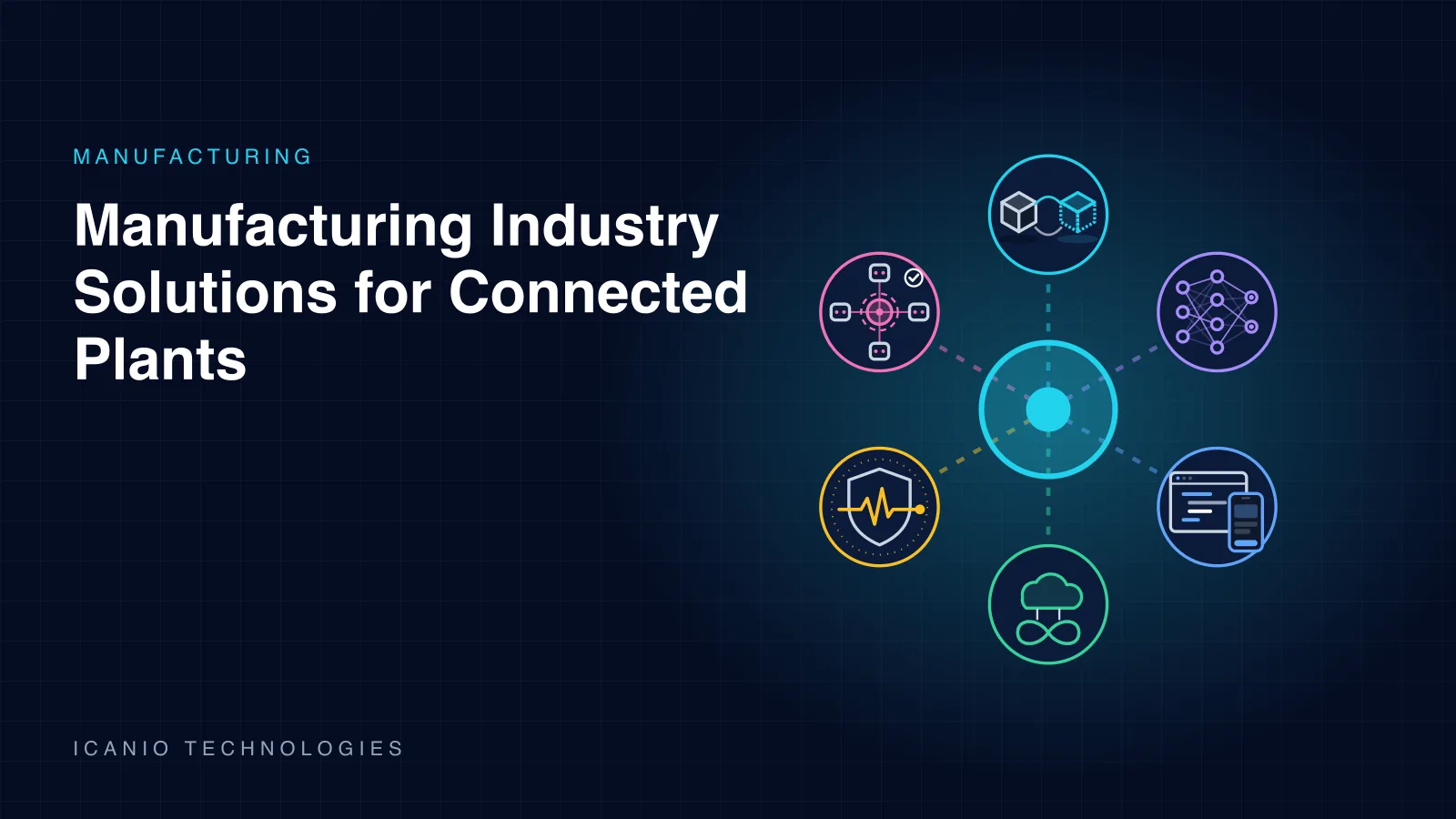
We help manufacturers modernise plant operations without stopping production. Our teams connect machines, MES and ERP, then add predictive maintenance, AI inspection and agents on top of the data you already have.
6 ways we build for Manufacturing
Digital Twin Solutions
Digital Twins of Lines and Critical Assets
Mirror a press, a kiln or a full assembly line in real time. Engineers test changeovers virtually, and this is where manufacturing industry solutions often start.
Digital Twin for Manufacturing →Plants rarely lack data. They lack a way to use it. Sensor readings stay in the historian, scrap counts live in spreadsheets, and the MES never quite matches the ERP. Our manufacturing industry solutions connect those islands so a supervisor can see what is happening on every line, right now.
ICANIO builds software for real factory floors, not lab demos. We integrate with the equipment and systems you already run, from PLCs and SCADA to SAP and Siemens MES. Then we add the intelligence layer: predictive maintenance, computer vision inspection, digital twins and supervised AI agents.
This page explains the challenges manufacturers face today, the systems and standards involved, and how each of our six services applies to a plant. Use it to find the right starting point for your own operation.
Manufacturing industry solutions are the software systems that connect, monitor and improve production. They sit between the machines on the floor and the business systems in the office. They turn raw signals into decisions about maintenance, quality, scheduling and energy.
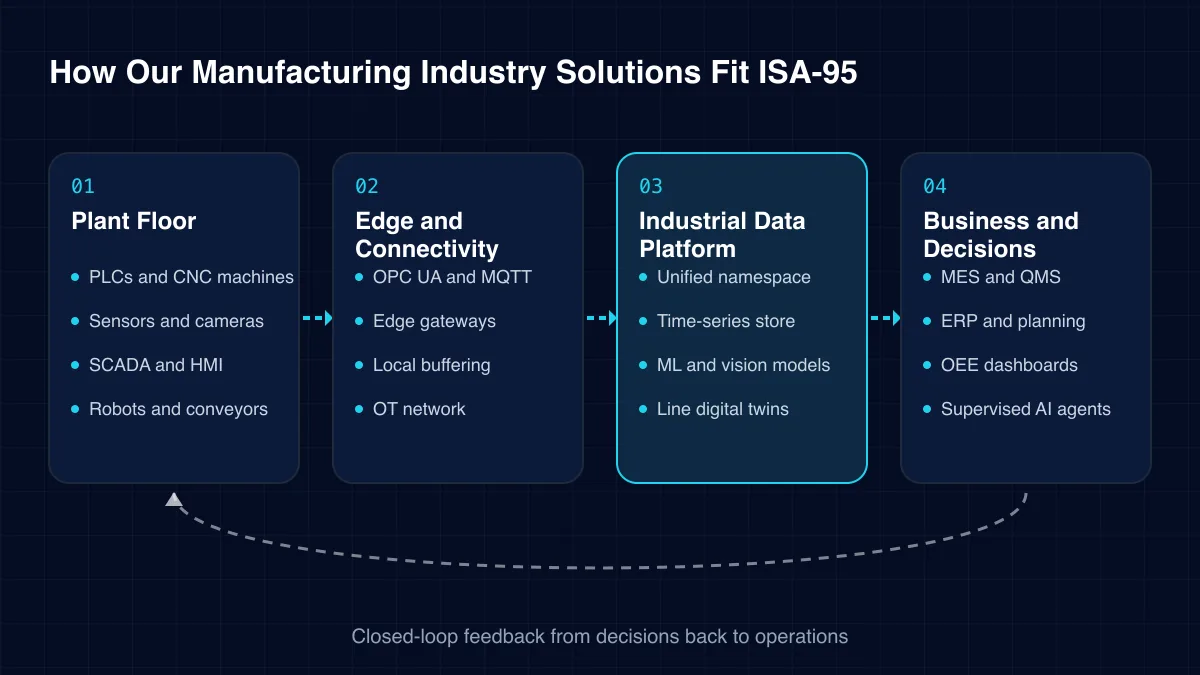
A modern stack follows the ISA-95 model. Level 0 to 2 covers sensors, PLCs and SCADA. Level 3 is the MES, which runs work orders, genealogy and quality. Level 4 is the ERP, which plans materials, orders and finance. Most value is lost in the gaps between these levels.
Good manufacturing industry solutions close those gaps without a rip-and-replace. They read data where it already lives, normalise it, and push decisions back to the people and machines that can act on them.
Plain-English definition
“Manufacturing industry solutions are integrated software platforms that link plant-floor equipment, MES and ERP, so manufacturers can see, predict and improve throughput, quality and uptime in real time.”
Foundations
We connect to existing historians, SCADA and legacy machines. Our manufacturing industry solutions give plants visibility without a capital project or a shutdown window.
Critical monitoring runs at the edge, close to the asset. It keeps working when the plant network or cloud link drops.
Models and agents recommend. Operators and engineers approve. This follows Industry 5.0 thinking and builds the trust adoption needs.
We start on the line with the highest downtime or scrap cost. Early wins fund the next phase of your manufacturing industry solutions instead of a big upfront bet.
Core capabilities
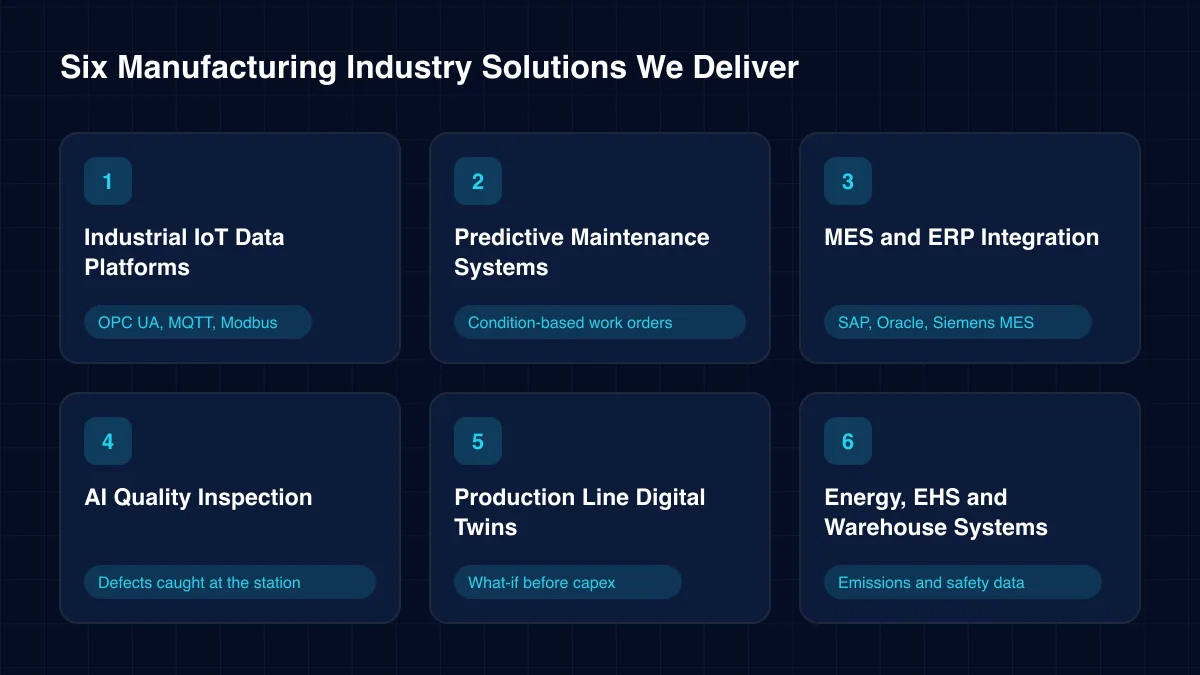
Each of these manufacturing industry solutions is staffed by engineers who have built production systems for industrial clients. Most plants combine two or three of them.
We ingest and normalise telemetry from machines of any vendor or age. The platform sits beside your historian and SCADA, feeding one clean data layer to every downstream tool.
OPC UA, MQTT, Modbus →Models learn the normal behaviour of motors, spindles and pumps. They flag wear early, so maintenance is planned by condition. These manufacturing industry solutions cut surprise breakdowns.
Condition-based work orders →Work orders and bills of material flow down to the line. Completions, scrap and downtime flow back up. No more manual reconciliation at the end of each shift.
SAP, Oracle, Siemens MES
Computer vision checks surface defects, dimensions and assembly at line speed. A detected defect triggers the right hold or rework flow inside your quality system.
Defects caught at the station →Live models of lines and equipment let engineers test layout, speed and changeover ideas before touching the floor. Capital decisions rest on simulation, not guesswork.
What-if before capex →We meter energy by line and shift for Scope 1 and 2 reporting. We digitise safety inspections and near-miss reports, and link WMS with conveyors and robotics.
Emissions and safety data
Mirror a press, a kiln or a full assembly line in real time. Engineers test changeovers virtually, and this is where manufacturing industry solutions often start.
Digital Twin for Manufacturing →Machine learning on vibration, temperature and current data predicts failures. Vision models inspect every part at line speed and feed results to the QMS.
Data & AI for Manufacturing →Operator tablets, maintenance mobile apps and supervisor portals that work with gloves on and offline. They connect straight into MES and ERP.
App Development for Manufacturing →Infrastructure as code for edge gateways and cloud data platforms. Safe, repeatable releases that respect OT change windows and segmentation.
DevOps & Cloud for Manufacturing →Plants run three shifts, so support for manufacturing industry solutions must too. We monitor integrations, data pipelines and apps, and fix issues before the morning meeting.
Support Engineering for Manufacturing →Agents triage alarms, draft work orders and check spare stock. A planner approves each action, so autonomy never outruns trust.
AgenticOps for Manufacturing →Architecture
We map every build onto the ISA-95 levels your engineers already know. Data moves up from the machines, and decisions move back down to the line.
01
02
03
04
Challenges we solve
Manufacturers are under pressure to cut downtime, tighten quality and absorb supply volatility. These are the blockers that manufacturing industry solutions must solve, and we see them on most discovery visits.
Plants generate huge volumes of sensor data. Without a unifying platform, most of it stays in PLC memory or a historian that only one engineer can query.
Machines from different decades speak different protocols. The MES gets partial data, so supervisors still walk the floor with a clipboard.
Reactive maintenance means a bearing fails mid-shift and the whole line stops. Every hour lost cuts directly into throughput and margin.
Human inspectors tire and disagree. Defects slip through to customers, or good parts get scrapped because nobody trusts the check.
Supplier lead times swing and demand shifts weekly. Planners rebuild schedules in Excel because the ERP cannot see live plant capacity.
Inspections, permits and near-miss reports sit on paper. Safety trends only appear after an incident, when it is too late to act.
The right manufacturing industry solutions depend on how you make things. We adapt the approach to four common production models.
Many plants already own a few tools. The table shows why integrated manufacturing industry solutions outperform a patchwork of point products.
| Capability | Spreadsheets | Point tools | Integrated platform |
|---|---|---|---|
| Live machine data | No | Partial | ✓ Yes |
| MES and ERP in sync | No | No | ✓ Yes |
| Predicts failures | No | Partial | ✓ Yes |
| Works with legacy equipment | ✓ Yes | Partial | ✓ Yes |
| One audit trail | No | No | ✓ Yes |
The benefits of manufacturing industry solutions grow as more lines and plants join the same data layer.
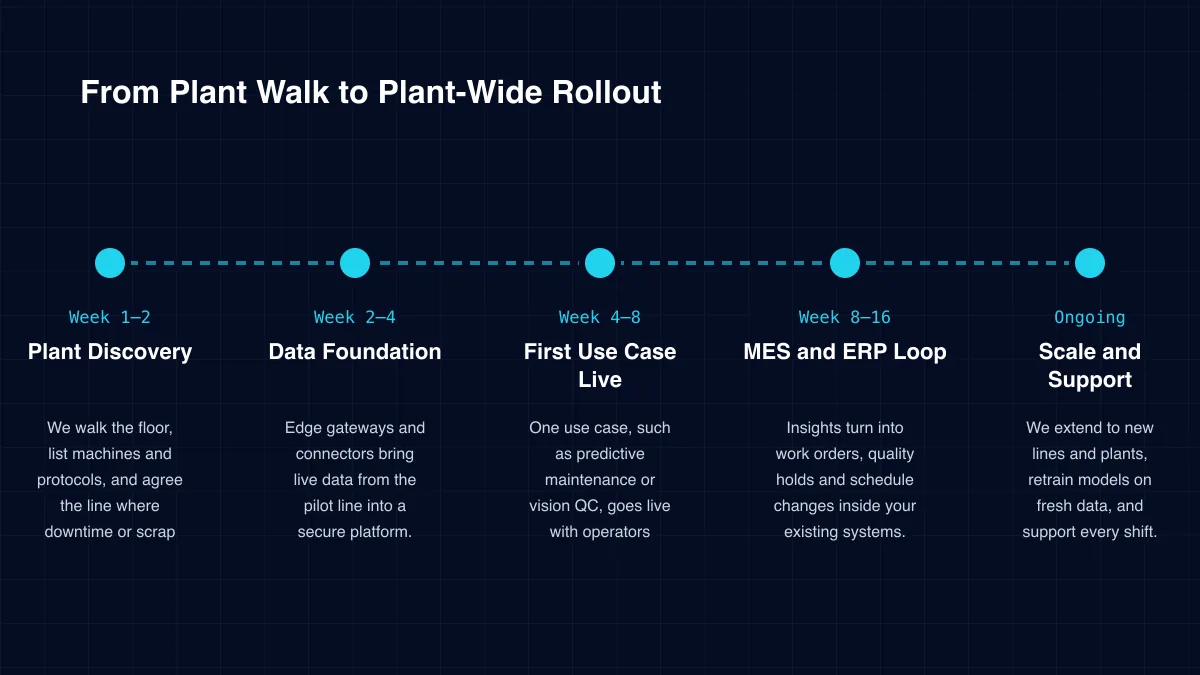
Delivery
Week 1–2
We walk the floor, list machines and protocols, and agree the line where downtime or scrap costs most.
Week 2–4
Edge gateways and connectors bring live data from the pilot line into a secure platform.
Week 4–8
One use case, such as predictive maintenance or vision QC, goes live with operators involved from day one.
Week 8–16
Insights turn into work orders, quality holds and schedule changes inside your existing systems.
Ongoing
We extend to new lines and plants, retrain models on fresh data, and support every shift.
Case study
A global mining and manufacturing leader managed high-value contracts through manual documents and scattered notes. Approvals stalled at every handoff. Our team built a unified contract lifecycle management system on Microsoft Power Platform. It delivered a 100% standardised workflow across departments and eliminated approval bottlenecks.
“A contract waiting in an inbox is not a paperwork delay. It is a business risk with a cost for every day it waits.”Read the full case study →
Power Apps · SharePoint
One governed system of record replaced scattered physical and digital files.
Power Automate · E-signature
Every contract follows the same auditable route through HOD, MAD and stakeholders.
Microsoft Graph API · Azure AD
Contract health, renewals and alerts are visible in real time with secure identity.
Plenty of vendors can show a dashboard. Fewer can keep one accurate on a noisy plant floor. We recommend testing five things before you commit.
In our experience, the last point decides whether a pilot scales plant-wide or stalls after the first line.
Connecting OT to IT creates new risk, so security is designed in from the start. We follow the zones and conduits model of ISA/IEC 62443. Plant networks stay segmented, and edge gateways push data out rather than opening inbound paths.
ICANIO works under ISO 9001 and ISO 27001 certified processes. Data can stay on premises or in your own cloud tenancy. Access is role-based, and every model decision and agent action is logged for audit.
Start with the cost of one hour of unplanned downtime on your bottleneck line. Add the cost of scrap, rework and warranty claims from escaped defects. Those two figures set the ceiling for most manufacturing industry solutions.
We agree the baseline with your team during discovery using OEE, scrap rate and maintenance cost. Results are then measured against your own numbers, not an industry average.
Technology stack
We choose tools that fit your plant and your IT policy. These are the building blocks we use most in manufacturing industry solutions.
Connectivity
OPC UAModbusEdge gateways
Plant Systems
SCADAHistoriansSiemens MESQMS
Enterprise
Microsoft DynamicsPower Platform
Data and AI
Time-series databasesXGBoostComputer visionMLOps
Twin and 3D
OpenModelicaProcess simulation
Cloud and Ops
Yes. We build integrations between the MES, ERP and plant-floor equipment across common industrial protocols. This works even when machines span several vendors and generations. We map data to ISA-95 so it stays consistent.
No. Our manufacturing industry solutions connect to the sensors and machines you already run. Where a machine has no data port, we can add retrofit sensors. Replacement is a last resort, not a starting point.
Not necessarily. We usually build the data platform first, then layer the twin on top once reliable data flows. A twin is only as good as the signals feeding it.
They analyse sensor data to spot early signs of wear or failure. Maintenance teams can then plan an intervention before a breakdown halts the line, instead of reacting after the fact.
Yes. We design hybrid edge and cloud architectures. Critical monitoring runs locally and buffers data when the link drops. It syncs automatically once connectivity returns.
Most plants see a first use case live within four to eight weeks. We start on the highest-impact line so value appears early. Wider rollout then follows in phases.
Manufacturers do not need more dashboards. They need data that reaches the people who can act on it, in time to matter. The right manufacturing industry solutions deliver exactly that, without stopping production.
ICANIO brings digital twins, data and AI, application development, DevOps, support engineering and AgenticOps under one roof. Our team starts where your plant is today and builds forward, line by line, with measurable results at every phase.
By ICANIO Manufacturing Engineering Team · Published · Updated
Book a free 30-minute discovery call with our manufacturing engineers. We will review your lines, systems and goals, and suggest the best first use case. Contact us to scope manufacturing industry solutions for your plant.
Contact Our Manufacturing Team