Unified CI/CD for Financial Platforms
One standard pipeline across teams, built on Jenkins or GitHub Actions. Our DevOps for fintech work replaces patchwork tooling with a single, governed release path.
See: DevOps Automation Platform →DevOps & Cloud for Fintech
We automate delivery for payments, lending, wealth and banking platforms. Every release passes security and compliance gates, carries a four-eyes approval, and leaves the audit trail regulators expect.
14
Deploys today
38 min
Lead time
0
Failed changes
DevOps for fintech starts from a simple fact. In financial services, every manual handoff is also a potential compliance gap. Engineers want to ship faster, while risk and audit teams want proof that each change was reviewed, tested and approved. Too often both sides lose.
Our team builds DevOps for fintech that turns controls into automation. Security scans, policy checks and four-eyes approvals live inside the pipeline. Evidence is captured on every run. Database changes are rehearsed against replicas and scheduled around end-of-day processing.
We have delivered this for a financial services partner, cutting deployment time by 70% while holding 99.9% uptime, and we bring the same patterns to payments, lending and banking teams.
DevOps for fintech is continuous delivery, infrastructure as code and site reliability engineering applied to regulated financial software. It covers payment gateways, core banking integrations, KYC and onboarding, lending engines, wealth platforms, ledgers and the data pipelines between them.
Finance changes the rules in three ways. Controls must be provable: segregation of duties, change approval and access reviews need evidence. Data is sensitive: card data falls under PCI DSS, and personal data under privacy law. And resilience is regulated: frameworks like the EU Digital Operational Resilience Act expect tested recovery.
DevOps for fintech encodes these needs as pipeline gates, so compliance is continuous instead of a pre-audit sprint.
Working definition
“DevOps for fintech is the practice of releasing financial software through automated pipelines that enforce security, segregation of duties and change approval, while producing audit evidence and proving operational resilience.”
Foundations
Approvals, scans and policy checks are pipeline stages, not emails. Nothing reaches production without passing them.
The engineer who writes a change never approves it alone. Four-eyes rules are enforced by the platform.
Each run stores test results, scan reports, approvers and artefact hashes. Auditors get answers in minutes.
Failover, backup restores and rollback are rehearsed on schedule, with results logged for regulators.
Core capabilities
Together, these capabilities form a complete DevOps for fintech platform, from pull request to regulated production.
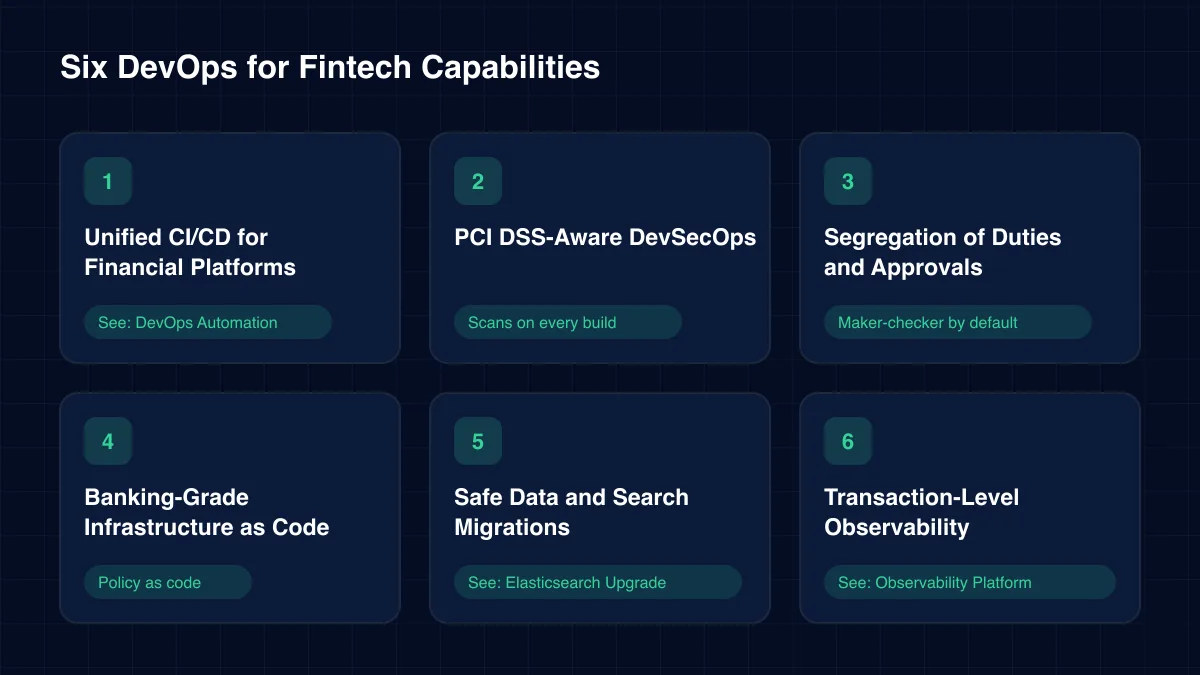
One standard pipeline across teams, built on Jenkins or GitHub Actions. Our DevOps for fintech work replaces patchwork tooling with a single, governed release path.
See: DevOps Automation Platform →SAST, dependency, container, IaC and DAST scans on every build. Services in cardholder data scope get stricter gates and separate approval rules.
Scans on every build
Four-eyes approvals, protected branches and role-based deploy rights enforced by the platform. DevOps for fintech makes the maker-checker rule automatic.
Maker-checker by default
Terraform and CloudFormation for segmented, encrypted, multi-zone environments. Policy as code blocks public buckets, open ports and unencrypted storage.
Policy as code
Phased upgrades for ledgers, search clusters and data stores, with verified backups and reconciliation tests. Nothing moves until the data is secured.
See: Elasticsearch Upgrade →Prometheus, Grafana and ELK dashboards that track payment success, latency and settlement jobs. Alerts fire on business failures, not only on servers.
See: Observability Platform →Architecture
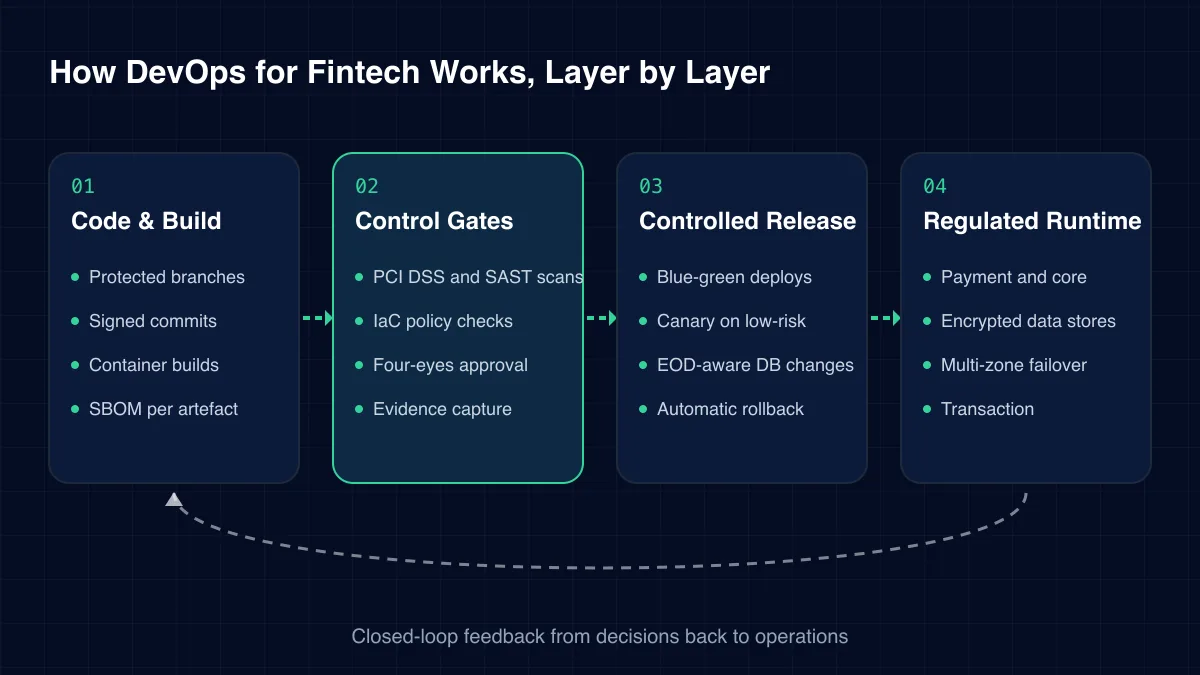
Our DevOps for fintech reference design has four layers. Changes flow down through controls into production. Evidence and health signals flow back up to risk and engineering.
01
02
03
04
Challenges we solve
Before a DevOps for fintech programme, we usually find a mix of these six problems.
Each team runs its own build and deploy tools. Nobody has one view of what is in production or how it got there.
Environments are built by hand. Every new environment repeats error-prone steps, and drift between UAT and production hides bugs.
Approvals live in email and chat. Before each audit, engineers rebuild the trail from memory and screenshots.
Schema changes to ledgers run during business hours without a rehearsal. A failed migration can halt payments or break reconciliation.
Search clusters, operating systems and runtimes drift past end of support. Each deferred upgrade adds security risk and cost.
Monitoring watches CPU and memory. A silent spike in declined transactions goes unnoticed until customers complain.
Financial platforms group into four kinds of systems. Each has its own risk profile.
Generic CI/CD is fast but weak on proof. Manual change boards are slow but auditable. Here is how the options compare.
| Capability | Manual change board | Generic CI/CD | Fintech-ready DevOps |
|---|---|---|---|
| Four-eyes approval enforced | Partial | No | ✓ Yes |
| Automated audit evidence | No | Partial | ✓ Yes |
| PCI-scoped security gates | Partial | No | ✓ Yes |
| Rehearsed database changes | Partial | No | ✓ Yes |
| Release speed | Slow | Fast | Fast |
The benefits of DevOps for fintech reach engineering, risk, compliance and customers.
Delivery
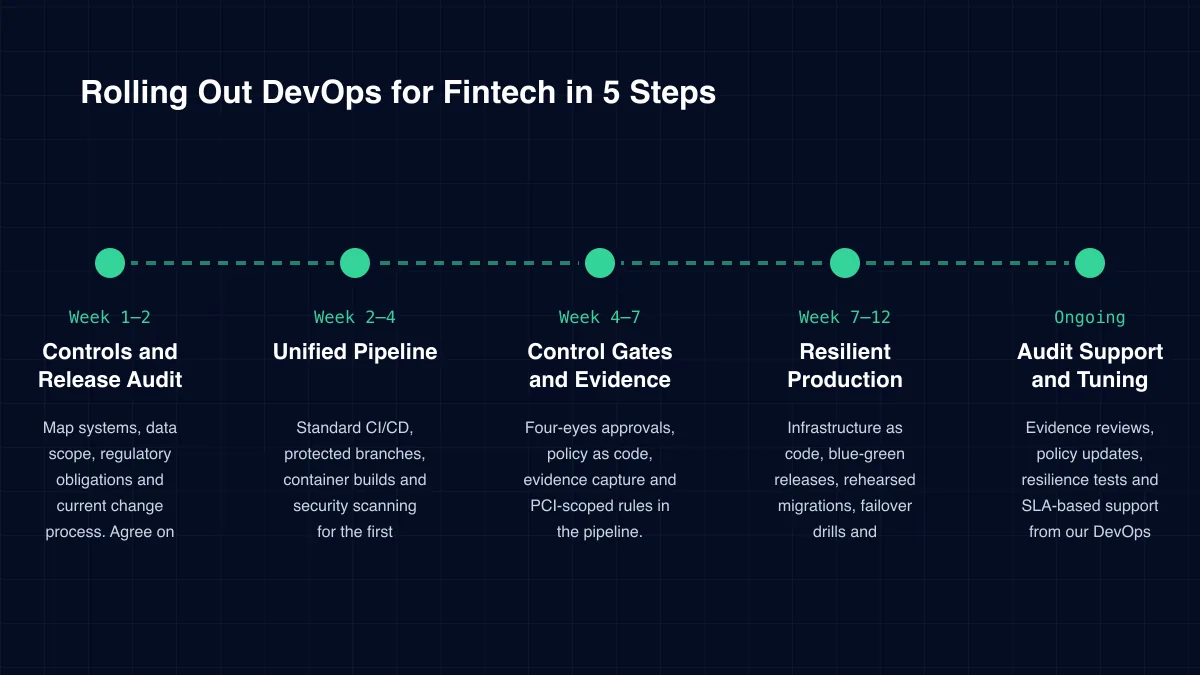
Week 1–2
Map systems, data scope, regulatory obligations and current change process. Agree on evidence needs with risk and audit.
Week 2–4
Standard CI/CD, protected branches, container builds and security scanning for the first services.
Week 4–7
Four-eyes approvals, policy as code, evidence capture and PCI-scoped rules in the pipeline.
Week 7–12
Infrastructure as code, blue-green releases, rehearsed migrations, failover drills and observability.
Ongoing
Evidence reviews, policy updates, resilience tests and SLA-based support from our DevOps engineers.
Case study
A financial services partner struggled with disconnected tools, manual infrastructure provisioning and fragmented governance. Our team built one platform with unified CI/CD, infrastructure as code and centralized observability, plus automated security scanning. Deployments became 70% faster, cloud costs fell by 30%, and the platform sustains 99.9% uptime.
“Disconnected tools do not just slow a release, in financial services they turn every manual handoff into an unaudited gap in governance.”Read the full case study →
Jenkins · GitHub Actions
One standard release process replaced a patchwork of delivery tools.
Terraform · CloudFormation
Manual environment setup became repeatable, auditable deployments.
Prometheus · Grafana · ELK Stack
Central monitoring and proactive alerts cut incident response time.
Speed is easy to promise in finance. Proof is harder. We recommend checking five things.
In our experience, the audit experience decides adoption. When evidence appears automatically, risk teams become the pipeline's strongest supporters.
ICANIO operates under ISO 9001 and ISO 27001 certified processes. Our DevOps for fintech pipelines scan code, dependencies, containers and infrastructure on every change.
Cardholder data scope stays as small as possible, and in-scope services follow PCI DSS-aligned gates. Secrets live in a vault with short-lived credentials. Data is encrypted in transit and at rest. We map pipeline controls to the frameworks you report on, such as PCI DSS, SOC 2 or DORA, and supply the evidence your auditors need.
Start with change lead time. How many days does a tested fix wait for approval and a release slot? Each day adds risk and slows product teams. DevOps for fintech shortens that wait first.
Then add hours spent preparing audit evidence, incidents caused by manual changes, and cloud spend on drifting environments. We baseline these with you during discovery and track them phase by phase.
Technology stack
We build on the tools your teams and auditors already trust where possible. These are common choices.
Source & CI
Security Scanning
SASTDASTContainer scanningSecret detection
Infrastructure as Code
OPA policy
Runtime
Multi-AZ databasesKey managementPrivate networking
Data Platforms
Managed data lakes
Observability
DevOps for fintech is automated software delivery for regulated financial systems. It adds security scans, four-eyes approvals, policy checks and audit evidence to every pipeline, so releases are fast and provable.
We first shrink cardholder data scope, often through tokenization. Services still in scope get stricter scans, approvals and logging aligned with PCI DSS. The pipeline stores the results as evidence for your assessor.
Yes. Protected branches, required reviewers and role-based deploy rights ensure no one person can write, approve and release a change alone. Every approval is logged with the artefact it covered.
We rehearse each migration on a production-like replica, verify backups, run reconciliation tests, and schedule the change outside end-of-day processing. Rollback steps are tested before the real run.
It supports it. DORA expects ICT risk management, incident handling and resilience testing. Our pipelines log changes, and we run and document failover and recovery drills. Your compliance team still owns the full DORA programme.
Our DevOps automation platform for a financial services partner delivered 70% faster deployments, 30% lower cloud costs and 99.9% uptime. Our Elasticsearch upgrade migration for a fintech firm moved 1000 GB with zero data loss.
Financial institutions need speed and proof at the same time. DevOps for fintech delivers both by making every control automatic and every change traceable.
ICANIO brings unified CI/CD, PCI DSS-aware security, infrastructure as code and observability in one team. We start with your slowest approval path, prove it with your auditors, and extend DevOps for fintech across the platform.
By ICANIO DevOps & Cloud Engineering Team · Published · Updated
Book a free 30-minute discovery call. We will review your release process, controls and audit needs. You will leave with a compliant pipeline plan and clear milestones.
Contact Our DevOps Team