Fleet Management and Telematics
We merge telematics, fuel, maintenance and driver data into one fleet platform. Alerts flag engine faults and fatigue risks before they cause a breakdown or incident.
Vehicle health in one view →Transportation & Logistics
Fleet operators, freight brokers and 3PLs run on thin margins. We connect telematics, TMS, WMS and carrier data into one live view, then add routing, prediction and agents that keep freight moving.
6 ways we build for Logistics
Digital Twin Solutions
Fleet and Network Digital Twins
Model each vehicle's engine health or a full distribution network. Test a new depot virtually, a common first step in logistics industry solutions.
Digital Twin for Logistics →A late truck costs more than fuel. It costs a shipper's trust, a detention fee and sometimes the whole account. Our logistics industry solutions give carriers, brokers and 3PLs the live visibility they need to stop surprises before a customer calls.
Most logistics companies already own the data. Telematics units report location and engine health. The TMS holds loads and rates. The WMS knows every pallet. The problem is that none of these systems share a timeline. We connect them, then build routing, tracking and prediction on top.
This page covers the challenges transport and supply chain teams face, the systems and rules that shape the work, and how each ICANIO service applies to a delivery network.
Logistics industry solutions are the software platforms that plan, execute and track the movement of goods. They cover the road, the warehouse and the handoffs between carriers, shippers and customers.
The core systems are well known. A transportation management system (TMS) plans loads and tenders them to carriers. A warehouse management system (WMS) runs receiving, slotting, picking and dispatch. Telematics and ELDs report where each vehicle is and how it is performing. EDI and APIs move orders, status and invoices between partners.
Strong logistics industry solutions make these systems act as one. A delay on the road should re-sequence the dock schedule, update the customer ETA and alert the planner, all without anyone retyping data.
Plain-English definition
“Logistics industry solutions are integrated software systems that link fleets, warehouses and trading partners, so shipments can be planned, tracked and adjusted in real time across every mode and carrier.”
Foundations
Routes must respect hours-of-service, delivery windows and vehicle capacity. Shortest distance is rarely the best plan in logistics industry solutions.
Owned trucks, brokered capacity and 3PL partners appear in one operational picture, not three separate tools.
Our engineers spend time with dispatchers and drivers. Real docks and cab consoles shape the design before code is written.
Holiday surges and storms stress the whole network at once. Logistics industry solutions must scale on the worst day, not the average one.
Core capabilities
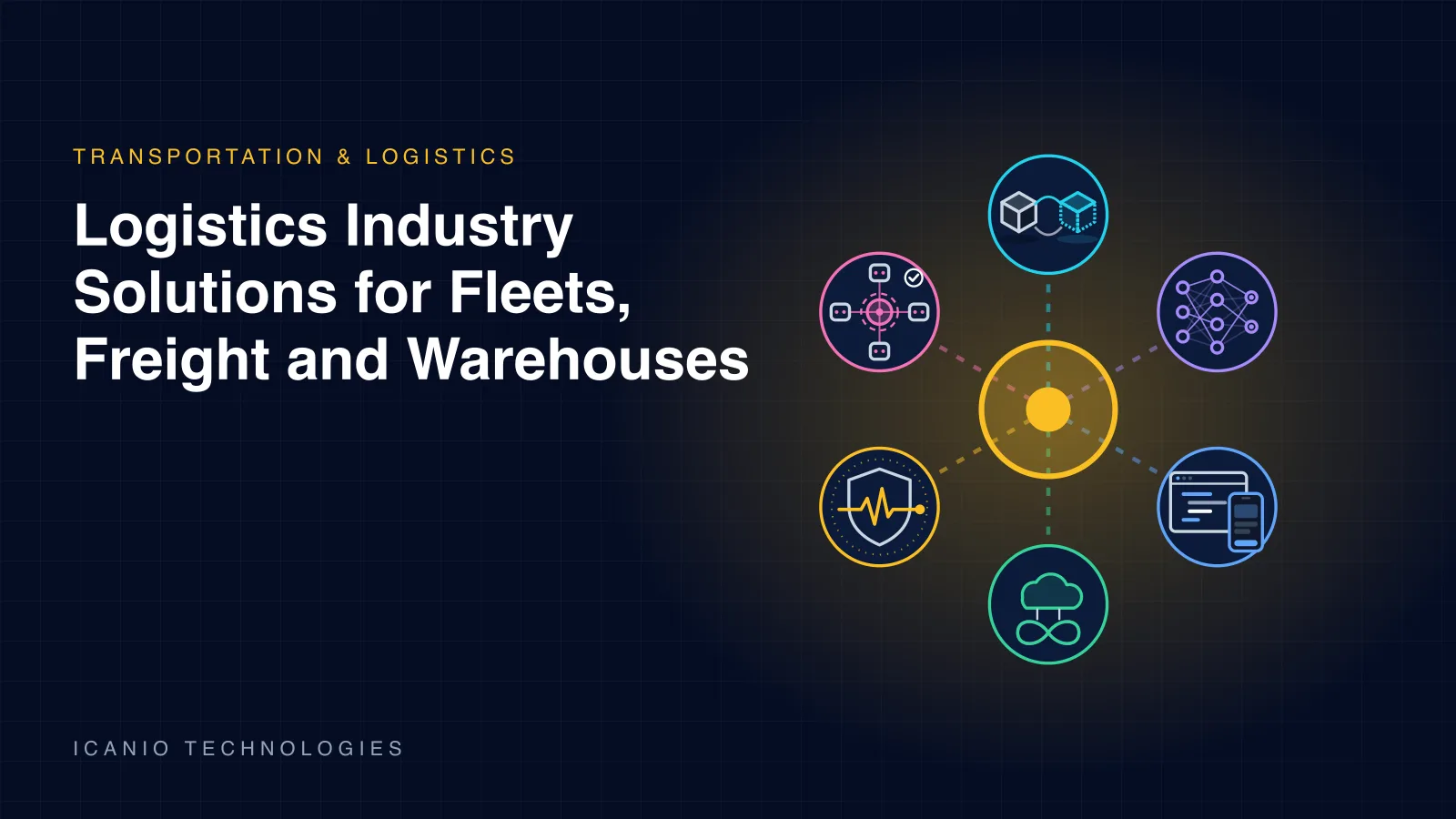
These logistics industry solutions are delivered by engineers who have built production systems for fleets and supply chains. Most clients start with one and add the rest over time.
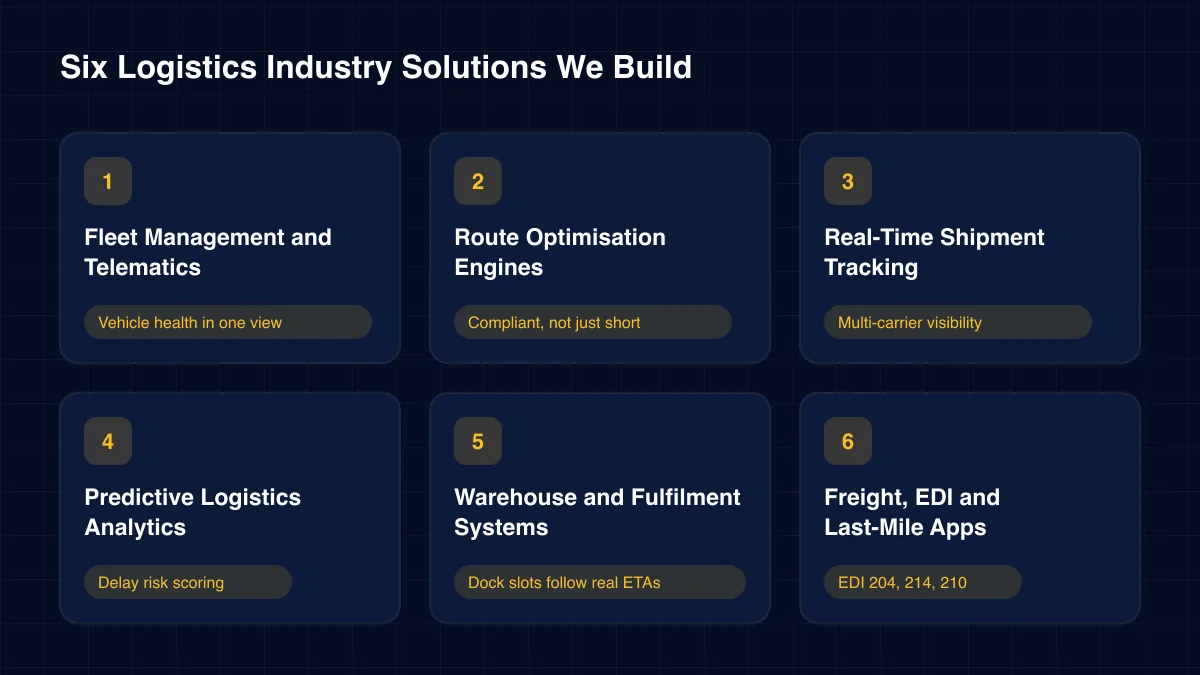
We merge telematics, fuel, maintenance and driver data into one fleet platform. Alerts flag engine faults and fatigue risks before they cause a breakdown or incident.
Vehicle health in one view →Routing that weighs traffic, time windows, capacity and hours-of-service rules. Plans re-optimise during the day as orders and conditions change.
Compliant, not just short →Live status for every load across carriers and modes. The same data feeds customer portals, branded apps and exception dashboards for the operations team.
Multi-carrier visibility
Models forecast demand, capacity and delay risk from history plus weather, traffic and seasonal signals. These logistics industry solutions give planners lead time instead of last-minute scrambles.
Delay risk scoring →WMS builds and integrations with barcode, RFID and dock scheduling. Inventory, pick-and-pack and outbound loads stay in sync with what is happening on the road.
Dock slots follow real ETAs
Brokerage platforms for carrier matching and load tendering. Driver apps with stop sequencing and proof of delivery. EDI and API links to every partner.
EDI 204, 214, 210 →Model each vehicle's engine health or a full distribution network. Test a new depot virtually, a common first step in logistics industry solutions.
Digital Twin for Logistics →Machine learning predicts late loads, forecasts volume by lane and scores carrier reliability, so planners act before a promise breaks.
Data & AI for Logistics →Offline-ready driver apps, branded tracking portals and dispatcher consoles that plug into your TMS, WMS and telematics.
App Development for Logistics →Autoscaling cloud platforms and CI/CD pipelines keep tracking, EDI and portals fast during holiday surges and storm reroutes.
DevOps & Cloud for Logistics →Freight moves at night and on weekends. We monitor EDI feeds, integrations and apps, and resolve incidents before drivers are stuck.
Support Engineering for Logistics →Agents spot a late load, find recovery options, draft the customer update and suggest a carrier. A planner approves before anything is sent.
AgenticOps for Logistics →Architecture
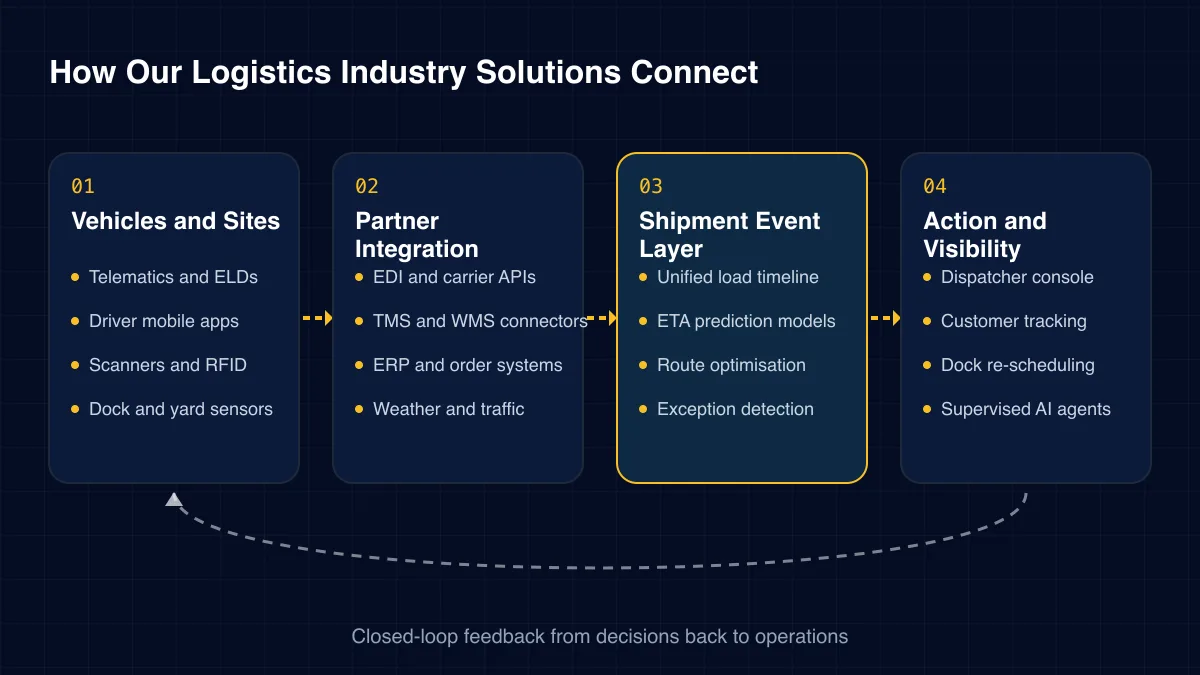
Every build follows the same flow. Signals come in from vehicles, docks and partners. A shared event layer joins them, and decisions go back out to drivers, planners and customers.
01
02
03
04
Challenges we solve
Transport and logistics firms face rising customer expectations with shrinking margins. These are the problems logistics industry solutions are asked to fix most often.
Routes built the night before cannot react to a closed road or a new urgent order. Fuel, time and driver hours are wasted every day.
Telematics, maintenance and driver records live in separate systems. Nobody sees that the truck due for service is also on tomorrow's longest route.
Shippers expect live tracking, but many operations still update status in batches. Customers call the desk to ask where their freight is.
Freight passes through carriers, cross-docks and 3PLs that rarely share data cleanly. A disruption is found only after a delivery is missed.
Company trucks sit in one tool and brokered capacity in another. Planners re-key data, and settlement errors creep in.
Hours-of-service records, proof of delivery and emissions reporting still involve manual steps. Audits become a scramble.
Logistics industry solutions look different for each business model. We adapt the platform to four common operators.
Many carriers run a TMS, a telematics portal and a spreadsheet. The table shows what changes when logistics industry solutions are unified.
| Capability | Spreadsheets | Separate tools | Unified platform |
|---|---|---|---|
| Live shipment status | No | Partial | ✓ Yes |
| HOS-aware routing | No | Partial | ✓ Yes |
| Owned and brokered in one view | No | No | ✓ Yes |
| Predicted ETAs | No | Partial | ✓ Yes |
| Automated partner updates | No | Partial | ✓ Yes |
The value of logistics industry solutions compounds as more lanes, depots and partners share the same data.
Delivery
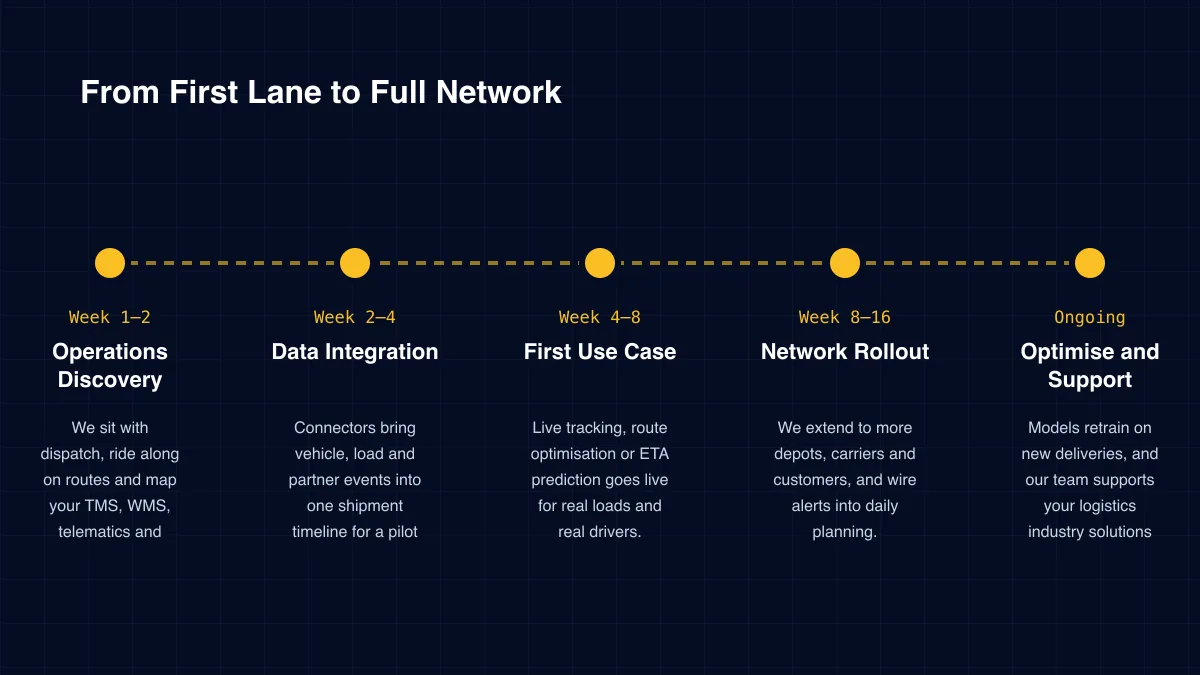
Week 1–2
We sit with dispatch, ride along on routes and map your TMS, WMS, telematics and partner feeds.
Week 2–4
Connectors bring vehicle, load and partner events into one shipment timeline for a pilot region.
Week 4–8
Live tracking, route optimisation or ETA prediction goes live for real loads and real drivers.
Week 8–16
We extend to more depots, carriers and customers, and wire alerts into daily planning.
Ongoing
Models retrain on new deliveries, and our team supports your logistics industry solutions through every peak.
Case study
A fleet management technology partner wanted to catch engine faults before breakdowns. We built a physics-based digital twin of a vehicle engine. It combines physics simulation, XGBoost fault detection and 3D visualisation, and the proof of concept detected two distinct real-world engine faults.
“The goal was never just an alert. It was an alert an operator could actually trust and act on.”Read the full case study →
CARLA · OpenModelica FMU
Models how a healthy engine should behave under the current driving conditions.
XGBoost · Rule engine
Compares live sensor data with the healthy baseline and alerts on sustained deviation.
NVIDIA Omniverse
Shows the affected component on an interactive 3D vehicle model.
Dispatch software often demos well and fails at 6 a.m. on a Monday. We recommend checking five things before you pick a partner.
Our experience is that integration depth decides success. A beautiful tracking screen is useless if the carrier feed behind it is late.
Shipment, customer and driver data is commercially sensitive. ICANIO works under ISO 9001 and ISO 27001 certified processes, with role-based access and encrypted partner links.
We design around the rules your fleet already follows. In the US that includes FMCSA hours-of-service and the ELD mandate. For partners, we follow EDI and GS1 standards so data exchange stays clean and auditable.
Start with three numbers: fuel spend per mile, on-time delivery rate and cost per customer status call. Most logistics industry solutions pay back through gains in these first.
Then add avoided roadside breakdowns, fewer detention fees and lower settlement errors. We baseline each metric with you during discovery and report against it after go-live.
Technology stack
We pick tools that fit your network and your partners. These are the components we use most often in logistics industry solutions.
Vehicle Data
Telematics APIsELD integrationsCAN bus dataGPS feeds
Partner Exchange
EDI X12Carrier APIsWebhooksSFTP
Core Systems
TMSWMSERPYard management
Routing and AI
Route optimisationETA modelsDemand forecastingXGBoost
Apps
Offline sync
Cloud and Ops
No. We integrate with the telematics devices and ELDs you already run. You gain software-level visibility without replacing fleet equipment. New hardware is only suggested where a vehicle has no data source at all.
Yes. Our routing engines factor in hours-of-service limits, delivery windows, vehicle capacity and live traffic. The result is a plan that is both efficient and compliant for each driver.
Yes. We build tracking experiences you can embed in your own portal or mobile app. Branding stays consistent with your business, and the data comes from the same shipment timeline your team uses.
Accuracy grows as more history becomes available. We start with baseline models and refine them as data volume and quality improve. Forecasts always show a confidence level, so planners know how much to trust them.
Yes. Our logistics industry solutions cover trucking, brokerage, warehousing and last-mile delivery. They are not scoped to one mode, so multi-modal networks get one view.
Yes. We build EDI and API integrations for load tenders, status updates and invoices. Brokered and owned-fleet loads then appear together, and partners get updates automatically.
Transport and supply chain leaders win on reliability. The right logistics industry solutions turn scattered vehicle, warehouse and partner data into promises you can keep.
ICANIO covers digital twins, data and AI, app development, DevOps, support engineering and AgenticOps in one team. We start with the lane that hurts most and build outward, measuring every step against your own delivery numbers.
By ICANIO Transportation & Logistics Engineering Team · Published · Updated
Book a free 30-minute discovery call with our logistics engineers. We will map your fleet, systems and partners, and suggest the best first use case. Contact us to plan your logistics industry solutions.
Contact Our Logistics Team