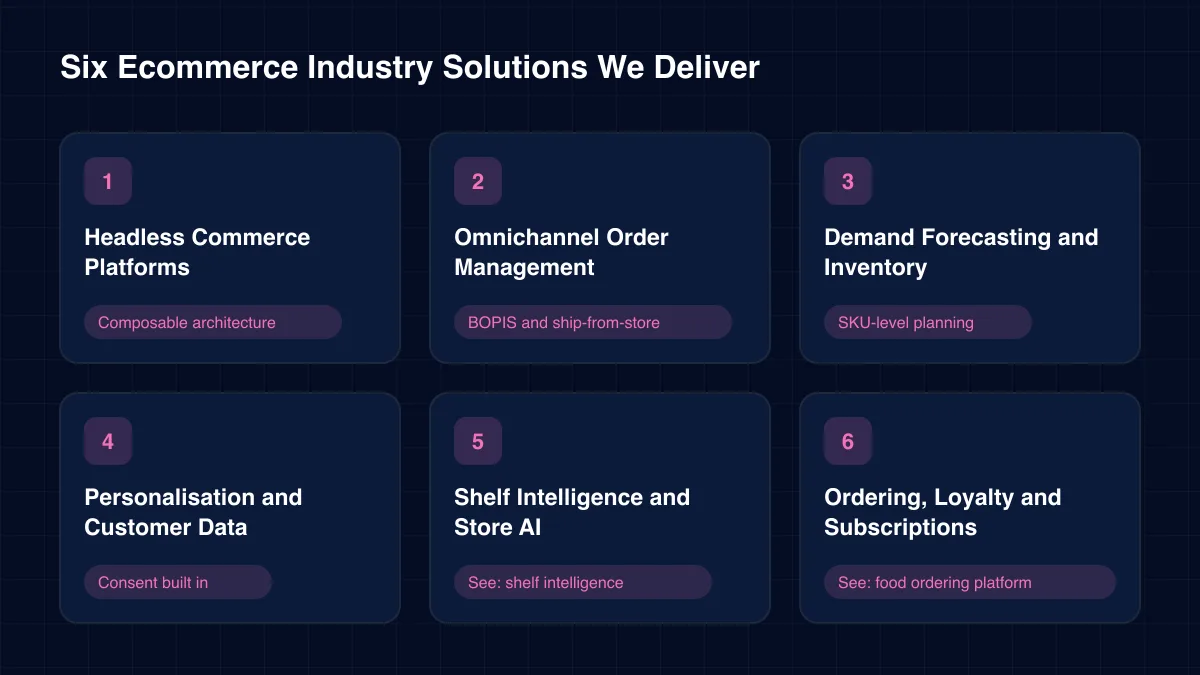
Headless Commerce Platforms
API-first storefronts that launch a new region, brand or marketplace listing in weeks. Inventory, pricing and order data stay consistent everywhere.
Composable architecture →Retail & E-Commerce
Shoppers move between app, web, marketplace and store in a single purchase. We connect POS, OMS, PIM and inventory so every channel tells the same story, then add forecasting, personalisation and agents on top.
6 ways we build for Retail
Digital Twin Solutions
Store, Warehouse and Supply Chain Twins
Model a fulfilment centre or store network inside your ecommerce industry solutions. Test a new layout, slotting plan or promotion's stock impact before it goes live.
Digital Twin for Retail →A shopper sees an item online, checks stock at the nearest store and buys it on a marketplace. If price, stock or delivery date differ at any step, the sale is lost. Our ecommerce industry solutions keep every channel in sync, so the promise a customer sees is the promise you can keep.
Most retailers already have the data. The POS records every basket, the OMS knows every order, the PIM holds every product detail and the loyalty system knows each customer. The trouble is that these systems were bought at different times and rarely talk. We join them with event-driven integration and build growth features on that foundation.
This page covers what retail and online brands struggle with, the systems and rules involved, and how each ICANIO service applies to commerce teams.
Ecommerce industry solutions are the platforms that let a retailer sell, fulfil and serve customers across every channel. They include the storefront, the commerce engine, order and inventory management, and the data and AI that sit behind them.
The core systems are familiar. POS handles in-store sales. An order management system (OMS) routes orders to the right warehouse or store. A product information management (PIM) system keeps catalogue data consistent. A customer data platform (CDP) unifies behaviour, purchases and consent for each shopper.
Modern ecommerce industry solutions are usually headless and API-first. The storefront is decoupled from the commerce engine, so marketing can change the front end without waiting for a full platform release.
Plain-English definition
“Ecommerce industry solutions are connected commerce systems, from storefront and POS to OMS, PIM and AI, that give shoppers one consistent experience and give retailers one live view of stock, orders and customers.”
Foundations
Storefront, search, checkout and content are separate services. Teams change one part of their ecommerce industry solutions without breaking the others.
Inventory events flow in real time from every store and warehouse. Overselling and phantom stock disappear from your ecommerce industry solutions.
Consent is captured and enforced at the data layer. Recommendations respect what each shopper agreed to share.
Conversion, inventory turns, lifetime value and fulfilment cost decide what we build first, not platform trends.
Core capabilities
These ecommerce industry solutions are delivered by engineers who have built storefronts, ordering platforms and retail AI in production. Most brands combine several.
API-first storefronts that launch a new region, brand or marketplace listing in weeks. Inventory, pricing and order data stay consistent everywhere.
Composable architecture →We connect POS, WMS, OMS and marketplaces through events. That powers BOPIS, ship-from-store and marketplace selling from one orchestration layer.
BOPIS and ship-from-store
Forecasts at SKU and location level from sales history, seasonality, promotions and external signals. Stock is rebalanced before a stockout or markdown.
SKU-level planning →Behaviour, purchases, loyalty and support data merge into one profile. A personalisation engine then drives recommendations, offers and tailored search.
Consent built in →AR-guided capture and computer vision give field teams usable shelf images on the first try. Audits move faster and data is clean for analysis.
See: shelf intelligence →Web and mobile ordering tied to kitchen or store workflows, plus loyalty tiers and recurring billing linked to the same customer profile.
See: food ordering platform →Model a fulfilment centre or store network inside your ecommerce industry solutions. Test a new layout, slotting plan or promotion's stock impact before it goes live.
Digital Twin for Retail →SKU-level demand forecasts, recommendation engines, conversational shopping assistants and computer vision for shelf compliance.
Data & AI for Retail →Fast storefronts, PWAs and native apps on shared commerce APIs, plus ordering apps linked to kitchen or store workflows.
App Development for Retail →Autoscaling, load testing and zero-downtime releases so checkout stays fast on Black Friday and during flash sales.
DevOps & Cloud for Retail →Stores trade daily, so ecommerce industry solutions need support all year. We monitor checkout, integrations and payments, and fix issues before carts are lost.
Support Engineering for Retail →Agents enrich product data, answer order questions and flag stock risks. A merchandiser approves changes before they publish.
AgenticOps for Retail →Architecture
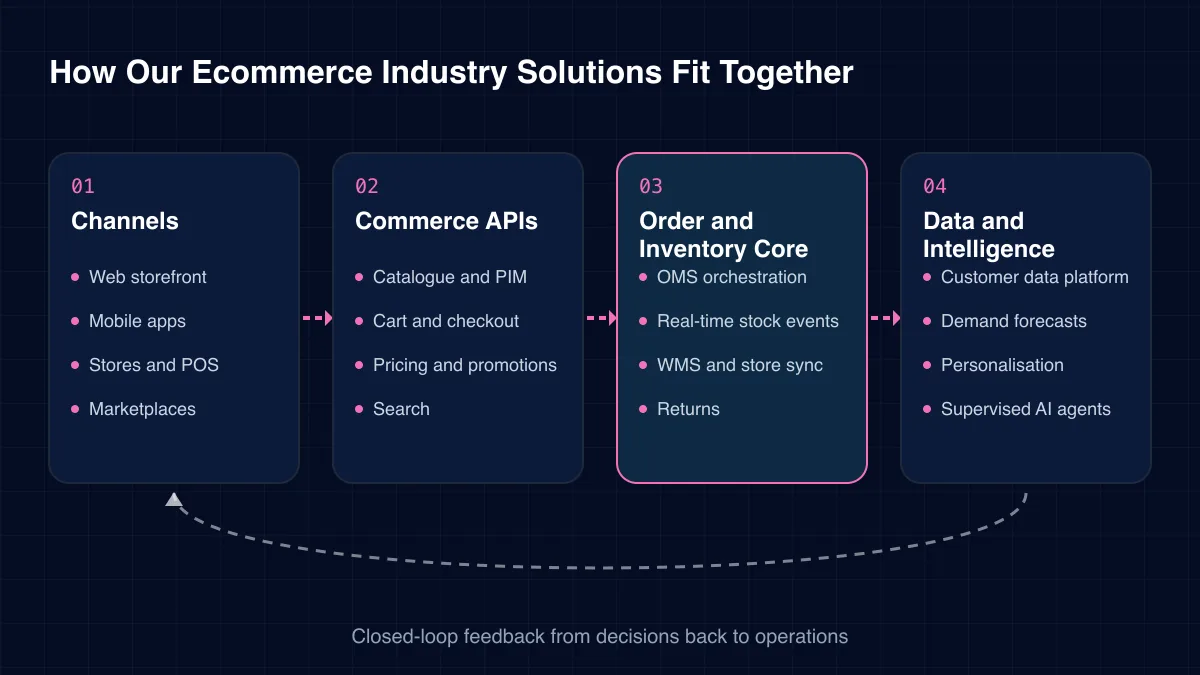
We design commerce as four layers. Channels sit on top of shared APIs, events keep the core in sync, and data and AI turn each interaction into the next best action.
01
02
03
04
Challenges we solve
Retailers face rising shopper expectations and thin margins. These are the gaps ecommerce industry solutions are most often asked to close.
The website shows stock the store sold an hour ago. Prices differ between app and marketplace. Shoppers notice and leave.
Without SKU-level forecasting, slow items pile up and bestsellers run out. Both hurt margin and customer trust.
A monolithic platform makes every new storefront, checkout test or channel a long, costly project.
POS, web, loyalty and marketing each hold a slice of the shopper. Real personalisation stays out of reach.
Flash sales and holiday peaks expose infrastructure that cannot scale. A slow checkout on the busiest day costs the most.
Shelf audits produce blurry photos and late reports. Merchandising decisions rest on data nobody trusts.
Ecommerce industry solutions differ by business model. We tailor the architecture to four common types of commerce business.
Retailers choose between three common models. The table shows how headless ecommerce industry solutions compare.
| Capability | Marketplace-only | Monolithic platform | Headless platform |
|---|---|---|---|
| Own customer data | No | ✓ Yes | ✓ Yes |
| Fast front-end changes | No | Partial | ✓ Yes |
| Real-time omnichannel stock | No | Partial | ✓ Yes |
| Scales for peak traffic | ✓ Yes | Partial | ✓ Yes |
| Add channels quickly | No | No | ✓ Yes |
Returns from ecommerce industry solutions grow as more channels, stores and partners join one commerce core.
Delivery
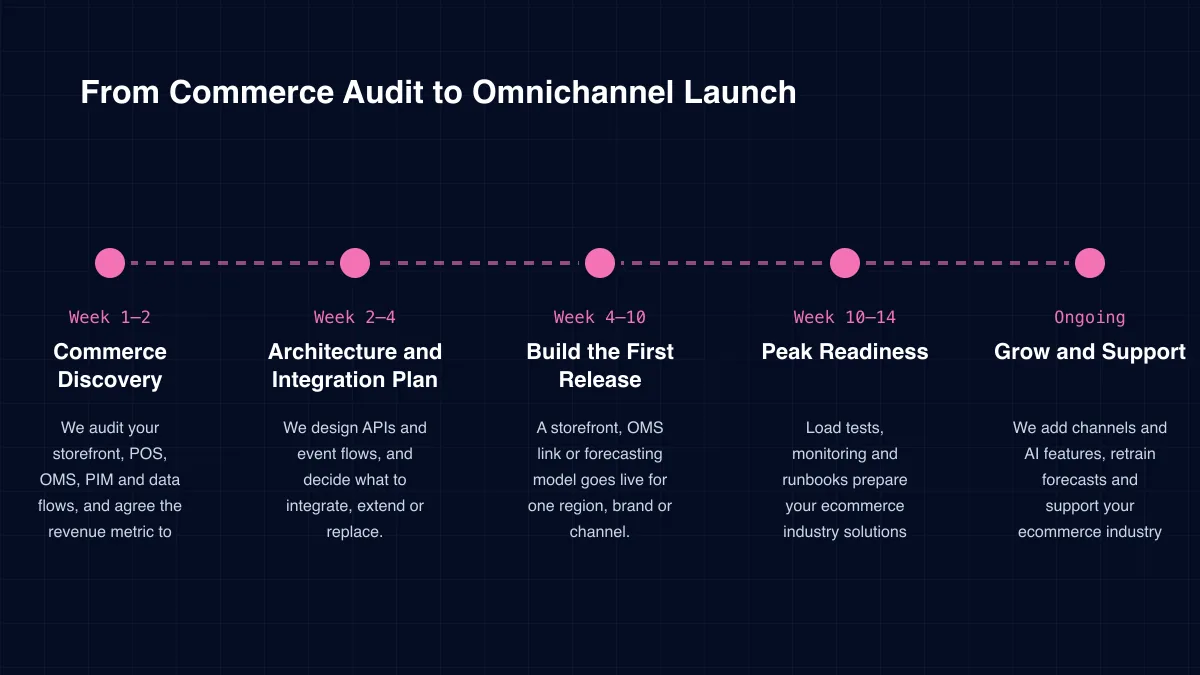
Week 1–2
We audit your storefront, POS, OMS, PIM and data flows, and agree the revenue metric to move first.
Week 2–4
We design APIs and event flows, and decide what to integrate, extend or replace.
Week 4–10
A storefront, OMS link or forecasting model goes live for one region, brand or channel.
Week 10–14
Load tests, monitoring and runbooks prepare your ecommerce industry solutions for the next big sale.
Ongoing
We add channels and AI features, retrain forecasts and support your ecommerce industry solutions all year.
Case study
A retail field operations partner received blurry, inconsistent shelf photos from store audits. Retakes were common and backend teams reviewed images by hand. Our team built an AR-guided, cross-platform capture app with real-time validation. It eliminated retakes, reduced manual backend review and produced usable shelf images on the first capture.
“A blurry shelf photo is a data point the business cannot use, found only after the field team has left the store.”Read the full case study →
iOS · Android · AR SDK
Guides staff to the right distance and angle on any phone.
Mobile computer vision
Checks tilt, slant, overlap and duplicates before a photo is submitted.
Modular AR SDK
Configurable capture rules let the same engine power future field apps.
Many agencies can build a pretty storefront. Fewer can keep stock, orders and data in sync at peak. We recommend checking five things.
Our experience is that integration depth decides whether ecommerce industry solutions pay back or become another silo.
Payment data follows PCI DSS. We keep card data out of your systems wherever possible by using tokenised payment providers, which shrinks audit scope. Customer data is encrypted, access is role-based and every change is logged.
Privacy rules such as GDPR shape how we collect and use shopper data, with consent stored alongside each profile. We also build storefronts to WCAG guidelines, so every customer can shop. ICANIO works under ISO 9001 and ISO 27001 certified processes.
Start with conversion rate, average order value and stockout rate on your top 100 SKUs. Most ecommerce industry solutions pay back through gains in these three numbers first.
Then add markdown cost, fulfilment cost per order and revenue lost to peak-day slowdowns. We set baselines with your team during discovery and report against them after launch.
Technology stack
We pick tools to match your catalogue, channels and team. These are the parts we use most often in ecommerce industry solutions.
Front End
PWA
Commerce
Headless commerce enginesPIMSearchPayments gateways
Orders and Stock
OMSPOS integrationWMSMarketplace APIs
Data and AI
Customer data platformForecasting modelsComputer visionLLM assistants
Cloud
CDNAutoscaling
Operations
CI/CDLoad testingObservabilityIncident runbooks
Both. We build headless architectures from the ground up, or integrate and extend the platform you already own. The choice depends on your current investment and growth plans.
Yes. We sync stock across warehouses, stores and online channels in real time using events. That reduces overselling and improves fulfilment accuracy.
We build customer data platforms with consent management built in from the start. The personalisation engine only uses data each shopper agreed to share, within applicable data protection rules.
Yes. We build on cloud-native, elastically scalable foundations and load test before peak. Checkout, search and inventory services scale on their own when traffic spikes.
Yes. Many engagements start by integrating your current commerce platform, POS and marketing tools. We move to headless only where there is a clear business case.
We usually start with the gap that costs the most revenue. For many retailers that is real-time inventory or forecasting. For online brands it is often storefront speed and personalisation.
Shoppers judge a retailer on its weakest channel. The right ecommerce industry solutions remove those weak spots by giving every channel the same live data.
ICANIO brings digital twins, data and AI, app development, DevOps, support engineering and AgenticOps to one delivery team. Our team starts with the gap that costs you the most revenue and builds from there, measured against your own numbers.
By ICANIO Retail & Commerce Engineering Team · Published · Updated
Book a free 30-minute discovery call with our commerce engineers. We will review your channels, systems and data, and suggest the first release that moves revenue. Contact us to get started.
Contact Our Retail Team