Skip to content

Data & AI for Manufacturing

AI in Manufacturing That Runs on the Plant Floor

We build production-grade models for maintenance, quality and planning. They read your sensor, MES and ERP data, and they push decisions back to the people and systems that run the line.

  • 100+ global brands served
  • ISO 9001 & ISO 27001 certified
  • India · Singapore · USA
Live AI pipeline
simulated demo
IN

CNC-07 spindle vibration, 72h

  1. Ingest

  2. Features

  3. Score

  4. Work order

Fault modeBearing wear
--
Time to failure9–12 days
--
ActionSwap at next changeover
--

⟳ Model running…

Faster decisions in our Enterprise AI Chatbot build
40%
Faster decisions in our Enterprise AI Chatbot build
Models that keep scoring when the plant link drops
Edge + cloud
Models that keep scoring when the plant link drops
Results written back into work orders and holds
MES-native
Results written back into work orders and holds
Certified information security processes
ISO 27001
Certified information security processes

AI in manufacturing only pays off when it changes what happens on the line. A model that predicts a bearing failure is worthless if nobody books the repair. A vision system that flags defects is noise if the lot is not held.

Our team builds AI in manufacturing as part of the plant system, not beside it. We connect to historians, SCADA, MES and ERP data. We train models on your machines and your defects. Then we write the result back as a work order, a quality hold or a plain answer to a supervisor's question.

This guide explains where AI in manufacturing delivers value, how the architecture fits together, what goes wrong, and how to pick a partner who can keep models accurate after launch.

What Is AI in Manufacturing?

AI in manufacturing is the use of machine learning, computer vision and language models on plant data to predict, detect and decide. The data comes from sensors, PLCs, machine logs, quality records and planning systems.

Classic automation follows fixed rules written by engineers. AI in manufacturing learns patterns from history instead. It can spot a slow vibration trend, a faint surface scratch or a scheduling conflict that no rule was written for.

The strongest programmes pair both. Rules handle safety and hard limits. Models handle the fuzzy signals that rules miss. Operators stay in control of the final call.

Working definition

“AI in manufacturing is a closed loop: plant data trains models, models score live signals, and the scores trigger actions inside the systems operators already use.”

AI in manufacturing: a production line scored live by machine learning models

Foundations

Four Foundations of Plant-Floor AI

  1. 01 →

    Clean, Time-Aligned Data

    Sensor tags, MES events and quality results must share one clock and one asset ID. Without that, no model can link a cause to an effect.

  2. 02 →

    Domain-Trained Models

    Generic models do not know your presses, ovens or fillers. We train on your failure history and your defect images, labelled with your engineers.

  3. 03 →

    Edge and Cloud Inference

    Vision and safety-adjacent models run at the edge for speed. Heavier training and fleet-wide analytics run in the cloud.

  4. 04 ↺

    Action in Existing Systems

    Outputs land where work happens: CMMS work orders, MES holds, ERP planning and operator screens. No extra dashboard to ignore.

Core capabilities

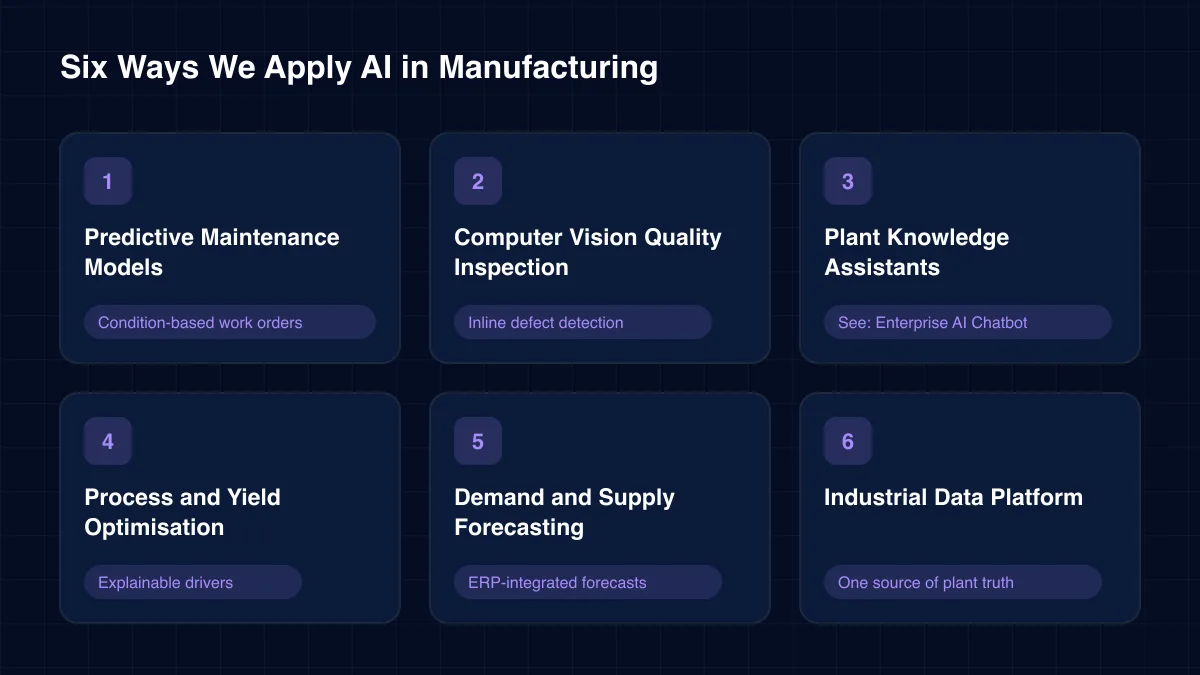
Six Ways We Apply AI in Manufacturing

Each capability below is a production pattern our engineers deliver end to end, from data access to the operator screen.

Predictive Maintenance Models

Models learn how each asset behaves when healthy, then flag drift in vibration, temperature, current or pressure. AI in manufacturing maintenance works best when every alert carries a likely fault mode and a suggested window.

Condition-based work orders

Computer Vision Quality Inspection

Camera models detect surface defects, missing parts and dimensional variance at line speed. Results connect to the MES so a detected defect triggers the right hold or rework path.

Inline defect detection →

Plant Knowledge Assistants

A RAG assistant answers questions from SOPs, maintenance manuals, shift logs and MES tables. Supervisors ask in plain language and get a sourced answer, within their access rights.

See: Enterprise AI Chatbot →

Process and Yield Optimisation

Models relate recipe settings, material lots and ambient conditions to yield and scrap. Engineers get ranked drivers and safe setpoint ranges to test, not a black box.

Explainable drivers

Demand and Supply Forecasting

Forecasts blend orders, seasonality and supplier lead times. They feed ERP planning so material and capacity match real demand.

ERP-integrated forecasts

Industrial Data Platform

Everything above depends on the data layer. We unify historian, SCADA and MES data into one governed store, which is the part of AI in manufacturing most projects underestimate.

One source of plant truth

Architecture

How AI in Manufacturing Fits Your Plant Stack

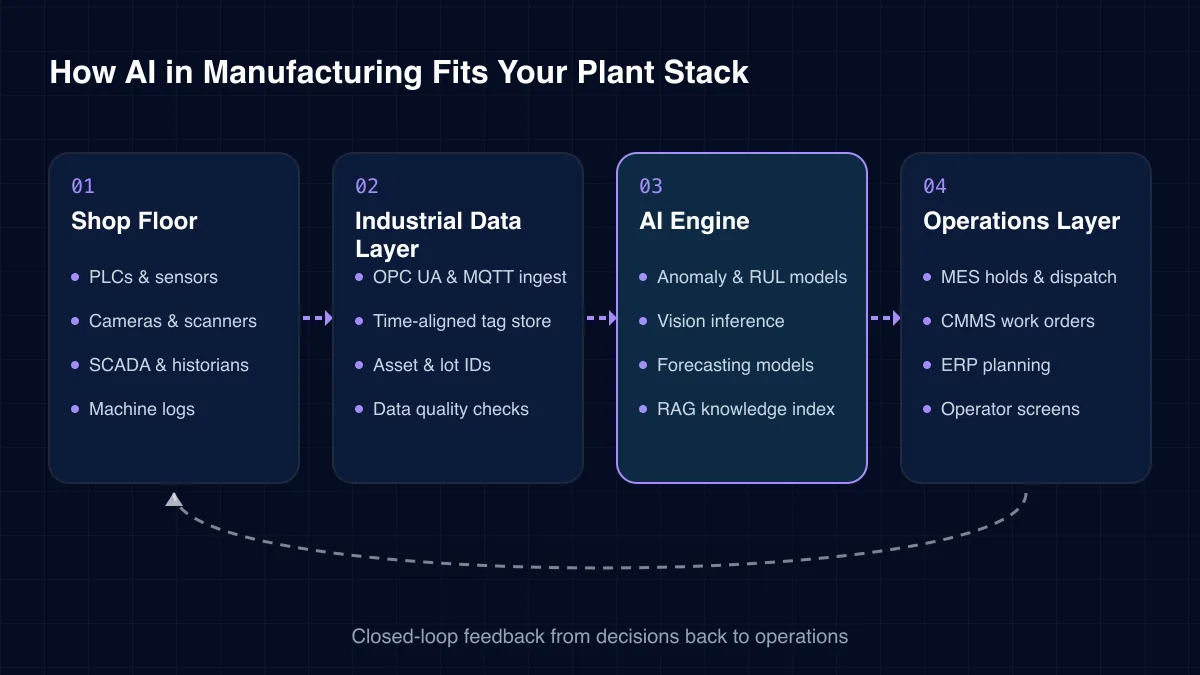
We follow the ISA-95 view of the plant. Data rises from the floor, models score it, and decisions flow back down to operations.

01

Shop Floor

  • PLCs & sensors
  • Cameras & scanners
  • SCADA & historians
  • Machine logs

02

Industrial Data Layer

  • OPC UA & MQTT ingest
  • Time-aligned tag store
  • Asset & lot IDs
  • Data quality checks

03

AI Engine

  • Anomaly & RUL models
  • Vision inference
  • Forecasting models
  • RAG knowledge index

04

Operations Layer

  • MES holds & dispatch
  • CMMS work orders
  • ERP planning
  • Operator screens
Closed-loop feedback: Every repair, hold and override is logged as a label. Models retrain on real outcomes, so accuracy improves as the plant runs.

Challenges we solve

Why Plant AI Projects Stall

Most factories have tried a pilot. Few have scaled one. These are the failure modes we see most often.

  1. 01

    Pilots Built on Exported Spreadsheets

    A model trained on a one-off CSV export cannot run live. Nobody built the pipeline to feed it fresh data every minute.

  2. 02

    Tags Without Context

    Historians store thousands of tags with cryptic names. Without an asset model, data scientists guess which signal belongs to which machine.

  3. 03

    Too Few Failure Examples

    Good plants fail rarely, so labelled failures are scarce. We combine anomaly detection, physics limits and engineer input to work around it.

  4. 04

    Alerts Nobody Trusts

    If a model cries wolf twice, operators mute it. AI in manufacturing needs explainable alerts and tuned thresholds from week one.

  5. 05

    No Link to MES or CMMS

    An insight on a laptop changes nothing. The output has to open a work order or place a hold automatically.

  6. 06

    Model Drift After Changeovers

    New tooling, materials or recipes shift the data. Without monitoring, accuracy decays quietly until someone notices bad calls.

Types of AI in Manufacturing

Most programmes combine several of these model families. Each suits a different kind of plant data.

  • 1Predictive models: Time-series models that estimate failure risk or remaining useful life from sensor streams.
  • 2Vision models: Detection and classification models that inspect parts, labels and assemblies from camera images.
  • 3Optimisation models: Models that recommend setpoints, schedules or batch sizes against yield, energy and cost targets.
  • 4Language models: RAG assistants and document AI that make manuals, logs and quality records searchable in plain language.

Rules, Dashboards and Plant AI Compared

Plants already run alarms and OEE dashboards. The table shows what AI in manufacturing adds on top of them.

CapabilityAlarm rulesOEE dashboardPlant AI
Catches slow driftNoPartial✓ Yes
Explains root causeNoPartial✓ Yes
Predicts a failure windowNoNo✓ Yes
Inspects every partNoNo✓ Yes
Triggers MES or CMMS actionPartialNo✓ Yes

Benefits of AI in Manufacturing

The benefits compound as more lines and assets join the same data platform.

  • Fewer surprise breakdownsBecause drift is flagged while there is still time to plan a repair.
  • Consistent inspectionBecause a vision model checks every part with the same standard on every shift.
  • Faster root-cause workBecause sensor, MES and quality data sit on one timeline.
  • Better use of engineersBecause they review ranked insights instead of digging through raw tags.
  • Leaner inventoryBecause forecasts and condition data tell planners what is really needed.
  • Kept know-howBecause a knowledge assistant makes veteran experience searchable for new staff.

Delivery

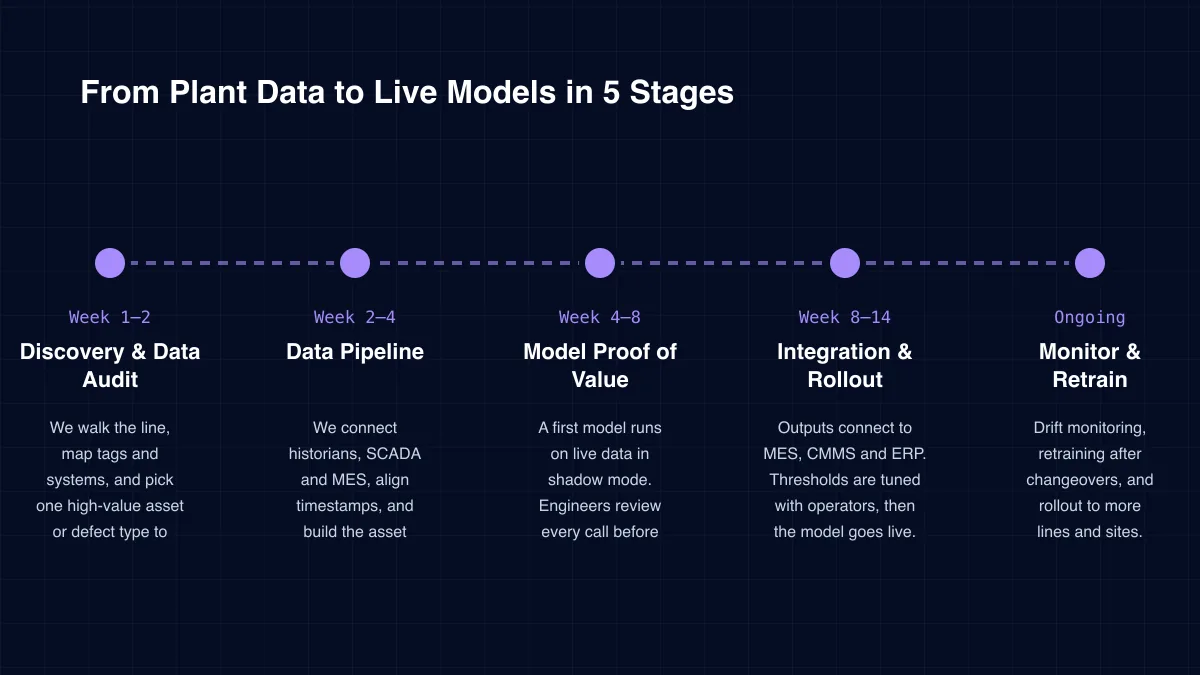
From Plant Data to Live Models in 5 Stages

  1. Week 1–2

    Discovery & Data Audit

    We walk the line, map tags and systems, and pick one high-value asset or defect type to start with.

  2. Week 2–4

    Data Pipeline

    We connect historians, SCADA and MES, align timestamps, and build the asset model the AI will rely on.

  3. Week 4–8

    Model Proof of Value

    A first model runs on live data in shadow mode. Engineers review every call before anything is automated.

  4. Week 8–14

    Integration & Rollout

    Outputs connect to MES, CMMS and ERP. Thresholds are tuned with operators, then the model goes live.

  5. Ongoing

    Monitor & Retrain

    Drift monitoring, retraining after changeovers, and rollout to more lines and sites.

Case study

Case Study: Enterprise AI Chatbot

Business teams at an enterprise partner depended on technical staff for every data question. Our team built an LLM and RAG chatbot that queries SQL and NoSQL databases plus PDFs, emails and reports behind role-based access. It lifted data accessibility by 30% and sped decision-making by 40%. The same pattern powers plant knowledge assistants over MES tables and maintenance manuals.

“The fastest database query in the world is still too slow if a business user has to file a ticket and wait.”
Read the full case study →
01

Conversational Core

LLM · Intent understanding

Understands plain-language questions and the intent behind them.

02

Live Data Access

SQL · NoSQL connectors

Answers stay grounded in real-time business data, not stale exports.

03

Document Intelligence

RAG · Role-based access

Pulls answers from PDFs, emails and reports without bypassing permissions.

How to Choose a Manufacturing AI Partner

Plenty of vendors can train a model in a notebook. We recommend testing five things before you commit.

  1. 1OT fluency. The team should read PLC tags, SCADA screens and MES events without a translator.
  2. 2Proof on your data. Ask for a shadow-mode proof of value on your own line, not a canned demo.
  3. 3Integration first. Every model should end in a work order, hold or schedule change.
  4. 4Explainability. Operators need to see why a model fired, in terms they already use.
  5. 5MLOps after launch. Changeovers and new products will shift the data, so retraining must be planned.

The last point decides whether AI in manufacturing is still useful a year later. Every ICANIO engagement includes structured post-launch support.

OT Security and Data Ownership

Plant networks were not built for cloud traffic. We design one-way data paths out of the control network and follow IEC 62443 zone and conduit principles with your OT team.

Models never write directly to PLCs. They act through MES, CMMS and operator approval. Your data stays in your cloud tenancy or on premises, and ICANIO works under ISO 9001 and ISO 27001 certified processes.

Measuring the ROI of AI in Manufacturing

Start with one number you already track: an hour of downtime on a bottleneck asset, or the cost of one escaped defect. Multiply it by last year's events. That is the value pool your first model works against.

We agree the baseline with you in discovery and measure against your own OEE, scrap and maintenance records. That keeps the business case for AI in manufacturing grounded in plant data, not vendor slides.

Technology stack

Our Manufacturing AI Toolchain

We pick tools to fit your plant. These are the building blocks we use most often.

  • Plant Connectivity

    • MQTT

    OPC UASCADA & historian connectorsEdge gateways

  • Data Engineering

    • Apache Airflow
    • RabbitMQ
    • Python

    Time-series storage

  • Machine Learning

    • PyTorch

    XGBoostAnomaly detectionForecasting models

  • Computer Vision

    • OpenCV

    YOLOEdge GPU inference

  • Language AI

    LLMsRAG pipelinesVector searchRole-based access

  • Enterprise Systems

    • SAP & Oracle ERP

    MESCMMSPower BI dashboards

Inside Our Plant AI Builds

AI in manufacturing architecture from shop floor sensors to MES actions
Four-layer plant AI architecture with retraining feedback
Six AI in manufacturing capabilities from maintenance to vision inspection
Maintenance, vision, knowledge, process, planning and data
AI in manufacturing delivery timeline from data audit to live models
Five delivery stages from discovery to retraining

AI in Manufacturing FAQs

Where should AI in manufacturing start?

Start with one asset or defect that already costs you money and has data behind it. A bottleneck machine with vibration sensors, or a defect your inspectors catch by eye, is ideal. Proving value there builds trust for the next use case.

Do we need new sensors before we use AI in manufacturing?

Usually not at first. Most plants already hold years of historian, SCADA and MES data. Our discovery audit shows what you can model today and where one or two extra sensors would add real signal.

How does AI in manufacturing connect to our MES and ERP?

We integrate through the APIs, databases or message queues your MES, CMMS and ERP already expose. Model outputs become holds, work orders or planning inputs. Operators keep approval rights on anything that affects production.

Can vision models run without the cloud?

Yes. Inspection models usually run on edge hardware beside the line, so they keep working if the plant link drops. Images and results sync to the cloud later for retraining and reporting.

How long until AI in manufacturing shows results?

A shadow-mode proof of value typically runs within four to eight weeks of kickoff. Full integration with MES and CMMS follows over the next few weeks, depending on how many systems are involved.

What happens when a product or recipe changes?

Changeovers shift the data. We monitor model accuracy continuously and retrain when drift appears. That MLOps loop is part of our support, because AI in manufacturing must evolve with the line.

Key Takeaways

  • AI in manufacturing creates value only when its output triggers a real action on the floor.
  • The industrial data layer is the hardest part and the foundation for every model.
  • Start with one asset or defect in shadow mode, prove it, then scale across lines.
  • Plan retraining from day one, because every changeover shifts the data.

Conclusion

AI in manufacturing is not a dashboard project. It is a data, model and integration project that ends in a work order, a hold or a better answer for the supervisor on shift.

ICANIO brings industrial data engineering, machine learning and enterprise integration into one delivery team. We start small on your real plant data, prove value in shadow mode, and then keep models accurate as your operation changes. That is how AI in manufacturing moves from pilot to plant standard.

By ICANIO Data & AI Engineering Team · Published · Updated

Ready to Put AI on Your Plant Floor?

Book a free 30-minute discovery call with our team. We will review your plant data and pick the first model worth building. You will leave with a scoped plan and clear milestones.

Contact Our Data & AI Team