LMS Development and Integration
Custom LMS builds, or extensions to the one you run, integrated with your SIS, gradebook and SSO. Faculty get one place to run each course, and students get one login for every class.
LMS, SIS, SSO →Education & E-Learning
Learners expect personal, mobile-friendly experiences. Institutions need platforms that survive exam week and protect student records. We build LMS, SIS integrations, adaptive learning and placement platforms that do both.
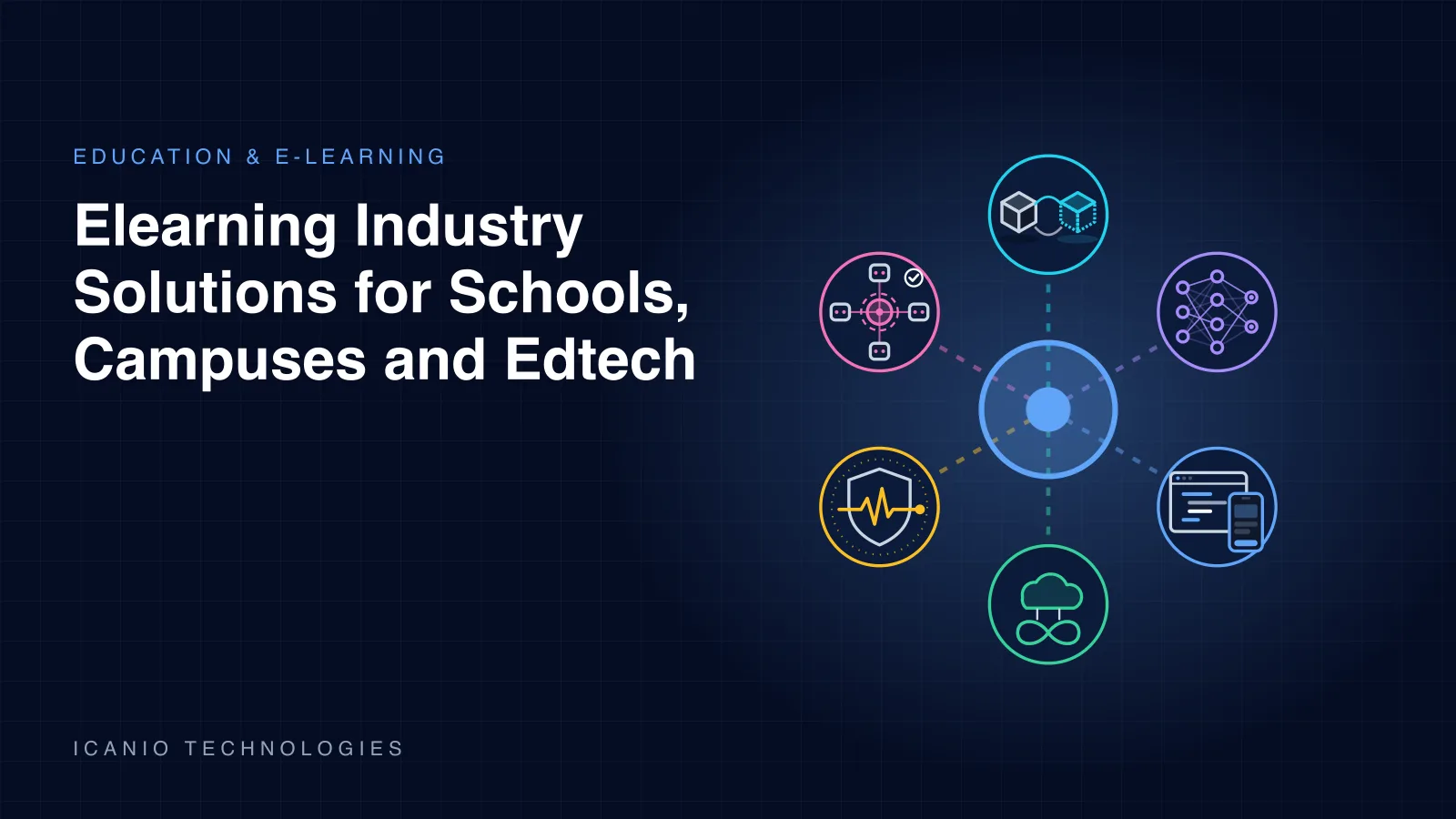
6 ways we build for Education
Digital Twin Solutions
Campus and Facility Twins
Model buildings, labs and classrooms for remote facility management, extending elearning industry solutions to the physical campus. Plan room use and energy across a campus from one live view.
Digital Twin for Education →A student logs in to the LMS, joins a live class, submits an assignment and checks placement news, often on a phone. If any of those steps is slow or disconnected, engagement drops. Our elearning industry solutions join these moments into one smooth learning journey.
Schools, universities and edtech companies usually run many systems at once. The student information system holds enrolment and grades. The LMS holds courses. Video, proctoring and content tools sit beside them. We integrate what you have, then add adaptive learning, analytics and AI where they help learners most.
This page covers the challenges education leaders face, the standards and privacy rules involved, and how each ICANIO service applies to learning organisations. It also explains how to choose a partner and how to measure the value of elearning industry solutions once they are live.
Elearning industry solutions are the software platforms that deliver, manage and measure learning. They include learning management systems, virtual classrooms, assessment engines, content pipelines and the analytics that show how students progress.
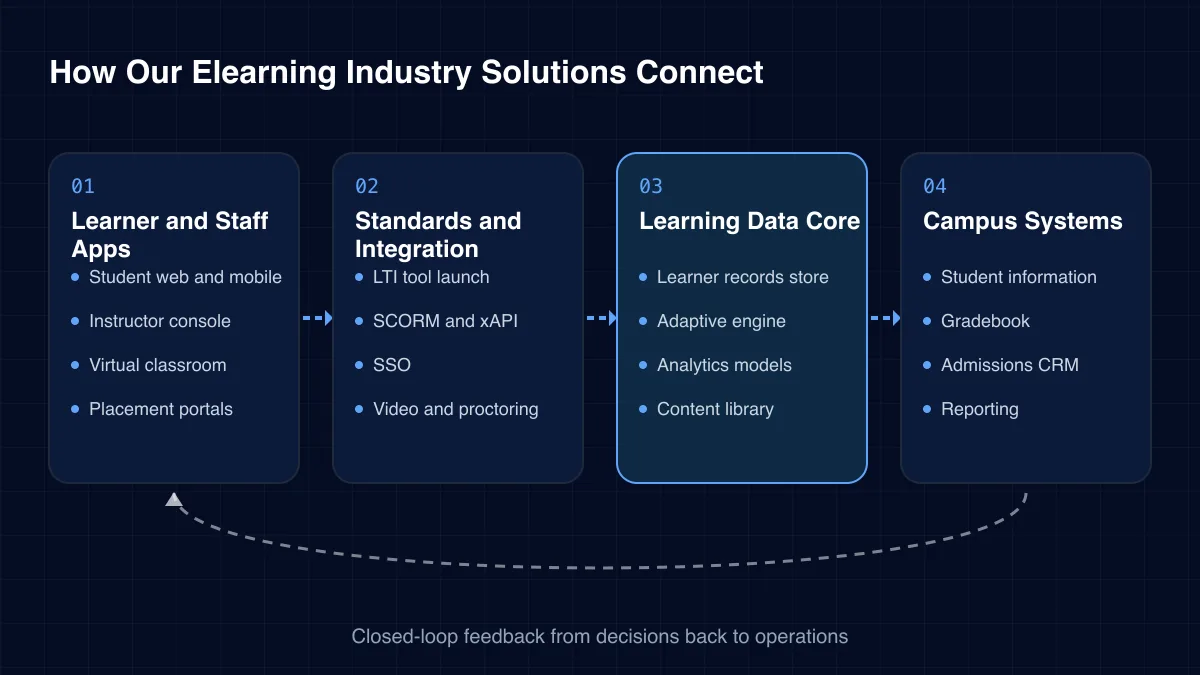
A few standards hold the ecosystem together. LTI lets tools plug into any LMS. SCORM and xAPI let course content and learning records move between platforms. The SIS remains the system of record for enrolment and grades, and SSO gives students one login.
Effective elearning industry solutions also go beyond the classroom. Career guidance, campus placement and skills assessment increasingly sit on the same platform, linking learning to outcomes.
Plain-English definition
“Elearning industry solutions are connected learning platforms, from LMS and SIS to virtual classrooms and AI tools, that help institutions and edtech companies teach, assess and support learners at scale.”
Foundations
The SIS stays the source of truth. Rosters, grades and SSO sync automatically, so faculty never re-enter data.
Live sessions, self-paced work and timed exams run side by side. We load test for the week everyone logs in at once.
FERPA-aware access control, data minimisation and WCAG accessibility are defaults, not extras.
Adaptive and AI features suggest. Instructors decide what content and feedback reach each student.
Core capabilities
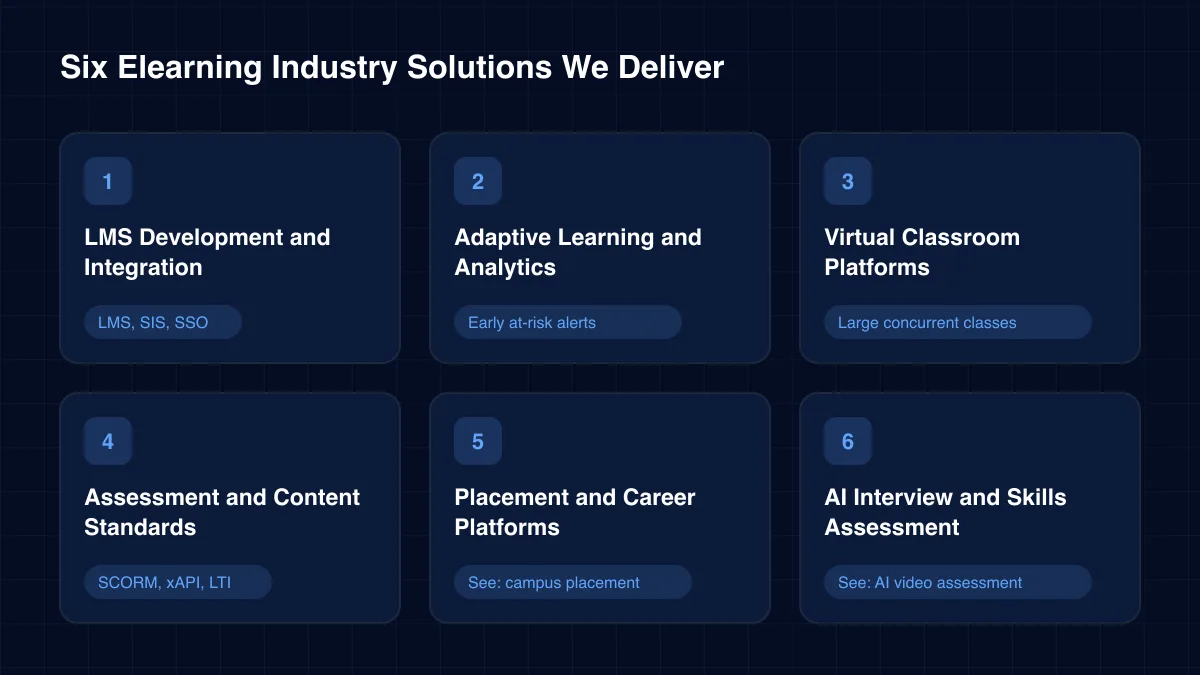
These elearning industry solutions are delivered by engineers who have built learning, career and placement platforms in production. Most institutions combine a few.
Custom LMS builds, or extensions to the one you run, integrated with your SIS, gradebook and SSO. Faculty get one place to run each course, and students get one login for every class.
LMS, SIS, SSO →Engines that adjust pacing and difficulty from assessment and engagement data. Dashboards show instructors who is falling behind while there is still time to help.
Early at-risk alerts →Reliable video, breakout rooms and built-in assessment for large live classes. Captioning and screen-reader support are included.
Large concurrent classes →Timed exams, randomised question pools, rubric grading and proctoring integrations. Content pipelines follow SCORM, xAPI and LTI so courses are never rebuilt.
SCORM, xAPI, LTI
Portals that connect colleges, students and recruiters, plus mobile career guidance apps. Placement season runs on shared, real-time data. Career apps replace manual counselling with guidance students can use any time.
See: campus placement →AI video interview assessment scores communication skills objectively at scale. It gives students fair, consistent feedback before real interviews.
See: AI video assessment →Model buildings, labs and classrooms for remote facility management, extending elearning industry solutions to the physical campus. Plan room use and energy across a campus from one live view.
Digital Twin for Education →Adaptive pacing, at-risk prediction, AI tutoring under instructor control and objective video interview assessment.
Data & AI for Education →Custom LMS features, virtual classrooms, placement portals and mobile career guidance apps linked to your SIS.
App Development for Education →Autoscaling infrastructure, load testing and safe releases keep elearning industry solutions fast when every student logs in at once.
DevOps & Cloud for Education →We monitor LMS integrations, video and assessments, and resolve incidents quickly during enrolment, live classes and exams.
Support Engineering for Education →Agents answer routine student questions, prepare course shells and flag missing grades. Staff approve every change, so elearning industry solutions stay accountable.
AgenticOps for Education →Architecture
We build learning platforms in four layers. Learners and staff use apps on top, standards connect the tools, a learning data core holds progress, and records sync with campus systems.
01
02
03
04
Challenges we solve
Institutions and edtech firms must scale without losing the personal touch. These are the problems elearning industry solutions are asked to fix most.
Rosters and grades are copied by hand between systems. Errors creep in, students see the wrong marks, and staff lose hours every term fixing them.
Every learner gets the same pace and difficulty. Strong students get bored and struggling ones fall further behind.
Without analytics, a struggling learner is spotted only after the exam. By then, intervention is too late.
Enrolment day and exam week bring every user online at once. Slow video or crashed quizzes damage trust quickly.
Colleges, students and recruiters coordinate through email and spreadsheets. Students lose visibility, and hiring cycles drag.
Education records are sensitive and regulated. Loose access control or oversharing with vendors creates legal and reputational risk.
Elearning industry solutions differ by audience. We adapt the approach to four groups.
Most institutions run a mix of tools. The table shows how integrated elearning industry solutions compare.
| Capability | Tool patchwork | Off-the-shelf LMS | Integrated platform |
|---|---|---|---|
| SIS sync | No | Partial | ✓ Yes |
| Adaptive learning | No | Partial | ✓ Yes |
| Placement and career | No | No | ✓ Yes |
| Standards (LTI, xAPI) | Partial | ✓ Yes | ✓ Yes |
| Unified learner analytics | No | Partial | ✓ Yes |
Value grows as more courses, departments and partners share one learning data layer.
Delivery
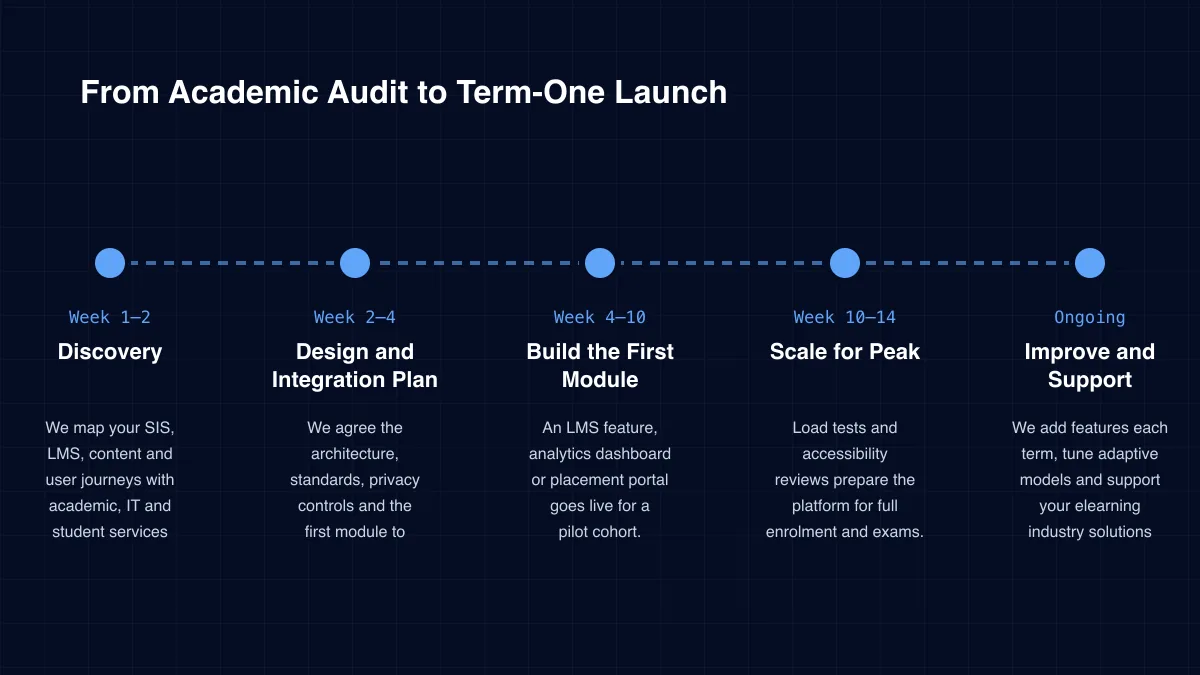
Week 1–2
We map your SIS, LMS, content and user journeys with academic, IT and student services teams.
Week 2–4
We agree the architecture, standards, privacy controls and the first module to deliver.
Week 4–10
An LMS feature, analytics dashboard or placement portal goes live for a pilot cohort.
Week 10–14
Load tests and accessibility reviews prepare the platform for full enrolment and exams.
Ongoing
We add features each term, tune adaptive models and support your elearning industry solutions year-round.
Case study
A placement network ran campus hiring through manual, fragmented workflows between colleges, students, training partners and recruiters. Students had little visibility into their progress. Our team built one platform with dedicated portals for every stakeholder. It cut manual coordination effort by 60%.
“Placement season fails when colleges, students and recruiters work from different information at different times.”Read the full case study →
Placement calendars · Resumes
Colleges manage the whole placement season in one place.
Job postings · Shortlisting
Recruiters post roles and shortlist with automated eligibility filtering.
Applications · Notifications
Students track applications and interviews in real time.
Plenty of vendors can build a course page. Fewer can keep it running on exam day. We recommend checking five things.
In our experience, SIS integration decides adoption. If faculty must re-enter data, even great elearning industry solutions go unused.
Student records deserve strict protection. We design FERPA-aware architecture with role-based access, audit logging and data minimisation. For services used by children, we account for COPPA, and GDPR for European learners.
ICANIO works under ISO 9001 and ISO 27001 certified processes. We build to WCAG accessibility guidelines, with captioning, screen-reader support and flexible pacing, so learning works for every student.
Start with staff hours spent on manual rosters, grading admin and placement coordination. Most elearning industry solutions first pay back by removing that work.
Then track course completion, at-risk interventions and placement conversion. We baseline these with your team during discovery and report after each term. Over time, the same data shows which courses, tools and teaching approaches help learners most.
Technology stack
We pick tools that fit your campus and learners. These are the parts we use most in elearning industry solutions.
Standards
LTISCORMxAPISSO and SAML
Learning Systems
LMSSISGradebookContent library
Apps
AI
Adaptive enginesVideo assessment AILLM tutorsAnalytics models
Cloud
CDNAutoscaling
Operations
CI/CDLoad testingAccessibility testingMonitoring
Yes. We build integrations between the LMS, SIS, SSO and content libraries. Rosters and grades sync automatically, so you keep your existing infrastructure.
No. We can start with a rules-based engine and evolve to a data-driven model as usage grows. Learners benefit from day one, and accuracy improves each term.
Yes. We build on scalable cloud infrastructure and load test before launch. Large live sessions run without degraded video or collaboration.
Yes. We build elearning industry solutions for schools, universities and commercial edtech products. The approach adapts to each organisation's scale and goals.
Yes. Captioning, screen-reader support and flexible pacing are built into our classrooms and LMS work, following WCAG guidelines.
We apply FERPA-aware access control, audit logging and data minimisation. Only the people who need a record can see it, and every access is logged.
Learners judge a platform on its worst day, usually exam week. The right elearning industry solutions stay fast, fair and private when it matters most.
ICANIO brings digital twins, data and AI, app development, DevOps, support engineering and AgenticOps to one team. Our team integrates what you already run, adds the features learners need, and supports you term after term.
By ICANIO Education Engineering Team · Published · Updated
Book a free 30-minute discovery call with our education engineers. We will review your systems, learners and goals, and suggest the best first module. Contact us to get started.
Contact Our Education Team