Java Runtime Upgrades
JDK 8 to 17 or 21 migrations with deprecated API refactoring and toolchain updates. Our JVM optimization delivered a 2x faster runtime after moving to JDK 21.
2x faster runtime →Legacy Application Modernization
Upgrade ageing runtimes, frameworks and architectures in safe, tested steps. Your users keep working while the platform underneath becomes secure, fast and cloud-ready.
ModernizeOps
JDK 8 → 17 readiness
ModernizeOps
JDK 8 → 17 readiness
⟳ Design in progress
Old systems often still hold the most valuable rules in the business. The risk is that nobody can safely change them anymore. Legacy application modernization keeps those rules and replaces what is holding them back: unsupported runtimes, brittle frameworks and architectures that cannot reach the cloud.
Our team at ICANIO has moved Java applications from JDK 8 to JDK 17 and 21, upgraded React frontends across major versions and replaced ageing integrations. We work in phases, prove behaviour with automated tests and keep production running throughout.
This guide explains the modernization options, how we assess risk, what usually goes wrong and how to measure success. It draws on real ICANIO engagements in insurance, fintech and healthcare.
Legacy application modernization is the process of updating an existing system so it stays secure, supportable and able to grow. It can mean a runtime upgrade, a framework migration, a move to the cloud or a staged rewrite of parts of the code.
A system becomes legacy for many reasons. Its runtime may be out of vendor support. Its libraries may carry known vulnerabilities. Its build tools may not run on modern machines, or the people who wrote it may have left.
Modernization is different from replacement. The goal is to keep proven business logic while removing the constraints around it. That makes it lower risk than a rewrite, but it still needs careful planning.
The work is rarely only technical. Data, integrations, user training and compliance evidence all move with the code. Good legacy application modernization treats each of those as part of the plan.
Working definition
“Legacy application modernization is the phased upgrade of an existing application's runtime, frameworks, architecture or hosting, preserving its business behaviour while restoring security, performance and maintainability.”
Foundations
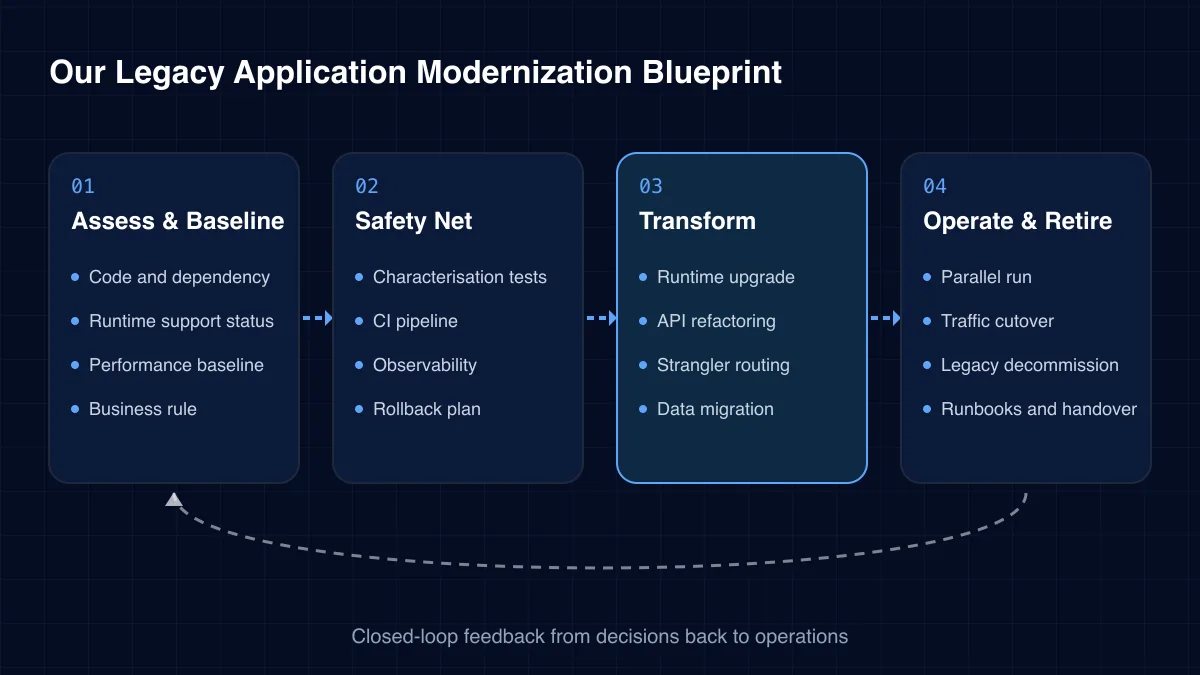
We capture what the system does today in characterisation tests before changing a line.
Each change ships behind a flag or route, so it can be rolled back in minutes.
We rank debt by business risk and fix the items that block security or delivery first.
Every phase moves the app closer to containers, CI/CD and managed services.
Core capabilities
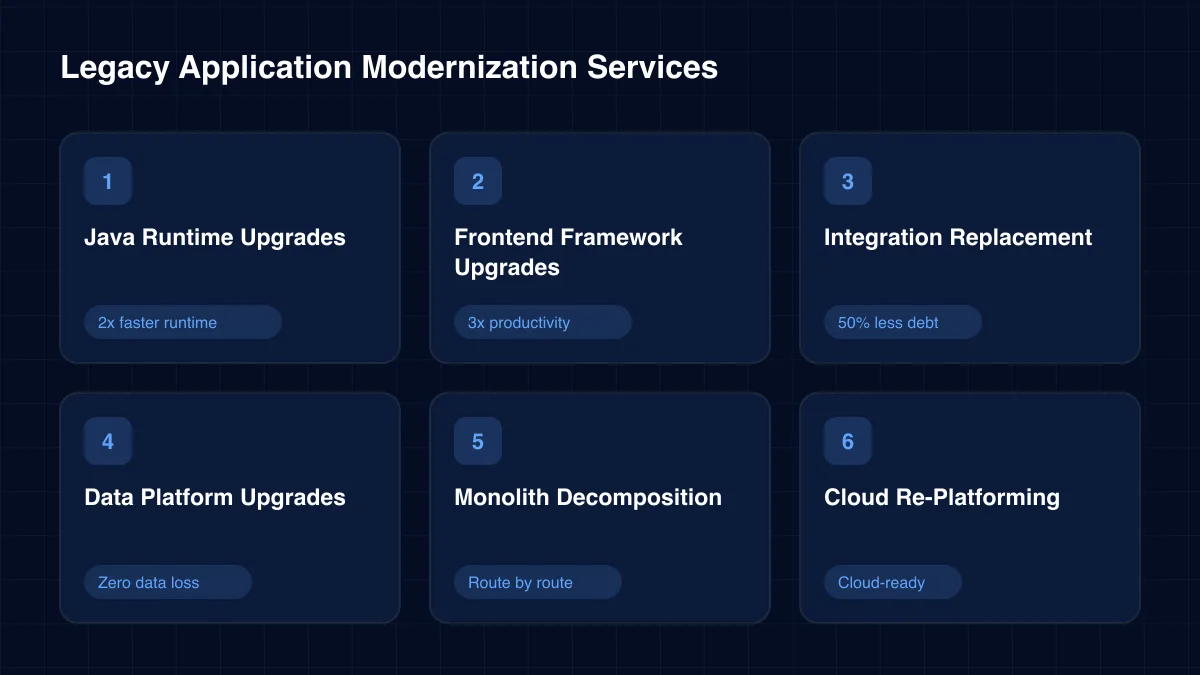
Each service targets a different kind of ageing. Many legacy application modernization programmes combine two or three of them.
JDK 8 to 17 or 21 migrations with deprecated API refactoring and toolchain updates. Our JVM optimization delivered a 2x faster runtime after moving to JDK 21.
2x faster runtime →React, Angular and JavaScript upgrades with dependency clean-up and test coverage. A healthcare React upgrade from 16.3.1 to 18.3.1 fixed 186 outdated packages.
3x productivity →Swapping retired third-party services for supported ones. Our insurance legacy application modernization replaced NIPR with Vertafore alongside a JDK 17 upgrade.
50% less debt →Phased upgrades of databases and search clusters with zero data loss. A fintech Elasticsearch move from v7.15 to v8.8.1 covered 1000GB of production data.
Zero data loss →Strangler fig migrations that move one capability at a time into new services. Legacy application modernization this way avoids a risky big-bang cutover.
Route by route
Containerising applications, adding CI/CD and moving to managed cloud databases. We plan the hosting change together with the code change, so both land cleanly.
Cloud-ready →Architecture
We wrap the legacy system with a safety net first, then replace parts behind a routing layer. Users never see the seams.
01
02
03
04
Challenges we solve
Most failed upgrades share a handful of causes. We design each legacy application modernization plan to avoid them.
Rewriting everything at once freezes features for years. We modernise in slices that deliver value as they go.
Old code hides rules nobody documented. We extract them through tests and expert reviews before refactoring.
Some libraries have no supported version. We find replacements early, before they block the upgrade.
Toolchain issues found at the end cause delays. We modernise the build and test setup first.
Migrations fail on edge-case records. We rehearse data moves on production-like copies.
Running old and new forever doubles cost. We set a clear decommission milestone.
Industry frameworks list several strategies, often called the Rs. These four cover most legacy application modernization work.
Each path trades speed for long-term benefit. We recommend mixing them across components.
| Criterion | Rehost | Replatform | Refactor |
|---|---|---|---|
| Speed to complete | Fast | Medium | Slow |
| Removes technical debt | No | Partial | ✓ Yes |
| Fixes unsupported runtime | No | ✓ Yes | ✓ Yes |
| Enables microservices | No | Partial | ✓ Yes |
| Best for | Data centre exits | Ageing runtimes | Core systems that must evolve |
Modern platforms are cheaper to run and safer to change.
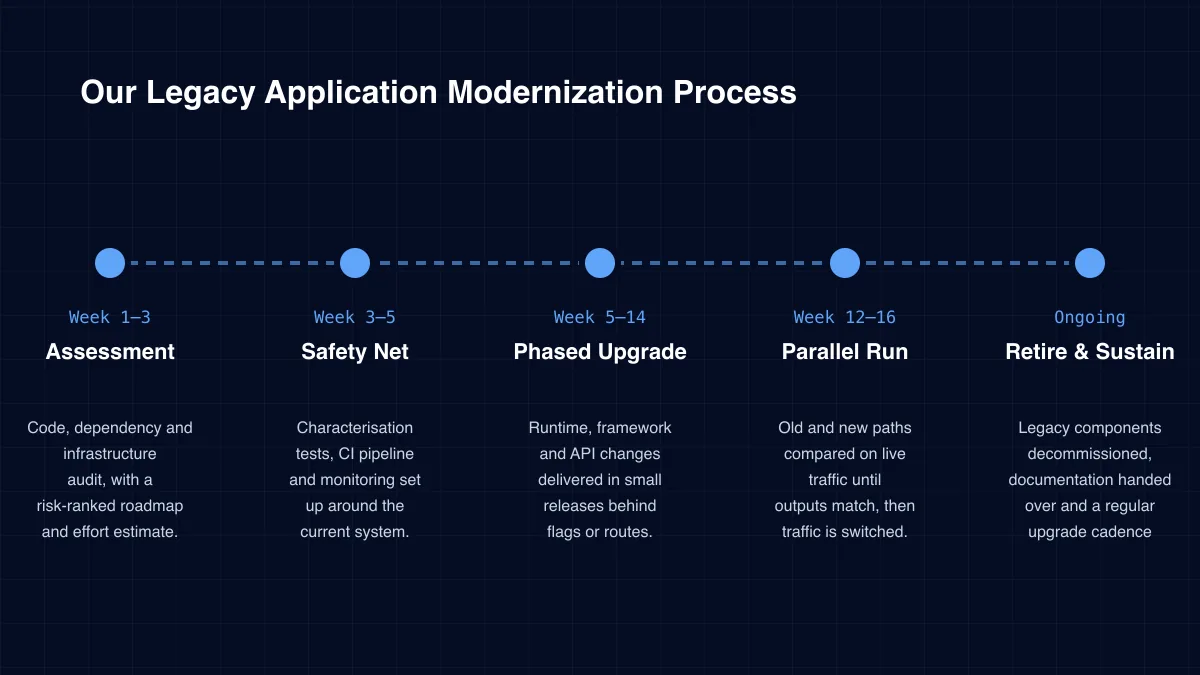
Delivery
Week 1–3
Code, dependency and infrastructure audit, with a risk-ranked roadmap and effort estimate.
Week 3–5
Characterisation tests, CI pipeline and monitoring set up around the current system.
Week 5–14
Runtime, framework and API changes delivered in small releases behind flags or routes.
Week 12–16
Old and new paths compared on live traffic until outputs match, then traffic is switched.
Ongoing
Legacy components decommissioned, documentation handed over and a regular upgrade cadence agreed.
Case study
A legacy Java application on JDK 8 faced security risks, compliance issues and incompatibility with modern build tools and cloud platforms. ICANIO migrated it to JDK 17, refactored deprecated APIs, updated the toolchain and ran comprehensive testing. The result was 40% better performance, 3x stronger security compliance, 50% less technical debt and a cloud-ready platform.
Read the full case study →JDK 8 → 17
Version-specific issues were found and fixed in code before they reached production.
Deprecated API removal
Deprecated APIs were aligned with JDK 17 standards, which made the debt reduction stick.
Modern build tools
The development environment was updated first, so testing matched real production conditions.
Specialist services within our mobile & web application development practice.
Modernization rewards patience and precision. Look for these five qualities.
Our team treats every legacy application modernization as a sequence of small wins. Each release reduces risk and proves the next step is safe.
Unsupported runtimes are one of the most common audit findings. Moving to a current long-term support release restores vendor patches and closes known vulnerabilities.
ICANIO works under ISO 9001 and ISO 27001 certified processes. During legacy application modernization we add dependency scanning, an SBOM and secrets management to the new pipeline.
For regulated clients we keep evidence of each change, test result and data verification. That record helps when auditors ask how the upgrade was controlled.
Start with the cost of standing still. Extended support fees, security exceptions, slow releases and hard-to-hire skills all have a price.
Then add the gains. Our Java modernization delivered 40% faster performance and cut technical debt by half. Faster runtimes often reduce hosting cost, and cleaner code speeds up every future feature.
We recommend measuring a few baselines before work starts, such as response time, deployment frequency and incident count. Comparing them after each phase shows the return of legacy application modernization in your own data.
Technology stack
We combine automated migration tooling with careful manual engineering.
Java
JDK 17 and 21Spring BootJakarta EEOpenRewrite
Frontend
React 18Vite
.NET
EF Core
Data
Flyway
Quality
JUnitPlaywrightDependency scanning
Platform
A focused runtime upgrade can take a few months. Larger re-architecture programmes run in phases over a longer period. Our assessment gives you a phased roadmap with effort for each step.
Usually, yes. We use feature flags, strangler routing and parallel runs, so users stay on a working system while parts are replaced underneath.
Modernising keeps proven business logic and lowers risk. A rewrite makes sense only when little of the old code is worth keeping. Many projects mix both by component.
Newer long-term support releases bring security updates, better garbage collection and modern language features. Our JDK upgrades improved both performance and security compliance.
Cost depends on code size, test coverage, dependencies and data. We fix the price of the assessment, then estimate each phase so you can fund the work in stages.
Yes. Once the platform is modern, adding machine learning, smart search or document automation becomes much easier. We often plan these as later phases.
How we deliver legacy application modernization and the wider app development practice in each sector.
Ageing software does not have to be a choice between risky rewrites and growing exposure. Legacy application modernization offers a middle path that protects the business while restoring speed and security.
ICANIO has delivered JDK, React, search and integration upgrades for clients in insurance, fintech and healthcare. The method is consistent: assess, protect, transform in phases and retire the old.
If an unsupported runtime or a fragile codebase worries you, contact us. We will assess your system and propose a practical legacy application modernization roadmap.
By ICANIO Application Engineering Team · Published · Updated
Book a free discovery call. We will review your stack, risks and goals, then outline a phased plan to modernise without disrupting your users.
Contact Our Modernization Team