Functional & Exploratory Testing
Requirement-based test cases plus session-based exploration of new features. Testers check business rules, edge cases and usability across real devices.
Web, mobile, API
Software Testing Services
ICANIO tests web, mobile and API products for function, load and security. Automated suites run on every commit, so defects surface in minutes instead of in production.
Test Console
Nightly regression
Test Console
Nightly regression
⟳ Design in progress
Most release delays are not caused by writing code. They come from finding problems late, then scrambling to fix them before a deadline. Software testing services exist to move that discovery earlier, when a defect costs minutes instead of a weekend.
Our team tests web apps, mobile apps and APIs across four dimensions: does it work, does it still work, does it hold up under load, and is it secure. We automate what repeats, explore what is new, and wire every check into your CI/CD pipeline.
This guide explains what modern software testing services cover, how we build a test architecture, and how to balance manual and automated work. It includes a real ICANIO platform that uses generative AI to speed up API performance testing.
Software testing services are the planning, design and execution of checks that prove an application meets its requirements. They cover functional behaviour, user experience, performance, security and compatibility across devices and browsers.
Testing used to be a phase at the end of a project. Today it runs alongside development. Unit and API tests run on every commit, end-to-end suites run nightly, and load and security tests run before each release.
Good testing is about risk, not test counts. A checkout flow, a payment API or a patient record deserves deep coverage. A static help page does not. Risk-based planning puts the effort where a failure would hurt most.
Testing also produces evidence. Reports, traceability to requirements and security scan results support audits for standards such as SOC 2, PCI DSS or ISO 27001.
Working definition
“Software testing services are the structured verification of an application's function, performance and security, automated where possible and run continuously, so each release ships with known, acceptable risk.”
Foundations
Testers join refinement sessions and write acceptance criteria with developers. Many defects are prevented before code exists.
Regression, smoke and API checks run by machine on every build. People focus on exploratory and usability testing.
Realistic data, devices and traffic patterns reveal problems that clean test environments hide.
Releases move forward only when agreed quality gates pass. Decisions rest on results, not optimism.
Core capabilities
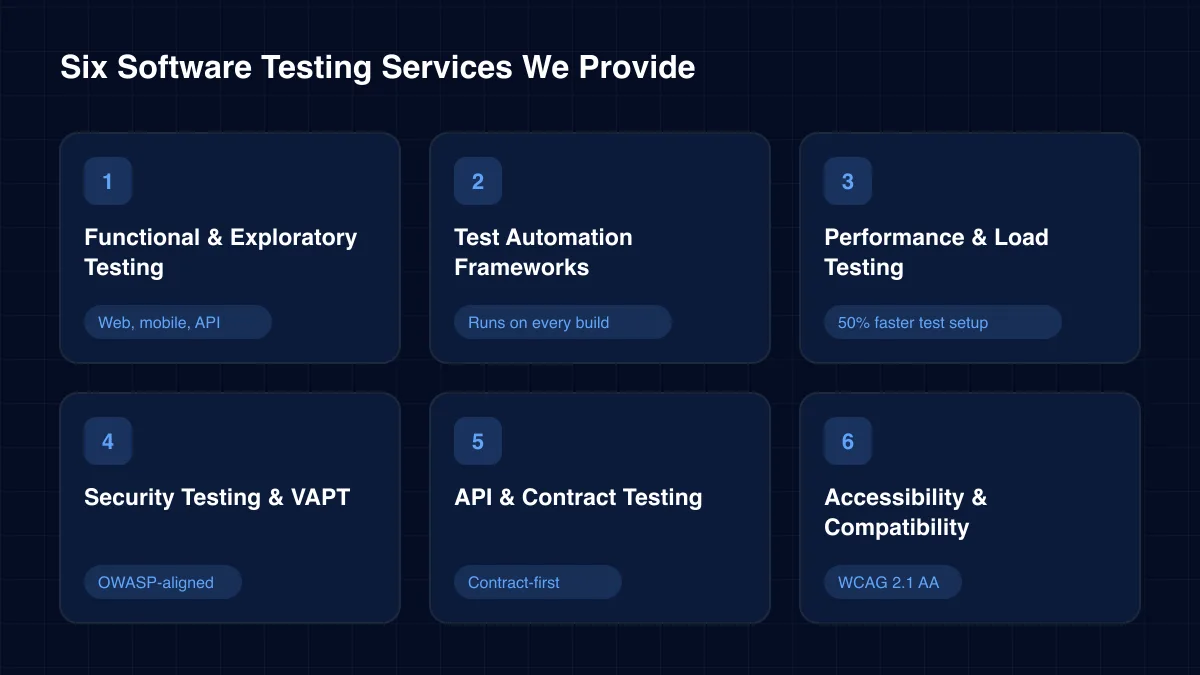
You can engage one service for a specific release or combine them into a full quality programme. All our software testing services plug into your existing tools and pipeline.
Requirement-based test cases plus session-based exploration of new features. Testers check business rules, edge cases and usability across real devices.
Web, mobile, API
Selenium, Playwright, Cypress and Appium suites built on page-object patterns. Our software testing services keep suites stable, fast and owned by your team.
Runs on every build
Load, stress, spike and soak tests with k6, JMeter or Artillery. Our AI performance testing platform turns HAR and XHR captures into ready-to-run tests.
50% faster test setup →SAST, DAST, dependency scanning and OWASP-aligned penetration testing. We ran VAPT on a TYPO3 v14 platform before its zero-downtime go-live.
OWASP-aligned →Schema validation, contract tests and integration checks for REST and event-driven services. Broken contracts are caught before downstream teams notice.
Contract-first
WCAG 2.1 AA audits, screen reader checks and cross-browser runs. These software testing services sit inside our wider application development delivery.
WCAG 2.1 AA →Architecture
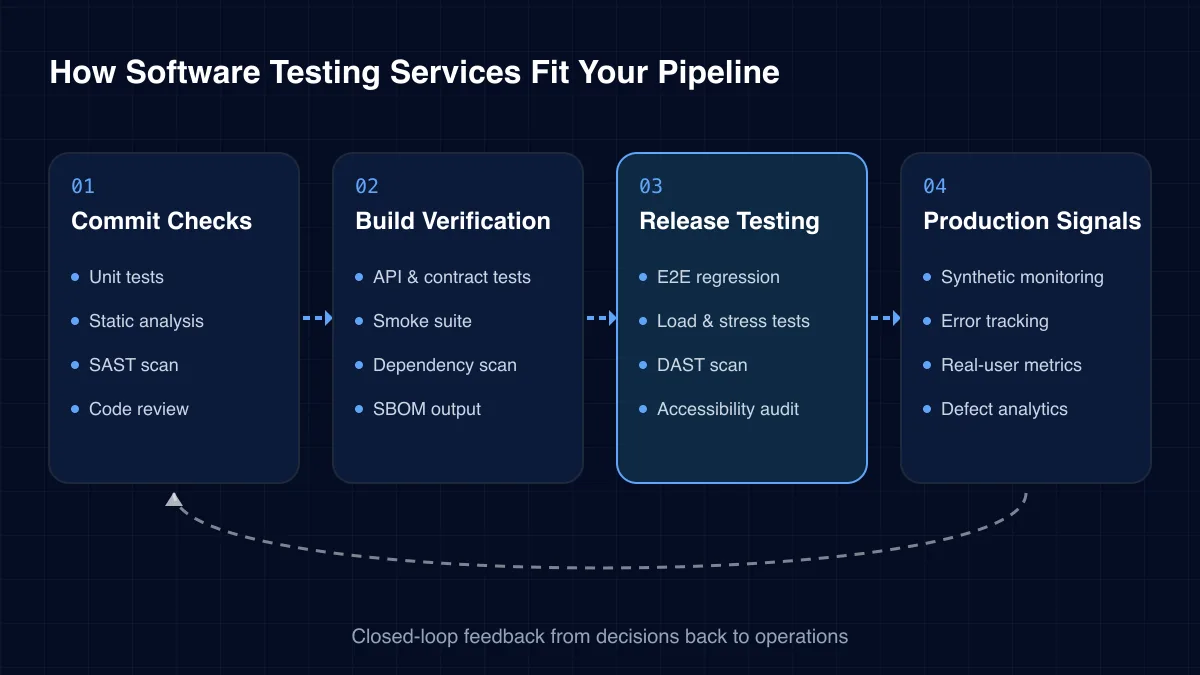
We build testing in four layers, each with its own speed and purpose. Fast checks run often; slow, deep checks run before release.
01
02
03
04
Challenges we solve
Teams usually call us when quality issues start slowing releases or hurting users. These patterns come up again and again.
Manual regression blocks every release. Automating the stable core frees testers and shortens the cycle.
Brittle selectors and shared test data make suites unreliable. Teams start ignoring red builds, which defeats the purpose.
Load is never simulated, so slowdowns appear on launch day. Realistic load tests reveal limits in advance.
An annual pen test misses everything shipped in between. Automated scans in the pipeline close that gap.
Staging differs from production in data, config and scale. Tests pass there and fail for real users.
Nobody can say whether a build is safe. Quality gates and a single dashboard make the answer visible.
Testing types differ by the question they answer. Most products need a mix, weighted by risk.
Each approach has a place. We recommend combining them rather than chasing full automation.
| Criterion | Manual | Automated | AI-assisted |
|---|---|---|---|
| Finds new, unexpected bugs | ✓ Yes | No | Partial |
| Fast repeat regression | No | ✓ Yes | ✓ Yes |
| Setup effort | Low | High | Medium |
| Judges usability | ✓ Yes | No | Partial |
| Best for | New features | Stable core flows | Test generation |
Investment in testing returns as speed, not just as fewer bugs.
Delivery
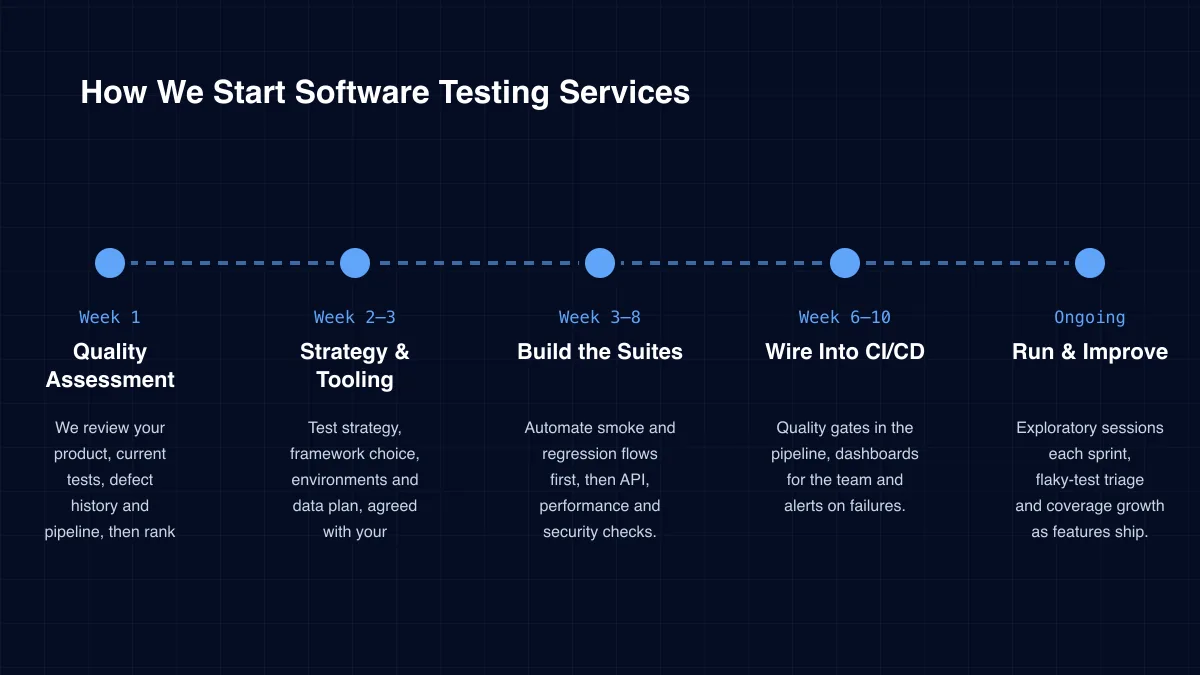
Week 1
We review your product, current tests, defect history and pipeline, then rank areas by risk.
Week 2–3
Test strategy, framework choice, environments and data plan, agreed with your engineering leads.
Week 3–8
Automate smoke and regression flows first, then API, performance and security checks.
Week 6–10
Quality gates in the pipeline, dashboards for the team and alerts on failures.
Ongoing
Exploratory sessions each sprint, flaky-test triage and coverage growth as features ship.
Case study
A partner found API performance tools too complex, so realistic load tests rarely ran. ICANIO built a platform on the Artillery engine that uses generative AI to convert JSON, HAR and XHR captures into ready-to-run YAML tests. An AI chatbot guides configuration, and shared dashboards serve developers and QA. The result was 50% faster testing setup and threefold broader test coverage.
Read the full case study →Generative AI · YAML
Raw API captures become runnable load tests without specialist scripting.
Artillery
Functional and non-functional scenarios with load spread across users, regions and servers.
Visual dashboards
Developers and QA read the same performance results without extra training.
Specialist services within our mobile & web application development practice.
Testing vendors often sell hours of execution. Look for engineering depth instead.
The right software testing services leave you with faster releases and a suite you own. That is how ICANIO measures success.
Security testing runs at three depths. SAST and secrets scanning run on every commit. DAST and dependency checks run on each build, with an SBOM produced for audit. OWASP-aligned penetration testing runs before major releases.
Test data is masked or synthetic, so no real personal data enters lower environments. Results map to the controls your auditors ask about, from OWASP Top 10 coverage to ISO 27001. ICANIO itself works under ISO 9001 and ISO 27001 certified processes.
Track four numbers before and after: regression cycle time, defects that escape to production, incident hours and release frequency. These map closely to the DORA delivery metrics many teams already watch.
Testing costs are visible while failure costs are scattered across support, rework and lost users. Once escaped defects drop and releases speed up, software testing services usually pay for themselves. Machine learning can then help rank flaky tests and pick the riskiest areas to retest.
Technology stack
We work with your existing tools where possible and add proven open-source options where gaps exist.
UI Automation
PlaywrightCypressAppium
API Testing
REST AssuredPact
Performance
ArtilleryGatling
Security
Semgrep
Accessibility
axe-coreNVDAVoiceOver
CI/CD & Cloud
Device clouds
Our software testing services include functional, exploratory, automated regression, API, performance, security, accessibility and compatibility testing. You can take one service or a full programme.
No. Automate stable, repeated flows such as login, checkout and core APIs. Keep people on new features, usability and exploratory work. We recommend a mix weighted by risk.
Usually Playwright or Selenium for web, Appium for mobile, and k6, JMeter or Artillery for load. We adapt to tools your team already knows when they fit the job.
Yes. We wire suites and scans into GitHub Actions, Jenkins, GitLab or Azure DevOps. Quality gates then decide whether a build can move to the next environment.
Yes. Many engagements start with an existing product. We assess current coverage and defect history first, then build suites around the highest-risk areas.
An assessment can start within a week. First automated smoke tests usually run in the pipeline within the first month, with coverage growing each sprint after that.
How we deliver software testing services and the wider app development practice in each sector.
Quality is cheaper to build in than to bolt on. Teams that test early, automate the repeatable and gate releases on evidence ship faster and sleep better.
Our software testing services bring functional, automation, performance and security specialists into one team that works inside your pipeline. Whether you ship to manufacturing plants, hospitals or shoppers on the cloud, contact us to start with a quality assessment of your current product.
By ICANIO Quality Engineering Team · Published · Updated
Book a free 30-minute call with our quality engineers. We will review your current testing, pipeline and defect trends, then outline a practical plan.
Contact Our QA Team