Driver and Proof of Delivery Apps
Turn-by-turn stop lists, photo and signature capture, and exception codes. In logistics app development this is usually the first app, because it replaces paper PODs.
Paperless PODs
App Development for Logistics
We build the driver, warehouse and dispatch apps that keep freight moving. Each one talks to your TMS, WMS and telematics, and keeps working in a dead zone on the highway.
RoutePro
Route 14 · Van 22
RoutePro
Route 14 · Van 22
⟳ Design in progress
Freight moves on paper more often than anyone admits. Drivers carry printed manifests. Pickers read from clipboards. Dispatchers juggle phone calls and spreadsheets. Logistics app development replaces that friction with apps built for each person in the chain.
Our team builds these apps around your existing TMS, WMS, ERP and telematics. We add the mobile and web layer your people actually touch. Scans, signatures, photos and GPS events then flow straight into your systems of record.
This guide covers what logistics app development involves in 2026. You will find the main app types, a reference architecture, common failure modes, a delivery plan and advice on choosing a partner.
Logistics app development is the design and build of software for people who move, store and track goods. That includes drivers, warehouse staff, yard teams, dispatchers, carriers and the customers waiting at the other end.
These apps face harsh conditions. Drivers lose signal on rural roads. Scanners take knocks on the dock. Every event must still reach the TMS or WMS in the right order, because billing and customer promises depend on it.
Good logistics app development treats the phone or handheld as a sensor for the whole network. Each scan and delivery confirmation becomes structured data. That data drives ETAs, invoices, claims and planning.
Working definition
“Logistics app development is building role-specific mobile and web software that captures movement events at the source and syncs them reliably with transport and warehouse systems.”
Foundations
Large touch targets, barcode-first input and minimal typing. Screens work in sunlight, with gloves and one hand on a pallet jack.
Events queue on the device and sync in sequence when signal returns. Nothing is lost, and nothing arrives out of order.
A single delivery scan can update the TMS, notify the customer and trigger an invoice. We design those flows once, centrally.
GPS tracking is limited to working hours and clear purposes. Retention and consent rules follow the laws where you operate.
Core capabilities
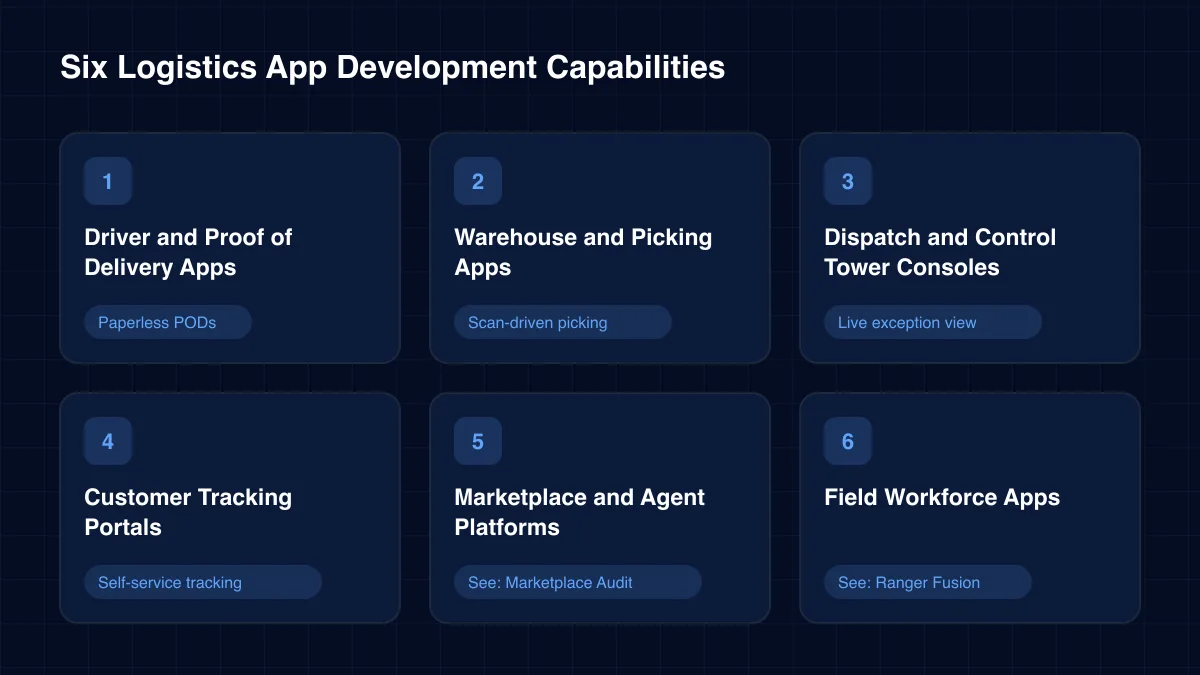
These are the builds carriers, 3PLs and shippers request most. Each can start as a focused pilot and grow into a wider logistics app development roadmap.
Turn-by-turn stop lists, photo and signature capture, and exception codes. In logistics app development this is usually the first app, because it replaces paper PODs.
Paperless PODs
Handheld apps guide receiving, putaway, picking and packing. They read GS1 barcodes and write straight to your WMS.
Scan-driven picking
Web consoles show live loads, delays and driver hours on one map. Dispatchers reassign work in a few clicks instead of a dozen calls.
Live exception view
Shippers and consignees see ETAs, documents and delivery proof without calling your team. Branded portals reduce where-is-my-order traffic.
Self-service tracking
Booking, quoting and agent tracking platforms for transport businesses. Our automotive marketplace work shows how logistics app development can rescue an inherited build.
See: Marketplace Audit →Attendance, task assignment and supervision for yard crews and field teams. Our Ranger Fusion workforce platform is a working reference.
See: Ranger Fusion →Architecture
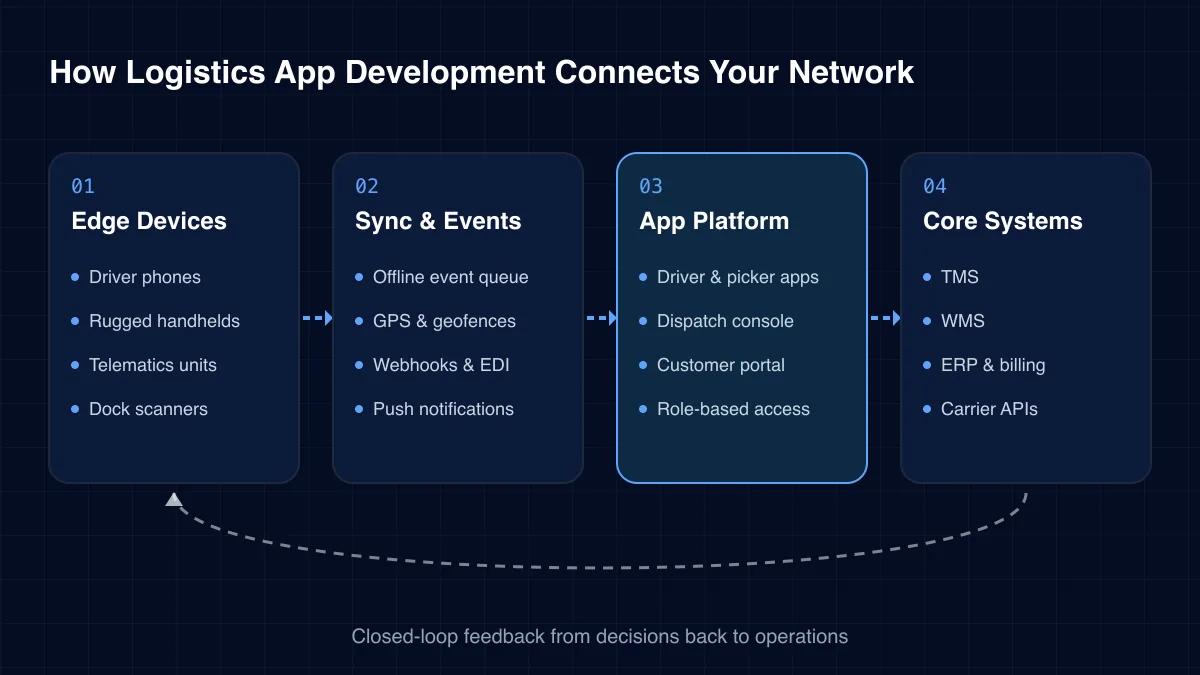
Apps sit at the edge of your network, where goods change hands. An integration layer keeps them in step with planning, execution and billing systems.
01
02
03
04
Challenges we solve
Logistics runs on thin margins and tight windows. Small data gaps turn into missed slots, disputes and unpaid invoices. These are the gaps we close most often.
Signed paperwork returns days after delivery, and some gets lost. Invoices wait with it. A digital POD reaches billing the moment the driver taps confirm.
Without live status, dispatchers phone drivers to learn where they are. That wastes time and distracts people behind the wheel.
Paper pick lists invite wrong items and short shipments. Scan-to-confirm workflows catch the error before the tote is sealed.
Shippers want ETAs and documents now. Without a portal, your service desk becomes a manual tracking lookup service.
Many transport firms run platforms built by a previous vendor. Bugs pile up and the team loses trust in the data. A structured audit is often cheaper than a rewrite.
An app that works for ten trucks can choke at five hundred. We load test sync paths and TMS calls before rollout, not after.
Logistics app development projects usually fall into one of four shapes. Larger operators run several side by side.
Your TMS may already ship a mobile module. The table shows when custom logistics app development is worth it.
| Need | TMS mobile module | Generic field app | Custom app |
|---|---|---|---|
| Fits your exception codes | Partial | No | ✓ Yes |
| Works fully offline | Partial | Partial | ✓ Yes |
| Connects TMS, WMS and billing | Partial | No | ✓ Yes |
| Branded customer portal | No | No | ✓ Yes |
| You control the roadmap | No | No | ✓ Yes |
The benefits build as more of the network reports through the same apps and events.
Delivery
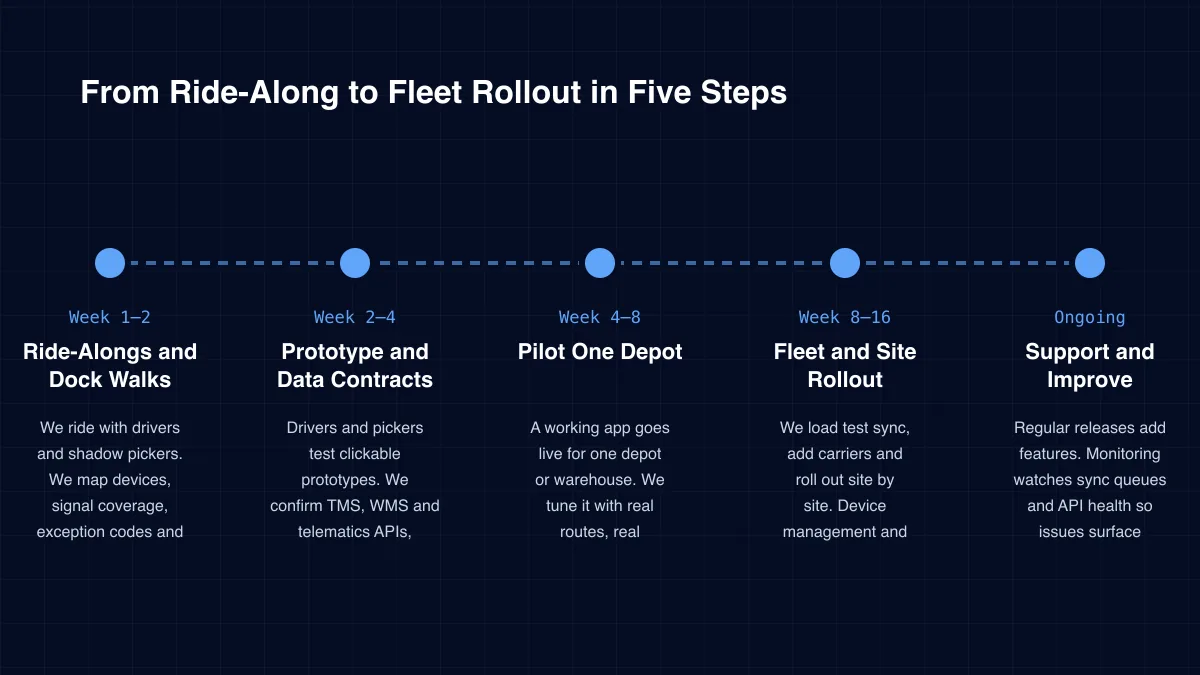
Week 1–2
We ride with drivers and shadow pickers. We map devices, signal coverage, exception codes and every system each event touches.
Week 2–4
Drivers and pickers test clickable prototypes. We confirm TMS, WMS and telematics APIs, including EDI where needed.
Week 4–8
A working app goes live for one depot or warehouse. We tune it with real routes, real scanners and real exceptions.
Week 8–16
We load test sync, add carriers and roll out site by site. Device management and driver training ship alongside.
Ongoing
Regular releases add features. Monitoring watches sync queues and API health so issues surface before drivers notice.
Case study
A client ran a high-traffic car-buying marketplace built by an external vendor. It suffered from lag, poor agent visibility and high bounce rates. Our team ran a structured stabilization and audit instead of a rebuild. The platform reached 95% stability, full data visibility into agent performance and a 40% increase in customer engagement.
“Customers lose trust the moment a platform itself feels unstable.”Read the full case study →
QA audit · Regression testing
Resolved the functional and performance bugs behind system lag.
Real-time tracking · Reporting
Live tracking of agent activity and commissions, with leadership sales reports.
Node.js · Modern UI/UX
A backend upgrade for responsiveness and a refined vehicle purchase flow.
Many teams can build a map with pins on it. Far fewer understand detention, tendering or a short pick. We recommend checking five things.
In our experience, offline design and integration depth decide whether logistics app development succeeds. Drivers abandon apps that lose their work.
ICANIO operates under ISO 9001 and ISO 27001 certified processes. Apps use role-based access, encrypted storage on the device and secure token handling.
Location tracking is scoped to duty time and a clear purpose. We align retention with GDPR and local privacy law where they apply. For US fleets, we integrate with ELD providers rather than replacing certified devices.
Pick one cost that paper creates. Examples are days from delivery to invoice, calls per load, or picking error rates. Put a value on it for one depot.
Measure the same figure before and after the pilot. We agree the baseline with you during discovery. Each logistics app development phase is then judged on your own numbers.
Technology stack
We choose the stack for each fleet and site. These are the tools we use most.
Mobile
Web
Map SDKs
Backend
Integration
REST & webhooksEDITelematics APIsMessage queues
Devices
Rugged handheldsGS1 barcodesBluetooth printersMDM
Cloud & Delivery
CI/CD pipelinesObservability
 Free white paper · App DevelopmentApplication DevelopmentBuilding Enterprise-Grade Applications That Drive Digital TransformationGet the white paper →
 Free white paper · LogisticsTransportation & Logistics Technology SolutionsTransforming Modern Supply Chains with AI, Cloud, and IoT IntegrationGet the white paper →
Most logistics app development starts with proof of delivery or picking. Both replace paper, touch billing, and show results within weeks. A dispatch console often follows once events flow reliably.
Yes. Integration is central to our logistics app development work. We connect through vendor APIs, EDI or middleware. Where no API exists, we scope a safe connector during design.
The app keeps working. Events are stored on the device and sent in order when signal returns. Drivers never have to redo a stop.
Cross-platform frameworks such as Flutter suit most driver and portal apps. Native code can make sense for heavy scanner or Bluetooth use. We recommend the option that fits your devices and budget.
Yes. We often start with a structured audit of code, QA gaps and performance. Our automotive marketplace work stabilized a vendor-built platform instead of rewriting it.
We track only during duty time and for stated purposes. Retention periods, consent and access rules are agreed with you and follow applicable privacy law.
Every handoff in a supply chain is a chance to lose data, time or money. Logistics app development captures those handoffs at the source, on the devices your people already carry.
ICANIO brings mobile, web and integration engineers into one team. We pilot at one depot, prove value on your numbers, and scale across the network. Our logistics app development work continues through structured support after launch.
By ICANIO Application Engineering Team · Published · Updated
Book a free discovery call with our team. We will map one workflow, its integrations and a pilot depot plan. Contact us to get started.
Contact Our App Team