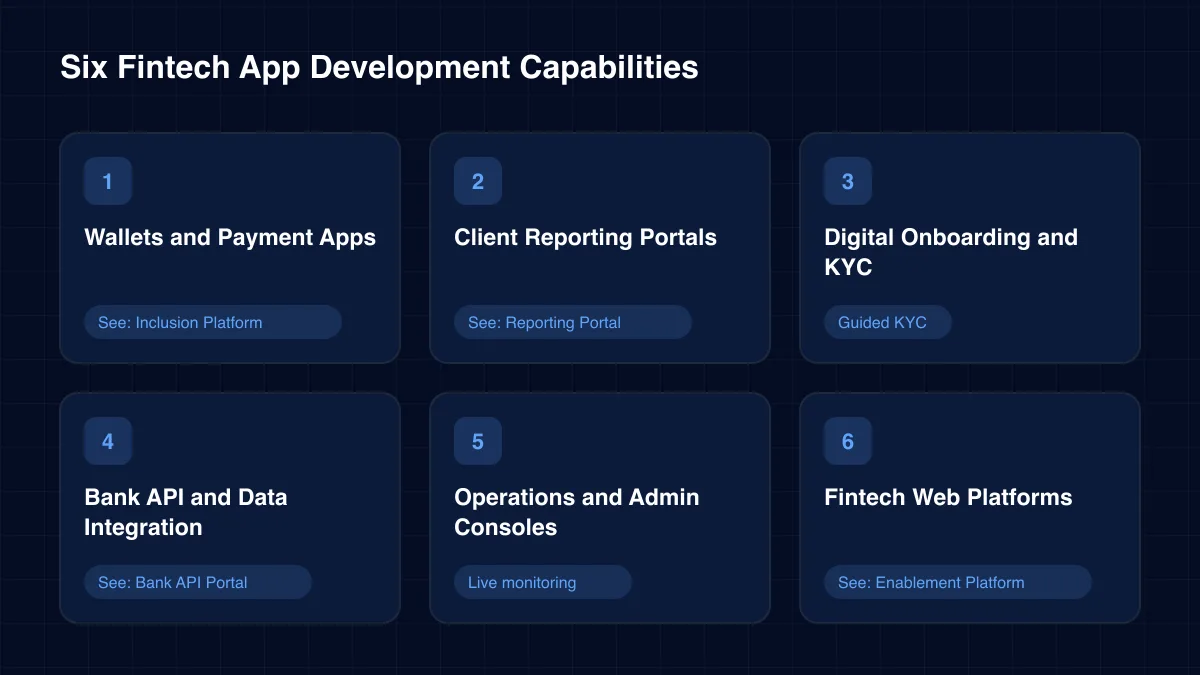
Wallets and Payment Apps
Transfers, withdrawals, bill payments and merchant pay in one app. Our financial inclusion platform brought these to rural and underserved users.
See: Inclusion Platform →App Development for Fintech & Banking
We build wallets, payment apps, onboarding flows and client portals that sit safely on top of core banking and payment rails. Security and auditability come first, then delightful UX.
PayEase
My wallet
PayEase
My wallet
⟳ Design in progress
Money apps live or die on trust. One failed transfer, one confusing fee or one leaked record and customers leave. Fintech app development has to deliver consumer-grade UX while meeting banking-grade security and regulation.
Our team builds wallets, payment apps, onboarding journeys and client portals on top of core banking, card and payment systems. We treat compliance, reconciliation and audit trails as product features, not paperwork at the end.
This guide explains what serious fintech app development involves in 2026. It covers the main app types, a reference architecture, the failure modes regulators and customers punish, a delivery plan and how to choose a partner.
Fintech app development is the design and build of software that moves, records or reports money. It spans consumer wallets, payment and transfer apps, lending journeys, account onboarding, trading tools and client reporting portals.
Three things make it different from ordinary app work. Every transaction must reconcile to the ledger. Identity must be verified to KYC and anti-money laundering rules. And every screen that touches funds must stand up to security review and audit.
Good fintech app development keeps the core banking system as the source of truth. The app is a secure, well-designed window onto accounts, payments and reports. Heavy logic such as ledger posting stays in systems built for it.
Staff tools deserve the same care. Operations teams handle disputes, limits, refunds and approvals every day. When their consoles show live, reconciled data, problems are fixed in minutes and customers rarely notice them.
Working definition
“Fintech app development is building secure, compliant customer and staff apps that initiate, track and report financial transactions on top of banking and payment infrastructure.”
Foundations
Strong authentication, device binding, encrypted storage and certificate pinning. Threat modelling happens before the first screen is built.
Every action maps to a ledger entry with an idempotent reference. Retries never create a duplicate payment.
KYC, consent, limits and disclosures live in the user journey. Audit trails are generated automatically, not rebuilt later.
Fees, status and next steps are always visible. Clarity reduces disputes and support calls more than any chatbot.
Core capabilities
These are the builds banks, brokers and fintech companies request most. Each fits a broader fintech app development roadmap.
Transfers, withdrawals, bill payments and merchant pay in one app. Our financial inclusion platform brought these to rural and underserved users.
See: Inclusion Platform →Self-service ledgers, portfolio reports and trade confirmations. In fintech app development, portals like this remove a large share of manual requests.
See: Reporting Portal →Document capture, liveness checks and screening built into a short, guided journey. Drop-off falls when each step explains why it is needed.
Guided KYC
Secure connectors to bank APIs, core banking and payment rails. Our bank API data acquisition portal centralises client transactions in one place.
See: Bank API Portal →Real-time dashboards for transactions, disputes, limits and approvals. Operators see problems before customers report them.
Live monitoring
Credible, compliance-aware websites and web apps for payment companies. Our fintech digital enablement work rebuilt a payments company's site around SWIFT and compliance content.
See: Enablement Platform →Architecture
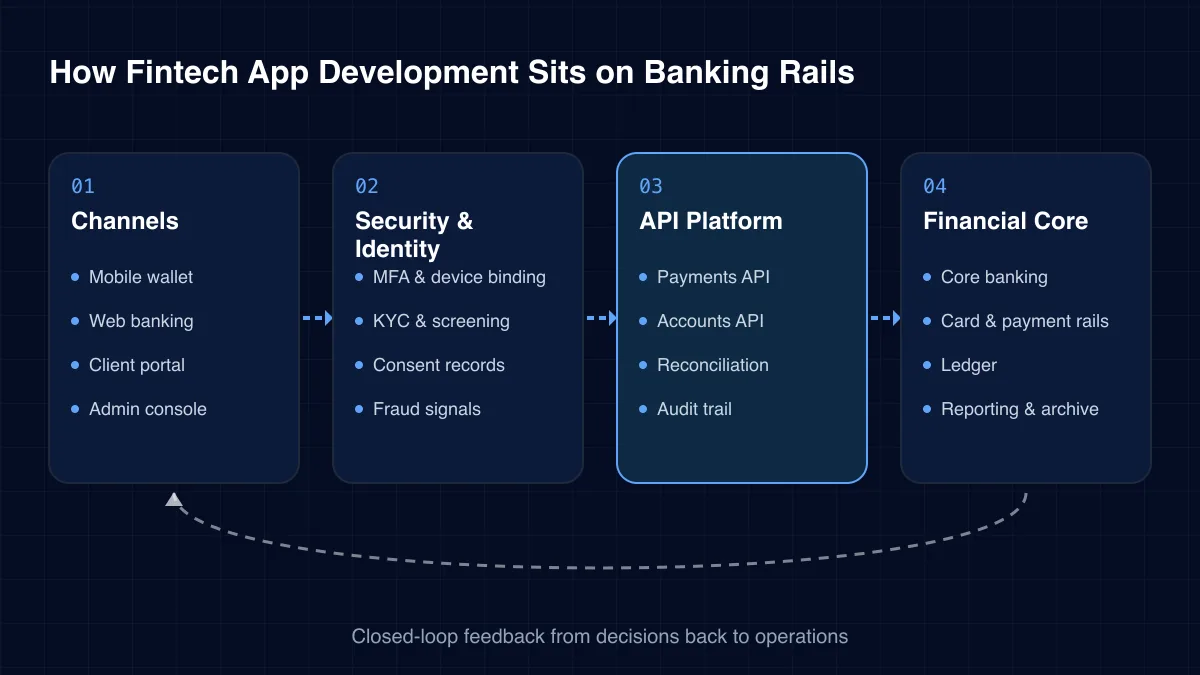
Customer and staff apps never talk to the ledger directly. A secured API tier handles identity, limits, idempotency and audit, then calls core systems.
01
02
03
04
Challenges we solve
Finance has little tolerance for error. These are the failure modes we design out most often.
Network retries can post a payment twice or not at all. Idempotency keys and clear status screens prevent both.
Long, confusing KYC flows lose good customers. Guided capture and instant feedback keep them moving.
Clients email for statements and wait. Our reporting portal replaced that with self-service ledgers and confirmations.
Holdings split across asset classes and systems never quite agree. One platform with reconciliation modules resolves it.
New users hesitate to trust an unfamiliar app. Transparent status, fast dispute handling and referrals from people they know help.
Pen tests just before launch find deep design flaws. We threat model early and test in every pipeline instead.
Fintech app development projects usually take one of four shapes. Each has its own regulatory weight.
White-label and core vendor apps can launch fast. The table shows when custom fintech app development is worth it.
| Need | Core vendor app | White-label app | Custom app |
|---|---|---|---|
| Distinct brand and journeys | No | Partial | ✓ Yes |
| Multiple cores and rails | No | Partial | ✓ Yes |
| Custom compliance flows | Partial | Partial | ✓ Yes |
| Own product roadmap | No | No | ✓ Yes |
| Speed to first launch | ✓ Yes | ✓ Yes | Partial |
The benefits compound as more customer and staff journeys move into secure, connected apps.
Delivery
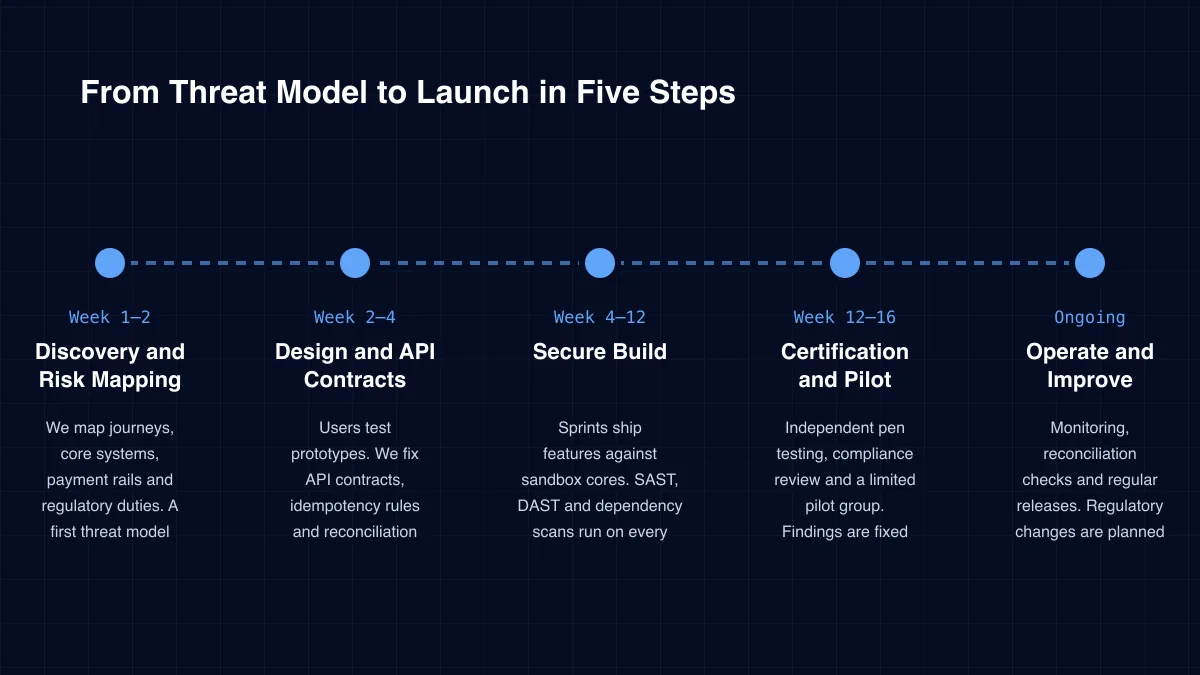
Week 1–2
We map journeys, core systems, payment rails and regulatory duties. A first threat model is drafted with your security team.
Week 2–4
Users test prototypes. We fix API contracts, idempotency rules and reconciliation logic with your core team.
Week 4–12
Sprints ship features against sandbox cores. SAST, DAST and dependency scans run on every merge.
Week 12–16
Independent pen testing, compliance review and a limited pilot group. Findings are fixed before general release.
Ongoing
Monitoring, reconciliation checks and regular releases. Regulatory changes are planned into the roadmap.
Case study
An organisation relied on manual, request-based reporting across Equity, F&O, Currency and Commodities. Clients waited for statements and reconciliation was hard. Our team built a secure portal with real-time ledgers, self-service flows and compliance-ready archives. It cut report retrieval time by 60% and manual processing effort by 50%.
“A client who waits for a statement starts to wonder what else is manual.”Read the full case study →
Real-time ledgers · Reports
Ledgers, portfolio reports and trade confirmations available the moment they change.
PayIN · PayOut · Margin pledge
Clients complete payments, pledges and profile updates without manual requests.
SSO · Reconciliation modules
SSO, UI-level security and compliance-ready historical data archives.
Many teams can build a slick payments demo. Few can pass a bank's security review. We recommend checking five things first.
In our experience, reconciliation and security decide whether fintech app development succeeds. Beautiful screens cannot rescue an app that loses a payment.
ICANIO works under ISO 9001 and ISO 27001 certified processes. Apps use multi-factor authentication, device binding, encrypted storage and certificate pinning. Secrets live in managed vaults, never in code.
Card flows use tokenisation, so primary account numbers stay with PCI DSS-certified providers. We support SOC 2 evidence collection and align with open banking and local regulator rules. Formal certification of your service remains with you, and we provide the controls and evidence it needs.
Security testing is continuous. Static and dynamic scans run on every merge, dependencies are monitored, and independent penetration tests precede each major release.
Pick a measurable cost. Examples are statement requests per month, onboarding abandonment, manual reconciliation hours or dispute resolution time.
Track the figure before and after the pilot. We agree the baseline with you during discovery. Each fintech app development phase is then judged on your own operational data.
Growth metrics matter too. Track onboarding completion, active users, transaction volume and referral-driven sign-ups. Our financial inclusion platform showed how a referral system built into the product can lower acquisition costs.
Some value is defensive. Fewer security findings, faster audit responses and fewer payment errors all protect revenue and licences. We report these alongside growth metrics.
Technology stack
We choose tools per product and regulator. These are our common picks.
Mobile
Web
SSO
Backend
Financial Integration
Bank APIsPayment gatewaysUPIISO 20022
Security
MFATokenisationSecrets vaultsSAST & DAST
Cloud & Data
Audit loggingData lake
Security starts in design. Our fintech app development uses threat modelling, strong authentication, encrypted storage and continuous security testing. Independent penetration tests run before major releases.
We design to keep card data out of your systems through tokenisation with certified providers. That reduces PCI DSS scope. Where some scope remains, we build the controls and evidence your assessor needs.
Yes. We integrate through core banking APIs, middleware or bank-provided connectors. Idempotency and reconciliation rules are agreed with your core team during design.
Yes. We build guided document capture, liveness checks and screening integrations. Providers are chosen to match your market and regulator.
A focused wallet, onboarding or portal product can reach a pilot within a few months. Security reviews and regulator steps affect timing. We give you a dated plan after discovery.
Yes. We often start with an audit of code, security and reconciliation gaps. Then we modernise in phases, so customers are never left without service.
Customers will only trust a money app that is fast, clear and safe. Fintech app development earns that trust through security, reconciliation and honest design.
ICANIO brings mobile, web, integration and security engineers into one team. We threat model early, build against sandbox cores and pilot before scale. Our fintech app development work continues with monitoring, reconciliation checks and regular releases.
By ICANIO Fintech Engineering Team · Published · Updated
Book a free discovery call with our team. We will map one journey, its core integrations and a secure pilot plan. Contact us to get started.
Contact Our Fintech Team