Multi-Tenant Architecture
Pooled, siloed or hybrid tenancy designed around your compliance and cost needs. SaaS development starts with this choice, because it shapes the database, the APIs and the price.
Isolation by design
SaaS Development
We engineer subscription software with tenant isolation, billing, onboarding and observability built into the foundation, so growth adds revenue rather than rework.
PayrollCloud
Tenant overview
PayrollCloud
Tenant overview
⟳ Design in progress
A SaaS product earns money only when one codebase can serve hundreds of customers safely. SaaS development is the discipline of making that possible. Tenant isolation, plans and billing, onboarding and usage limits all have to work before the second customer signs.
Our team at ICANIO builds new SaaS products and rebuilds single-client software into multi-tenant platforms. We design the tenancy model, the subscription engine and the admin tooling together. Then we automate deployment so every tenant gets the same release on the same day.
This guide covers the architecture choices behind SaaS development, the mistakes that hurt margins later, and the delivery steps we follow. It also shows how one of our clients turned a rigid payroll product into a configurable platform.
SaaS development is the engineering of software that customers rent by subscription and use over the internet. The vendor runs one platform in the cloud. Each customer, or tenant, sees only its own data, users and settings.
That shared model changes almost every design decision. Data must carry a tenant identifier everywhere. Features must be switchable per plan. Noisy tenants must not slow down quiet ones, and upgrades must reach everyone without downtime.
A SaaS business also needs commercial plumbing. Trials, plan changes, proration, invoices, failed-payment recovery and usage metering are all part of the product. So are audit logs and admin consoles for your own support staff.
Done well, SaaS development lets revenue grow faster than cost. Each new tenant reuses the same code and infrastructure. Done poorly, every customer becomes a custom fork that drains engineering time.
Working definition
“SaaS development is the design and delivery of subscription software in which one cloud platform serves many isolated tenants, with plans, billing, onboarding and operations automated end to end.”
Foundations
Every query, cache key and file path is scoped to a tenant, and tests prove it.
Tenants tailor workflows through settings and templates, so you never fork the product.
Plans, limits and usage events are first-class features, wired to billing from the start.
Automated pipelines and backward-compatible migrations let every tenant upgrade together.
Core capabilities
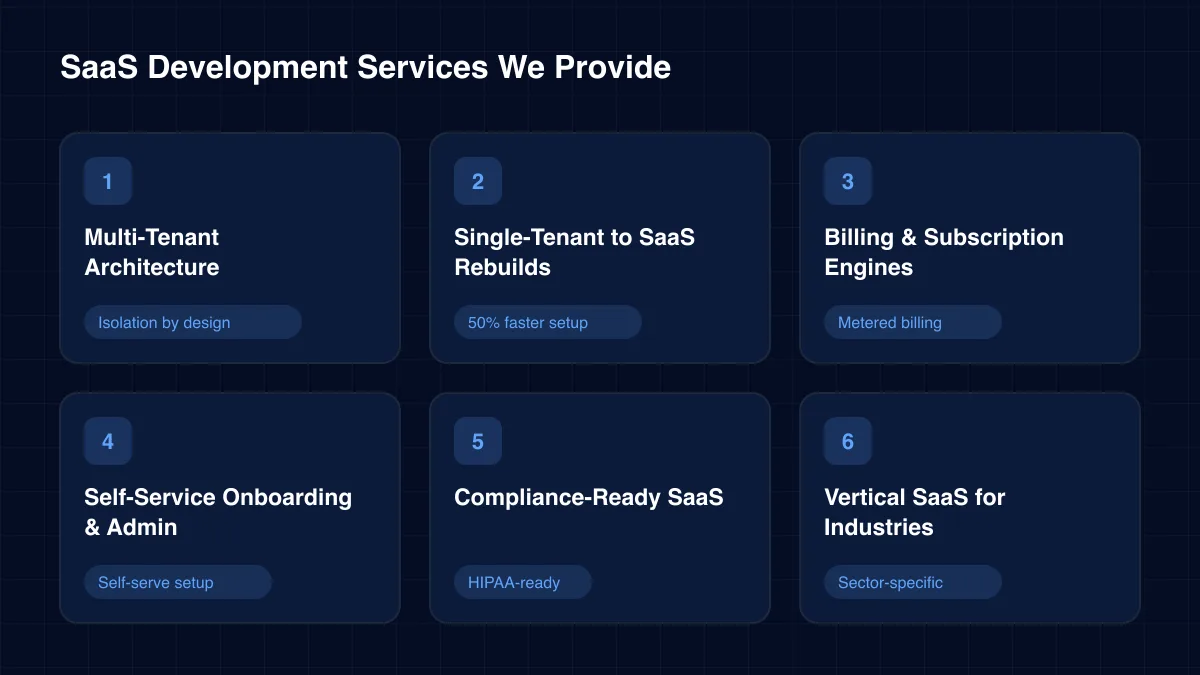
From a first MVP to a mature platform, each service targets one part of the SaaS lifecycle. Combine them into a full SaaS development engagement or pick what you need.
Pooled, siloed or hybrid tenancy designed around your compliance and cost needs. SaaS development starts with this choice, because it shapes the database, the APIs and the price.
Isolation by design
We turn products built for one client into configurable platforms. A payroll rebuild on microservices and REST APIs cut workflow setup time by half.
50% faster setup →Plans, trials, proration, invoices and dunning through providers such as Stripe or Chargebee. Usage metering feeds billing automatically, so finance never reconciles by hand.
Metered billing
Sign-up, workspace setup, data import, SSO and role management that customers complete alone. Internal consoles let your support team help tenants safely.
Self-serve setup
SOC 2 controls, GDPR data rights and HIPAA safeguards built into SaaS development. Our pharma SaaS modernization moved releases from weeks to hours on Azure.
HIPAA-ready →Products built for one sector's rules, such as healthcare, fintech or manufacturing. We bring domain patterns from our industry work to shorten discovery.
Sector-specific →Architecture
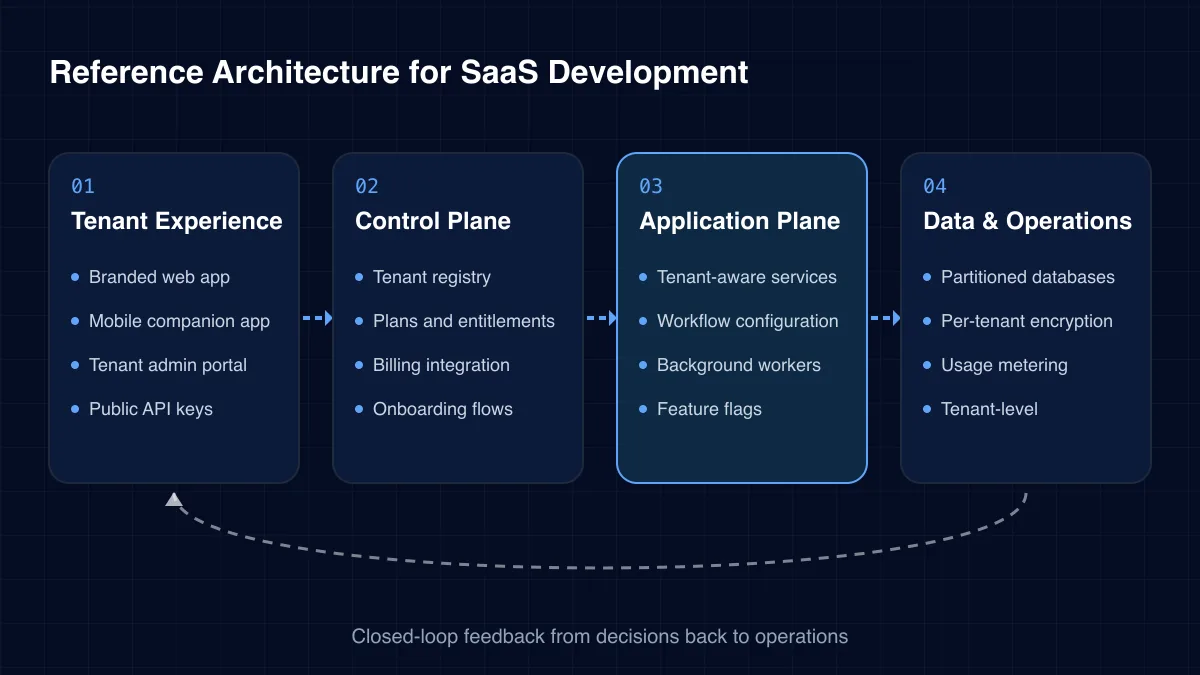
We separate the control plane, which manages tenants and plans, from the application plane, which serves their users. That split keeps commercial logic out of business features.
01
02
03
04
Challenges we solve
Most SaaS pain appears after the tenth customer, not the first. These are the patterns we fix most often.
Custom code per client stops upgrades. We move differences into configuration, templates and feature flags.
One missing filter can expose another tenant's data. We enforce scoping in the data layer and test it automatically.
A large tenant can slow everyone else. We add quotas, rate limits and queue isolation per tenant.
Hand-made invoices do not scale. We wire plans, metering and payment recovery into the first release.
If engineers must set up each customer, growth stalls. We automate provisioning, imports and SSO setup.
Without per-tenant cost data you cannot price well. We tag infrastructure and usage by tenant.
The tenancy model is the most important decision in SaaS development. Each option trades cost against isolation.
We recommend choosing per tier rather than once for the whole product.
| Criterion | Pooled | Schema per tenant | Silo |
|---|---|---|---|
| Cost per tenant | Low | Medium | High |
| Data isolation | Partial | ✓ Yes | ✓ Yes |
| Easy fleet upgrades | ✓ Yes | Partial | Partial |
| Per-tenant restore | No | ✓ Yes | ✓ Yes |
| Best for | SMB plans | Mid-market | Enterprise and regulated |
Getting the foundations right turns each new customer into margin, not extra work.
Delivery
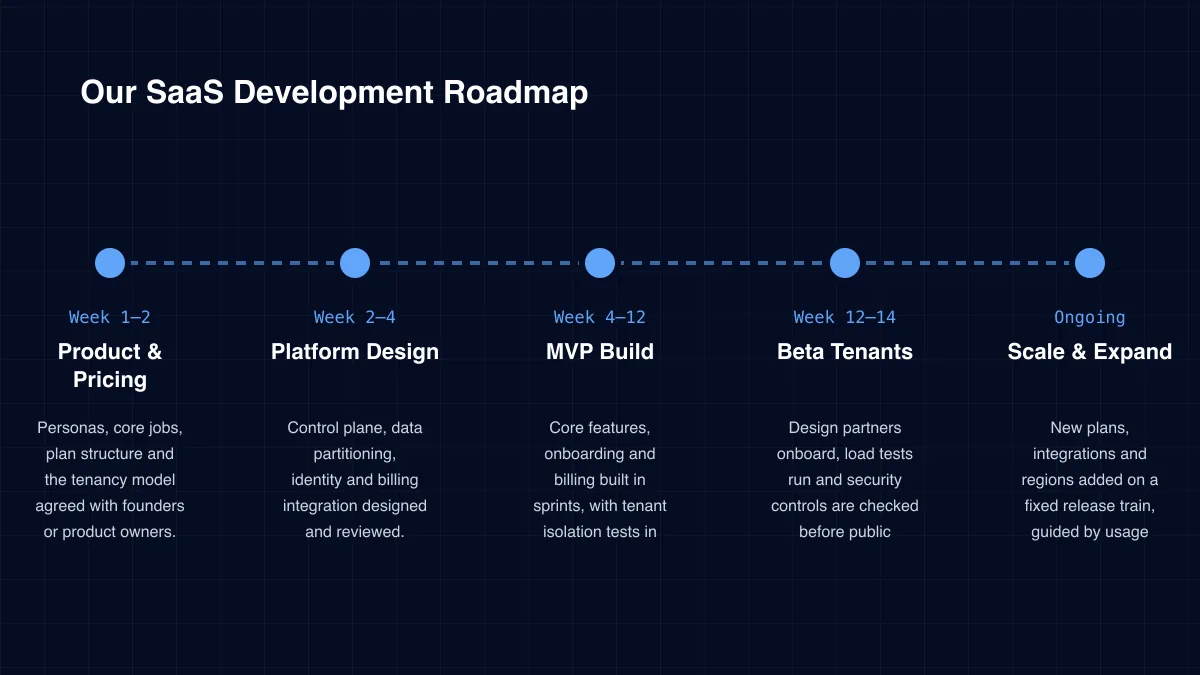
Week 1–2
Personas, core jobs, plan structure and the tenancy model agreed with founders or product owners.
Week 2–4
Control plane, data partitioning, identity and billing integration designed and reviewed.
Week 4–12
Core features, onboarding and billing built in sprints, with tenant isolation tests in CI.
Week 12–14
Design partners onboard, load tests run and security controls are checked before public launch.
Ongoing
New plans, integrations and regions added on a fixed release train, guided by usage data.
Case study
A payroll product built as a monolith could not adapt to different clients, and manual workflows caused compliance errors. ICANIO rebuilt it on a microservice architecture with modular REST APIs, role-based access and drag-and-drop configuration. Workflow setup became 50% faster, manual operational effort dropped 40% and user experience quality improved 3x.
Read the full case study →Microservices · REST APIs
Modular services let each part of the platform evolve without destabilising the rest.
Drag-and-drop builder
Administrators shape payroll structures themselves instead of raising engineering tickets.
Role-based access control
Each tenant's users see and manage only their own payroll data and permissions.
Specialist services within our mobile & web application development practice.
Many teams can build a web app. Fewer understand subscription businesses. Check for these five signals.
Our team asks about your pricing model in the first workshop. In SaaS development, the commercial design and the technical design are the same conversation.
ICANIO delivers under ISO 9001 and ISO 27001 certified processes. Every SaaS development project includes tenant isolation tests, OWASP-aligned code checks and secrets management in the pipeline.
Enterprise buyers will ask for evidence. We design controls that map to SOC 2 trust criteria, support GDPR access and deletion requests, and apply HIPAA safeguards when health data is involved.
Per-tenant audit logs, SSO with SAML or OIDC, and optional customer-managed keys help you pass security reviews faster. Infrastructure as code keeps every environment consistent and auditable.
Healthy SaaS businesses watch cost to serve each tenant alongside revenue per tenant. Good SaaS development makes both numbers visible from the first month.
Automation drives the margin. Self-service onboarding cuts sales and support time. Automated billing cuts finance effort. Shared infrastructure cuts hosting cost as tenants grow.
When we rebuild existing products, we compare the effort of serving clients before and after. The payroll rebuild, for example, cut manual operational effort by 40%.
Technology stack
We favour managed cloud services, so your team spends time on the product rather than servers.
Frontend
Backend
Data
Identity & Billing
Auth0StripeChargebee
Platform
Observability
Per-tenant cost tags
A focused SaaS MVP with onboarding and billing usually takes around twelve to fourteen weeks after discovery. Enterprise features such as SSO and audit exports follow in later releases.
Most products start pooled for cost, then offer schema or silo isolation for enterprise plans. The right answer depends on your compliance needs, customer size and pricing.
Yes. We add tenant scoping, move client differences into configuration and automate provisioning. Our payroll rebuild shows how SaaS development can turn a rigid product into a configurable one.
Yes. We connect providers such as Stripe or Chargebee for plans, trials, proration, invoices and payment recovery, and feed them usage data from the product.
We design for the standards your buyers ask about, such as SOC 2, GDPR or HIPAA. Controls, logs and evidence are part of the platform rather than a late add-on.
Yes. As an AI-native company we add search, assistants and machine learning features with per-tenant data boundaries, so one customer's data never trains another's model.
How we deliver saas development and the wider app development practice in each sector.
A subscription product is only as strong as the platform underneath it. SaaS development that gets isolation, configuration and commercial automation right lets you add customers without adding chaos.
ICANIO brings product, cloud and compliance engineering to every build. Whether you are launching a new idea or turning client software into a platform, we design for scale from the first sprint.
If you are planning a new product or a rebuild, contact us. We will review your model, customers and roadmap, then outline a practical SaaS development plan.
By ICANIO Application Engineering Team · Published · Updated
Book a free discovery call. We will discuss your customers, pricing and current platform, then map the architecture and first release you need.
Contact Our SaaS Team