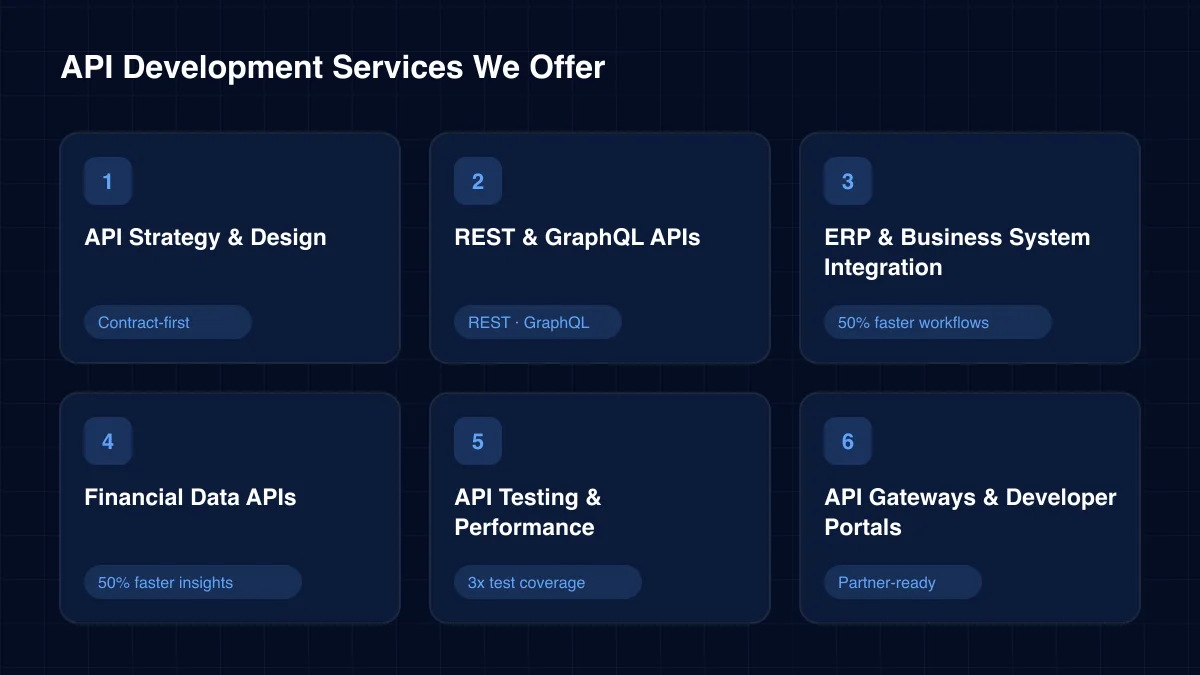
API Strategy & Design
Resource modelling, OpenAPI contracts, naming standards and versioning rules. API development services start here, because a clean contract outlives any implementation.
Contract-first
API Development Services
Contract-first APIs, partner integrations and event streams that let your apps, ERP, payment and data platforms share information securely and in real time.
API Console
orders-api · v2
API Console
orders-api · v2
⟳ Design in progress
Most businesses already own the data they need. It is just trapped in an ERP, a payment gateway, a legacy database or a partner's system. API development services free that data. They give every application a secure, documented way to read and act on it.
Our team at ICANIO designs, builds and runs APIs for internal apps, mobile clients and external partners. We write the contract first, generate documentation from it and protect every endpoint behind a gateway. We also build the integration flows that keep systems in sync.
This page covers API styles, architecture, security, common integration failures and our delivery process. It also includes a real ERP integration project and a checklist for choosing a partner.
API development services cover the design, build, testing, documentation and operation of application programming interfaces. An API is a contract. It defines what a system offers, what it expects and how errors are reported.
The work spans several layers. There are the APIs your own apps call, the public or partner APIs others consume, and the integration flows that move data between packaged systems such as ERP and CRM.
Modern APIs are usually RESTful and described with the OpenAPI Specification. GraphQL suits apps that need flexible queries. Event-driven interfaces, using queues or streams, suit work that should happen asynchronously.
Good API development services also plan for change. Versioning, deprecation notices and backward compatibility let you improve an API without breaking the apps and partners that rely on it.
Working definition
“API development services are the end-to-end engineering of documented, secure and versioned interfaces and integration flows that let applications, partners and data platforms exchange information reliably.”
Foundations
The OpenAPI or AsyncAPI document is agreed before code, so client and server teams build in parallel.
OAuth 2.0, scoped tokens, input validation and rate limits protect every endpoint.
Every call is traced and measured, so latency and errors are visible per consumer.
Clear versioning and deprecation policies let the API grow without breaking clients.
Core capabilities
Each service can stand alone or form part of a wider integration programme. All of our API development services share the same design and security standards.
Resource modelling, OpenAPI contracts, naming standards and versioning rules. API development services start here, because a clean contract outlives any implementation.
Contract-first
Fast, well-tested APIs on Java, .NET, Node.js or Python. We pick REST for broad compatibility and GraphQL when clients need flexible, nested queries.
REST · GraphQL
Connectors and sync flows for ERP, CRM and back-office tools. Our ERP integration automation used n8n, RabbitMQ Shovel and Apache Airflow for real-time data sync.
50% faster workflows →Secure APIs for transactions, reports and data feeds in banking and wealth management. Our CSV parser platform delivered wealth insights 50% faster through an API.
50% faster insights →Contract, functional and load testing in the pipeline. Our generative AI testing platform cut API test setup time by half and tripled coverage for dev teams.
3x test coverage →Gateway setup, key management, usage plans and self-service developer portals. These API development services suit fintech and open banking programmes that onboard partners.
Partner-ready →Architecture
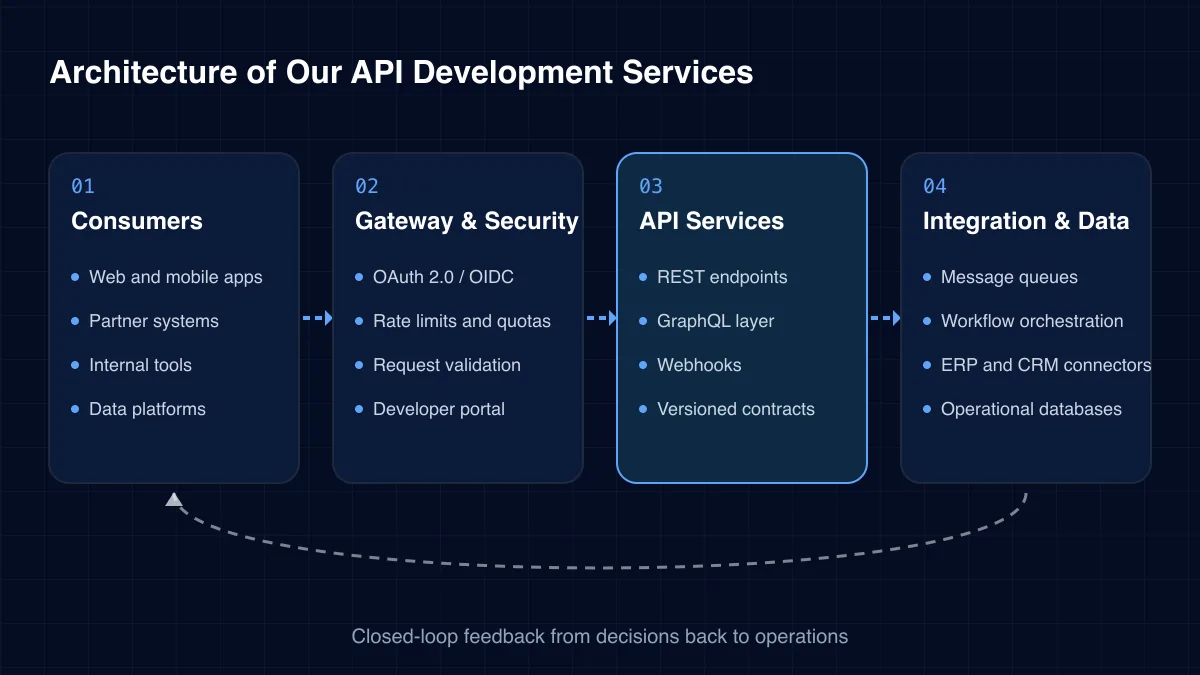
We separate the public contract from internal services and from integration flows. Each layer can change at its own pace without breaking consumers.
01
02
03
04
Challenges we solve
Integration problems are expensive because they break several systems at once. These are the ones we see most.
Every system wired directly to every other becomes impossible to change. We introduce a gateway and shared integration layer.
Without docs, each new consumer needs a meeting. We publish OpenAPI docs and sandboxes for every API.
Silent field changes break partner apps. We version APIs and announce deprecations with clear timelines.
Shared keys and broad tokens invite misuse. We apply OAuth 2.0 scopes and follow the OWASP API Security Top 10.
Network failures drop data between systems. We use retries, idempotency keys and dead-letter queues.
XML, CSV and JSON rarely line up cleanly. We validate and transform payloads at the integration boundary.
API development services cover four main interface styles. Many platforms use more than one.
No single style fits every use. We recommend choosing per use case rather than per company.
| Criterion | REST | GraphQL | Event-driven |
|---|---|---|---|
| Broad tool support | ✓ Yes | Partial | Partial |
| Flexible client queries | No | ✓ Yes | No |
| Real-time updates | Partial | Partial | ✓ Yes |
| HTTP caching | ✓ Yes | Partial | No |
| Best for | Public and partner APIs | Complex app screens | System sync and workflows |
Well-built APIs turn isolated systems into one connected business.
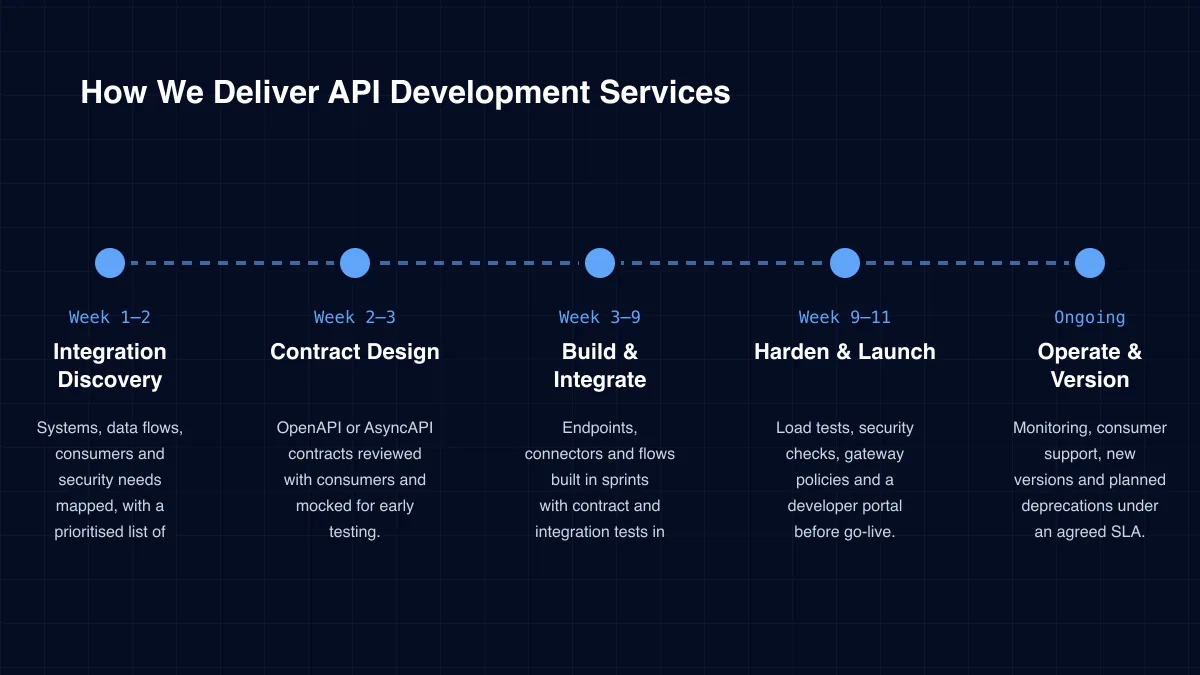
Delivery
Week 1–2
Systems, data flows, consumers and security needs mapped, with a prioritised list of APIs.
Week 2–3
OpenAPI or AsyncAPI contracts reviewed with consumers and mocked for early testing.
Week 3–9
Endpoints, connectors and flows built in sprints with contract and integration tests in CI.
Week 9–11
Load tests, security checks, gateway policies and a developer portal before go-live.
Ongoing
Monitoring, consumer support, new versions and planned deprecations under an agreed SLA.
Case study
A retail operation suffered from manual workflows, fragmented communication and errors between its ERP and MagOffice. ICANIO upgraded legacy packages and built a structured integration layer with orchestration, XML processing and real-time sync of receipts, billing and transactions. Workflows became 50% faster, data accuracy tripled and manual effort fell 40%.
Read the full case study →n8n · RabbitMQ Shovel
Data between the ERP and MagOffice flows through a structured, auditable delivery channel.
Apache Airflow
Scheduling, execution monitoring and dependency management run every automation pipeline.
XML processing · Real-time sync
Payloads are parsed and validated, and every financial event is synchronised across systems.
Specialist services within our mobile & web application development practice.
APIs last longer than the apps that first use them. Check these five things before you commit.
Our team judges API development services by one test: can a new consumer integrate from the docs alone, without a meeting?
APIs are now one of the most common attack surfaces. ICANIO designs every endpoint against the OWASP API Security Top 10, with object-level authorisation checks, input validation and rate limiting.
We use OAuth 2.0 and OpenID Connect for identity, mutual TLS where partners require it and secrets stored in a managed vault. Our API development services follow ISO 27001 certified processes.
For regulated data we design for the relevant rules, such as PCI DSS for card data or GDPR for personal data. Audit logs record who called what, and when, for every sensitive operation.
Count the manual steps that move data between systems today. Rekeying, exports and reconciliations all cost staff time and cause errors. That is the baseline good API development services remove.
Then count reuse. Each well-designed API can serve several apps and partners. The ERP integration project, for example, delivered 50% faster workflows and 40% less manual effort.
We recommend tracking API adoption, error rates and time to onboard a new consumer. Those numbers show how integration work turns into speed for the whole business.
Technology stack
We use open standards and proven tools, so your APIs stay portable.
Specification
AsyncAPIJSON Schema
Backend
Python FastAPI
Gateways
Kong
Integration
Security
OAuth 2.0mTLS
Testing
Pact
Design, build, testing, documentation, gateway setup and ongoing operation. We also build integration flows that connect ERP, CRM, payment and data platforms.
REST is the safer default for partner and public APIs. GraphQL helps when apps need many related objects in one call. Many platforms use REST externally and GraphQL internally.
We version contracts, keep old versions running for an agreed period and publish deprecation dates. Consumers get time and documentation to migrate.
Yes. Our ERP integration automation connected an ERP with MagOffice using queues, orchestration and real-time sync, with validated XML exchange.
OAuth 2.0 scopes, object-level authorisation, input validation, rate limits and full audit logs. We test against the OWASP API Security Top 10 before launch.
Always. We publish OpenAPI-based reference docs, examples and a sandbox, so new consumers can integrate without waiting for our team.
How we deliver api development services and the wider app development practice in each sector.
Every modern product depends on APIs, whether customers see them or not. API development services that start with a clear contract and strong security give your business a foundation it can build on for years.
ICANIO designs and runs APIs for apps, partners, cloud data platforms and even IoT and machine learning workloads. We connect the systems you already own and make sure each integration is observable and recoverable.
If data is stuck between systems or partners are waiting on an integration, contact us. We will map your flows and propose the API development services that remove the bottleneck.
By ICANIO Application Engineering Team · Published · Updated
Book a free discovery call. We will map your systems and data flows, then outline the APIs and integrations that will remove manual work.
Contact Our Integration Team