Career and Exam Prep Apps
Structured study plans, practice modules, job listings and mentor tracking in one app. Our career development platform is the model for this kind of education app development.
See: Career Platform →App Development for Education & E-Learning
We build learning apps, student portals and placement platforms that connect to your LMS and SIS. Every build is accessible, mobile-first and designed around how students actually study.
StudyPath
Today's plan
StudyPath
Today's plan
⟳ Design in progress
Students live on their phones, yet much of education still runs on emails, PDFs and spreadsheets. Education app development closes that gap. It gives learners a clear plan, mentors a live view of progress, and institutions one place to run admissions, courses and placements.
Our team builds these apps to work with the systems schools and edtech companies already use. That includes learning management systems, student information systems, video platforms and assessment tools. Standards such as LTI keep tools connected without fragile custom glue.
This guide explains what effective education app development looks like in 2026. It covers the app types that matter, a reference architecture, common failure modes, privacy, a delivery plan and how to choose a partner.
Education app development is the design and build of mobile and web software for learning and the work around it. Users include students, teachers, mentors, parents, administrators, training partners and recruiters.
The field has three distinct pressures. Engagement is voluntary, so apps must earn attention every day. Data is about students, sometimes minors, so privacy rules are strict. And institutions already run an LMS and SIS that the app must respect.
Good education app development solves all three. It uses structured plans and timely nudges to keep learners going. It limits and protects personal data. And it plugs into existing systems through standards, rather than creating another silo.
The audience is also wider than most teams expect. A single placement season involves colleges, students, training partners and corporate recruiters. Each needs its own view of the same data. Designing those views together, on one shared model, is what stops the process from falling back to email.
Working definition
“Education app development is building engaging, accessible and privacy-aware apps for learners and institutions, connected to the learning and student systems they already run.”
Foundations
Learners finish what they can see a path through. Day-by-day plans and clear milestones outperform a huge library.
Many students learn on budget phones and patchy data. Lightweight screens and offline downloads keep study going.
Captions, screen reader support, contrast and keyboard access follow WCAG guidance from the first design.
LTI, SSO and clean APIs connect the app to the LMS and SIS. Grades and progress flow without manual export.
Core capabilities
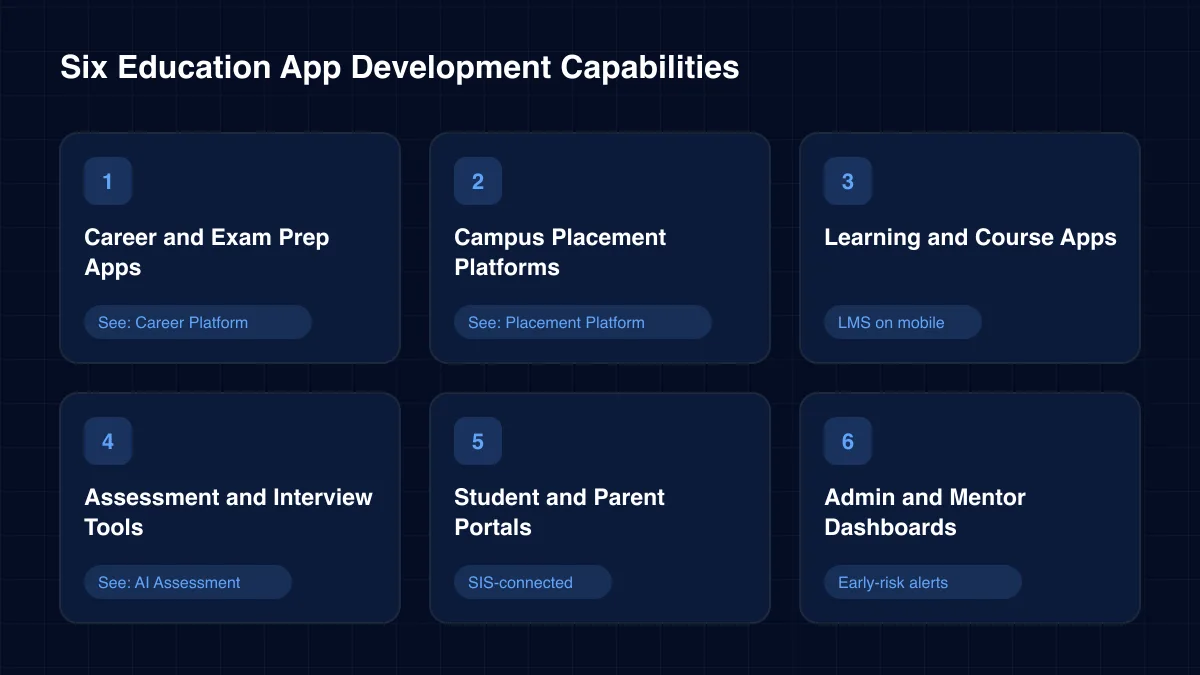
These are the builds institutions and edtech companies ask for most. Each fits a broader education app development roadmap.
Structured study plans, practice modules, job listings and mentor tracking in one app. Our career development platform is the model for this kind of education app development.
See: Career Platform →Institute, corporate and student portals on shared data. Our campus placement platform automated eligibility filtering and interview scheduling.
See: Placement Platform →Video lessons, quizzes, progress tracking and offline downloads. They extend your LMS to the phone instead of replacing it.
LMS on mobile
Online tests, skill assessments and AI-assisted interview scoring. Our AI video interview assessment engine scores communication skills objectively.
See: AI Assessment →Timetables, fees, results, attendance and messages in one secure place. SIS integration keeps records consistent.
SIS-connected
Live views of engagement, risk and outcomes for staff and mentors. In education app development, these dashboards turn usage data into timely support.
Early-risk alerts
Architecture
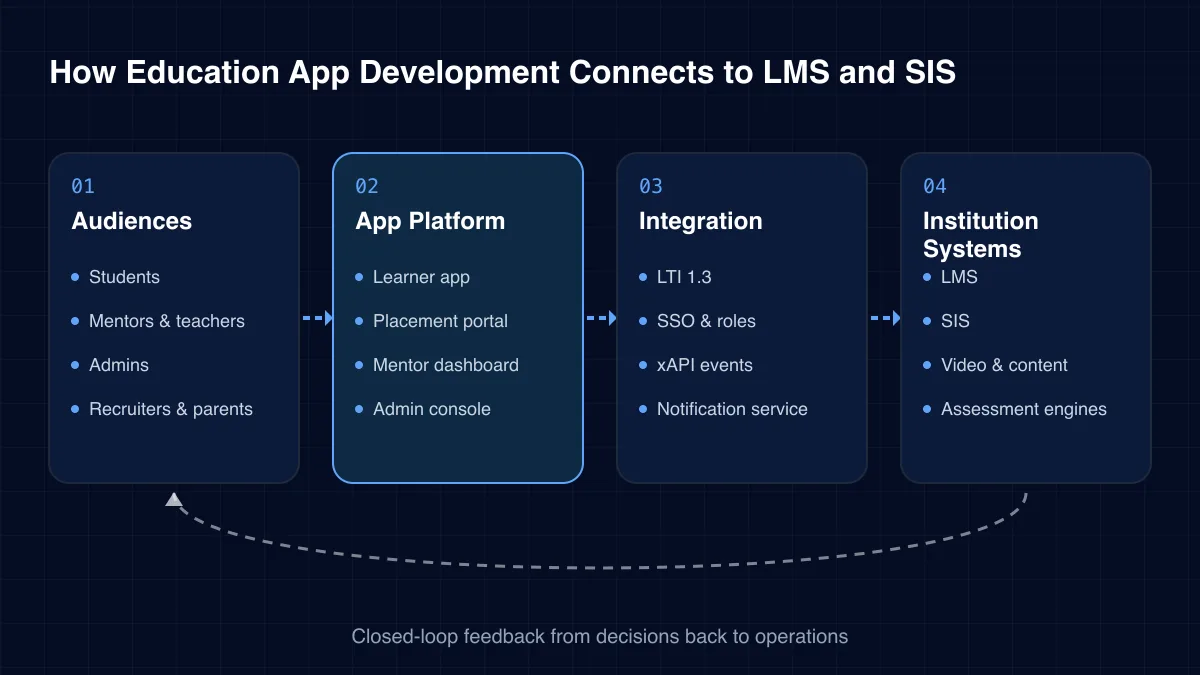
The app layer serves each audience with its own view. An integration tier links it to learning, student and assessment systems through standards and APIs.
01
02
03
04
Challenges we solve
Plenty of education apps are downloaded and then forgotten. The causes are predictable, and most can be designed out.
Open-ended content libraries overwhelm students. A structured plan, like a 60-day exam prep path, keeps them moving.
Colleges, students and recruiters coordinate by email and spreadsheet. Shared portals on one data set remove the confusion.
Without live data, mentors notice struggling students too late. Dashboards and alerts surface risk early.
Apps that ignore the LMS force double entry and extra passwords. LTI and SSO keep the experience joined up.
Missing captions and poor contrast exclude learners and create legal risk. Accessibility has to be designed in.
Cold calls and on-site visits cap growth for edtech businesses. A useful app becomes the acquisition channel itself.
Education app development projects usually take one of four forms. Many providers run more than one.
Your LMS may already offer a mobile app. The table shows when custom education app development is worth the effort.
| Need | LMS mobile app | Generic course platform | Custom app |
|---|---|---|---|
| Your programme structure | Partial | Partial | ✓ Yes |
| Placement and career flows | No | No | ✓ Yes |
| Mentor and admin dashboards | Partial | Partial | ✓ Yes |
| Works with your LMS and SIS | ✓ Yes | Partial | ✓ Yes |
| Own brand and roadmap | No | No | ✓ Yes |
The benefits grow as more learners, staff and partners work inside connected apps.
Delivery
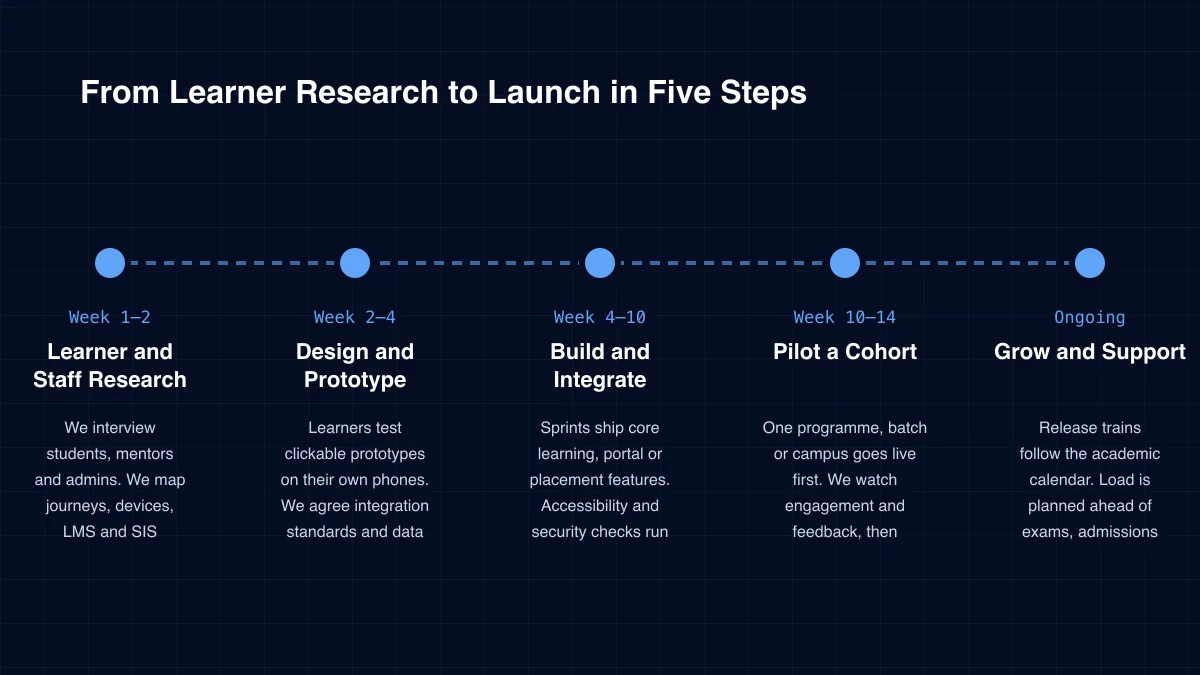
Week 1–2
We interview students, mentors and admins. We map journeys, devices, LMS and SIS integrations and privacy duties.
Week 2–4
Learners test clickable prototypes on their own phones. We agree integration standards and data flows.
Week 4–10
Sprints ship core learning, portal or placement features. Accessibility and security checks run in every pipeline.
Week 10–14
One programme, batch or campus goes live first. We watch engagement and feedback, then refine.
Ongoing
Release trains follow the academic calendar. Load is planned ahead of exams, admissions and placement season.
Case study
A career services business relied on manual counselling, on-site visits and cold calls. Exam prep and job tracking lived in separate tools. Our team built one mobile app with job listings, skill assessments, mentor tracking and structured 60-day GRE prep plans. It achieved 80%+ user engagement, 3x lead conversions and a 100% digital transition.
“Students do not experience three services. They experience one career journey.”Read the full case study →
Mobile app · Job listings
Admissions consulting, exam prep and job seeking in one interface.
GRE plans · Skill assessments
Structured 60-day prep plans, practice modules and real-time assessments.
Mentor tracking · Scalable backend
Mentors track performance in the app, on a backend built for growth.
Many studios can build a quiz app. Fewer understand cohorts, grading and placement season. We recommend checking five things.
In our experience, engagement design and integration decide whether education app development pays back. An app students ignore helps nobody.
ICANIO works under ISO 9001 and ISO 27001 certified processes. Apps use role-based access, SSO, encryption in transit and at rest, and audit logs on student records.
We collect only the data each feature needs. For US institutions we design to FERPA expectations, and for European learners to GDPR. Apps for younger children need extra consent controls, which we scope during discovery.
Accessibility is tested with automated checks and manual screen reader passes. Captions, transcripts and adjustable text are part of the standard build.
Pick the outcome that matters most. Examples are course completion, weekly active learners, placement coordination hours or lead conversion.
Track it before and after the pilot cohort. We agree the baseline with you during discovery. Each education app development phase is then judged on your own data.
Engagement data tells you what to build next. Watch which lessons learners replay, where they stop and which nudges bring them back. We review these signals with you each release, so the roadmap follows real student behaviour rather than guesswork.
Remember the operational side. Hours saved on manual coordination, fewer support emails and faster placement cycles all count. Our campus placement platform cut manual coordination effort by 60%.
Technology stack
We choose tools per institution and audience. These are our common picks.
Mobile
Web
PWA
Backend
Learning Standards
LTI 1.3xAPISCORMSSO
Media & Assessment
Video streamingQuiz enginesAI scoringProctoring
Cloud & Delivery
CI/CDAccessibility testing
Most education app development starts with one high-value journey. Exam prep, placement season or a student portal are common first picks. They are easy to measure and quick to show value.
Yes. We integrate through LTI 1.3, SSO and LMS APIs where available. Grades and progress can flow back automatically, so staff avoid double entry.
We design around structured plans, short sessions and timely nudges. Our career development app reached 80%+ user engagement with day-by-day study plans and mentor tracking.
Yes. We minimise data, encrypt it and control access by role. We design to FERPA, GDPR or local rules depending on where your learners are.
A focused learner app or portal can reach a pilot cohort within a few months. Integration scope and approvals affect timing. We give you a dated plan after discovery.
Yes. Our campus placement platform connects colleges, students, training partners and recruiters, and cut manual coordination effort by 60%.
Learners, mentors and institutions all want less friction and more progress. Education app development delivers both when apps are engaging, accessible and connected.
ICANIO brings mobile, web and learning integration engineers into one team. We research with real students, pilot with one cohort and grow from there. Our education app development work continues with calendar-aware releases and support.
By ICANIO EdTech Engineering Team · Published · Updated
Book a free discovery call with our team. We will map one learner or campus journey, its integrations and a pilot cohort plan. Contact us to get started.
Contact Our EdTech Team