UX Research & Product Design
User interviews, journey maps, wireframes and clickable prototypes in Figma. Web and mobile app development starts with tested flows, not guesses about what users want.
Tested flows
Web & Mobile App Development
One product, every screen. We design and ship responsive web apps and iOS and Android apps that share a backend, a design system and a release rhythm.
HireSwipe
Matches for you
HireSwipe
Matches for you
⟳ Design in progress
Your customers switch between a laptop at work and a phone on the move, and they expect the same account everywhere. Web and mobile app development at ICANIO treats those screens as one product. One backend, one design system and one release plan serve them all.
Our team covers the full path. We run UX research, build responsive web apps and progressive web apps, and ship native or cross-platform apps to the App Store and Google Play. Analytics, crash reporting and release automation are part of the build from the first sprint.
This page explains how we pick between native, cross-platform and PWA, how the architecture fits together, and what slows most projects down. You will also find our process, a real case study and the questions to ask before you hire a partner.
Web and mobile app development is the work of designing, building and releasing software that people use in a browser and on smartphones or tablets. A good build feels native on each device while sharing data, logic and identity across all of them.
The web side usually means a responsive single-page or server-rendered app, often built with React and Next.js. The mobile side may be native Swift and Kotlin, a cross-platform framework such as Flutter or React Native, or an installable progressive web app.
Behind both sits a shared API layer, authentication, push notifications and analytics. That shared core is where most of the value lives. It lets you add a feature once and expose it on every channel.
Release work is part of web and mobile app development too. Mobile apps pass store review, need signing certificates and must support older OS versions. Web apps need fast load times, accessibility and search visibility. A complete plan covers both rhythms.
Working definition
“Web and mobile app development is the engineering of browser and smartphone experiences that share one backend, one identity system and one design language, released and measured as a single product.”
Foundations
We design for the smallest screen and the busiest moment first, then scale the layout up to desktop.
Business logic lives in APIs, not in each app, so web, iOS and Android always agree.
We set targets for load time, bundle size and app start time, and check them on every build.
Colour contrast, screen reader labels and touch targets follow WCAG guidance from the first design.
Core capabilities
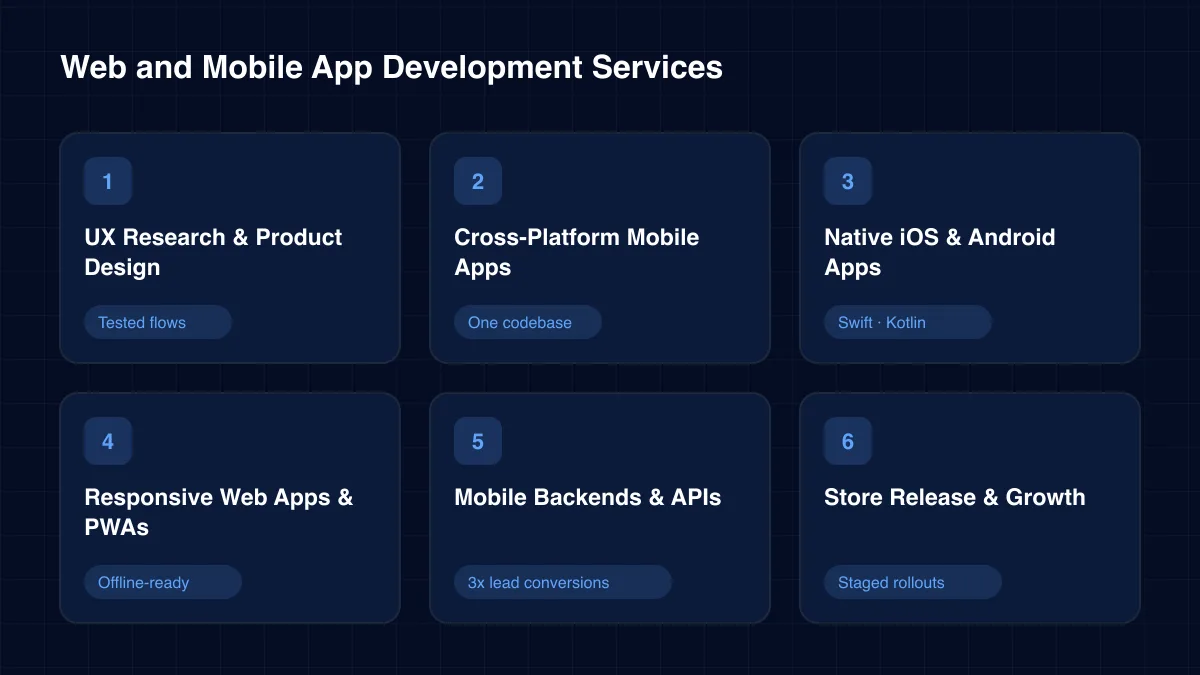
Engage us for a single app or for the whole multi-channel product. Every service follows the same web and mobile app development standards.
User interviews, journey maps, wireframes and clickable prototypes in Figma. Web and mobile app development starts with tested flows, not guesses about what users want.
Tested flows
Flutter and React Native apps that ship to iOS and Android from one codebase. Our food ordering platform used Flutter, Node.js and MongoDB to unify app and website ordering.
One codebase →Swift and Kotlin builds for apps that need deep device features, heavy media or the smoothest animation. We follow Apple and Google platform guidelines closely.
Swift · Kotlin
React and Next.js apps with service workers, offline caching and install prompts. A progressive web app often gives retail and field teams app-like speed without a store release.
Offline-ready →Authentication, push notifications, real-time updates and file uploads on a cloud backend. Our career app replaced manual counselling with a mobile experience students adopted.
3x lead conversions →App Store and Google Play submission, staged rollouts, crash monitoring and in-app analytics. After launch, web and mobile app development continues with data-led improvements.
Staged rollouts
Architecture
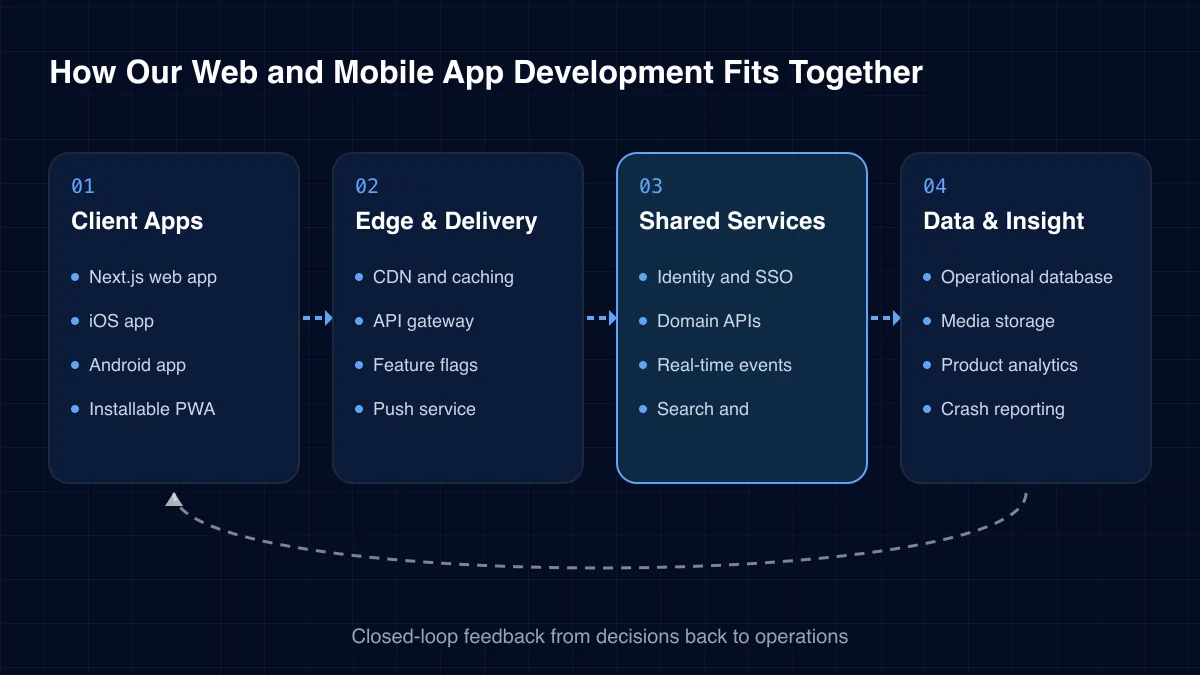
Each channel is a thin client over the same services. That keeps features consistent and lets each app team move fast without duplicating rules.
01
02
03
04
Challenges we solve
Most delays in web and mobile app development come from decisions made, or skipped, in the first month.
Separate web and mobile teams drift apart. We share one backlog, one design system and one API contract.
Shrinking a desktop layout frustrates mobile users. We design each flow for touch and short sessions first.
Privacy labels, permissions and payment rules trip up many launches. We check store guidelines before features are built.
Large bundles drain data plans and patience. We set performance budgets and test on mid-range devices.
Field users lose signal all the time. We plan caching, queued actions and sync conflicts up front.
Without analytics you cannot tell what to fix. We wire events and crash reporting before the first beta.
In web and mobile app development, the right delivery model depends on device features, budget and how often you need to ship.
Use this table as a starting point. We recommend validating the choice against your top three user journeys.
| Criterion | Native | Cross-platform | PWA |
|---|---|---|---|
| Full device API access | ✓ Yes | Partial | Partial |
| Single codebase | No | ✓ Yes | ✓ Yes |
| App store presence | ✓ Yes | ✓ Yes | Partial |
| Instant updates | No | Partial | ✓ Yes |
| Best for | Device-heavy apps | Most business apps | Content and commerce |
Web and mobile app development on one core pays off in speed, cost and consistency.
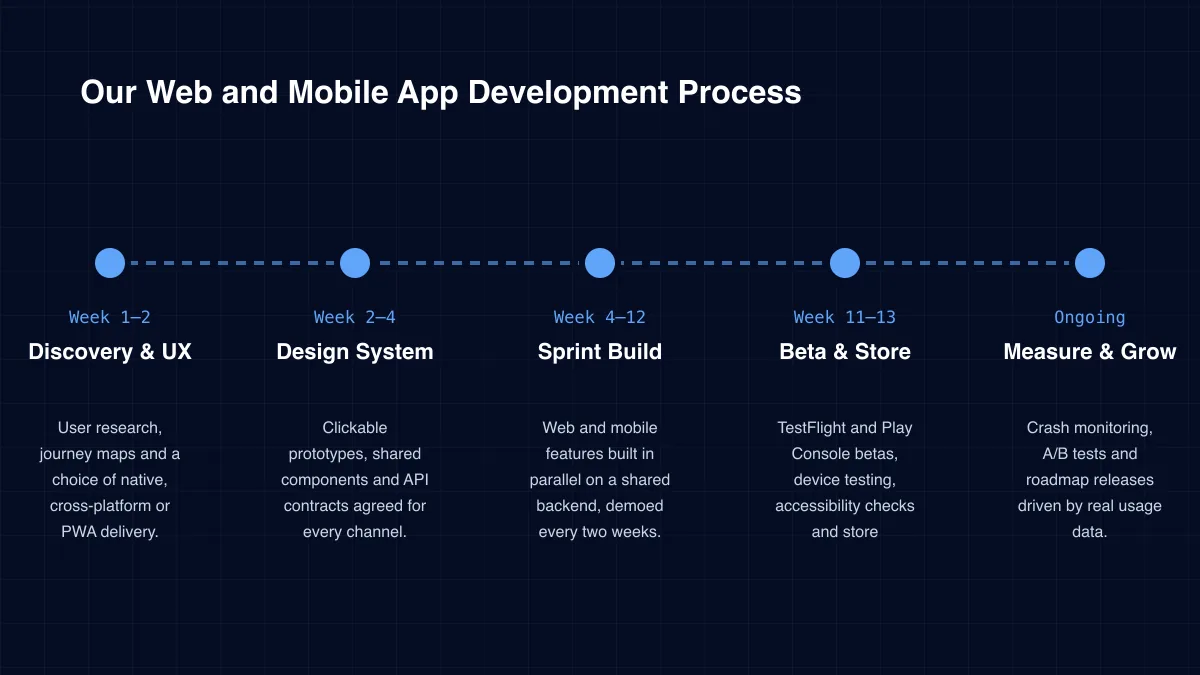
Delivery
Week 1–2
User research, journey maps and a choice of native, cross-platform or PWA delivery.
Week 2–4
Clickable prototypes, shared components and API contracts agreed for every channel.
Week 4–12
Web and mobile features built in parallel on a shared backend, demoed every two weeks.
Week 11–13
TestFlight and Play Console betas, device testing, accessibility checks and store submission.
Ongoing
Crash monitoring, A/B tests and roadmap releases driven by real usage data.
Case study
Job seekers were using desktop-built portals on their phones and getting generic results. ICANIO delivered a full-stack recruitment platform across iOS, Android and web, with social sign-in, swipe-based discovery and real-time employer dashboards. The platform achieved 40% faster time-to-hire, 30% higher application conversion and 3x candidate engagement.
Read the full case study →Swipe UI · My Jobs folders
A swipe interface with saved-job tracking made discovery feel native on phones.
Google · Apple · LinkedIn
One-tap sign-in cut the time from download to first application.
Real-time funnel analytics
Employers saw the whole hiring funnel live, with AI ranking of best-fit candidates.
Specialist services within our mobile & web application development practice.
Screens are easy to show in a portfolio. These five checks reveal how a partner really works.
The best web and mobile app development partners talk about users and release cadence before they talk about frameworks.
ICANIO works under ISO 9001 and ISO 27001 certified processes. For web and mobile app development we follow the OWASP Mobile Application Security guidance and the OWASP Top Ten for web.
Tokens are stored in the device keychain or keystore, never in plain storage. APIs use short-lived tokens, certificate pinning where justified and rate limits at the gateway.
We prepare App Store privacy labels and Google Play data safety forms from the real data flows. For regulated sectors, such as health or payments, we design for rules like HIPAA or PCI DSS from the start.
Agree three or four product metrics before web and mobile app development begins. Typical ones are activation rate, conversion, repeat use and support tickets per user.
Then compare the cost of a shared-core build with separate web and native teams. Unified web and mobile app development usually cuts duplicated effort, which shows up as faster releases.
Track the numbers inside the product from day one. That turns roadmap debates into evidence, and it shows leadership exactly what each release returned.
Technology stack
For web and mobile app development we pick tools with strong communities and long-term support, so your app is easy to hire for.
Web
Tailwind CSS
Cross-platform
Expo
Native
Backend
Data & Cloud
Firebase
Release & Insight
TestFlightCrashlyticsProduct analytics
Cross-platform suits most business and consumer apps. Native is worth it for heavy graphics, advanced hardware access or premium polish. We recommend deciding after mapping your key journeys, not before.
A first release across web, iOS and Android typically takes around twelve to fourteen weeks after discovery. Store review adds a few days. Later features ship in two-week sprints.
Sometimes. In web and mobile app development, a PWA works well for content, commerce and field tools that need offline access and instant updates. If you need deep device features or a store listing, a mobile app is better.
Yes. Our team prepares listings, screenshots, privacy labels and data safety forms. We manage beta testing through TestFlight and Play Console and respond to reviewer feedback.
It should. We build shared APIs for identity, data and notifications. Every client app uses them, so features stay consistent and changes ship once.
Yes. Examples include recommendations, smart search and document capture. Our job matching platform used AI ranking to route each application to the right employer. Machine learning is added only where it improves a real task.
How we deliver web & mobile app development and the wider app development practice in each sector.
People judge your business by how your app feels in their hand and in their browser. Web and mobile app development that shares a core, a design system and a release plan gives them the same experience everywhere.
ICANIO brings UX, web, mobile and cloud engineering into one team. Whether you build for retail, healthcare, education, fintech or manufacturing, we ship a focused first release, measure it and grow it sprint by sprint.
Ready to plan your next app? Contact us and we will review your users, channels and goals, then propose a clear path for your web and mobile app development.
By ICANIO Application Engineering Team · Published · Updated
Book a free discovery call. We will look at your users, channels and timelines, then recommend the right delivery model and a scoped first release.
Contact Our App Team