Ingestion and Connectors
Batch, API and change data capture connectors for ERP, CRM, core banking and SaaS tools. Our data engineering services automated 50+ Wealth Spectrum views into AWS for one partner.
Batch, API & CDC →Data & AI · Data Engineering
ICANIO designs and runs the pipelines, lakes and warehouses behind your reports and models. Raw feeds arrive on schedule, keep their lineage and land in a shape analysts and AI can use.
Nightly export: 52 portfolio views
Extract
Land Raw
Catalog
Publish
⟳ Model running…
Data engineering services exist for one reason: people need numbers they can trust. Most firms have plenty of data. It sits in ERP tables, SaaS exports, spreadsheets and event logs, and none of it agrees. ICANIO builds the pipes that fix that.
Our team designs ingestion, storage, transformation and quality checks as one system. We automate the jobs people run by hand, record where every field came from and publish clean tables on a schedule. Analysts stop reconciling exports. Models finally get consistent inputs.
This guide explains what modern data engineering services include, the platform patterns we use, where projects go wrong and how to pick a partner. It also walks through a real Icanio data lake build for a wealth management technology partner.
Data engineering services cover the design, build and operation of systems that move data from where it is created to where it is used. That includes connectors, orchestration, storage layers, transformation logic, testing and access control.
The work sits between source systems and consumers. On one side are databases, APIs, files and streams. On the other side are dashboards, finance reports, machine learning features and language model retrieval indexes. A good platform serves all of them from the same governed copy.
Unlike a one-off migration, the job never really ends. Sources change their schemas, new teams ask for new tables and volumes grow. That is why we treat data engineering services as a product with owners, service levels and a backlog.
Working definition
“Data engineering services are the practice of building and operating automated, tested and documented pipelines that deliver accurate data from every source system to every consumer on a known schedule.”
Foundations
We land source data untouched before shaping it. Anyone can then trace a figure back to the original record and replay history if logic changes.
Every job, schema and test lives in version control. Changes go through review and CI, just like application code.
Row counts, null checks, uniqueness and freshness rules run automatically. Bad batches stop before they reach a dashboard.
Tables are modelled so BI, machine learning and search can reuse them. The second use case costs far less than the first.
Core capabilities
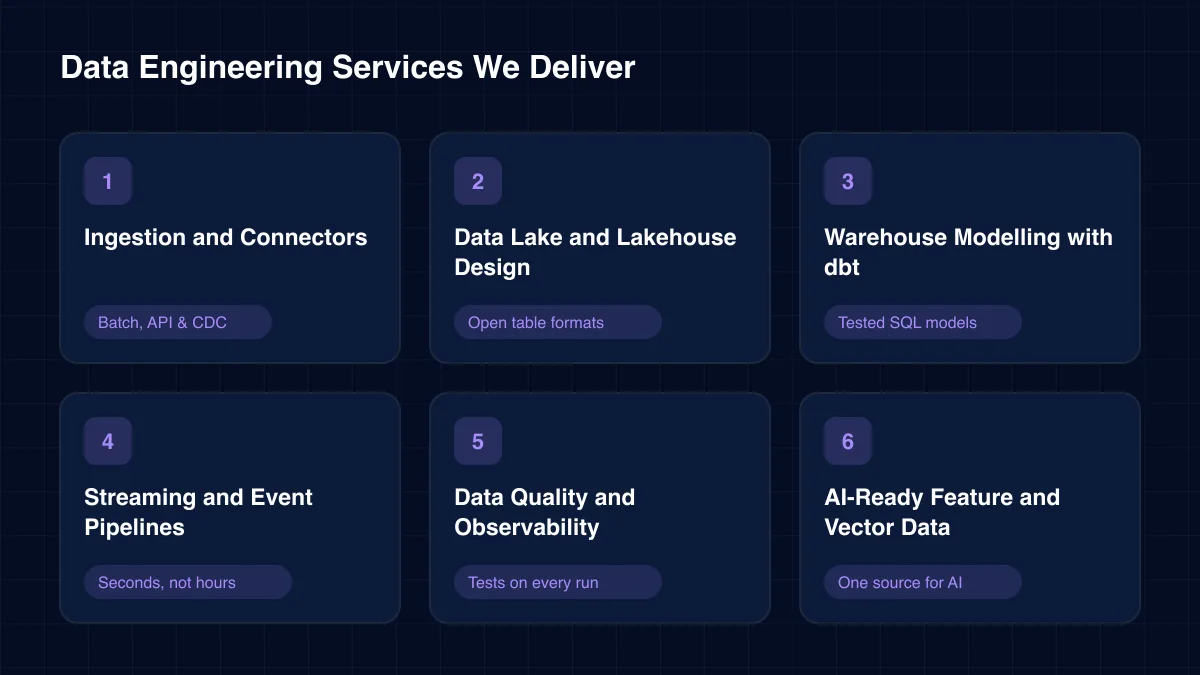
These six capabilities make up our data engineering services. Clients usually start with two or three and add the rest as the platform grows.
Batch, API and change data capture connectors for ERP, CRM, core banking and SaaS tools. Our data engineering services automated 50+ Wealth Spectrum views into AWS for one partner.
Batch, API & CDC →Object storage with open table formats such as Apache Iceberg or Delta Lake. Bronze, silver and gold layers keep raw, cleaned and business-ready data apart.
Open table formats
Dimensional models, tested SQL transformations and documented metrics in Snowflake, BigQuery, Redshift or PostgreSQL. Business logic is written once and reused.
Tested SQL models →Apache Kafka and managed streaming services for events that cannot wait for a nightly batch, such as payments, orders and sensor readings.
Seconds, not hours
Automated tests, freshness monitors and lineage graphs across the whole platform. Our data engineering services alert the owner before a stale table reaches a board pack.
Tests on every run
Feature tables, embeddings and chunked documents for machine learning and retrieval. The same governed platform feeds every model our Data & AI practice builds.
One source for AI →Architecture
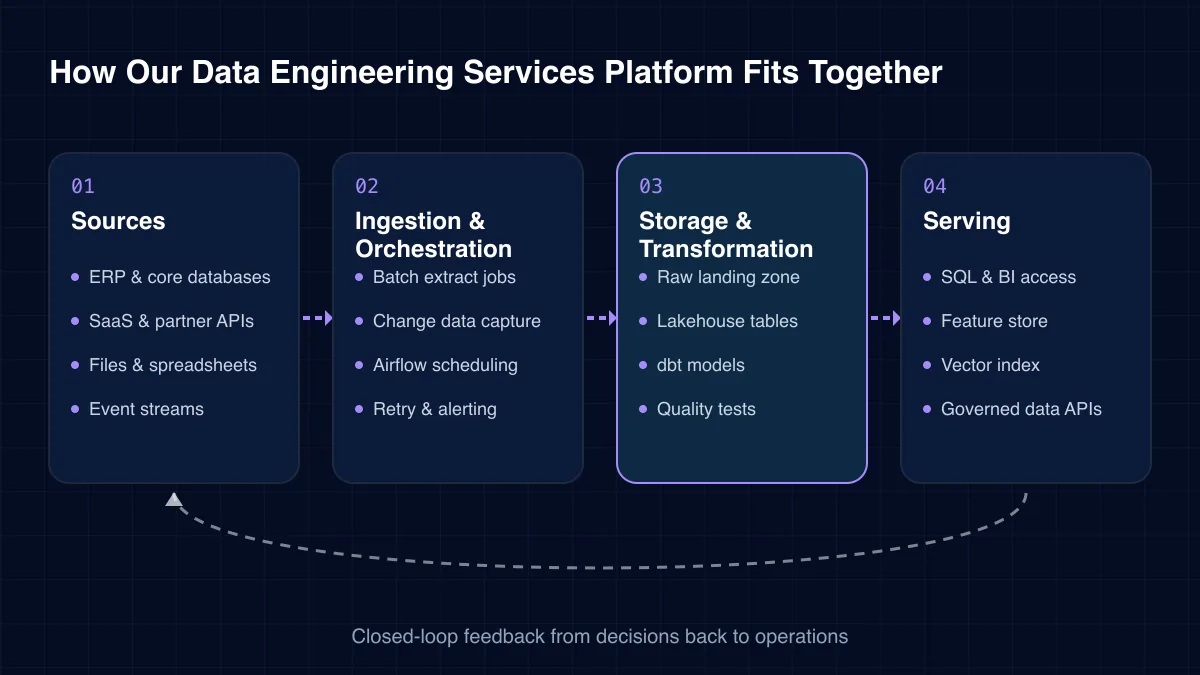
Every platform we build follows the same four layers. Data flows up from source systems, and each hop adds checks, context and structure.
01
02
03
04
Challenges we solve
Buyers rarely call us about a tool. They call because the numbers are late, wrong or impossible to trace.
Someone downloads files, pastes them together and emails a spreadsheet. One sick day stops the report. We replace the routine with scheduled, monitored jobs.
Finance and sales calculate revenue in separate places. A single modelled metric layer ends the debate over whose number is right.
When an auditor asks where a value came from, the answer takes days. Column-level lineage answers it in minutes.
A source adds a column and a job fails at 2 a.m. without telling anyone. Contracts, tests and alerts make failures loud and quick to fix.
Unpartitioned tables and full reloads burn compute. Incremental models, partitioning and clustering bring the cost back under control.
Data scientists spend weeks cleaning extracts before they can train. A governed feature layer lets them start on day one.
Data engineering services come in four common shapes. The right one depends on how much already exists and what is failing.
Choosing a pipeline style shapes cost, freshness and flexibility. This table compares the three patterns our data engineering services use most.
| Criterion | Classic ETL | ELT in warehouse | Streaming |
|---|---|---|---|
| Keeps raw source copy | No | ✓ Yes | ✓ Yes |
| Typical freshness | Daily | Hourly | Seconds |
| Easy to change logic | Partial | ✓ Yes | Partial |
| Running cost | Low | Medium | Higher |
| Best for | Fixed reports | Analytics & BI | Events & alerts |
The payoff compounds. Each new source and model reuses the platform that already exists.
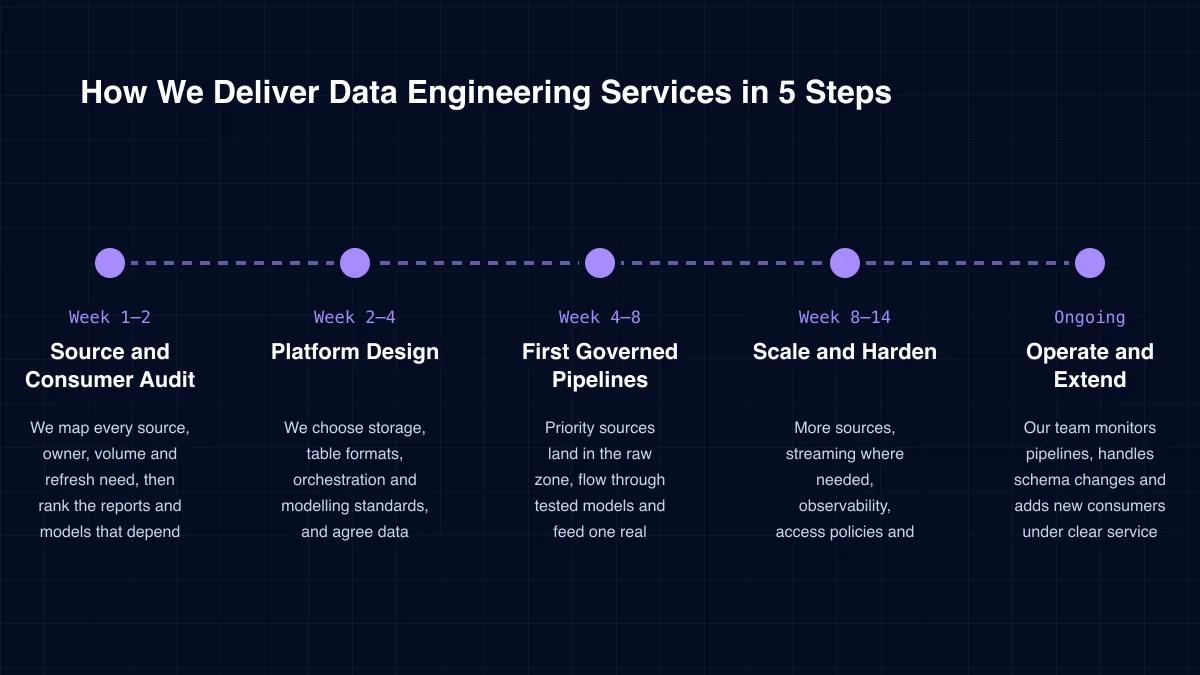
Delivery
Week 1–2
We map every source, owner, volume and refresh need, then rank the reports and models that depend on them.
Week 2–4
We choose storage, table formats, orchestration and modelling standards, and agree data contracts with source owners.
Week 4–8
Priority sources land in the raw zone, flow through tested models and feed one real dashboard or model.
Week 8–14
More sources, streaming where needed, observability, access policies and cost controls across the platform.
Ongoing
Our team monitors pipelines, handles schema changes and adds new consumers under clear service levels.
Case study
A wealth management technology partner extracted Wealth Spectrum data by hand, which slowed financial workflows and limited scale. ICANIO built Python pipelines that automate 50+ data views into AWS S3 and MySQL with zero manipulation of source records. Apache Airflow schedules and monitors each run, AWS Glue catalogs the datasets and Amazon Athena queries them directly.
“A finance team trusts a data lake because every number in it traces back to the source untouched.”Read the full case study →
Python · Apache Airflow
Scheduled pipelines replace manual exports and give the team visibility into every run.
AWS S3 · MySQL
Source records land without transformation, so their integrity is preserved.
AWS Glue · Amazon Athena
Catalogued datasets that analysts query with SQL straight from the lake.
Specialist services within our data & artificial intelligence practice.
Many vendors can wire up a connector. We recommend asking five harder questions before you sign.
Our data engineering services are priced to include that last point. A platform nobody maintains decays within a quarter.
ICANIO works under ISO 9001 and ISO 27001 certified processes. Pipelines run inside your own cloud account, and credentials sit in a managed secrets store, never in code.
We classify sensitive columns at ingestion. Personal and financial fields are masked or tokenised in shared layers, and row-level policies limit who sees what. Every query and job run is logged.
Where regulation applies, we map controls to it. Examples include GDPR data subject requests, PCI DSS scope reduction for card data and HIPAA safeguards for health records. Retention rules and deletion jobs are part of the design, not an afterthought.
Start with the hours people spend today collecting, cleaning and reconciling data. Multiply by their cost. That is the first line of savings once pipelines run on their own.
Next, count the decisions that wait on late or disputed numbers. Month-end close, pricing reviews and stock planning all speed up when data lands on time and teams agree on it.
Finally, look at what the platform unlocks. Every machine learning model, dashboard and AI assistant built afterwards reuses the same pipelines. We track platform cost per consumer so the value of data engineering services stays visible as usage grows.
Technology stack
We fit tools to your cloud and your team's skills. These are the ones our engineers use most often.
Orchestration
Dagster
Processing
SQL
Streaming
Amazon KinesisDebezium CDCSpark Structured Streaming
Storage
Apache Iceberg
Warehouse & Modelling
dbt
Quality & Catalog
Great Expectationsdbt testsOpenLineage
Our data engineering services include source audits, ingestion and connectors, lake or warehouse design, transformation models, data quality testing, lineage, access control and ongoing operations. You can buy the full platform or a single piece, such as a pipeline rescue.
Most clients see their first governed pipeline feeding a real report within four to eight weeks. A broader platform with several sources and streaming usually takes three to four months. The source audit sets the timeline.
Often both, in one lakehouse. Raw and semi-structured data lands cheaply in object storage. Modelled, business-ready tables are served through a warehouse engine. We recommend the split based on your query patterns and team skills.
Yes. We regularly extend existing Snowflake, BigQuery, Redshift, Azure or PostgreSQL estates. We keep what works, fix what breaks and only add new tools where they clearly pay off.
We land every feed in a raw zone exactly as received, with load timestamps. Transformations happen in later layers. In our Wealth Spectrum data lake project this approach gave zero manipulation of source records.
They are the foundation. Machine learning needs consistent features and generative AI needs clean, chunked documents. Our data engineering services prepare both, so AI teams build on governed data instead of private extracts.
How we deliver data engineering services and the wider data & ai practice in each sector.
Reports, models and AI assistants all fail the same way when the data underneath them is late or wrong. Data engineering services fix the problem at its root, with pipelines that are automated, tested and owned.
ICANIO designs the platform, builds the first governed pipelines and runs them with you. Contact us to audit your sources and plan data engineering services that your analysts and models can rely on.
By ICANIO Data & AI Engineering Team · Published · Updated
Book a free 30-minute discovery call. We will review your sources and reports, find the pipelines that hurt most and outline a platform plan with clear milestones.
Contact Our Data Engineering Team