ELASTICSEARCH MIGRATION · ELK STACK · ZERO DATA LOSS
This Elasticsearch upgrade migration modernized a financial services firm’s end-of-life search infrastructure without sacrificing uptime or data integrity.
Quick Answer
What Does an Elasticsearch Upgrade Migration to v8.8.1 Involve?
An Elasticsearch upgrade migration from v7.15 to v8.8.1 replaces an end-of-life search cluster with a modern, secure environment through a phased process that stabilizes node communication, backs up production data, and upgrades in controlled stages rather than a single risky cutover. ICANIO executed this Elasticsearch upgrade migration for a financial services partner, moving 1000 GB of production data with zero data loss onto a stable 3-node v8.8.1 cluster with modernized Kibana and Logstash tooling.
Executive Summary
Turning an End-of-Life Search Cluster Into a Modern, Secure Platform
A search cluster nearing end-of-support might still run today, but for a financial services platform it is already a compliance and security liability. ICANIO’s partner was running exactly this kind of infrastructure: a legacy Elasticsearch v7.15 cluster nearing end-of-support, hosted on aging RHEL 7.0 infrastructure with known security vulnerabilities, carrying rising technical debt, cluster instability from stale node metadata, and a real risk of data loss with no secure migration pathway defined.
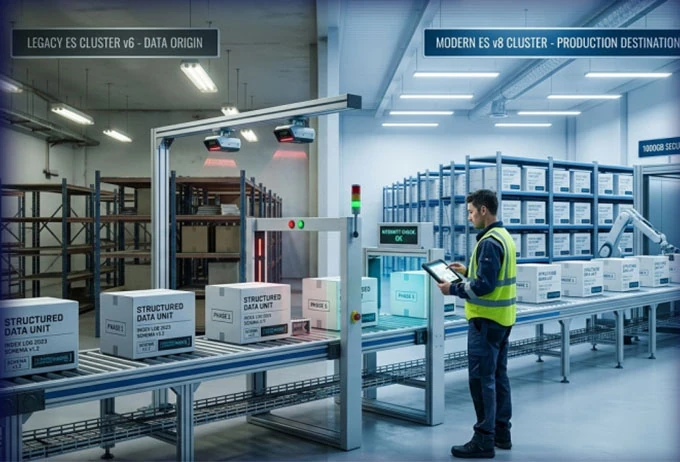
ICANIO addressed this with a controlled Elasticsearch upgrade migration rather than a single risky cutover. The objective was to first stabilize the legacy cluster by resolving node communication issues, back up and secure the full 1000 GB production dataset, then execute a stepwise phased upgrade from v7.15 to v8.8.1, modernizing Kibana and Logstash alongside the core ELK stack. Every step ran inside strictly planned, minimal-impact maintenance windows. The result was zero data loss across the full migration and a stable 3-node cluster running on modern, supported infrastructure.
Every one of those outcomes traces back to the same design decision: stabilizing the cluster and securing the data before attempting a single version change, so this phased Elasticsearch migration eliminated risk at each stage instead of betting the entire dataset on one cutover.
“An end-of-life search cluster is not a problem you can defer, every day it stays in production is another day of unpatched vulnerabilities and undocumented risk to the data it holds.”
The Challenge
Five Risks This Elasticsearch Upgrade Migration Resolved
Our financial services partner relied on aging database infrastructure that threatened long-term operational stability and compliance. This outdated environment introduced severe scaling and security risks.
End-of-Support Elasticsearch v7.15
A legacy Elasticsearch v7.15 cluster nearing end-of-support status also meant restricted access to the modern search capabilities newer versions provide.
Aging RHEL 7.0 Security Vulnerabilities
Aging RHEL infrastructure security gaps in the 7.0 host environment introduced severe vulnerabilities that could not be resolved without modernizing the underlying operating system.
Technical Debt This Elasticsearch Upgrade Migration Cut
Rising technical debt threatened long-term operational stability, making every deferred upgrade more expensive and more urgent than the last.
Instability Fixed by This Elasticsearch Upgrade Migration
Cluster instability and stale node metadata hindered performance, creating the kind of unpredictable behavior that erodes confidence in a production system.
Data Loss Risk This Elasticsearch Upgrade Migration Solved
The high risk of data loss without a secure migration pathway meant any upgrade attempt without careful planning could jeopardize the platform’s core dataset.
Elasticsearch Upgrade Migration Solutions Provided
A Six-Part Controlled Elasticsearch Upgrade Migration Strategy
Icanio Technologies executed a Controlled Data Migration & Upgrade Strategy, upgrading the core ELK stack while resolving node communication issues. The solutions included:
Cluster Metadata in This Elasticsearch Upgrade Migration
Stabilized legacy clusters by resetting stale node metadata, resolving the communication issues that had to be fixed before any version upgrade could safely begin.
Secured 1000 GB of Production Data
Backed up and secured 1000 GB of production data, giving the team a safe fallback before any structural changes were made to the live cluster.
Stepwise Phased Upgrade to v8.8.1
Executed stepwise phased upgrades from v7.15 to v8.8.1, moving through intermediate versions rather than attempting a single, high-risk version jump.
Timeout Fixes in This Elasticsearch Upgrade Migration
Tuned configurations to resolve discovery and cluster timeouts, addressing the root causes of instability rather than just the symptoms.
ELK Modernization in This Elasticsearch Upgrade Migration
Deployed ELK stack modernization with Kibana and Logstash, bringing the entire observability toolchain up to the same supported standard as the core cluster.
Maintenance Windows in This Elasticsearch Upgrade Migration
Minimized operational impact using strictly planned downtime windows, so the migration never disrupted the platform outside of pre-approved maintenance periods.
Business Outcomes
Measurable Results Across Data Integrity, Performance, and Security
This Elasticsearch upgrade migration delivered outcomes across every dimension of the client’s original infrastructure risk, converting an end-of-life, security-exposed cluster into a modern, stable platform with zero data loss and no remaining unsupported legacy systems.
Zero Data Loss
For 1000GB production data migration
Minimal Downtime
Via controlled scheduled maintenance windows
Enhanced Performance
Using Elasticsearch v8.8.1 search capabilities
Stronger Security
Across modernized enterprise Linux infrastructure
Stable 3-Node Cluster
Ensuring constant operational reliability
Eliminated Technical Debt
By deprecating unsupported legacy systems
Key learnings
What This Proves for Teams Running End-of-Life Search Clusters
Stabilize Before This Elasticsearch Upgrade Migration
Attempting a version upgrade on a cluster with stale node metadata and active communication issues compounds risk instead of resolving it. Resetting stale metadata and resolving discovery and timeout issues before starting the phased upgrade is what kept this Elasticsearch upgrade migration from becoming two problems at once.
Phased Upgrades Contain Risk Better Than a Single Cutover
Jumping directly from Elasticsearch v7.15 to v8.8.1 in one step would have concentrated every compatibility risk into a single high-stakes event. Moving through intermediate versions in a stepwise, phased upgrade is what let the team catch and resolve issues at a scale small enough to manage.
Zero Data Loss Requires a Backup Before Every Structural Change
Backing up and securing the full 1000 GB production dataset before touching the cluster’s structure is what made this a zero data loss migration, not a lucky outcome. Treating the backup as a prerequisite, not a safety net, is the difference between a controlled migration and a gamble.
Conclusion
From End-of-Life Cluster to a Modern, Secure Elasticsearch Platform
An end-of-life Elasticsearch cluster might still serve queries today, but for a financial services platform running on vulnerable infrastructure, it had become a compliance and security liability the business could not keep carrying. This engagement demonstrates that a phased Elasticsearch upgrade migration can resolve stability, security, and technical debt gaps within one structured programme rather than three separate initiatives.
By stabilizing the legacy cluster, securing 1000 GB of production data, and executing a stepwise phased upgrade to v8.8.1 alongside a modernized ELK stack, ICANIO helped this partner complete the migration with zero data loss, minimal downtime, and no remaining unsupported legacy systems. The stable 3-node cluster, modernized Kibana and Logstash tooling, and hardened Linux infrastructure delivered through this engagement are the foundation every future search and analytics workload this team runs will depend on.
Related Resources
This Elasticsearch upgrade migration sits within ICANIO's support engineering and DevOps practices. Our team handles cluster upgrades like this through support engineering services and DevOps and cloud engineering. Related data engineering and software development work appears in our software development case studies. To plan a similar upgrade, contact ICANIO.
- Support Engineering Services
- Fintech and Banking Industry Solutions
- Data Lake Integration Platform: 50+ Secure Feeds
- Structured Logging and Production Observability
References
- Upgrade the Elastic Stack: Elastic's official guide to planning and running Elastic Stack upgrades.
- Discovery and cluster formation: Elasticsearch reference on how nodes discover each other and form a cluster.
- Snapshot and restore: Elasticsearch reference on backing up and restoring cluster data.
- Elasticsearch: Wikipedia overview of the Elasticsearch search engine.
- Red Hat Enterprise Linux: Wikipedia overview of RHEL and its release history.
Frequently asked questions
Common Questions About This Elasticsearch Upgrade Migration
What is an Elasticsearch upgrade migration and why not defer it?
An Elasticsearch upgrade migration moves a cluster from an end-of-life version to a modern, supported one. It can't be deferred indefinitely because every month on an unsupported version compounds security exposure and technical debt, especially for a financial services platform under compliance scrutiny.
Why upgrade through intermediate versions, not straight to v8.8.1?
A stepwise phased upgrade from v7.15 to v8.8.1 moves through intermediate versions so compatibility issues surface and get resolved in smaller, manageable stages, rather than all at once in a single high-risk cutover.
How was zero data loss achieved across 1000 GB of production data?
The team backed up and secured the full 1000 GB dataset before making any structural changes to the cluster, treating the backup as a prerequisite for the migration rather than a fallback in case something went wrong.
What causes cluster instability from stale node metadata?
Stale node metadata causes clusters to lose reliable track of node membership and state, leading to discovery and timeout issues. Resetting that metadata and tuning discovery configurations resolved the instability before the version upgrade began.
Why upgrade RHEL alongside Elasticsearch, not just the database?
Aging RHEL 7.0 infrastructure carried its own security vulnerabilities independent of the Elasticsearch version, so modernizing the underlying Linux environment alongside the cluster was necessary to actually close the security gap, not just move it up a layer.
What role do Kibana and Logstash play in ELK stack modernization?
Kibana and Logstash needed to be modernized alongside the core Elasticsearch cluster so the entire observability toolchain runs on supported, compatible versions, rather than leaving visualization and log ingestion on outdated components.