
Patient Portals and Apps
Records, prescriptions, results and bills in one place. In healthcare app development this is often the anchor product, as in our digital healthcare platform.
See: Healthcare Platform →App Development for Healthcare
We build patient portals, telehealth apps and clinician tools that connect to your EHR through HL7 FHIR. Privacy, consent and audit trails are designed in from the first sprint.
CareConnect
My care
CareConnect
My care
⟳ Design in progress
Patients expect to book, message and see results from their phone. Clinicians need the chart in two taps, not twelve. Healthcare app development meets both needs, but only when the app is wired correctly into the EHR and the privacy rules around it.
Our team builds patient, clinician and admin apps on top of existing clinical systems. We use HL7 FHIR where it is available, and careful interfaces where it is not. The app becomes a clean front door, while the EHR stays the source of truth.
This guide explains what healthcare app development involves in 2026. It covers app types, architecture, interoperability, security, a delivery plan and what to ask any partner.
Healthcare app development is the design and build of web and mobile software for patients, care teams and healthcare operations. Examples include patient portals, telemedicine apps, remote monitoring apps, clinician tools and billing workflows.
Three things set it apart from other app work. The data is protected health information. The core systems, such as EHRs, labs and PACS, have strict interfaces. And the users range from anxious patients to time-pressed nurses.
Good healthcare app development respects all three. It follows privacy law such as HIPAA in the US, or India's digital health rules for ABHA-linked records. It speaks HL7 FHIR. And it is tested with the people who will actually use it.
Working definition
“Healthcare app development is building secure, interoperable software that lets patients and care teams read and act on clinical data, without replacing the systems of record.”
Foundations
Minimum necessary data, encryption everywhere and consent captured in the flow. Privacy is an architecture decision, not a later review.
HL7 FHIR resources and SMART on FHIR launch where supported. Records move between EHR, lab and app without manual re-entry.
Large type for older patients, quick actions for busy clinicians, and accessible design for every user.
Every read and write of patient data is logged with who, when and why. Compliance teams can answer questions in minutes.
Core capabilities
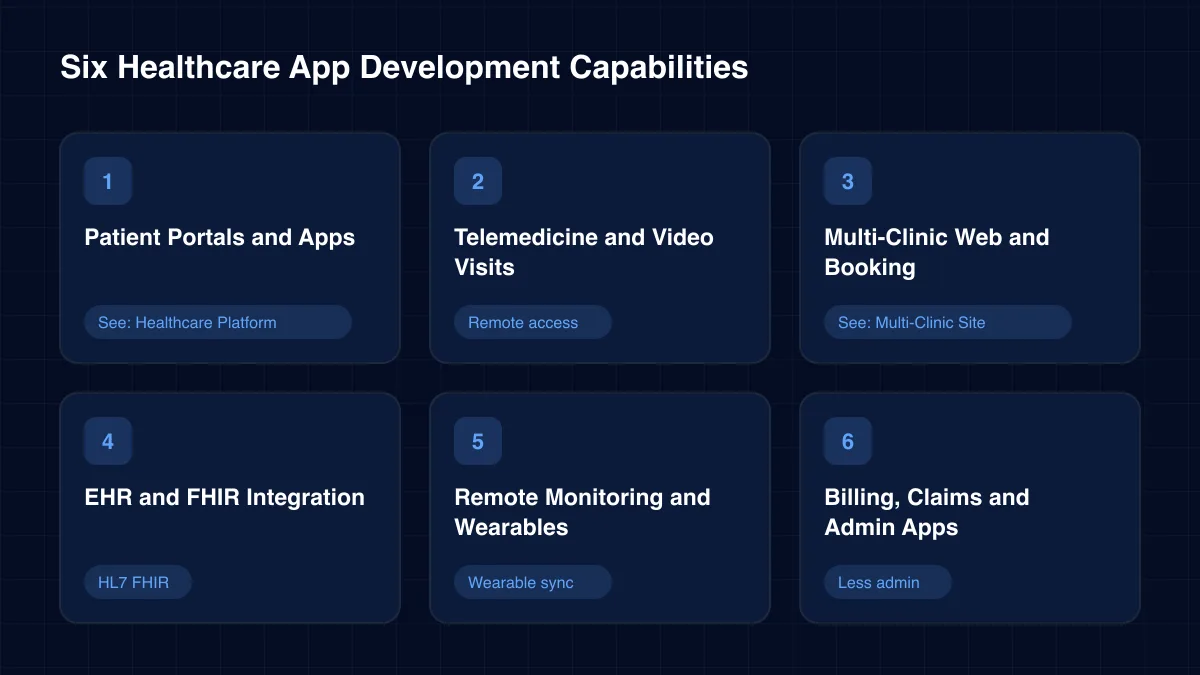
These are the builds providers and health tech companies ask us for most. Each fits into a wider healthcare app development roadmap.
Records, prescriptions, results and bills in one place. In healthcare app development this is often the anchor product, as in our digital healthcare platform.
See: Healthcare Platform →Scheduling, secure video, e-prescriptions and visit notes. Rural and remote patients reach a doctor without the journey.
Remote access
One site and booking flow across locations. Our multi-clinic website cut appointment clicks by half for a healthcare network.
See: Multi-Clinic Site →Connect apps to EHR, EMR, lab and imaging systems through HL7 FHIR APIs and interface engines. This is the backbone of any serious healthcare app development effort.
HL7 FHIR
Pull readings from Apple Health, Fitbit or Garmin into the patient record. Care teams see trends and act before a visit is needed.
Wearable sync
Front desk, insurance verification and claims workflows. Automation removes manual errors that never touch patient care.
Less admin
Architecture
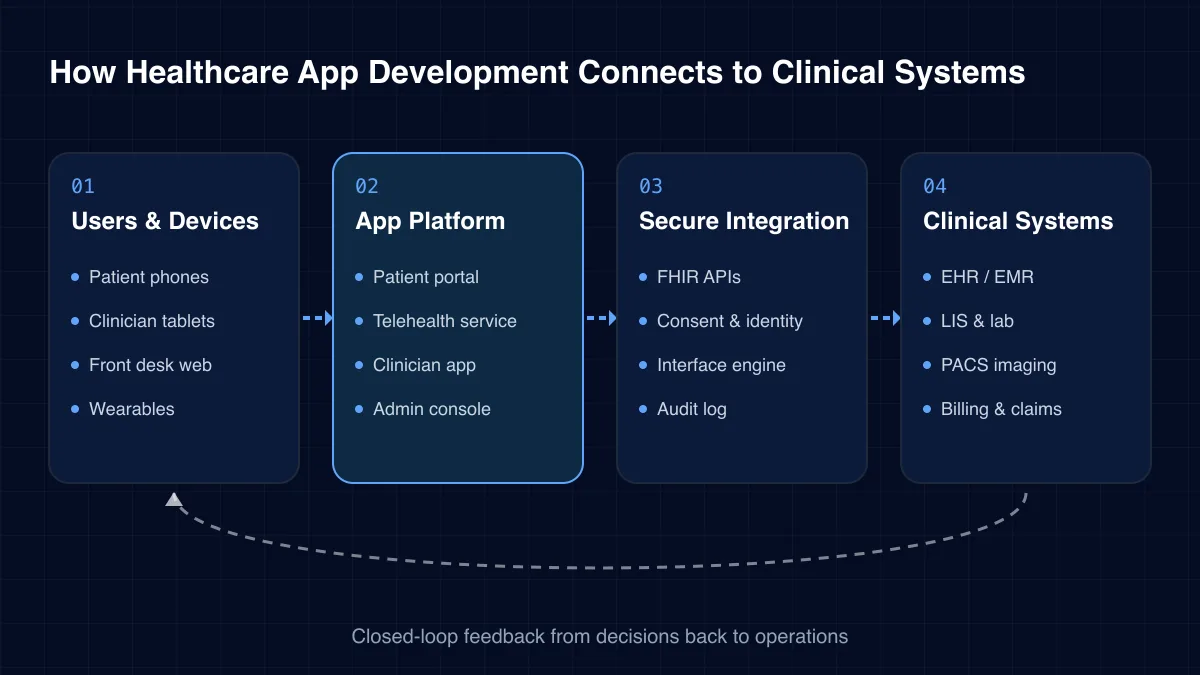
The app layer sits between people and clinical systems. A secure integration tier handles identity, consent and data exchange, so no app talks directly to the EHR database.
01
02
03
04
Challenges we solve
Healthcare is full of well-meant apps that nobody uses. The reasons are predictable, and most can be designed out early.
A patient seen at three sites often has three partial records. Doctors reassemble the history at every visit. FHIR-based exchange brings it together.
Long, confusing booking flows push patients to the phone line. Simplified journeys reduce calls and no-shows.
Another password means another abandoned tool. Single sign-on and EHR-launched apps keep clinicians in their workflow.
Weak session handling and leaky logs expose patient data. We follow OWASP mobile guidance and test for it before release.
Manual claims, insurance checks and re-keyed forms waste staff hours. Automated workflows return that time to patients.
Rural patients face long journeys for short consultations. Telehealth and remote monitoring extend care to where they live.
Healthcare app development projects fall into four main groups. Each carries different regulatory weight.
Your EHR may include a basic patient portal. The table shows when custom healthcare app development adds value.
| Need | EHR vendor portal | Off-the-shelf app | Custom app |
|---|---|---|---|
| Your brand and journeys | No | Partial | ✓ Yes |
| Works across several EHRs | No | Partial | ✓ Yes |
| Telehealth and wearables | Partial | ✓ Yes | ✓ Yes |
| Custom clinical workflows | No | No | ✓ Yes |
| You own the roadmap | No | No | ✓ Yes |
The benefits compound as patients and staff move more tasks into connected apps.
Delivery
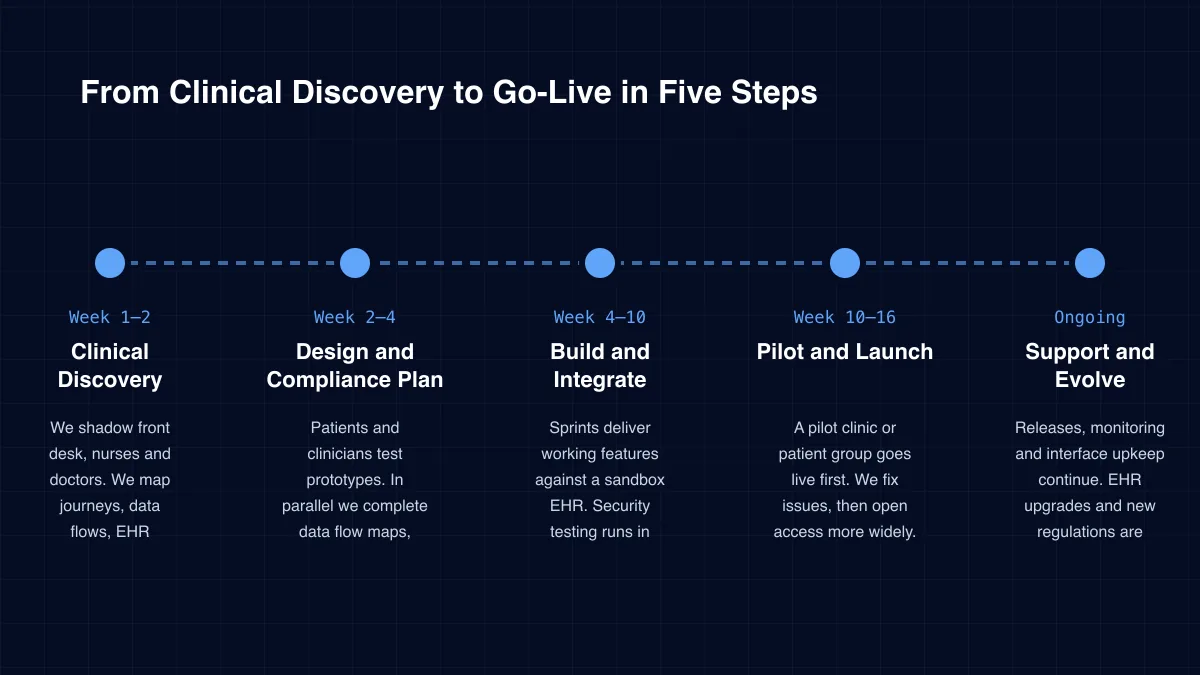
Week 1–2
We shadow front desk, nurses and doctors. We map journeys, data flows, EHR interfaces and the privacy rules that apply.
Week 2–4
Patients and clinicians test prototypes. In parallel we complete data flow maps, threat models and FHIR scope.
Week 4–10
Sprints deliver working features against a sandbox EHR. Security testing runs in every pipeline.
Week 10–16
A pilot clinic or patient group goes live first. We fix issues, then open access more widely.
Ongoing
Releases, monitoring and interface upkeep continue. EHR upgrades and new regulations are planned into the roadmap.
Case study
Providers across India faced long waits, fragmented records, high admin costs and limited rural access. Our team built one platform with a patient portal, telemedicine, EHR integration, billing automation, wearables and AI insights. It delivered 25% faster patient service and a 40% cut in administrative workload.
“A record scattered across three clinics is not a history. It is a set of clues.”Read the full case study →
Web · Mobile · Telemedicine
Unified records, prescriptions and history, plus video consultations.
EHR / EMR · Billing module
Hospitals, labs and clinics connected, with automated insurance claims.
Apple Health · Fitbit · Garmin · AI
Wearable data in the record and AI insights for preventive care.
Healthcare punishes shortcuts. We recommend checking five things before you commit to a vendor.
In our experience, integration and security decide whether healthcare app development succeeds. A beautiful app that cannot reach the chart will not survive.
ICANIO works under ISO 9001 and ISO 27001 certified processes. Apps encrypt data in transit and at rest, use short-lived tokens and never store health data in plain device storage.
Security testing runs in every release pipeline. That includes static analysis, dependency scanning and dynamic tests against the OWASP mobile and web guidance. Penetration tests are scheduled before major launches.
We design to HIPAA Security Rule safeguards for US clients and to India's health data rules for ABHA-linked records. Consent, access logs and retention are agreed with your compliance team. Formal certification of your service remains your responsibility, and we supply the evidence it needs.
Pick a measurable burden. Examples are phone bookings per day, no-show rates, claim rework or minutes per discharge. Value one unit of it.
Track it before and after the pilot clinic launches. We agree baselines during discovery, so each healthcare app development phase is judged on your own data.
Some returns are harder to count but still real. Patients who can see their own results call less. Clinicians who launch an app from the chart adopt it faster. Rural patients who avoid a long trip are more likely to attend follow-ups. We track these signals too, through usage analytics and short staff surveys.
Technology stack
We choose tools per project and per regulation. These are our common picks.
Mobile
Web
WCAG testing
Backend
Interoperability
HL7 FHIRSMART on FHIRHL7 v2Interface engines
Health Data
ABHA
Cloud & Security
KMS encryptionSAST & DAST
 Free white paper · App DevelopmentApplication DevelopmentBuilding Enterprise-Grade Applications That Drive Digital TransformationGet the white paper →
 Free white paper · HealthcareHealthcare Technology SolutionsDigital Transformation, Clinical Excellence, and Patient-Centric InnovationGet the white paper →
Our healthcare app development follows HIPAA Security Rule safeguards for US projects. That covers encryption, access control, audit logs and business associate terms. Compliance also depends on how you operate the service, so we work with your compliance team.
Yes, in most cases. We use HL7 FHIR APIs and SMART on FHIR where the EHR supports them. For older systems we use HL7 v2 feeds or an interface engine.
Yes. Our digital healthcare platform includes video consultations, scheduling and records. We scope video, e-prescribing and payments to your market and rules.
Software that diagnoses, treats or drives clinical decisions may be regulated as a medical device. Portals and booking apps usually are not. We flag this in discovery so you can take regulatory advice early.
A focused patient or clinician app can reach a pilot within a few months. Timelines depend on EHR access and approvals. We give you a dated plan after discovery.
Yes. Our healthcare work includes ABHA-ready records. We design consent and linking flows to match the national digital health rules.
Patients and clinicians both want less friction. Healthcare app development removes it, as long as the app is secure, interoperable and built with real users.
ICANIO combines mobile, web and clinical integration engineers in one team. We start with discovery in real care settings, pilot with one clinic and scale from there. Our healthcare app development work continues through structured support and compliance upkeep.
By ICANIO Healthcare Engineering Team · Published · Updated
Book a free discovery call with our team. We will map one patient or clinician journey, its integrations and a pilot plan. Contact us to get started.
Contact Our Healthcare Team