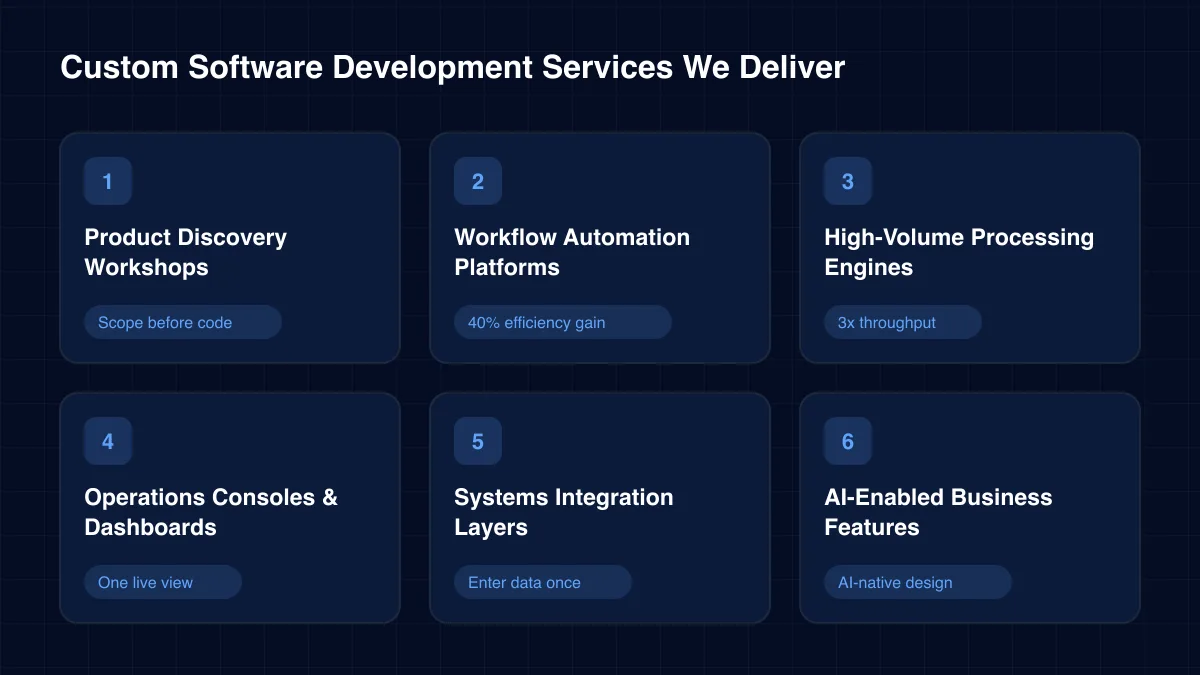
Product Discovery Workshops
Stakeholder interviews, process mapping and a prioritised backlog. Discovery gives custom software development a scoped first release, a budget range and clear success measures.
Scope before code →Custom Software Development
Bespoke platforms that encode how your business actually runs. We model your rules, automate the busywork and hand you software you fully own.
LeaseDesk
Rent cycle · October
LeaseDesk
Rent cycle · October
⟳ Design in progress
Every business has a process that no product on the market quite fits. Custom software development closes that gap. Instead of bending your team around a vendor's screens, you get software shaped around your rules, roles and data.
Our team at ICANIO designs and builds bespoke platforms for operations, finance, field work and customer service. We start with the workflow, not the feature list. Then we model the domain, automate the repetitive steps and connect the systems you already run.
This guide explains when custom software development is worth it, how we scope and architect it, and where these projects usually go wrong. It also covers delivery models, pricing drivers and the questions to ask any partner before you sign.
Custom software development is the design and engineering of software for one organisation's specific needs. The result is not sold to the market. It belongs to you and it reflects the way your business competes.
Typical examples include rule engines for pricing or commissions, operations consoles, approval workflows, scheduling systems and internal marketplaces. Some are small tools used by a single team. Others become the core platform a whole company runs on.
The key difference from packaged software is who controls the roadmap. With a licence, the vendor decides what ships next. With custom software development, your priorities set the backlog and your data model reflects your real entities.
That freedom has a cost. You carry the responsibility for quality, security and upkeep. That is why the engineering discipline behind bespoke software matters as much as the idea itself.
Working definition
“Custom software development is the end-to-end creation of software designed for a single organisation's workflows, data and rules, owned by that organisation and evolved to match its strategy.”
Foundations
We shadow the people doing the work and map every hand-off before a single screen is designed.
Business terms become code. Leases, claims or payouts are modelled exactly as your experts describe them.
We automate the steps that are frequent, rule-based and error-prone, and leave judgement calls to people.
Source code, infrastructure scripts and documentation are yours, so you are never locked into one supplier.
Core capabilities
Each engagement combines product discovery, engineering and long-term care. Pick one service or combine several into a single custom software development programme.
Stakeholder interviews, process mapping and a prioritised backlog. Discovery gives custom software development a scoped first release, a budget range and clear success measures.
Scope before code →Rules engines and approval flows that replace spreadsheets and email chains. Our property platform automated rent collection and lease workflows across a whole portfolio.
40% efficiency gain →Batch and calculation engines that must be fast and exact. We re-engineered a broker compensation engine for parallel execution with transactional consistency.
3x throughput →Role-based back-office tools that give managers one live view. Custom software development here means screens designed for your exact decisions, not generic reports.
One live view
Connectors to accounting, banking, ERP and identity platforms, so data is entered once. The property platform synced with QuickBooks and Plaid for accurate reporting.
Enter data once
Document reading, smart search and recommendations inside your own tools. We treat AI as part of the architecture, and only add it where it shortens a real task.
AI-native design
Architecture
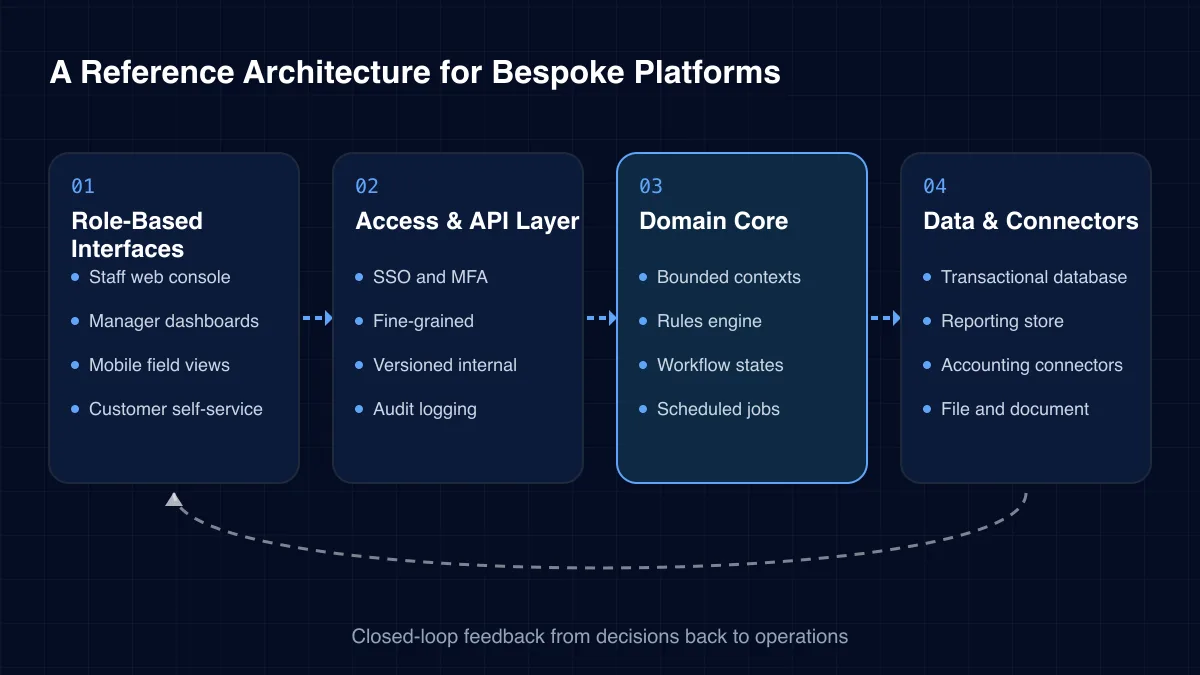
Most custom platforms we build follow a modular monolith or a small set of services. We split only where scale or team structure demands it, which keeps early delivery fast.
01
02
03
04
Challenges we solve
Bespoke builds rarely fail because the code is hard. They fail because the business problem was never pinned down.
Digitising a messy workflow just makes the mess faster. We simplify the process with your team before we encode it.
Key rules often live in one expert's head. We run structured workshops and write the rules down as testable examples.
A two-year build with one launch date is a gamble. We release a working slice early and grow it every sprint.
Legacy spreadsheets hide formulas and exceptions. We reverse-engineer them and prove the new system matches their outputs.
Some suppliers keep code or infrastructure under their own accounts. We set up every repository and cloud account in your name.
Software without an owner decays quickly. We agree a support model and a product owner before launch day.
Not every bespoke build is the same. The type shapes the team, budget and timeline.
Custom software development competes with two other options. This comparison helps you pick honestly.
| Criterion | Packaged SaaS | Heavily customised package | Custom build |
|---|---|---|---|
| Matches unique rules | Partial | ✓ Yes | ✓ Yes |
| Upgrade effort | Low | High | Medium |
| Roadmap control | No | Partial | ✓ Yes |
| Licence cost per user | ✓ Yes | ✓ Yes | No |
| Best fit | Commodity processes | Near-fit processes | Differentiating processes |
When the process is worth owning, bespoke software returns value for years.
Delivery
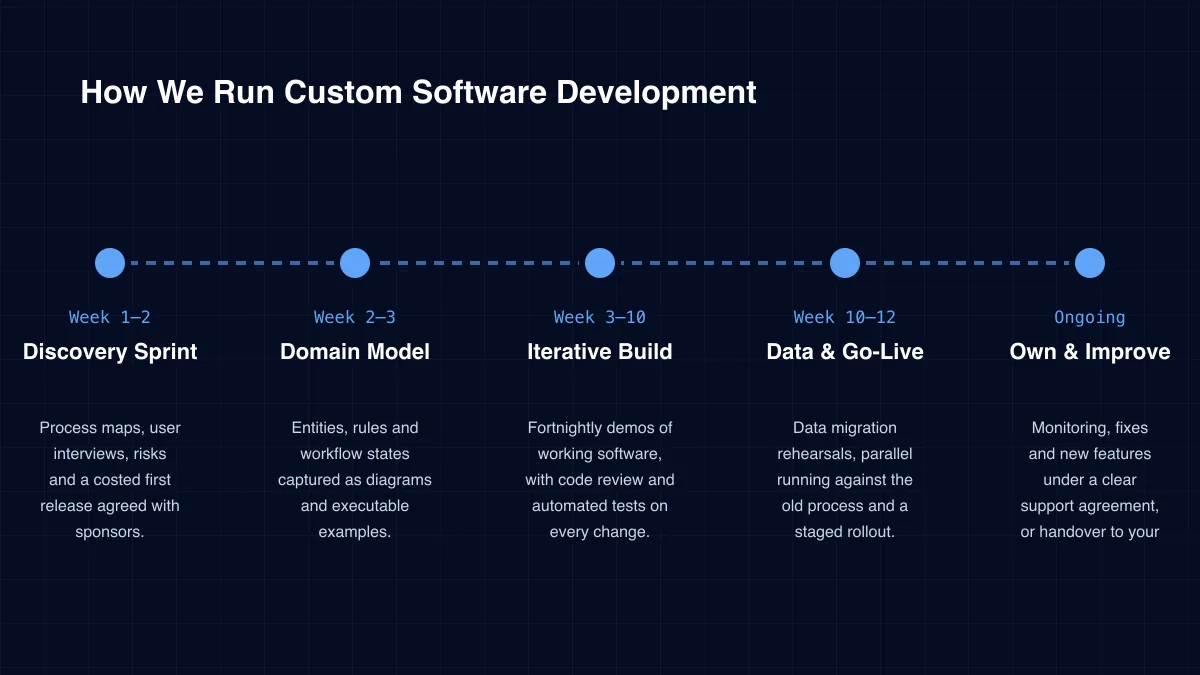
Week 1–2
Process maps, user interviews, risks and a costed first release agreed with sponsors.
Week 2–3
Entities, rules and workflow states captured as diagrams and executable examples.
Week 3–10
Fortnightly demos of working software, with code review and automated tests on every change.
Week 10–12
Data migration rehearsals, parallel running against the old process and a staged rollout.
Ongoing
Monitoring, fixes and new features under a clear support agreement, or handover to your team.
Case study
A property partner managing high-volume portfolios was held back by legacy tools, calculation errors and slow maintenance tracking. ICANIO treated it as a full-stack engineering challenge and delivered a cloud-native platform tailored to its rent, lease and maintenance workflows. The result was a 40% efficiency boost, zero errors in automated financial calculations and 3x faster maintenance response.
Read the full case study →Automated workflow rules
Rent cycles and renewals run without manual oversight, which removed calculation errors.
QuickBooks · Plaid
Accounting and banking data stay aligned, so portfolio reports are accurate.
Automated vendor flows
Requests are tracked from report to resolution, so tenants get faster answers.
Specialist services within our mobile & web application development practice.
A bespoke build is a multi-year relationship. We recommend testing a partner on these five points.
A partner who challenges your requirements early usually saves you a rebuild later. That challenge is the first thing our team brings to every custom software development engagement.
ICANIO runs delivery under ISO 9001 and ISO 27001 certified processes. Secure coding follows OWASP guidance, and dependency and secret scans run in every pipeline.
Bespoke systems often hold sensitive business rules and financial data. We design role-based access, encryption in transit and at rest, and complete audit logs into the domain core.
Every change passes peer review and automated tests before it merges. For regulated clients, we map controls to the standards that apply to them, such as SOC 2 or HIPAA, and keep evidence as part of the pipeline.
Start with the current cost of the process. Count staff hours, error correction, licence fees and delays that the new system should remove. That is your baseline.
Then compare the build and running cost over three to five years with the packaged alternatives. Custom software development often wins where per-seat licences grow with headcount or where workarounds consume skilled time.
We agree measurable targets during discovery, such as cycle time or error rate. After launch we track them in the product itself, so the return is visible rather than assumed.
Technology stack
We select tools that your team can hire for and maintain long after we hand over.
Frontend
Backend
Data
Workflow
Rules enginesJob schedulersMessage queuesCamunda BPMN
Integration
RESTWebhooksAccounting APIs
Delivery
Build when the process is unique, central to how you compete or poorly served by packages. Buy when the process is standard, such as payroll or email. Many clients do both: buy the commodity parts and build the edge.
Cost depends on scope, integrations, data migration and compliance needs. We give a range after a short discovery sprint, then fix the budget for a first release. Phased delivery keeps each commitment small.
A focused first release usually takes around ten to twelve weeks after discovery. Larger platforms grow in phases. You see working software every two weeks, so progress is never hidden.
Yes. Repositories, cloud accounts and documentation are created under your organisation from the first day. You can keep us for support or move the work in-house at any time.
Yes. We extract every formula and exception, write them as test cases and run the new system against past data. The spreadsheet is retired only when the outputs match.
Where it helps. Common examples are reading documents, suggesting next actions and smarter search. We design these features into the architecture and measure whether they save real time.
How we deliver custom software development and the wider app development practice in each sector.
Off-the-shelf tools serve the average company. Your advantage usually lives in the parts that are not average. Custom software development turns those parts into durable, owned systems that staff enjoy using.
ICANIO combines discovery, domain modelling and disciplined engineering in one team. We ship early, prove value in your own numbers and keep improving the platform as your business changes.
If a spreadsheet, an email chain or a rigid package is slowing your team down, contact us. We will map the workflow with you and show what a first custom software development release could look like.
By ICANIO Application Engineering Team · Published · Updated
Book a free discovery call. We will walk through your workflow, flag quick wins and outline a costed first release you can take to your stakeholders.
Contact Our Engineering Team