INSURANCE SOFTWARE · JDK MIGRATION · SYSTEM INTEGRATION
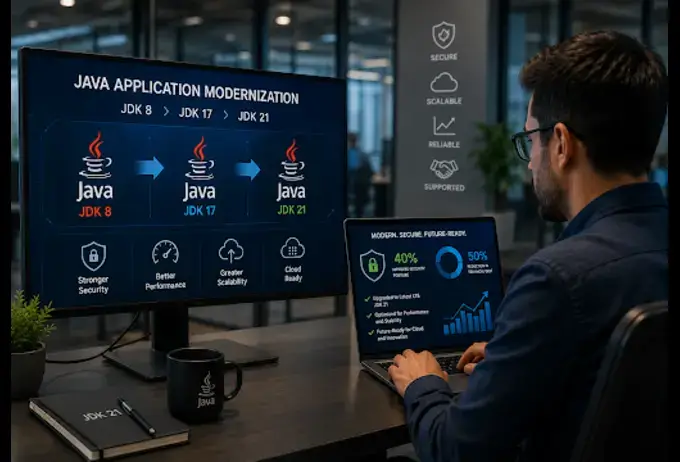
This insurance application modernization upgraded legacy Java applications from JDK 8 to JDK 17, replaced an outdated NIPR integration with Vertafore, and added ongoing production support across enterprise insurance systems.
Quick Answer
What Is Insurance Application Modernization?
Insurance application modernization upgrades legacy Java runtimes and replaces outdated third-party integrations to resolve security, performance, and maintainability gaps in enterprise insurance systems. ICANIO completed this insurance application modernization by migrating JDK 8 to JDK 17 and replacing an outdated NIPR integration with Vertafore, improving security posture by 40% and cutting technical debt by 50%.
Executive Summary
Turning a Legacy Insurance Stack Into a Modern, Supported Platform
Legacy Java applications on JDK 8 faced security risks, outdated integrations, and ongoing maintenance challenges. Businesses needed secure runtime, modern third-party integrations, and continuous production support for stable operations. ICANIO’s partner was facing exactly that gap: security vulnerabilities in the legacy JDK 8 environment, an outdated NIPR integration that required removal, the need to implement Vertafore for modern business requirements, and deprecated functionalities that increased technical debt and maintenance overhead.
ICANIO addressed this by upgrading Java applications from JDK 8 to JDK 17, replacing legacy integrations with Vertafore, and providing ongoing support, rather than treating the runtime upgrade and integration replacement as separate projects. The objective was to migrate the application securely, refactor the architecture to accommodate new integration workflows, remove obsolete components to reduce technical debt, and maintain continued production support with bug fixes and feature enhancements.
The result was a 40% improvement in security performance posture and a 50% reduction in technical debt complexity, with seamless system integration capability, 99.9% application stability assurance, 30% better user experience quality, and a future-ready application platform foundation.
“An insurance platform still running on JDK 8 with a deprecated integration is not stable, it is two separate outages waiting for the same afternoon.”
The Challenge
Five Risks of a Legacy Insurance Application Stack
Legacy Java applications on JDK 8 faced security risks, outdated integrations, and ongoing maintenance challenges. Businesses needed secure runtime, modern third-party integrations, and continuous production support for stable operations.
Insurance Application Modernization Had to Fix JDK 8 Security
Security vulnerabilities existed in the legacy JDK 8 environment, leaving the application exposed to risks a modern runtime would have already resolved.
Insurance Application Modernization Needed a Vertafore Replacement
The NIPR integration was outdated and required removal, and the business needed to implement Vertafore in its place to meet modern requirements.
Ongoing Production Support Demands
Production support was required for bug fixes and feature updates, an ongoing need that a one-time upgrade alone would not resolve.
Deprecated Functionality Increased Technical Debt
Deprecated functionalities increased technical debt and maintenance overhead, making every future change more expensive than it needed to be.
Stability and UX Needed Continuous Improvement
Application stability and user experience needed continuous improvement, since a single upgrade would not sustain long-term reliability on its own.
Insurance Application Modernization Solutions
A Six-Part Insurance Application Modernization
Icanio upgraded Java applications from JDK 8 to JDK 17, replaced legacy integrations with Vertafore, and provided ongoing support, ensuring security, performance, maintainability, and enhanced user experience. The solutions included:
Insurance Application Modernization via Secure JDK 17 Migration
Migrated the application from JDK 8 to JDK 17 securely, resolving the security exposure of the legacy runtime.
Vertafore Integration Replacement
Replaced the NIPR integration with Vertafore per business needs, aligning the platform with current insurance industry requirements.
Architecture Refactored for New Workflows
Refactored the architecture to accommodate new integration workflows, so the platform could support Vertafore without structural rework later.
Continued Production Support
Continued production support with bug fixes and feature enhancements kept the application reliable well past the initial modernization.
Insurance Application Modernization Removed Obsolete Components
Removed obsolete components to reduce technical debt effectively, clearing years of accumulated maintenance overhead.
Insurance Application Modernization Enterprise Environment
Maintained a stable, scalable, and reliable enterprise application environment as the foundation for future feature work.
Business Outcomes
Measurable Results Across Security, Stability, and Debt
This insurance application modernization delivered outcomes across every dimension of the original legacy-stack problem, converting a vulnerable, outdated platform into a secure, stable, and future-ready application environment.
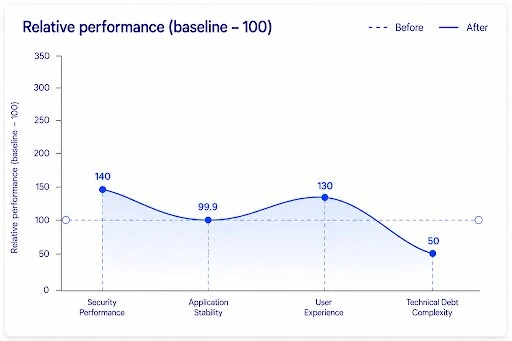
Insurance application modernization outcomes: 99.9% application stability, 50% less technical debt and a 40% stronger security performance posture.
40%Improved
Security performance posture
Seamless System
Platform integration capability
99.9%System
Application stability assurance
30%Better
User experience quality
50%Reduced
Technical debt complexity
Future-Ready
Application platform foundation
Key learnings
What This Engagement Proves for Legacy Insurance Platforms
Insurance Application Modernization Needs Both Done Together
Migrating JDK 8 to JDK 17 and replacing NIPR with Vertafore as separate projects would have meant refactoring the same architecture twice. Doing both together is what let the team accommodate new integration workflows without rework.
Technical Debt Reduction Requires Actually Removing Components
Deprecated functionality doesn’t go away on its own after a runtime upgrade. Explicitly removing obsolete components is what drove the 50% reduction in technical debt, not the JDK migration alone.
Ongoing Support Is What Makes Modernization Stick
A modernized platform without continued production support drifts back toward instability as new bugs and feature requests accumulate. Ongoing bug fixes and enhancements are what kept 99.9% application stability assurance durable after launch.
Conclusion
From Legacy Insurance Stack to a Modern, Supported Platform
Legacy Java applications on JDK 8 might have been tolerable while the NIPR integration was still supported, but for an insurance platform needing modern integrations and long-term reliability, it had become a real source of security and maintenance risk. This engagement demonstrates that a single insurance application modernization can resolve security, integration, and technical debt gaps within one structured programme rather than three separate initiatives.
By migrating to JDK 17, completing the Vertafore integration, and providing production support services alongside insurance system integration work, ICANIO helped this partner improve security posture by 40% and reduce technical debt by 50%. The refactored architecture and future-ready platform foundation delivered through this engagement are the foundation every future integration this insurance platform adds will run on.
Related Resources
This work is part of ICANIO's software development practice, alongside DevOps and cloud engineering. Our team handles runtime upgrades and integration replacements through application development services and support engineering services. Related examples include Java application modernization and ERP integration automation. To plan a similar upgrade, contact ICANIO.
- Application Development Services
- Industries We Serve
- Java Application Modernization: JDK 17
- Best Insurance Management Software in 2026
- ERP CRM Integration: Real-Time Data Sync Guide 2026
References
- JDK 17 (OpenJDK): features and release details of Java Development Kit 17.
- Java version history: overview of Java SE releases, including JDK 8 and JDK 17.
- National Insurance Producer Registry (NIPR): the producer licensing data service named in this case study.
- Vertafore: official site of the insurance software provider.
- Technical debt: background on technical debt in software systems.
Frequently asked questions
Common Questions About This Insurance Application Modernization
What is insurance application modernization and why was it needed?
Insurance application modernization upgrades legacy Java runtimes and integrations to resolve security and maintainability gaps, needed here because JDK 8 carried security vulnerabilities and the NIPR integration was outdated and required removal.
Why did this project replace NIPR with a Vertafore integration?
The Vertafore integration replaced NIPR because NIPR no longer met modern business requirements, and Vertafore is what the business needed to support current insurance industry workflows going forward.
How did system integration stay stable during the JDK migration?
Insurance system integration work stayed stable because the architecture was refactored to accommodate new integration workflows before Vertafore went live, rather than bolting the new integration onto the old JDK 8 structure.
Why do production support services matter after modernization ends?
Production support services matter because a modernized platform still needs bug fixes and feature enhancements over time, which is what kept 99.9% application stability assurance holding well after the initial migration.
What does technical debt reduction involve beyond a JDK upgrade?
Technical debt reduction involved removing obsolete components entirely, not just upgrading the runtime, which is what drove the 50% reduction in technical debt complexity in this engagement.
How much did security posture improve after this modernization?
Security performance posture improved by 40% after this insurance application modernization, alongside 99.9% application stability assurance and a 50% reduction in technical debt complexity.