Mobile Shopping Apps
Native-feel apps for browsing, wishlists, checkout and tracking. In ecommerce app development this is usually the flagship channel for loyal customers.
Fast checkout
App Development for Retail & E-Commerce
We build shopping apps, ordering platforms and store tools that stay in sync with your POS, OMS and product catalogue. Fast on every phone, and ready for peak season.
ShopNow
Your basket
ShopNow
Your basket
⟳ Design in progress
Shoppers judge a brand by how fast its app loads and how easily it checks out. Ecommerce app development is where that judgement is won or lost. A slow search, a confusing basket or a failed payment sends the customer straight to a competitor.
Our team builds shopping and ordering apps that connect cleanly to the systems behind them. That means POS, order management, product information, inventory and payments. When stock, price and order status agree everywhere, customers trust what they see.
This guide explains what strong ecommerce app development looks like in 2026. It covers app types, a headless reference architecture, common failure points, a delivery plan and how to choose a partner.
Ecommerce app development is the design and build of mobile apps, web storefronts and progressive web apps that let customers browse, buy and track orders. It also covers the staff tools behind them, such as order dashboards and in-store apps.
The hard part is rarely the storefront. It is keeping catalogue, stock, prices, promotions and orders consistent across web, app and store. A basket that shows an item as available, then cancels it later, damages trust fast.
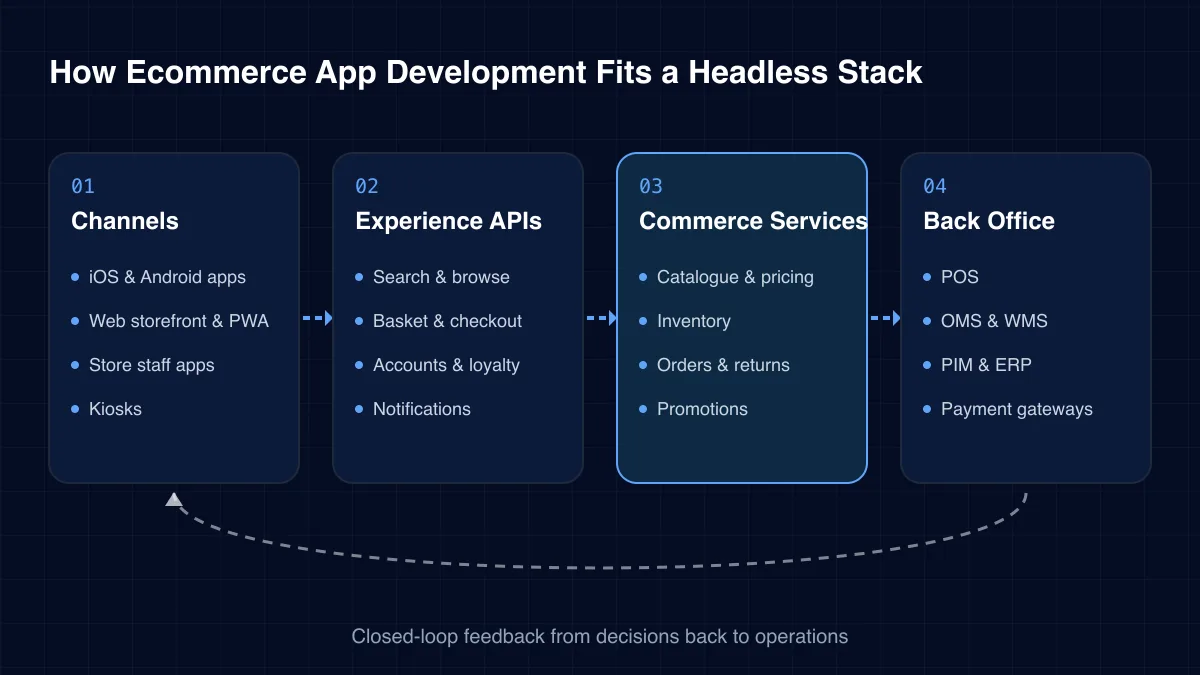
Modern ecommerce app development therefore leans on headless and API-first design. The front end can change quickly, while commerce services stay stable and shared across every channel.
Staff apps matter as much as shopper apps. Store teams need to pick online orders, check stock and fix shelves. When they work from the same live data as customers, click and collect and in-store returns run smoothly.
Working definition
“Ecommerce app development is building customer and staff apps for digital selling, connected in real time to the catalogue, inventory, order and payment systems behind them.”
Foundations
Fast first load, instant search and a short checkout. Every extra second and extra tap costs orders.
Stock, price and order status come from shared services. Web, app and store never disagree.
Saved baskets, quick reorder and relevant offers. Loyal customers should reach checkout in seconds.
Load tested for sale days and festive traffic. Autoscaling and caching keep the app standing when demand spikes.
Core capabilities
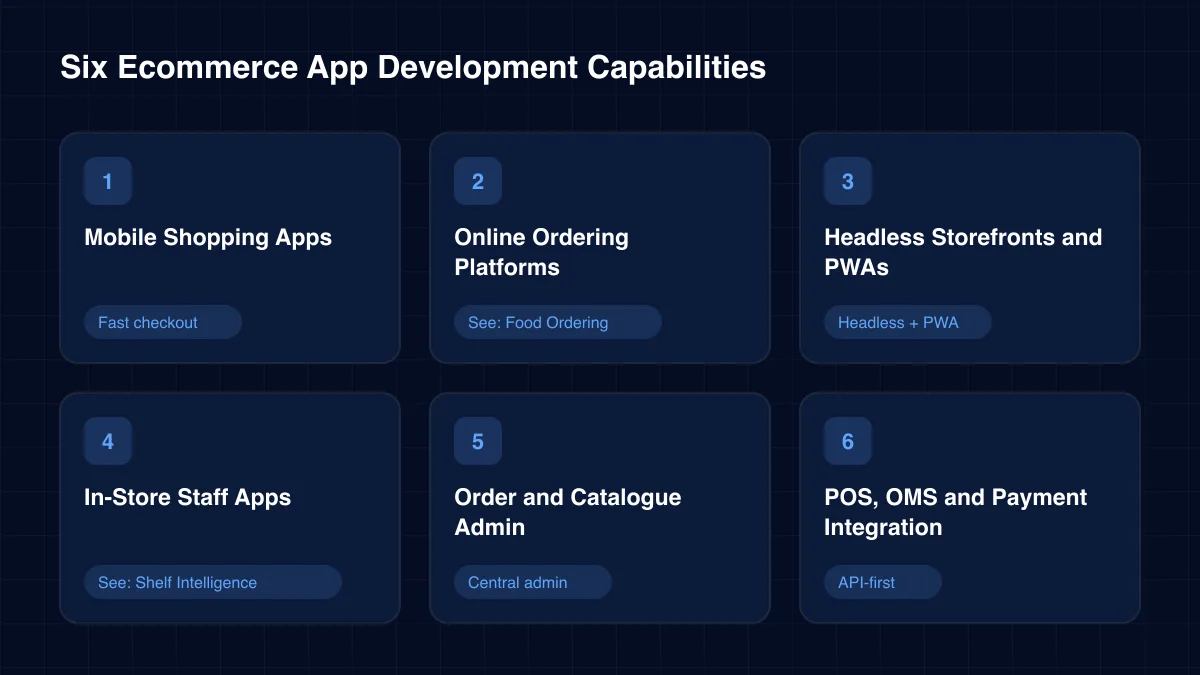
These are the builds retailers and brands ask us for most. Each slots into a broader ecommerce app development roadmap.
Native-feel apps for browsing, wishlists, checkout and tracking. In ecommerce app development this is usually the flagship channel for loyal customers.
Fast checkout
Web and app ordering tied to real-time fulfilment. Our food ordering platform connected customer orders straight into kitchen workflows.
See: Food Ordering →Fast web storefronts on a headless commerce back end. Progressive web apps add offline browsing and push notifications without an app store.
Headless + PWA
Shelf tasks, stock checks and photo capture for store teams. Our AR shelf intelligence app validates shelf photos in real time.
See: Shelf Intelligence →Back-office dashboards for orders, returns, menus and pricing. One change reaches every channel, which is central to good ecommerce app development.
Central admin
Connect apps to POS, order management, PIM, ERP and payment gateways. Tokenised payments keep card data out of your app.
API-first
Architecture
Customer apps sit on top of shared commerce services. An API layer shields them from back-office systems, so each channel can move at its own pace.
01
02
03
04
Challenges we solve
Most lost revenue in digital retail hides in small frictions. These are the ones we fix most often.
Long forms, forced sign-up and surprise delivery fees push shoppers away. A short, guest-friendly checkout keeps them.
Apps that read stale inventory sell items already gone. Real-time stock services prevent cancellations and angry reviews.
Updating each channel by hand invites errors. Our food ordering build replaced that with one central admin.
Heavy images and scripts stall on patchy networks. Performance budgets and PWA caching keep pages quick.
Traffic spikes expose weak back ends. Load testing and autoscaling are planned before the campaign, not during it.
Customers call because they cannot see where the order is. Live status and push updates answer the question first.
Ecommerce app development projects usually fall into four patterns. Many brands combine two or more.
Hosted platforms and app builders are a fine start. The table shows when custom ecommerce app development pays off.
| Need | Platform template | No-code app builder | Custom app |
|---|---|---|---|
| Unique brand experience | Partial | Partial | ✓ Yes |
| Real-time POS and OMS sync | Partial | No | ✓ Yes |
| Custom fulfilment workflows | No | No | ✓ Yes |
| Performance under peak load | Partial | Partial | ✓ Yes |
| You own code and data | Partial | No | ✓ Yes |
The benefits grow as more of your customers and staff use connected apps.
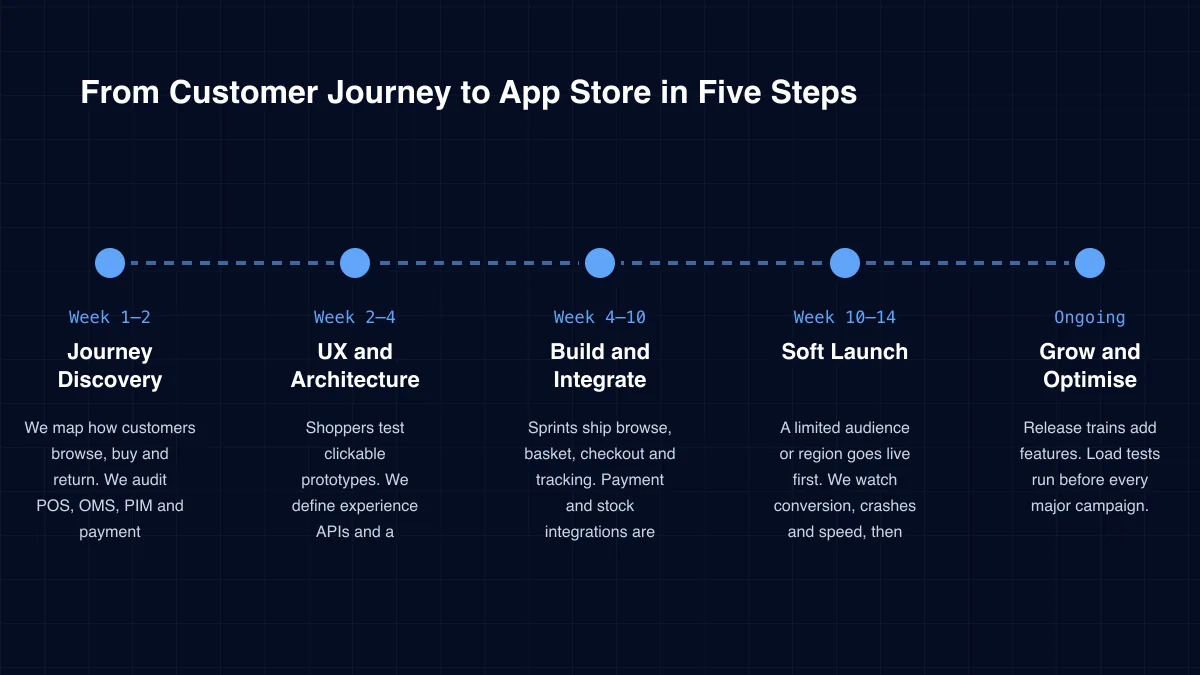
Delivery
Week 1–2
We map how customers browse, buy and return. We audit POS, OMS, PIM and payment integrations.
Week 2–4
Shoppers test clickable prototypes. We define experience APIs and a performance budget.
Week 4–10
Sprints ship browse, basket, checkout and tracking. Payment and stock integrations are tested end to end.
Week 10–14
A limited audience or region goes live first. We watch conversion, crashes and speed, then tune.
Ongoing
Release trains add features. Load tests run before every major campaign.
Case study
A restaurant partner relied on manual order handling while customers moved to mobile and web ordering. Menus were managed separately per channel. Our team built one ordering app and website linked to real-time kitchen processing and delivery status. The result was more online orders, faster processing and a scalable digital sales channel.
“Orders are lost when the app is slower than picking up the phone.”Read the full case study →
Flutter
One ordering experience across app and website, designed for fast repeat use.
Node.js · MongoDB
Real-time order receipt for the kitchen and live delivery status for customers.
Admin console
Menu items and pricing managed once and reflected across every channel.
Plenty of studios can design a pretty storefront. We recommend checking five deeper things before you sign.
In our experience, integration quality decides whether ecommerce app development pays back. A fast app that sells stock you do not have still loses customers.
ICANIO works under ISO 9001 and ISO 27001 certified processes. We use hosted or tokenised payment flows, so card numbers never touch your app servers. That keeps PCI DSS scope as small as possible.
Customer accounts use secure authentication and rate limiting against credential stuffing. Personal data is minimised, encrypted and handled in line with GDPR or local privacy law where it applies.
Every release passes automated security checks in the pipeline. We scan dependencies, test for common OWASP web and mobile risks, and review access to admin tools. Store staff apps use device management, so a lost handset can be locked and wiped remotely.
Start with your current funnel. Measure sessions, basket rate, checkout completion and repeat purchase rate on each channel.
Then track the same funnel after launch. We agree the baseline with you during discovery. Each ecommerce app development release is then judged on conversion and order value, not on opinions about design.
Look beyond the storefront as well. Central catalogue admin saves staff hours on every price change. Live order status cuts where-is-my-order calls. Fewer cancelled orders mean fewer refunds and fewer bad reviews. These savings often match the revenue gains, so we track both.
Technology stack
We choose the stack per brand and scale. These are the tools we use most.
Mobile
Web
PWA
Backend
Commerce
Headless commerceSearch enginesPIMOMS
Payments
Payment gatewaysUPITokenisationWallets
Cloud & Delivery
CDN cachingCI/CDLoad testing
It depends on your customers. A progressive web app is often enough for occasional shoppers. Loyal, frequent buyers usually justify a native-feel app. Many ecommerce app development plans start with a PWA and add an app later.
Yes. We connect apps to POS, OMS, PIM and ERP systems through their APIs or middleware. Real-time stock and price sync is scoped during architecture design.
We use hosted or tokenised payment flows from established gateways. Card data stays with the payment provider, which keeps your PCI DSS scope small.
We load test before launch and before major campaigns. Autoscaling, caching and queueing protect checkout when traffic spikes.
A focused ordering or shopping app can soft launch within a few months. Integration depth and catalogue size affect the timeline. We give you a dated plan after discovery.
Yes. Our team runs release trains, monitoring and performance tuning. We recommend a steady cadence of small releases rather than rare big ones.
Digital shoppers have little patience and many alternatives. Ecommerce app development earns their loyalty with fast, accurate and reliable apps.
ICANIO brings mobile, web and commerce integration engineers into one team. We start from your customer journey, soft launch, and grow from real funnel data. Our ecommerce app development work continues with release trains and peak-season readiness.
By ICANIO Commerce Engineering Team · Published · Updated
Book a free discovery call with our team. We will map your customer journey, integrations and a soft launch plan. Contact us to get started.
Contact Our Commerce Team