JAVA MODERNIZATION · JVM OPTIMIZATION · DEVOPS & CLOUD
A mission-critical migration from JDK 8 to JDK 21. It delivered performance gains, Java technical debt reduction, and CI/CD modernization for enterprise-grade application security and long-term cloud scalability.
Quick Answer
What Is JVM Performance Optimization in a JDK 8 to 21 Migration?
JVM performance optimization through Java migration JDK 8 to 21 means migrating enterprise applications from end-of-life JDK 8 to a modern long-term support runtime. The move eliminates security vulnerabilities, resolving garbage collection inefficiencies, removing deprecated APIs, and unlocking the performance gains that make cloud-native deployment viable. ICANIO executed a full Java legacy modernization engagement. It delivered 2x faster overall application runtime, 100% alignment with modern security compliance standards, and a 40% reduction in enterprise Java technical debt reduction for an enterprise partner running mission-critical workloads on an aging JDK 8 infrastructure. ICANIO Technologies delivered this JVM performance optimization project in multiple stages. It refactored the core application, modernized the build environment, and deployed automated CI/CD pipelines across the engineering stack.
Executive Summary
Eliminating Technical Debt That Blocks Cloud Adoption
End-of-life JDK 8 is one of the most common and consequential forms of technical debt deferred in enterprise environments. The security exposure is well understood. Oracle ended free public updates for JDK 8 in 2019. That left teams still running the legacy version on a runtime with no active vulnerability patching. The performance cost is less visible but equally significant: JDK 8’s garbage collection architecture, JVM internals, and concurrency model predate a decade of runtime engineering advances that modern JDKs deliver as standard. Every quarter an enterprise application remains on JDK 8 is a quarter in which it runs slower, costs more to operate, and accumulates the maintenance overhead that makes Java legacy modernization progressively more expensive.
ICANIO approached this as a multi-stage engineering challenge. The objective was to execute a complete end-to-end migration for the client’s DCM application. That meant migrating the runtime, refactoring the codebase to remove deprecated APIs, completing the framework migration to modern Spring Boot standards, updating the full build toolchain, integrating automated testing, and delivering a modernized CI/CD pipeline. The result was a JVM performance optimization outcome that doubled application runtime performance, eliminated the security and compliance exposure of end-of-life infrastructure, and set the foundation for long-term cloud scalability.
“Every quarter an enterprise application runs on end-of-life JDK 8 is a quarter of compounding security exposure, degrading runtime performance, and deferred Java technical debt reduction that becomes harder and more expensive to resolve.”
The Challenge
Six Technical Failures That Make End-of-Life JDK 8 Unsustainable
Without JVM performance optimization, every technical gap in an aging Java infrastructure compounds every other. Security vulnerabilities in an unpatched runtime create compliance risk. Compliance risk blocks cloud platform adoption. Limited cloud compatibility constrains deployment architecture. Inefficient garbage collection inflates runtime latency. Elevated maintenance overhead slows development cycles. Six distinct failure modes defined the technical debt profile this engagement was commissioned to resolve.
End-of-Life Security and Compliance Risk
End-of-life JDK 8 carries critical security and compliance risks with no active vulnerability patching available. Enterprise applications on this runtime are exposed to known CVEs that cannot be resolved without completing the Java migration JDK 8 to 21.
JVM Inefficiencies Blocking Scalability
JVM inefficiencies in legacy Java limit scalability across high-concurrency workloads. Performance gains in JDK 17 and JDK 21, including improved JIT compilation, generational GC, and virtual thread support, are entirely inaccessible on JDK 8.
Limited Cloud Platform Compatibility
Limited compatibility with modern cloud platforms, container orchestration, and build toolchains makes deploying JDK 8 applications increasingly difficult. Modernizing legacy Java is not optional for cloud-native teams. It is a prerequisite.
Deprecated APIs and Library Overhead
Outdated libraries and deprecated APIs from years of JDK 8 development increase maintenance overhead and introduce fragility into every build cycle. Systematic removal cannot be deferred without creating new migration blockers downstream.
Garbage Collection Latency
Inefficient garbage collection in JDK 8 produces unpredictable runtime latency spikes. This is a direct result of missing advanced GC algorithms. G1GC improvements, Generational ZGC, and JDK 21 concurrency advances are all inaccessible until the migration is complete.
JVM Performance Optimization Solutions Provided
A Six-Component Java Modernization Strategy
ICANIO designed and executed a multi-stage JVM performance optimization strategy that addresses every dimension of the client’s technical debt and runtime exposure. Rather than treating this as an isolated runtime upgrade, ICANIO engineered a six-component modernization architecture where runtime migration, codebase refactoring, framework migration, build toolchain modernization, testing automation, and CI/CD pipeline upgrades are executed as an integrated programme. Every component of the modernization effort is completed in a sequence that minimises migration risk while maximising the performance and security gains delivered at each stage.
Seamless Java Migration JDK 8 to 21
Executed the Java migration JDK 8 to 21 for the DCM application. The team migrated to JDK 21 LTS, validated module compatibility, and resolved version-specific API changes.
Codebase Refactoring to Remove Deprecated APIs
Systematically refactored the codebase to remove all deprecated APIs and legacy library dependencies, delivering the clean dependency graph required for reliable cloud deployment.
Build Environment Modernization for Maven, Gradle, and JUnit
Updated Maven, Gradle, and JUnit configurations to versions aligned with JDK 21 requirements, enforcing modern dependency management standards across the full build environment.
Playwright and Spring Boot Migration for Automated Testing
Integrated Playwright for automated stability testing and completed the Spring Boot migration, ensuring post-migration behaviour is validated across all critical workflows.
JVM Tuning with Advanced Garbage Collection
Executed JVM performance optimization through advanced GC configuration, enabling G1GC and generational GC settings in JDK 21 that were inaccessible under the legacy JDK 8 runtime.
CI/CD Pipeline Modernization for Security and Throughput
Modernized the deployment pipeline to deliver automated technical debt governance, improved build security, and 3-click CI/CD execution across development, staging, and production.
Business Outcomes
Measurable Results Across Performance, Security, and Technical Debt
The JVM performance optimization programme delivered outcomes across every dimension of the client’s technical debt profile. It converted a security-exposed, performance-constrained legacy Java infrastructure into a modern, compliant, and cloud-ready application stack that performs at twice its pre-migration speed.
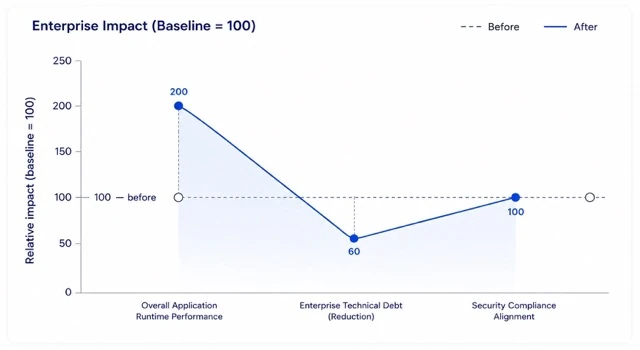
JVM performance optimization doubled runtime performance while reducing technical debt by 40%, enabling secure, scalable enterprise operations.
2xFaster
Overall application runtime performance through JVM performance optimization and JDK 21 migration
40%Reduction
In total enterprise technical debt through systematic codebase and API refactoring
Full System Stability
Via Spring Boot and JPA validation across all critical application workflows
100%Alignment
With modern security compliance standards through Java migration JDK 8 to 21 and active vulnerability patching
Automated Workflows
Via 3-click modern CI/CD pipelines across all deployment environments
Future-Proofed Stack
Ready for long-term cloud scalability through Java legacy modernization and JDK 21 LTS infrastructure
Key learnings
What This Engagement Proves for Enterprise Java Leaders
JVM Performance Optimization Gaps Compound When Migration Waits
The JVM performance optimization gap between JDK 8 and JDK 21 is not static. It widens with every JDK release that passes between the legacy version and the current LTS. Each intermediate JDK delivered incremental JIT compilation improvements, garbage collection advances, and concurrency model enhancements that accumulate into the 2x runtime performance gain measurable when the migration to JDK 21 is finally complete. Enterprise Java leaders who defer Java legacy modernization do not avoid the cost of migration. They defer it while accumulating an expanding performance deficit and a compounding security exposure that makes the eventual migration both larger and more urgent.
Java Technical Debt Reduction Needs More Than a Runtime Upgrade
The most common misconception about Java migration JDK 8 to 21 is that it is primarily a runtime version change. In practice, the Java technical debt reduction scope extends well beyond the JDK version number. It encompasses deprecated API removal, library dependency updates, build toolchain realignment, test framework modernization, and framework upgrades to current standards. ICANIO’s experience in this engagement confirms that teams which treat Java modernization as a simple runtime swap consistently encounter downstream blockers in their build pipelines, test environments, and deployment infrastructure. These could have been resolved as part of a structured multi-stage programme. Java technical debt reduction is a Java legacy modernization effort that spans systems, not a simple version bump.
Spring Boot Migration Sustains JVM Performance Optimization
JVM performance optimization gains delivered at the runtime level are only fully realised when the application framework running on top of that runtime is also modernized. A Spring Boot migration to current framework standards unlocks the thread model improvements, auto-configuration advances, and native compilation pathways that JDK 21 supports. Older Spring Boot versions cannot access them. Programmes that complete the JDK migration without completing the Spring Boot migration leave a significant portion of the available performance and security improvement unrealised. Platform engineering leaders should scope technical debt reduction to include the full application stack, from runtime through framework to deployment infrastructure.
Conclusion
From End-of-Life Risk to a Future-Proofed Java Stack
Legacy Java infrastructure running on end-of-life JDK 8 is not a stable baseline. It is a declining one. Every month without action is a month of wider security exposure, deeper technical debt, and greater distance from the cloud-native deployment architecture that modern enterprise operations require. This engagement demonstrates that with the right multi-stage JVM performance optimization approach, enterprises can resolve all three dimensions of that risk simultaneously. They can deliver measurable runtime performance gains, full security compliance alignment, and sustained Java technical debt reduction within a single structured programme.
By treating Java legacy modernization as a full-stack engineering challenge rather than a version upgrade task, ICANIO helped this enterprise partner achieve 2x faster application performance, 100% compliance alignment, and a 40% reduction in technical debt across the full application and infrastructure stack. The Spring Boot migration, JVM performance optimization, and CI/CD modernization delivered through this engagement are not a one-time fix. They are the technical foundation from which every future release, deployment, and cloud scaling decision this team makes will be built.
Related Resources
This JVM performance optimization work belongs to ICANIO's application development services. Our team handles runtime upgrades as part of wider software development and modernization programmes. Pipeline automation and cloud readiness come from our DevOps and cloud engineering practice. More examples sit in our software development case studies. To plan a similar Java upgrade, contact ICANIO.
- Application Development Services
- Industries We Serve
- Java Application Modernization: JDK 17
- Insurance Application Modernization: 50% Less Debt
- Continuous Testing for CI/CD: Enterprise Guide 2026
References
- Java virtual machine: overview of the JVM runtime that executes Java bytecode.
- OpenJDK JDK 21: the OpenJDK project page listing the features in JDK 21.
- JEP 444: Virtual Threads: the OpenJDK proposal that made virtual threads final in JDK 21.
- Java SE 21 Garbage Collection Tuning Guide: Oracle's guide to G1, ZGC and other collectors.
- Spring Boot: official project page for the Spring Boot framework.
Frequently asked questions
Questions About JVM Performance Optimization
What is JVM performance optimization and why does JDK 8 need it?
JVM performance optimization is the structured process of configuring the Java runtime, garbage collector, and application architecture to maximize throughput and minimize latency. Completing the move to JDK 21 is the single most impactful action available to teams still running on end-of-life infrastructure. JDK 8 applications are cut off from a decade of JIT compiler improvements, advanced GC algorithms, and concurrency advances that JDK 21 delivers as standard. That makes JVM performance optimization a prerequisite for competitive runtime performance in any enterprise workload.
How long does a Java migration from JDK 8 to 21 take?
Java migration JDK 8 to 21 timelines depend on application size, the volume of deprecated API usage, the complexity of the framework migration required, and the maturity of the existing build and test infrastructure. ICANIO's multi-stage approach sequences the migration to deliver incremental JVM performance optimization gains at each phase. It begins with runtime migration and codebase refactoring before progressing to build toolchain modernization, framework updates, and CI/CD pipeline upgrades. This enables measurable outcomes throughout rather than only at final delivery.
What does Java technical debt reduction include beyond the upgrade?
Technical debt reduction in this migration context includes removal of deprecated APIs and legacy library dependencies, framework updates to current versions, build toolchain updates for Maven, Gradle, and test frameworks, advanced GC configuration, and CI/CD pipeline modernization for security and deployment throughput. Modernization programmes that scope Java technical debt reduction narrowly to the runtime version change consistently encounter downstream blockers in their build and deployment infrastructure that a structured multi-stage approach would have resolved proactively.
What JVM performance gains does JDK 21 deliver over JDK 8?
JDK 21 delivers substantial improvements across every layer of the runtime compared to JDK 8. Improved JIT compilation reduces CPU overhead in steady-state workloads. Generational ZGC and G1GC advances replace JDK 8's unpredictable stop-the-world GC pauses with consistent sub-10ms latency profiles. Virtual thread concurrency scales concurrent workloads without platform thread overhead. Container-awareness improvements make cloud-native deployment significantly more efficient. ICANIO's Java migration JDK 8 to 21 engagement delivered a measured 2x improvement in overall application runtime performance through these combined runtime gains.
Why include Spring Boot migration in Java legacy modernization?
Spring Boot migration is included because JVM performance optimization gains are only fully realised when the application framework is also current. Older Spring Boot versions cannot access the thread model improvements, auto-configuration advances, and JDK 21 integration pathways that modern Spring Boot delivers. As a result, runtime migration without Spring Boot migration leaves a significant portion of the available performance improvement unrealised. ICANIO scopes framework migration as a core component of every Java technical debt engagement for this reason.
How does CI/CD modernization relate to JVM performance optimization?
CI/CD pipeline modernization is the operational layer that makes JVM performance optimization gains sustainable beyond the initial migration. It ensures that every future deployment enforces the security compliance standards, dependency governance rules, and build configuration requirements that Java legacy modernization establishes. Without automated pipeline enforcement, JVM performance optimization gains erode as teams reintroduce deprecated dependencies and outdated build configurations through uncontrolled development cycles. ICANIO's Spring Boot migration and pipeline modernization work ensures that the performance gains delivered at migration time are maintained and compounded through every subsequent release.