
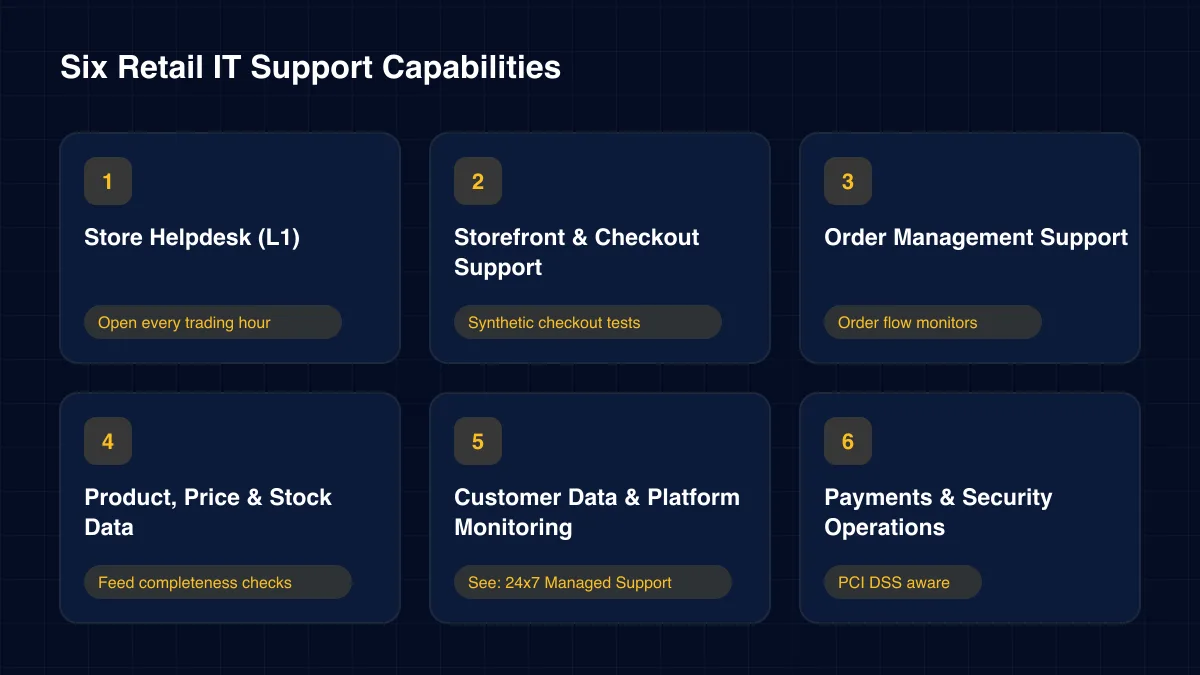
Store Helpdesk (L1)
Our L1 desk handles till faults, payment terminal pairing, handheld scanners, printers and store Wi-Fi. Store teams get retail IT support that speaks their language and fixes things fast.
Open every trading hour
Support Engineering · Retail
A 24/7 team for the systems every sale passes through: point of sale, online storefront, order management, product data, payments, loyalty and the customer data behind them.
128
Resolved today
100%
Within SLA
24/7
On shift
A frozen till on a Saturday afternoon loses sales you never get back. Retail IT support is the team that brings the lane back online while the queue is still patient.
Our team runs retail IT support as a 24/7, tiered service for store chains, online brands and omnichannel retailers. L1 engineers help store staff with tills, terminals and handhelds. L2 engineers own the storefront, order management, product data and loyalty apps. L3 engineers handle databases, cloud platforms and performance under load.
Read on for what that service covers, where retail systems usually fail, how we get you ready for peak, and what to ask any partner before you sign.
Retail IT support is the day-to-day operation of the technology that sells, fulfils and serves customers. In stores that means POS, payment terminals, handhelds and store networks. Online it means the storefront, search, checkout and the APIs behind them.
In between sit the systems that hold retail together: the order management system, product information management, inventory, pricing, loyalty and the customer data platform. A failure in any of them shows up at the till or in the basket.
Retail also has a calendar that other sectors do not. Promotions, holidays and sale events can multiply traffic in hours. Good retail IT support plans for those spikes long before they arrive.
Working definition
“Retail IT support is a tiered, always-on service that monitors and restores store, online and back-office commerce systems, with priorities set by lost sales and customer impact, and capacity planned around the trading calendar.”
Foundations
A broken checkout outranks everything. Tickets are ranked by how many sales they block right now.
Store and digital issues share one queue, because stock, price and order errors cross both.
Release freezes and extra cover are set around your promotions, not around our rota.
Recurring faults get standard playbooks, so any engineer on shift resolves them the same way.
Core capabilities
Each capability covers a point in the customer journey where a system failure costs a sale or a customer.
Our L1 desk handles till faults, payment terminal pairing, handheld scanners, printers and store Wi-Fi. Store teams get retail IT support that speaks their language and fixes things fast.
Open every trading hour
L2 and L3 engineers monitor search, basket and checkout performance. Synthetic checks buy a test product every few minutes, so a broken payment step is caught before customers report it.
Synthetic checkout tests
We support OMS routing, split shipments, click-and-collect and returns. Stuck or misrouted orders are found by monitors and fixed before promised delivery dates slip.
Order flow monitors
Retail IT support for PIM, pricing and inventory feeds keeps the catalogue accurate. Missing SKUs, wrong prices and stale stock levels are flagged and corrected quickly.
Feed completeness checks
We monitor CDP pipelines, audience syncs and campaign systems. For a Customer Data Platform client, we deployed 23+ real-time dashboards and took full ownership of L1 triage.
See: 24x7 Managed Support →SOC coverage for store and online estates, with care around the cardholder data environment. We support your PCI DSS obligations through access control, logging and change records.
PCI DSS aware
Architecture
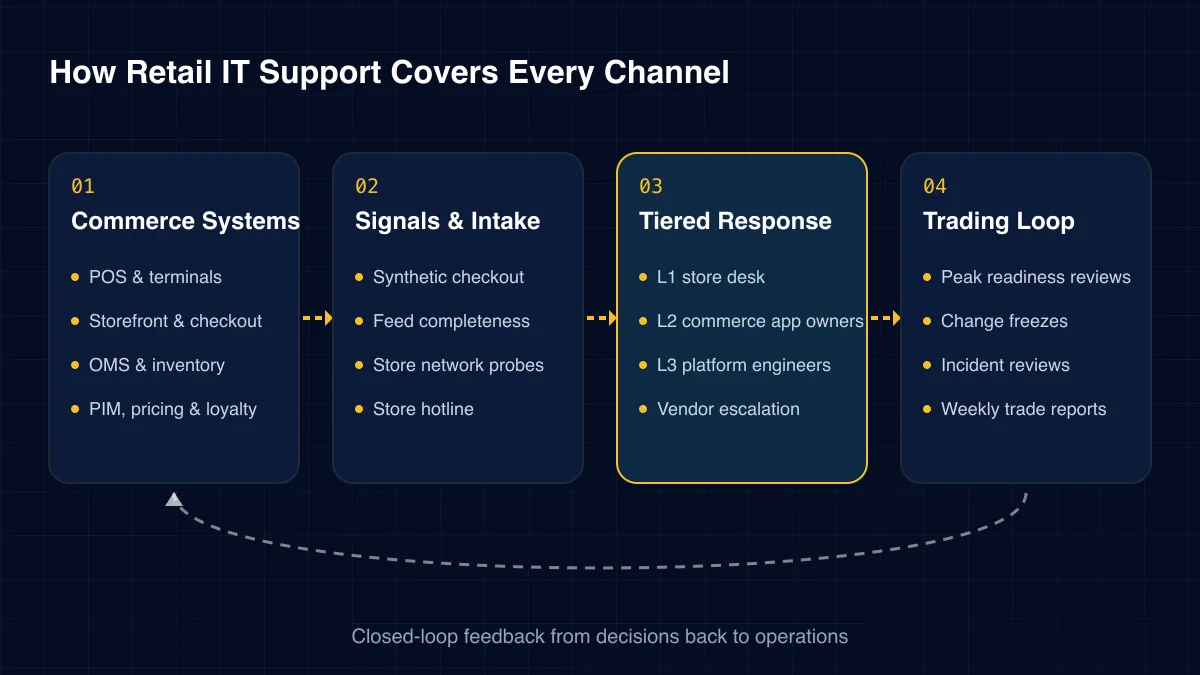
Our retail IT support model has four layers. Signals come from stores, storefronts and back-office systems, tiered engineers resolve them, and reviews stop repeats.
01
02
03
04
Challenges we solve
Most retail outages are not headline events. They are small breaks that quietly block sales across many stores or baskets.
Traffic spikes during a promotion and checkout response times climb. Customers abandon baskets before anyone sees a graph.
An overnight update fails on part of the POS estate. Stores open with lanes closed and queues building.
A PIM or pricing feed misses a batch. Shelf, till and website show different prices, and complaints follow.
Click-and-collect orders sit in the OMS without reaching a store. Customers arrive to collect nothing.
Without a support layer, product engineers triage every alert. Alert fatigue grows and roadmap work slows.
Load tests, freezes and extra cover are arranged in the last week. Gaps show up on the busiest day.
Store chains, pure-play online brands and omnichannel retailers need different mixes. Retail IT support usually starts in one of four ways.
This table compares specialist retail IT support with a general provider and an internal team alone.
| Capability | Generic MSP | In-house only | ICANIO retail support |
|---|---|---|---|
| Store and online in one queue | Partial | Partial | ✓ Yes |
| Synthetic checkout testing | No | Partial | ✓ Yes |
| OMS and PIM skills | No | ✓ Yes | ✓ Yes |
| Peak trading plans | Partial | Partial | ✓ Yes |
| 24/7 L1 alert ownership | Partial | No | ✓ Yes |
The value of retail IT support shows up in open lanes, completed baskets and calmer peak days.
Delivery
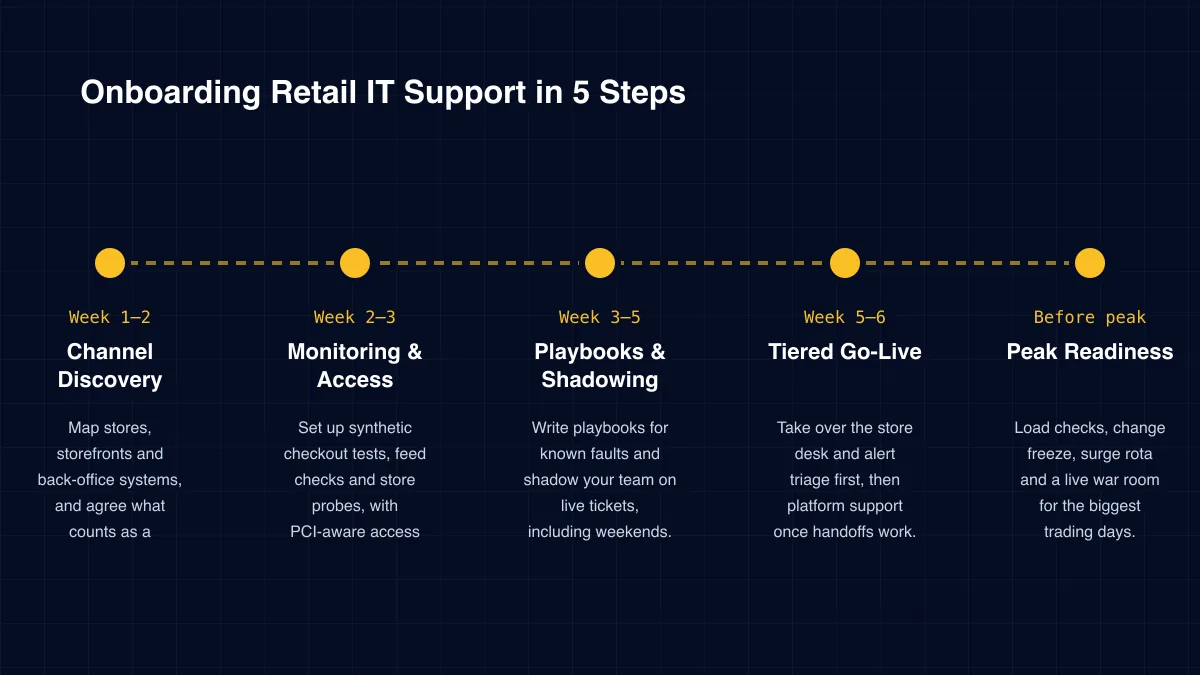
Week 1–2
Map stores, storefronts and back-office systems, and agree what counts as a sales-blocking incident.
Week 2–3
Set up synthetic checkout tests, feed checks and store probes, with PCI-aware access controls.
Week 3–5
Write playbooks for known faults and shadow your team on live tickets, including weekends.
Week 5–6
Take over the store desk and alert triage first, then platform support once handoffs work.
Before peak
Load checks, change freeze, surge rota and a live war room for the biggest trading days.
Case study
A high-growth Customer Data Platform was drowning in global alerts. Its core engineers had become the triage team, and development slowed. Our team took full ownership of L1 alert triage, deployed 23+ real-time dashboards, wrote standard playbooks and set clear escalation paths to L3. The result was zero L1 alert burden on the internal team and faster resolution through playbook triage.
“Alert fatigue in a high-growth platform is not a monitoring problem. It is a structural gap.”Read the full case study →
23+ real-time dashboards
Coverage across infrastructure and data pipeline environments.
Standard L1 runbooks
Known incident patterns resolved the same way on every shift.
L1 to L3 routing
Critical issues reach the right engineer instead of whoever is free.
Retail needs a partner who understands trading pressure. We recommend testing five things.
In our experience, peak record separates the real specialists. Retail IT support proves its value on the busiest day of the year.
ICANIO runs support under ISO 9001 and ISO 27001 certified processes. Access to commerce systems is role-based, logged and reviewed.
Retailers that handle card payments must meet PCI DSS. Our retail IT support works inside that framework. We keep engineers out of the cardholder data environment unless a ticket needs it, and every such session is logged and approved. Change records support your assessor's evidence requests.
Customer data in loyalty and CDP systems is handled on a least-privilege basis. Our SOC watches for credential stuffing, unusual admin logins and endpoint alerts across store and online estates.
Start with revenue per hour on your busiest day, online and in store. Count the minutes last year when checkout, tills or payments were down or degraded.
Then add engineering hours spent on alert triage and support instead of product work, plus the cost of price errors and failed click-and-collect orders. Those are the baselines for retail IT support. We agree them with you and report against them every month.
Technology stack
Our retail IT support team works with the platforms you already run. These are the most common groups.
Store
POS systemsPayment terminalsHandheld scannersStore networks
Digital Commerce
Headless storefrontsSearchCheckoutMobile apps
Back Office
Order managementPIMPricing enginesInventory
Customer
Customer data platformsLoyaltyCampaign toolsCustomer service desks
Monitoring
AlertmanagerSynthetic checks
Security
Endpoint protectionWAFAccess loggingPatch management
 Free white paper · Support EngineeringSupport EngineeringEnsuring Operational Excellence and Business Continuity Through Proactive, Intelligent OperationsGet the white paper →
 Free white paper · RetailRetail & E-Commerce SolutionsTransforming Modern Retail Through Technology, AI, and Digital InnovationGet the white paper →
Retail IT support covers store systems such as POS, payment terminals and handhelds. It also covers online systems such as the storefront, search and checkout, plus back-office systems like order management, PIM, pricing, inventory, loyalty and customer data platforms.
Yes, and we recommend it. Many retail incidents cross channels, such as a stock error that affects both the website and the till. One queue with shared priorities finds the cause faster.
We agree a peak plan months ahead. It covers load checks, a change freeze, extra engineers on shift and a live war room during the busiest days. After the event we review what worked and what did not.
PCI DSS compliance is your organisation's responsibility, and your assessor decides the outcome. Our support is designed to fit inside it, with controlled access to payment systems, full logging and change records you can use as evidence.
Yes. We did this for a Customer Data Platform client, taking full ownership of L1 triage with 23+ dashboards and clear escalation paths. Your engineers only see the issues that truly need them.
Most retailers reach full retail IT support in about six weeks. We start with the store desk and alert triage, then take on platform support once handoffs are proven.
Every sale passes through a chain of systems, from the product feed to the payment step. Retail IT support keeps that chain unbroken in stores, online and on the busiest days of the year.
ICANIO delivers retail IT support as a 24/7, L1–L3 service under ISO 27001 certified processes. Our work for a Customer Data Platform client shows how full L1 ownership frees engineers to build. To plan support around your trading calendar, contact our team.
By ICANIO Support Engineering Team · Published · Updated
Book a free discovery call. We will map your store and online systems, review last peak, and propose a support model sized for your trading calendar.
Contact Our Support Team
