AR MOBILE APP · COMPUTER VISION · RETAIL DATA QUALITY
Icanio built an AR computer vision shelf intelligence app for a retail field operations partner. It replaces blurry, inconsistent shelf photos with real-time capture validation.
Quick Answer
What Is AR Computer Vision Shelf Intelligence for Retail Field Teams?
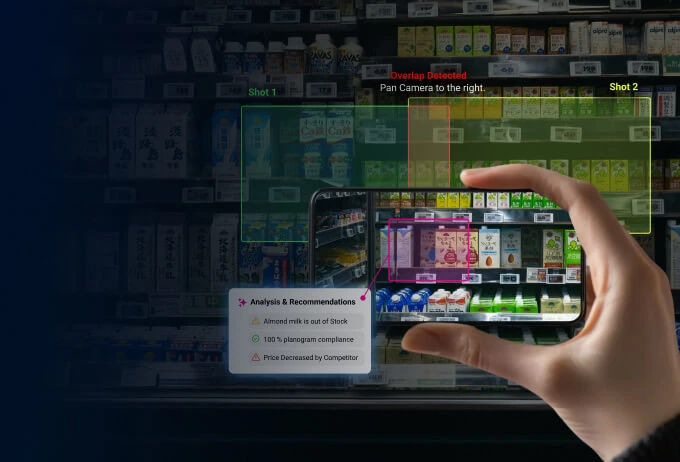
AR computer vision shelf intelligence is a mobile capture application that uses augmented reality guidance and real-time image validation to ensure field staff photograph retail shelves correctly on the first attempt. This eliminates blurry photos and reduces manual backend review. ICANIO built this AR computer vision shelf intelligence app on a reusable AR SDK for iOS and Android. It validates tilt, slant, and overlap in real time and gives field staff instant live preview feedback.
Executive Summary
Turning Inconsistent Shelf Photos Into Validated First-Try Data
Manual shelf image capture might be tolerable for a handful of stores, but it becomes a genuine liability once a retail field operations team is running audits at scale. ICANIO’s partner was facing exactly that problem: manual shelf image capture that produced blurry and unusable photos, no real-time quality validation, which led to frequent retakes, and field staff who struggled to judge correct distance and tilt without any instant feedback.
ICANIO addressed this by building a Smart AR-Guided Capture Application rather than a plain camera tool. The objective was to guide field staff through the capture process with real-time validation for tilt, slant, and overlap, configurable capture rules for custom retail quality parameters, and instant live preview feedback. All of it was built on a reusable, modular AR SDK for iOS and Android. The result was consistent, high-quality shelf images captured correctly on the first try, with eliminated retakes and reduced backend review effort.
Every one of those outcomes traces back to the same design decision: catching quality problems on the device in real time instead of discovering them after the fact during a manual backend review. As a result, field staff and the back office both spent less time on the same audit.
“A blurry shelf photo is not a minor inconvenience, it is a data point the business cannot use, discovered only after the field team has already left the store.”
The Challenge
Five Data Quality Failures in Manual Shelf Capture
The client’s field operations suffered from inefficient data collection methods during store audits. Store staff frequently submitted poor-quality media, which created significant downstream bottlenecks.
Blurry, Unusable Shelf Photos
Manual shelf image capture caused blurry and unusable photos. The backend team received media it could not actually use for analysis.
No Validation in This AR Computer Vision Shelf Intelligence
The lack of real-time quality validation led to frequent retakes. Staff had no way to know a photo failed until it reached the backend.
Delayed, Inaccurate Data Submissions
Delayed image submissions reduced retail data accuracy and timeliness. This undermined decisions that depended on current shelf conditions.
Backend Reviews Before This AR Computer Vision Shelf Intelligence
Increased manual backend reviews slowed down overall operational efficiency. This added a second bottleneck after the capture itself.
No Feedback Before This AR Computer Vision Shelf Intelligence
Field staff struggled to judge correct distance and tilt. The absence of instant feedback prolonged the store audit process for every visit.
AR Computer Vision Shelf Intelligence Solutions Provided
A Six-Part Smart AR-Guided Capture Application
Icanio Technologies built a Smart AR-Guided Capture Application, integrating mobile computer vision to ensure perfect data collection on the very first try. The solutions included:
Cross-Platform AR-Guided Capture App
Developed an AR-guided cross-platform mobile app for accurate capture, giving field staff the same guided experience on iOS and Android.
Real-Time Tilt, Slant, and Overlap Validation
Implemented real-time validation for tilt, slant, and overlap issues, catching quality problems before the staff member leaves the shelf.
Capture Rules in This AR Computer Vision Shelf Intelligence
Enabled configurable capture rules for custom retail quality parameters, letting the platform adapt to different clients’ data standards.
Modular SDK in This AR Computer Vision Shelf Intelligence
Built a reusable, modular AR SDK for iOS and Android, so future field applications can reuse the same validated capture engine.
Live Feedback in This AR Computer Vision Shelf Intelligence
Provided instant live preview feedback to guide store staff, replacing guesswork with a clear signal of when a shot is correct.
Dedup in This AR Computer Vision Shelf Intelligence
Integrated real-time checks to prevent duplicate image submissions completely, keeping the backend dataset clean without manual dedup.
Business Outcomes
Measurable Results Across Data Quality, Speed, and Reusability
This AR computer vision shelf intelligence app delivered outcomes across every dimension of the client’s original data quality gap. It converted inconsistent, retake-heavy manual capture into a validated, first-try process. That process moves faster and scales to future field applications.
Consistent High Quality
Usable shelf images on the first capture
Eliminated Retakes
Manual staff image retakes on the floor
Reduced Backend Review
Manual data review and quality control effort
Faster Turnaround
For image submission and retail data processing
Scalable Technology Foundation
Supporting future retail and field applications
Reusable AR SDK
Integrated seamlessly across internal field scenarios
Key learnings
What This Engagement Proves for Field Data Collection Apps
This AR Computer Vision Shelf Intelligence Validates Early
The real cost of poor shelf photos was not the retake itself. It was the delay between capture and discovering the photo failed. Moving tilt, slant, and overlap validation onto the device in real time is what eliminated that delay entirely, instead of just making the backend review faster.
A Reusable AR SDK Pays Off Beyond the First Use Case
Building a modular AR SDK for iOS and Android rather than a one-off feature meant the same validated capture engine could be reused across other internal field scenarios, turning a single-purpose app into a scalable technology foundation.
This AR Computer Vision Shelf Intelligence Uses Configurable Rules
Different retail clients and product categories need different quality parameters. Making capture rules configurable, rather than hardcoding one quality bar, is what let the same AR computer vision shelf intelligence app adapt to multiple use cases without a rebuild.
Conclusion
From Blurry Manual Photos to Validated First-Try Capture
Manual shelf image capture might have been workable for occasional spot checks. But for a retail field operations team running audits at scale, blurry photos and slow backend review had become the primary constraint on data quality. This engagement demonstrates that a single AR computer vision shelf intelligence app can resolve capture quality, speed, and reusability gaps within one structured programme rather than three separate initiatives.
By validating tilt, slant, and overlap in real time, giving field staff instant live preview feedback, and building a reusable, modular AR SDK for iOS and Android, ICANIO helped this partner achieve consistent, high-quality shelf images on the first try, eliminate unnecessary retakes, and reduce manual backend review effort. The configurable capture rules, real-time validation, and reusable AR SDK delivered through this engagement are the foundation every future field data collection app this team builds will run on.
Related Resources
This AR computer vision shelf intelligence app reflects ICANIO's mobile software development work. Our team builds capture and field apps through application development services. Vision and machine learning needs fit our data and artificial intelligence services. Retailers can explore our retail and ecommerce solutions. We also help field teams add automation to data quality checks. To discuss a similar app, contact ICANIO.
- Application Development Services
- Retail and Ecommerce Solutions
- Proven Online Food Ordering Platform in 2026
- AI Defect Detection: 5X ROI, Zero Downtime 2026
References
- Augmented reality: Wikipedia overview of overlaying digital guidance on the real world.
- Computer vision: Wikipedia overview of software that interprets images.
- ARKit: Apple documentation for augmented reality on iOS.
- ARCore: Google documentation for augmented reality on Android.
Frequently asked questions
Common Questions About This AR Computer Vision Shelf Intelligence App
What is AR computer vision shelf intelligence for retail?
AR computer vision shelf intelligence uses augmented reality guidance and real-time image validation to ensure field staff capture usable shelf photos on the first attempt. Retail field data needs it because blurry, inconsistent photos create downstream bottlenecks in data accuracy and manual review.
How does real-time tilt and slant validation reduce photo retakes?
Real-time validation for tilt, slant, and overlap issues flags a bad angle or framing the moment it happens, so field staff can correct and recapture immediately instead of learning about the problem after the photo reaches the backend.
Why build a reusable AR SDK instead of a single-purpose capture app?
A reusable, modular AR SDK for iOS and Android lets the same validated capture engine support other internal field scenarios beyond shelf audits, turning a one-off feature into a scalable technology foundation.
What do configurable capture rules let retail clients customize?
Configurable capture rules let the platform apply custom retail quality parameters per client or product category, rather than enforcing one fixed quality bar across every use case.
How does instant live preview feedback help store staff?
Instant live preview feedback shows field staff in real time whether a shot meets quality requirements, replacing guesswork about distance and tilt with a clear, immediate signal.
How does this app prevent duplicate shelf image submissions?
Real-time checks integrated into the capture flow detect and prevent duplicate image submissions completely, keeping the backend dataset clean without requiring manual deduplication.