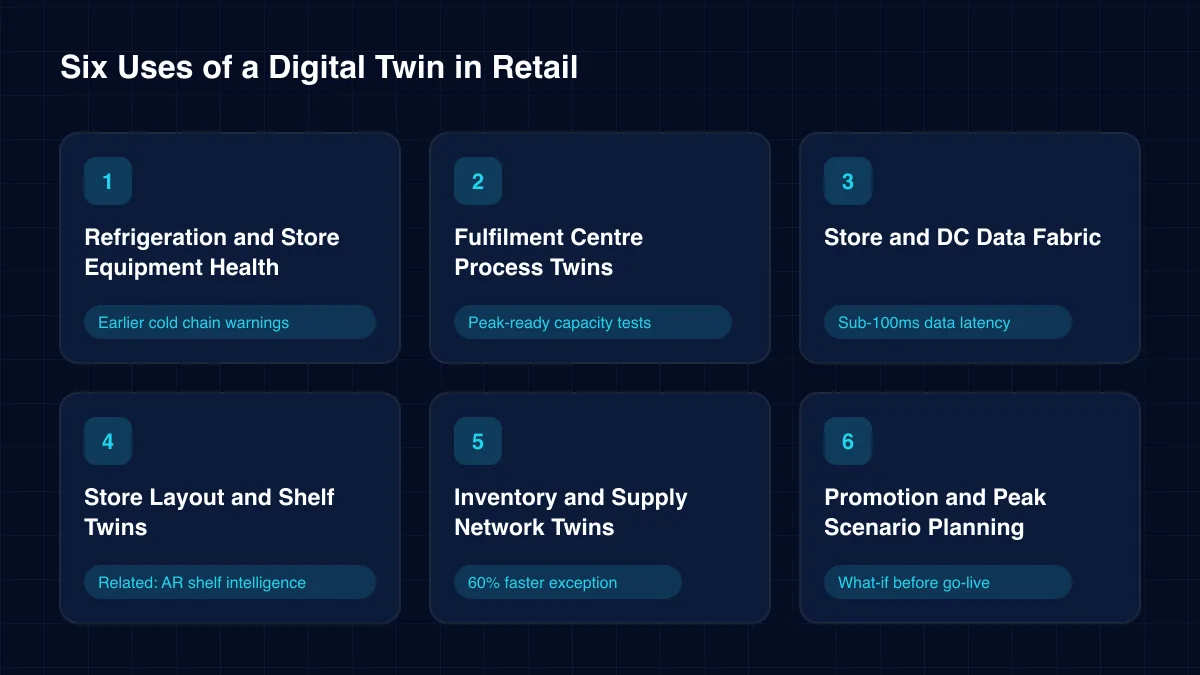
Refrigeration and Store Equipment Health
A digital twin in retail tracks chillers, freezers and HVAC against their expected behaviour. It spots a failing case from rising compressor effort before food goes out of range.
Earlier cold chain warnings
Digital Twin for Retail & E-Commerce
We build a digital twin in retail that mirrors your stores, shelves and fulfilment centres in real time. It joins POS, OMS and WMS data so you can test layouts and peak plans before customers feel them.
Dairy Chiller Case C-14
Store 208 · Aisle 3
Remaining life
212 days
Case temp
3.5°C
Compressor duty
52%
Defrost cycles
4/day
✓ All signals within physics baseline
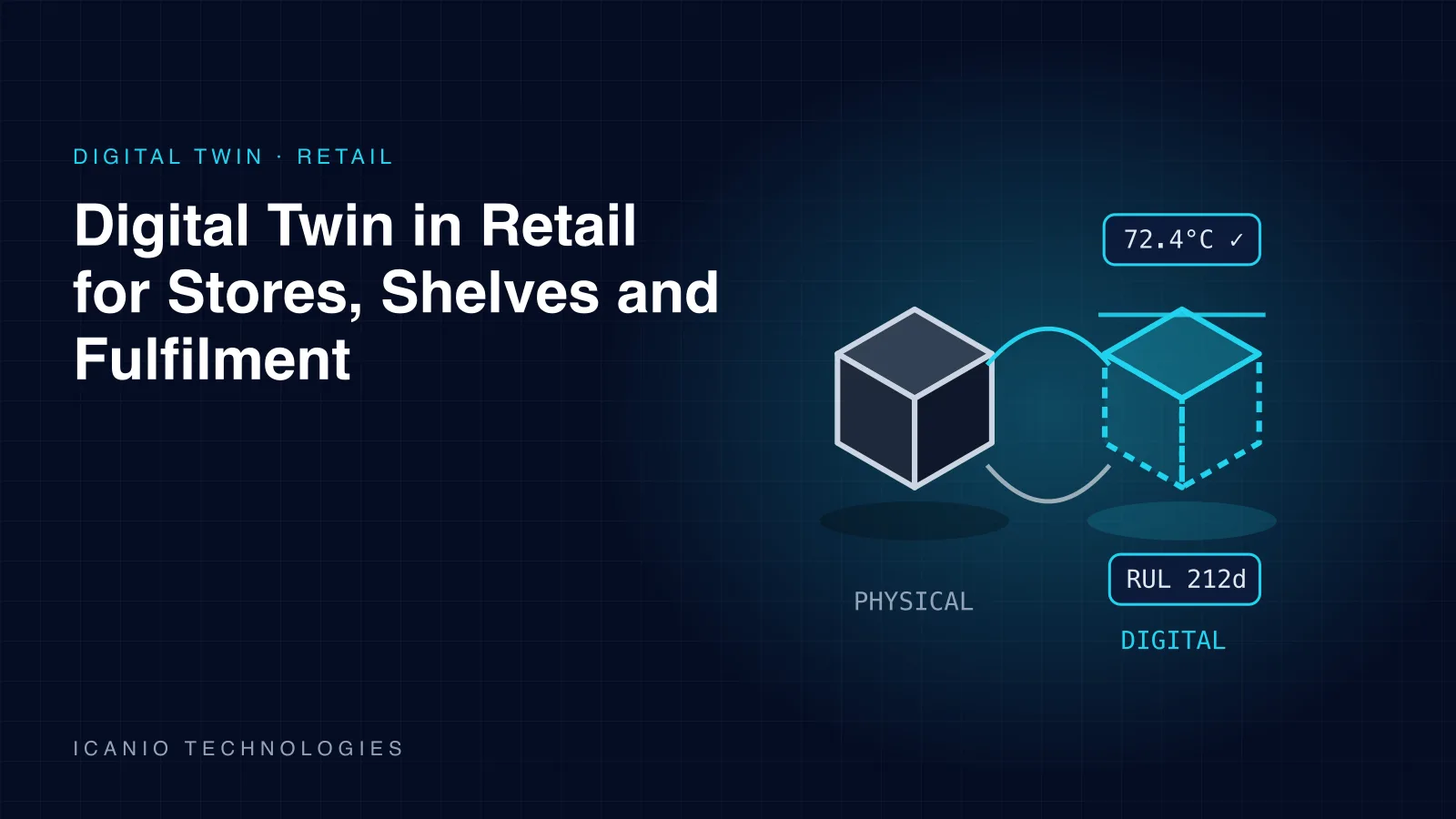
A digital twin in retail is a live model of the physical side of commerce: stores, shelves, refrigeration, fulfilment centres and the network that feeds them. It updates from POS, inventory and equipment data as the trading day unfolds.
Retailers are rich in data but poor in joined-up views. Sales live in POS, orders in the OMS, stock in the WMS and chiller alarms in a facilities portal. A shelf gap, a jammed pick zone or a failing freezer is usually spotted by a customer first.
Our team connects those sources into one digital twin in retail, then adds simulation and predictive AI. The twin shows where stock is really sitting, warns of equipment faults and lets you test a layout, promotion or peak plan before go-live.
A digital twin in retail is a virtual replica of a store, a fulfilment site or a supply network that stays synchronised with reality. Sales, scans, stock movements and sensor readings stream in continuously. The model reflects what is on the shelf and in the tote right now.
It works at three levels. A store twin models layout, shelves, footfall and refrigeration. A fulfilment twin models pick zones, conveyors, packing and carrier cut-offs. A network twin links suppliers, distribution centres and stores so planners can see how one delay spreads.
A planogram shows how a shelf should look. A demand forecast shows what should sell. A digital twin in retail compares both with what is actually happening, then points to the gap.
Retail operations definition
“A retail digital twin is a continuously updated virtual model of stores, fulfilment sites and supply flows. It fuses POS, OMS, WMS and equipment data with simulation and AI to predict problems and test changes safely.”
Foundations
POS sales, OMS orders, WMS movements and RFID or barcode scans show where every unit is. We read them through existing APIs and exports.
Floor plans, planograms and fixture maps give the twin its shape. They let it place each signal on a specific bay, aisle or pick face.
Flow models describe how shoppers and orders move. Demand and equipment models describe what should happen next, so drift stands out.
Insights become replenishment tasks, facilities tickets or wave changes. Store and warehouse managers approve them, so local judgement stays in charge.
Core capabilities
These are the places where a digital twin in retail pays back fastest. Most retailers start with one format or one fulfilment site, then scale.
A digital twin in retail tracks chillers, freezers and HVAC against their expected behaviour. It spots a failing case from rising compressor effort before food goes out of range.
Earlier cold chain warnings
Model pick zones, conveyors, packing stations and carrier cut-offs in one view. Test slotting and labour plans on the twin before peak season.
Peak-ready capacity tests
Unify POS, OMS, WMS, RFID reads and equipment sensors into one real-time stream. Store-level edge buffering keeps data flowing when the link drops.
Sub-100ms data latency
A spatial model of the store maps sales, gaps and footfall to each bay. Merchandisers test a new layout or promotion zone before refitting a single store.
Related: AR shelf intelligence →Mirror stock across suppliers, distribution centres, stores and dark stores. See how a late inbound container affects availability and online promises.
60% faster exception resolution
Run a promotion or holiday peak through the twin before launch. It shows where stock, labour or delivery capacity will run short first.
What-if before go-live →Architecture
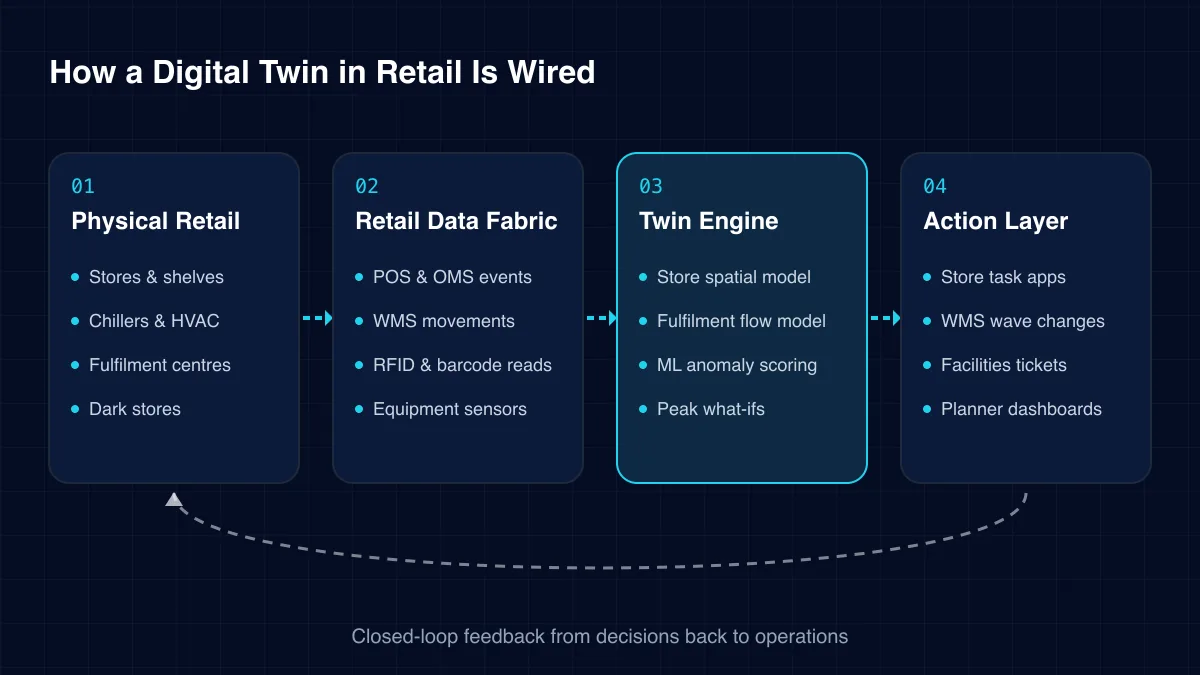
Every digital twin in retail we build follows four layers. Trading and equipment data rises into the model, and tasks flow back to stores and sites.
01
02
03
04
Challenges we solve
These are the issues we hear most from store operations and fulfilment leaders. Each one comes from data that exists in separate systems but is never joined.
Systems say the product is in store, but the shelf is empty. Sales are lost while the item sits in the backroom.
A chiller that slowly loses capacity can hold temperature on a quiet day. On a busy one, stock is binned and the case closes.
Online orders miss the evening collection when a pick zone falls behind. Delivery promises break and support contacts rise.
Each system tells part of the story. Teams reconcile exports instead of fixing the problem while it is still small.
New layouts are usually trialled in live stores. If the change hurts sales, the cost has already been paid.
Holiday peaks and promotions stress stock, labour and delivery at once. Spreadsheets cannot show how those limits interact.
Scope grows in stages. We usually start with one site or asset class and widen once the model earns trust.
Retailers often ask why they need a digital twin in retail when they already have BI reports and planogram software. The table shows the difference.
| Capability | BI reports | Planogram tool | Retail digital twin |
|---|---|---|---|
| Live store and DC data | Partial | No | ✓ Yes |
| Predicts equipment faults | No | No | ✓ Yes |
| Tests layouts before refit | No | Partial | ✓ Yes |
| Joins POS, OMS and WMS | Partial | No | ✓ Yes |
| Simulates peak demand | No | No | ✓ Yes |
The value of a digital twin in retail compounds as more stores, sites and suppliers join the model.
Delivery
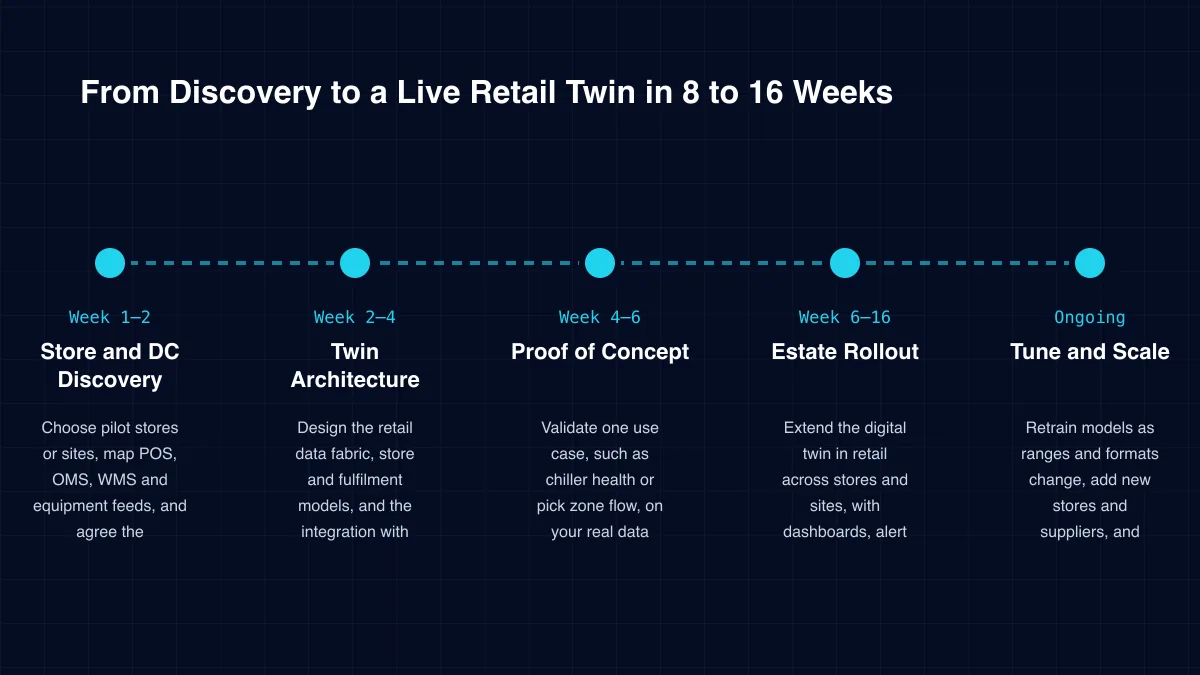
Week 1–2
Choose pilot stores or sites, map POS, OMS, WMS and equipment feeds, and agree the availability and waste baseline.
Week 2–4
Design the retail data fabric, store and fulfilment models, and the integration with store task and WMS tools.
Week 4–6
Validate one use case, such as chiller health or pick zone flow, on your real data before a full build.
Week 6–16
Extend the digital twin in retail across stores and sites, with dashboards, alert rules and task write-back.
Ongoing
Retrain models as ranges and formats change, add new stores and suppliers, and support teams under an SLA.
Many vendors can render a 3D store. Far fewer can keep a digital twin in retail accurate across hundreds of sites and a changing range. We recommend checking five things.
We have found that store adoption decides value. That is why every alert we design ends in one clear task for one named team.
A digital twin in retail needs sales patterns, not card data. We keep payment data out of the twin entirely, so it stays within your PCI DSS scope boundary. All work follows ISO 9001 and ISO 27001 certified processes.
Footfall models use aggregated counts rather than identifiable video where possible. Data stays in your cloud tenancy, access is role-based and every model decision is logged. GDPR and local privacy rules are reviewed during discovery.
Start with the sales lost to shelf gaps and the stock binned after refrigeration failures last year. Add the cost of missed carrier cut-offs. Together they set the ceiling your digital twin in retail works against.
Then add avoided refit mistakes, lower emergency call-outs and better labour use at peak. We agree these baselines in discovery, so results are measured against your own trading figures.
Technology stack
We choose tools per estate. These are the layers we most often assemble for a digital twin in retail.
Store & Site Data
POSRFID & barcodeRefrigeration controllersBMS
Commerce Systems
OMSWMSPIMPlanogram tools
Data Fabric
Real-time streamingTime-series storageStore edge buffering
Simulation & AI
Discrete-event flow modelsXGBoostDemand forecastingMLOps retraining
3D & Visualisation
Store mapsPlanner dashboards
Enterprise Integration
Microsoft DynamicsStore task apps
 Free white paper · Digital TwinThe Industrial Digital Twin PlaybookA practical, vendor-neutral guide to taking an industrial digital twin from first idea to a production system your operators trust.Get the white paper →
 Free white paper · RetailRetail & E-Commerce SolutionsTransforming Modern Retail Through Technology, AI, and Digital InnovationGet the white paper →
It monitors what your stores and sites already record: sales, stock movements, RFID reads, refrigeration and HVAC data, and fulfilment events. A digital twin in retail compares them with expected behaviour to find gaps early.
No. Many retailers start with POS, WMS and equipment data alone. Discovery shows where shelf images or RFID would sharpen the model. We add them only where they pay back.
Yes. The store twin simulates how shoppers and replenishment move through a new layout. Merchandisers compare options before a refit.
The twin uses aggregated sales and footfall, not personal or payment data. Card data stays in your PCI DSS environment and never enters the model.
It reads from POS, OMS, WMS, PIM and facilities systems, and writes tasks back to store apps and the WMS. Custom APIs are scoped for in-house platforms.
Most projects reach production in eight to sixteen weeks. A proof of concept on one store format or site runs in weeks four to six, using your real data.
A digital twin in retail turns scattered trading and equipment data into foresight. It shows where shelves are empty, which chiller is failing and where the next peak will break first.
ICANIO combines retail system integration, simulation and predictive AI in one delivery team. We take a digital twin in retail from discovery to production in eight to sixteen weeks, then keep it accurate as your range and estate change.
By ICANIO Digital Twin Engineering Team · Published · Updated
Book a free 30-minute discovery call with our digital twin engineers. We will map your stores, sites and data feeds to a scoped twin with clear milestones. Contact us to get started.
Contact Our Digital Twin Team