
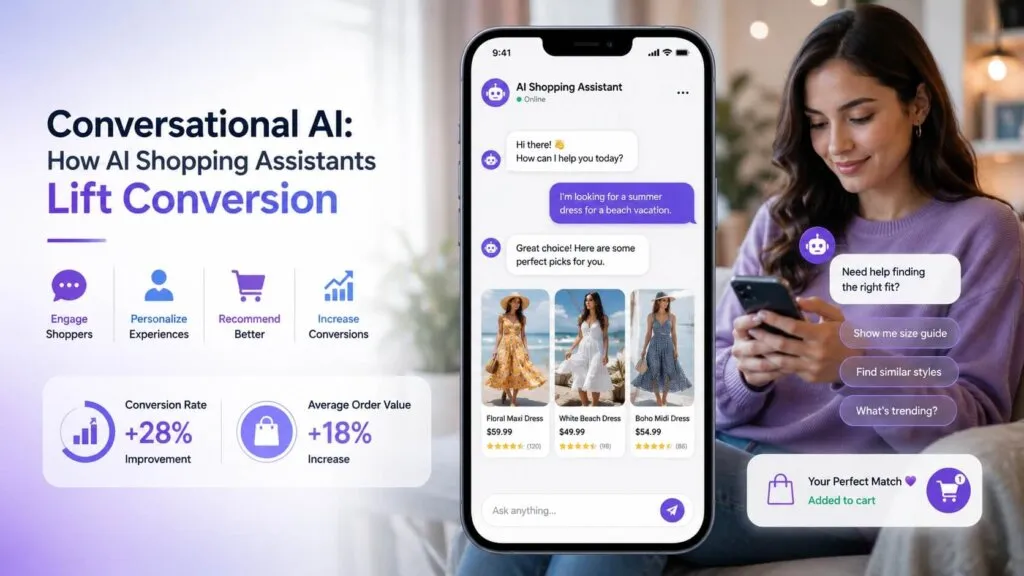
Conversational AI has become one of the more consequential shifts in how online retailers turn browsers into buyers. A traditional storefront relies on search bars, filters and static product pages to guide a shopper. Conversational AI replaces that structure with something closer to a knowledgeable store associate. It asks clarifying questions, narrows options based on stated preferences and addresses hesitation in real time.
Interest in this shift is no longer speculative. Retailers and AI vendors increasingly report that shoppers who engage with an assistant convert better than those who browse alone. The size of that lift varies widely by retailer, category and implementation quality, so treat any headline figure as a hypothesis to test on your own traffic. What is consistent is the mechanism, and that is what this guide explains.
Key Takeaways
- Conversational AI shifts the work of translating vague needs into product matches from the shopper to the system.
- An AI shopping assistant that can take actions is different from a scripted FAQ chatbot.
- Grounding in live product, pricing and inventory data is the biggest technical success factor.
- Measure conversion alongside order value, satisfaction and repeat purchases.
- Pilot results often shrink at scale, so validate them with controlled tests.
- Integration depth and ongoing monitoring sustain gains more than the chat interface itself.
Why Conversational AI Outperforms Traditional Browsing
The core mechanism is simple once separated from the hype. Traditional navigation asks the shopper to do the thinking. They must translate a vague need, such as "something for a beach trip", into the right search terms and filters. Conversational AI inverts that burden.
The shopper states intent in natural language. The system, powered by natural language processing, turns it into product matches, available stock and relevant promotions. The shopper never has to learn the catalogue's structure.
Where Browsing Breaks Down
This matters most at the moments traditional ecommerce handles worst. There are three:
- Ambiguous intent, when the shopper is not sure what they need.
- Comparison paralysis, when too many similar options appear.
- Last-minute hesitation, just before checkout.
A shopper unsure whether a product suits their skin type, use case or gift recipient often gets stuck in a grid of results. A well-designed AI shopping assistant can resolve that with a short, targeted conversation.
What Is Conversational AI in Retail?
In retail, conversational AI means software that talks with shoppers in natural language through chat or voice and helps them find, compare and buy products. It ranges from simple rule-based chatbots to assistants built on large language models that reason across a conversation. The broader trend of buying through messaging and chat is known as conversational commerce.
The distinction between these levels matters. Expecting assistant-level results from a basic bot is one of the most common reasons projects disappoint.
AI Shopping Assistant Versus a Scripted Chatbot
Many retailers already run an AI chatbot for ecommerce. It is usually rule-based and answers a fixed set of questions about shipping, returns or order status. That is useful. Yet it is not what drives the conversion gains retailers are now chasing.
Treating the two as the same technology leads to disappointment. A basic bot cannot produce the outcomes of a true AI shopping assistant. The table below shows the differences.
| Capability | Scripted chatbot | AI shopping assistant |
|---|---|---|
| Understanding | Keywords, menus | Free-form intent |
| Product data | Static FAQ | Live catalogue |
| Actions | Show links | Apply promos, start returns |
| Memory | Single message | Multi-turn context |
| Handoff | Generic | Context passed to agent |
Autonomy Is the Real Differentiator
A genuine AI shopping assistant can take action, not just answer questions. It can query live inventory, apply an eligible promotion and narrow a catalogue across a multi-turn conversation. In advanced deployments it can complete a purchase or start a return without sending the shopper elsewhere. A scripted chatbot mostly retrieves and displays information. It does not reason through the shopper's constraints.
Grounding in Real Product and Inventory Data
The biggest technical difference between conversational AI that lifts conversion and one that erodes trust is grounding. Are recommendations tied to live, accurate product and inventory data? Or is the assistant generating plausible suggestions that are out of stock, mispriced or irrelevant?
Our Data and AI services and application development teams work together on exactly this problem. They connect conversational AI directly to product information, inventory and pricing systems. A static knowledge base drifts out of sync with reality. Techniques like retrieval augmented generation keep answers anchored to real data.
Five Best Practices for Conversational AI in Retail
Our team recommends five practices for any retail conversational AI project. They come from integration work, not from the chat interface alone:
- Ground every answer in live catalogue, price and stock data.
- Give the assistant clear, safe actions it can take.
- Design a graceful human handoff with full context.
- Keep context consistent across web, app and messaging.
- Measure a balanced set of metrics and keep improving.
Each practice is explained in the sections that follow. Together they turn a demo into a durable channel.
Conversational AI and Retail Conversion Rate Optimization
Retail conversion rate optimization has traditionally focused on page-level changes. Button placement, checkout simplification, page speed and A/B tests on layouts all aim to squeeze gains from a fixed experience. Conversational AI is a different category. It does not tune a fixed page. It replaces rigid structure with an adaptive interaction for each shopper.
This matters when deciding where to spend optimization budget. Classic page tests usually produce incremental improvements and are bounded by the page's structure. A well-grounded assistant can remove the structural bottleneck rather than tuning around it. That is why many retailers now test it alongside traditional retail conversion rate optimization work.
Measuring Impact Beyond the Headline Number
A thorough evaluation of conversational AI looks past topline conversion. That single number can hide where value comes from. Average order value often moves too. An assistant that suggests genuinely relevant add-ons can grow baskets in ways a static "customers also bought" widget rarely matches.
Customer satisfaction and repeat purchase rate deserve equal attention. An assistant that converts in the moment but leaves shoppers feeling pressured can damage brand trust. Our team tracks a broader set of metrics together:
| Metric | What it reveals | Watch for |
|---|---|---|
| Conversion rate | Purchase lift | Selection bias in pilots |
| Average order value | Basket growth | Pushy upselling |
| Containment rate | Self-service share | Hidden frustration |
| Satisfaction score | Experience quality | Low response rates |
| Repeat purchase | Long-term trust | Slow to measure |
Implementation Considerations Retailers Underestimate
Beyond integration, a few operational factors decide whether conversational AI becomes a durable channel or quietly fades after launch.
Multi-Channel Consistency
Shoppers move between website, mobile app and messaging apps within one journey. An assistant that loses context or behaves differently across channels undermines its own value. Cross-channel continuity needs early architectural decisions. It is hard to retrofit once channel-specific builds have diverged. Our article on progressive web app development covers related front-end choices.
Handling Edge Cases Pilots Rarely Test
Real shoppers ask things pilot scripts never anticipated. Ambiguous comparisons, multilingual queries and requests the catalogue cannot satisfy all appear. Production conversational AI needs a tested approach for these. That includes knowing when to hand off to a human rather than giving a confident but unhelpful answer.
Accessibility and Trust
Chat widgets must work with screen readers and keyboards. Following the W3C Web Content Accessibility Guidelines protects shoppers and reduces legal risk. Security matters too. The OWASP Top 10 for LLM Applications covers risks such as prompt injection and data leakage that apply to any LLM-based assistant.
Where Conversational Commerce Moves the Needle
Conversational commerce tends to deliver most in a few specific moments of the journey. It is not equally valuable everywhere.
Pre-Purchase Discovery and Recommendation
Shoppers arriving with vague intent benefit most from an interface that asks a few questions and narrows to a confident recommendation. An overwhelming product grid does the opposite. Personalization compounds value here. An assistant that keeps context across a session, and ideally across visits, gives better recommendations the more a shopper uses it.
Cart Abandonment Recovery
Cart abandonment remains a persistent, expensive retail problem. Conversational AI approaches it differently from the retargeting email playbook. A generic discount sent hours later arrives after the shopper has gone. An assistant can step in at the moment of hesitation instead. It can address the actual friction, such as sizing, shipping cost or return policy, while intent is still present.
Post-Purchase Engagement and Loyalty
Value does not end at checkout. The same interface can handle order tracking, product guidance and helpful follow-up. Disconnected post-purchase touchpoints become a continuous relationship that supports repeat purchases.
Returns and exchanges are a good example. A shopper who wants a different size should not have to search a help centre, fill in a form and wait for an email. A well-integrated assistant can check the order, confirm the return policy and offer an exchange in one conversation. Our team recommends starting with read-only post-purchase tasks, such as order status, before allowing the assistant to change orders. That sequence builds trust with shoppers and with internal teams. It also gives you clean data on which questions customers ask most after they buy, which often reveals product page gaps worth fixing at the source.
Why Some Early Conversational AI Gains Do Not Hold
Not every reported uplift survives the move from pilot to full deployment. Leaders deserve a more honest picture than headline numbers.
Early pilots often attract curious, self-selected shoppers. That inflates engagement and conversion compared with what happens once the assistant is a normal part of the experience for everyone. Pilots also often launch in a narrow, curated category. Grounding is easier there than across a full, messy catalogue with many suppliers and inventory systems.
Retailers that scale successfully treat pilot results as a hypothesis. They validate them with controlled tests at scale, not assume they will repeat. Holdout groups, where some shoppers do not see the assistant, give the clearest read on real impact.
Building Conversational AI That Sustains Gains
Our approach treats integration depth, not the chat interface, as the hard problem. Natural language understanding is now widely available from credible vendors. What separates a lasting deployment from a fading one is how deeply it connects to the systems that run the business.
That means real-time inventory sync rather than batch updates. It means pricing and promotion logic that stays accurate as campaigns change. And it means a feedback loop where the model improves based on what actually helps shoppers. Our MLOps practice supports this cycle with continuous monitoring, because recommendation quality against live data can drift. Cloud infrastructure and DevOps automation keep the assistant fast and available during traffic peaks.
Where ICANIO Fits in Retail Conversational AI Projects
ICANIO retail engagements usually start with a focused assessment. We identify where conversational AI would remove the most friction in a specific shopping journey. We then validate impact in a contained scope before expanding to the full catalogue and more autonomous actions, such as applying promotions or starting returns.
A conversational assistant that lifts retail conversion is fundamentally an integration and data engineering project with a chat interface on top. Our retail and ecommerce industry solutions team brings data, application, cloud and MLOps skills together for that reason. For a broader view, see our overview of gen AI use cases and our article on ecommerce platform development.
Conclusion
Conversational AI helps retailers by moving the hard work of finding the right product from the shopper to the system. The gains come from grounding in live data, safe autonomous actions, smooth handoffs and consistent experiences across channels.
Treat pilot results as a starting point, measure a balanced set of metrics, and invest in integration and monitoring. Discovery, cart recovery and post-purchase support work best as one continuous experience.
If you are exploring an AI shopping assistant for your store, contact ICANIO to talk through your journey and data with our team.
References
- Natural language processing, Wikipedia
- Chatbot, Wikipedia
- Conversational commerce, Wikipedia
- W3C Web Content Accessibility Guidelines (WCAG)
- OWASP Top 10 for LLM Applications
Frequently asked questions
How much can conversational AI lift conversion rates?
Results vary widely by retailer, category and how deeply the assistant connects to live product and inventory data. Some retailers and vendors report strong lifts for shoppers who engage with an assistant, but pilots can overstate impact. The reliable approach is a controlled test with a holdout group on your own traffic, measuring conversion alongside order value and satisfaction.
How does a chatbot differ from an AI shopping assistant?
A scripted chatbot usually matches keywords and returns pre-written answers about topics like shipping or returns. An AI shopping assistant understands free-form intent, keeps context across a conversation, queries live inventory and can take actions such as applying a promotion or starting a return. That difference in capability is why outcomes differ so much between the two.
Why do some AI shopping assistant pilots underperform at scale?
Pilots often attract curious early adopters and cover a narrow, curated catalogue. Both make results look better than they will once every shopper sees the assistant and it must handle the full, messier inventory. Grounding, edge cases and integration all get harder at scale. Validating pilot results with controlled tests avoids unpleasant surprises later.
Does conversational commerce help with cart abandonment?
It can. Instead of a delayed retargeting email, conversational AI can step in at the moment a shopper hesitates and address the specific concern, such as sizing, shipping cost or return policy. Because the shopper is still on the site with intent, a helpful answer at that moment can resolve the doubt. Results should still be measured with proper tests.
What makes an AI chatbot for ecommerce sustainable long term?
Deep integration with real-time inventory, pricing and order systems matters most, along with ongoing monitoring and improvement. The chat interface itself is now broadly similar across credible vendors. Clear ownership, balanced metrics, accessible design and security controls keep the assistant trustworthy as the catalogue, campaigns and customer expectations change over time.
When should conversational AI hand off to a human?
Hand off when the assistant is unsure, when the request falls outside the catalogue or policy, when the shopper is frustrated, or when the issue involves payment disputes or sensitive personal matters. The handoff should pass the full conversation context so the shopper does not repeat themselves. A smooth handoff protects trust better than a confident but wrong answer.