
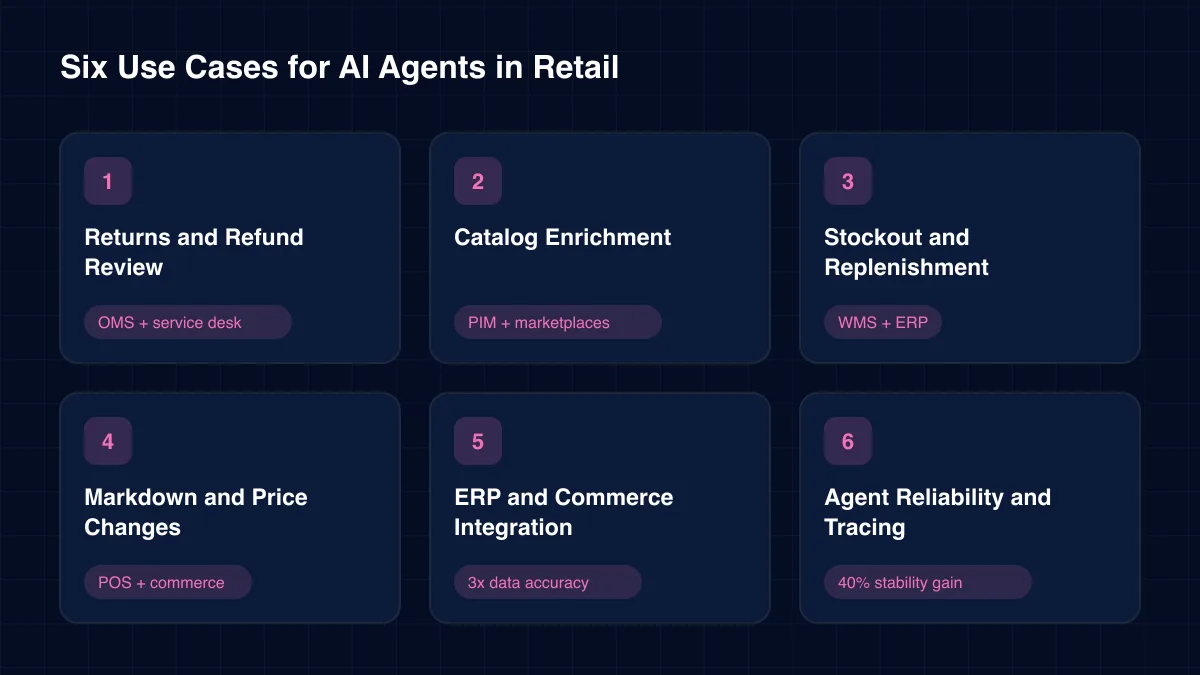
Returns and Refund Review
Agents check each return against delivery data, history and policy. Routine cases get a drafted approval. Unusual ones go to a service lead with the evidence.
OMS + service desk
AgenticOps · Retail & E-Commerce
We build and run multi-agent systems across your POS, OMS, PIM, WMS and ERP. Agents check returns, enrich listings, spot stockouts and model markdowns. Merchants, buyers and service leads approve anything that moves money, price or brand content.
⟳ Orchestrating agents…
every step traced · guardrails on · reversible
AI agents in retail are software workers that read orders, stock, catalog and customer data, then prepare the next action. They connect what the POS, OMS, PIM and WMS each know on their own. Then a merchant or service lead approves a ready decision instead of reconciling four screens.
Retail teams run on thin margins and constant change. New SKUs arrive daily, returns spike after every promotion and stock drifts between stores and warehouses. Each of those moments needs lookups, checks and a decision.
Our team builds AI agents in retail that take on the lookups and checks. People keep the decisions that move money, price or brand content. The rest of this page shows how we design those systems, where they pay back and how to start.
An AI agent is a program that works toward a goal by planning steps, calling tools and checking the result. In retail, the tools are your commerce platform, OMS, PIM, POS, WMS, ERP and customer service desk.
AI agents in retail differ from a shopping chatbot. A chatbot talks to customers. An agent does back-office work, such as checking a return against order history and policy. It then hands the case to a person with a recommendation.
Several agents usually share one job. One reads the order, one checks risk, one knows the policy and one drafts the reply. AgenticOps keeps that team observable and bounded, even on Black Friday volumes.
Commerce definition
“AI agents in retail are governed software agents that watch order, inventory, catalog and service events, reason across POS, OMS, PIM and ERP data, and prepare actions that a merchant or service lead approves.”
Foundations
Refunds, prices and purchase orders stay with people. AI agents in retail prepare the case and the numbers behind it.
Agents read POS, OMS and WMS together, so a return or stock question is answered from the full record.
Content agents follow your tone, banned claims and legal rules. A category manager approves before anything goes live.
Promotions and holidays multiply volume. Orchestration is load-tested and falls back to human queues if it strains.
Core capabilities
These are the workflows where AI agents in retail usually pay off first. Each one keeps a named approver at the risk point.
Agents check each return against delivery data, history and policy. Routine cases get a drafted approval. Unusual ones go to a service lead with the evidence.
OMS + service desk
AI agents in retail validate supplier feeds, fill missing attributes and draft on-brand copy in the PIM. Category managers approve before listings publish.
PIM + marketplaces
Agents spot SKUs heading for stockout, check transfers between stores and draft purchase orders. Buyers approve spend and vendor choice.
WMS + ERP
Agents model markdown depths against sell-through and margin rules. Merchandisers approve, and agents push the same price to POS and online.
POS + commerce
Agents need clean, synced data. Our retail ERP integration automation build delivered 50% faster workflows and 3x data accuracy.
3x data accuracy →We trace every tool call, recover from platform API limits and keep agents consistent at peak. Our agentic AI framework work improved stability 40%.
40% stability gain →Architecture
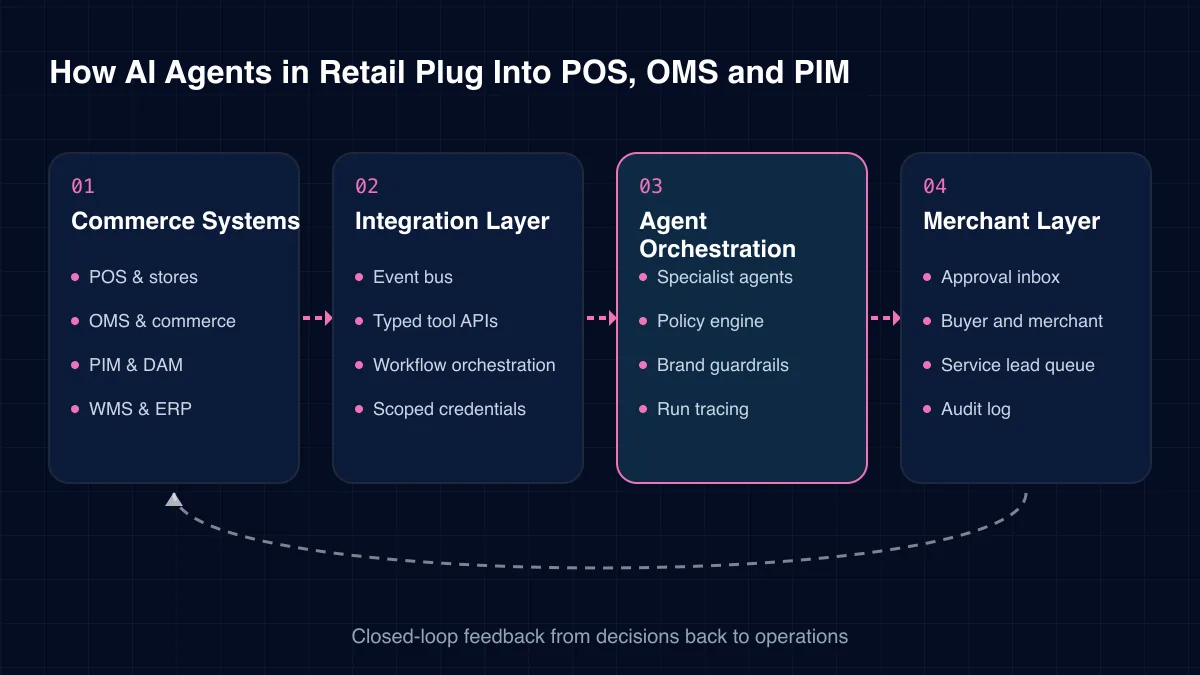
Agents sit above your commerce and store systems. Events flow up from orders, stock and feeds, and approved actions flow back through the same APIs.
01
02
03
04
Challenges we solve
Retail already runs on rules and scripts. They break when volume and variety spike, and that is where AI agents in retail help.
Service teams cannot check every return by hand. Agents look at history and patterns, then route only risky cases to a person.
Missing sizes, wrong units and weak copy stall new listings. Agents fix what they can and send the rest back with clear notes.
Store, warehouse and online counts rarely agree. Agents read all of them and flag the gaps before a customer finds one.
Aged stock waits while teams build spreadsheets. Agents model options in minutes, so merchandisers decide while there is still time to sell.
Receipts, billing and orders often live in systems that barely talk. Agents depend on fixing that first, which is why integration comes early.
A wrong price or claim spreads fast. We keep content and price changes behind human approval and log every change.
AI agents in retail usually take on more as trust grows, across four stages.
Most retailers already run a chatbot and some rules. This is where agents add something different.
| Capability | Chatbot | Rule engine | AI agents |
|---|---|---|---|
| Works back-office tasks | No | ✓ Yes | ✓ Yes |
| Handles messy supplier data | No | No | ✓ Yes |
| Reads across POS, OMS and PIM | Partial | Partial | ✓ Yes |
| Explains each recommendation | Partial | No | ✓ Yes |
| Needs human approval gates | Rarely | Rarely | Always |
Value grows as more workflows share the same agents, integrations and approval inbox.
Delivery
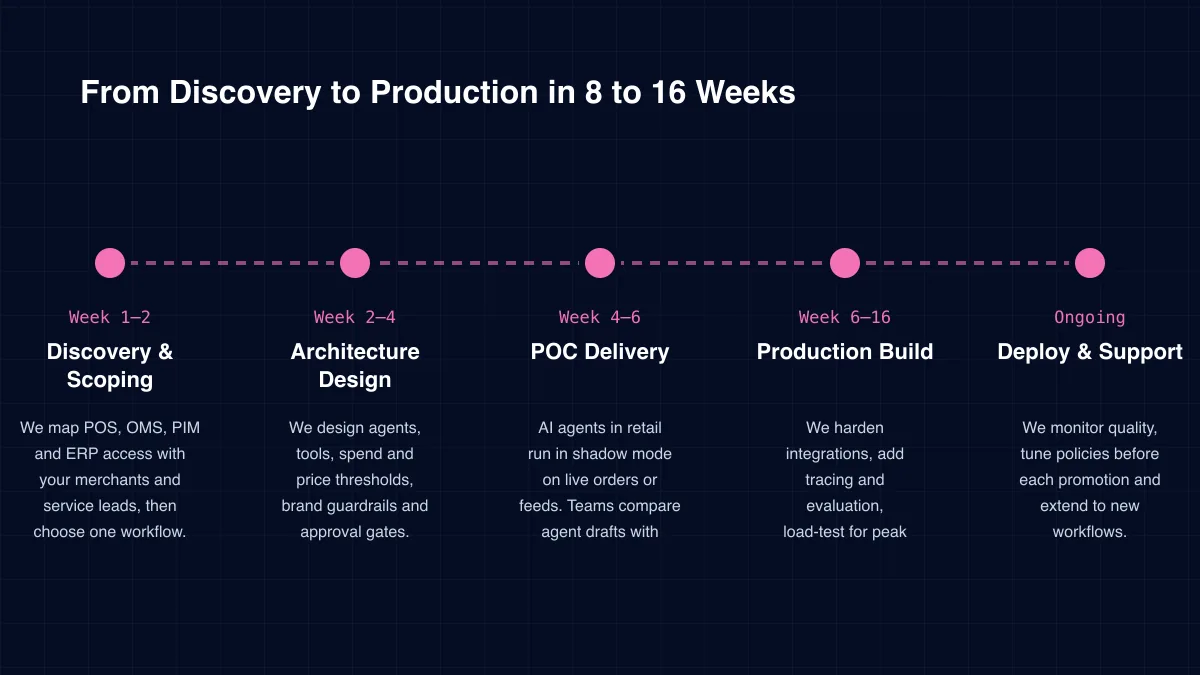
Week 1–2
We map POS, OMS, PIM and ERP access with your merchants and service leads, then choose one workflow.
Week 2–4
We design agents, tools, spend and price thresholds, brand guardrails and approval gates.
Week 4–6
AI agents in retail run in shadow mode on live orders or feeds. Teams compare agent drafts with their own.
Week 6–16
We harden integrations, add tracing and evaluation, load-test for peak and roll out by category or region.
Ongoing
We monitor quality, tune policies before each promotion and extend to new workflows.
Case study
A multi-department retail operation had receipts, billing and transactions stuck between an outdated ERP and MagOffice. Our team modernised the ERP, optimised the database and automated the flows between them. The result was 50% faster workflows, 40% less manual effort and 3x data accuracy. This synced foundation is exactly what AI agents in retail need before they can act reliably.
“Every data point that fails to synchronize becomes an operational liability.”Read the full case study →
n8n · RabbitMQ Shovel
Automated routing with reliable message delivery between ERP and MagOffice.
Apache Airflow
Scheduled, monitored pipelines keep receipts, billing and transactions in step.
ERP & MagOffice database
Records stay aligned across front and back office, with central visibility.
A chatbot demo says little about back-office agents. We recommend checking these five things.
The integration point matters most. Agents on unsynced data make confident mistakes.
ICANIO works under ISO 9001 and ISO 27001 certified processes. AI agents in retail never see full card numbers. Payment data stays with your PCI DSS scoped systems, and agents use tokens and order references only.
Customer data is minimised to what each task needs. We design for GDPR and CCPA where they apply, including retention limits and access logging.
Agent risks are mapped against the NIST AI Risk Management Framework. Every workflow has an owner, spending and pricing limits and an off switch.
Pick one workflow and cost it today. For returns, count handling minutes and refunds later found to be abuse. For catalog, measure days from supplier feed to live listing. For markdowns, look at stock that aged out last season.
We agree those baselines with your team in discovery. Shadow mode then shows how often agent drafts match staff decisions. The return on AI agents in retail is measured on your own orders and SKUs.
Technology stack
We choose tools for AI agents in retail per business. These are common choices, not a fixed bundle.
Commerce Systems
Commerce platformsOMSPIM & DAMPOS
Integration
REST & webhooks
Agent Frameworks
Custom orchestrators
Models
Cloud LLMsSmall language modelsVision models for images
Retrieval
Policy indexProduct knowledge baseVector databases
Observability
Evaluation suitesApproval audit log
 Free white paper · AgenticOpsThe AgenticOps PlaybookA practical, framework-neutral guide to engineering, governing and running AI agents in production, from the first workflow to a trusted agent estate.Get the white paper →
 Free white paper · RetailRetail & E-Commerce SolutionsTransforming Modern Retail Through Technology, AI, and Digital InnovationGet the white paper →
Only below limits you set. By default, AI agents in retail review the return and draft a decision, and a service lead approves it. Many retailers later allow small, low-risk refunds to clear automatically. Anything unusual or high value still goes to a person.
Usually the commerce platform, OMS, PIM, POS, WMS, ERP and service desk. Marketplaces and supplier portals are added for catalog work. Each connection uses scoped credentials and is logged.
The person who owns that decision today. Service leads approve refunds, category managers approve listings, buyers approve purchase orders and merchandisers approve price changes.
No. Card data stays inside your PCI DSS scoped payment systems. Agents work with order IDs and payment tokens, so they never widen your PCI scope.
We load-test orchestration for your peak before go-live. If a platform API throttles or a model slows, agents queue work or hand it to people. Thresholds can also tighten for the event.
Most engagements reach production in eight to sixteen weeks. Discovery, design and a shadow-mode proof of concept take about six weeks. The production build adds hardening, monitoring and approver training.
AI agents in retail work best in the busy middle of the business: returns queues, supplier feeds, stock gaps and price decisions. They gather the facts and draft the move, then let a merchant decide.
ICANIO combines integration engineering with AgenticOps discipline: synced data, scoped tools, clear thresholds and full tracing. We take retailers from one workflow in shadow mode to production agents in eight to sixteen weeks, then keep them steady through every season.
By ICANIO AgenticOps Engineering Team · Published · Updated
Book a free 30-minute discovery call. We will map one retail workflow, its systems and its approvers to an agent design. You will leave with a clear scope and a shadow-mode plan.
Contact Our AgenticOps Team


