Ecommerce platform development in 2026 starts with one foundational architecture decision. Many teams get it wrong, not because they lack information, but because they frame the question badly. The usual framing is microservices or monolith. That presents a binary choice. In practice, many successful teams chose neither extreme.
For ecommerce platform development teams, real examples help. Shopify has written publicly about running a modular monolith at very large scale. Amazon moved towards services only after its original architecture reached its limits. The lesson from both is simple. The right architecture matches your current scale and team size. It is not the one that looks most sophisticated on a whiteboard.
ICANIO works with retail and ecommerce clients of many sizes, and this conversation comes up in almost every engagement. This guide covers what the microservices vs monolith decision involves, when scalable ecommerce architecture needs a distributed approach, how headless commerce development fits in, and what a realistic migration path looks like.
Key Takeaways
- Choose an architecture for your actual scale, team size and product maturity, not for imagined future scale.
- A modular monolith is a strong default for most ecommerce platform development projects.
- Microservices architecture pays off when components have very different scaling or security needs.
- Headless commerce development is a separate decision and does not require microservices.
- Migrate gradually by extracting high-traffic or high-risk services, using the strangler fig pattern.
Ecommerce Platform Development: A Decision Framework
The most useful approach is not a long comparison of technical properties. It is a short set of practical questions. Answered honestly, they point towards the right starting architecture. Teams that skip this step and jump to technology selection often over-engineer early products. They then under-engineer the parts that actually limit scale later.
Our team uses four questions in ecommerce platform development discovery:
- Team size. Small teams rarely benefit from microservices. Separate pipelines, distributed tracing and service authentication consume capacity that a small team needs for features.
- Traffic profile. Very high or very uneven traffic may need components that scale independently. A single unit must scale as a whole, even when only one part is busy.
- Team structure. Microservices work best when independent teams own separate services. This is Conway's law in practice.
- Product maturity. If requirements are still changing quickly, a well-organized monolith allows faster iteration and simpler debugging.
These questions do not produce a fixed threshold. They produce a direction for ecommerce platform development. Revisit them as the business grows.
Why the Microservices vs Monolith Debate Has Matured
The microservices-first story dominated for several years. It often pointed to Netflix as proof that every serious platform ends up distributed. That comparison ignores context. Netflix built a large dedicated platform engineering capability to support its architecture. Most retailers cannot make that investment, and most do not need to.
The industry view of ecommerce platform development in 2026 is more balanced. Premature microservices can cause as many problems as premature scaling assumptions. Teams end up debugging network calls instead of shipping features.
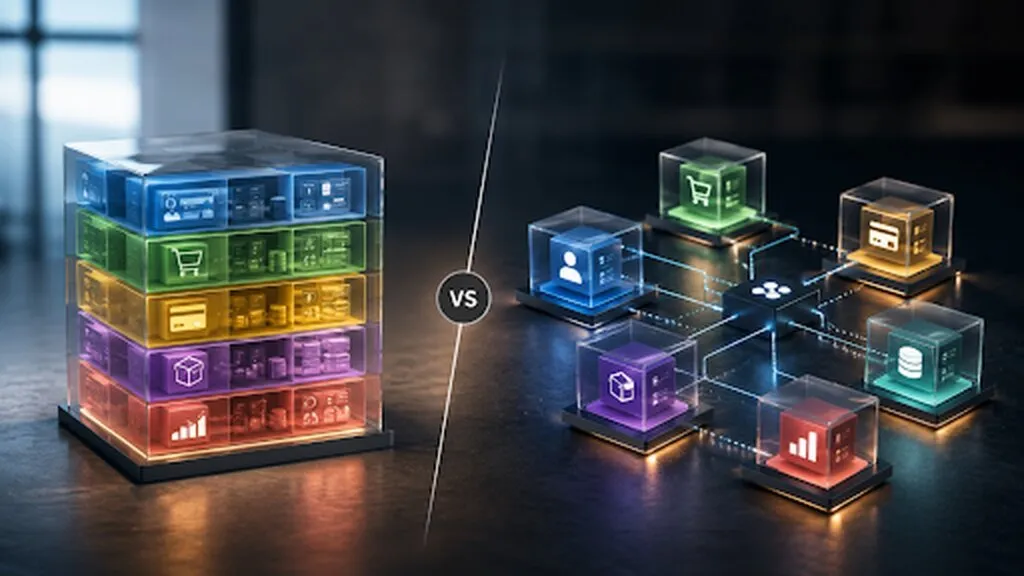
The rise of the modular monolith has also changed the debate. It is now seen as a legitimate pattern, not a compromise. A modular monolith is a single deployment unit with clear internal boundaries between domains. It gives teams the clarity of separated concerns without the overhead of distributed services. Our application development practice treats it as the default for ecommerce platform development until real scaling thresholds appear.
| Factor | Modular monolith | Microservices architecture |
|---|---|---|
| Team size | Small to mid | Many independent teams |
| Deployment | One unit | Many pipelines |
| Debugging | In-process, simpler | Needs distributed tracing |
| Scaling | Whole application | Per service |
| Ops overhead | Lower | Much higher |
When Microservices Architecture Fits Ecommerce
Microservices architecture delivers real advantages in specific scenarios. The clearest case is a high-volume platform where components have very different scaling needs. Search may face huge concurrent load during a flash sale. Order management may process a fraction of that volume. With services, each component scales independently. The whole platform does not need to scale for its busiest part.
Core Service Boundaries
Microservices architecture usually splits along business capabilities. Typical ecommerce services include:
- Product catalog and pricing.
- Inventory management.
- Cart and checkout.
- Order processing and payment.
- Search and recommendations.
- Customer accounts, shipping and logistics.
In ecommerce platform development, each service owns its data, deploys independently and talks to others through APIs or event streams. This makes the system more resilient. A bug in recommendations does not take down checkout, as it might in a tightly coupled system sharing one process.
The Operational Cost
The operational requirements are significant. You need distributed tracing, service-to-service communication patterns, separate deployment pipelines and centralized logging. A modular monolith does not need most of this.
Our DevOps and cloud engineering practice builds this foundation first in distributed engagements. A microservices system without good observability is much harder to run than the monolith it replaced. Standards such as OpenTelemetry help by giving every service a consistent way to emit traces, metrics and logs.
Scalable Ecommerce Architecture With a Modular Monolith
Scalable ecommerce architecture does not require microservices, which surprises many ecommerce platform development teams. A well-structured monolith can serve very large traffic when its internal design is disciplined. The key is to treat module boundaries as seriously as service boundaries.
In practice, that means a few firm rules:
- Each domain exposes a clear internal interface.
- No module queries another module's tables directly.
- Dependencies between modules are explicit and reviewed.
- Automated checks fail the build when boundaries are crossed.
Without these rules, boundaries erode as the codebase grows. With them, teams keep the option to extract a service later. That extraction becomes a refactor, not a rewrite. Why does this matter? Because it lets ecommerce platform development stay simple today without closing doors tomorrow.
Database Strategies at Scale
At high volume, scalable ecommerce architecture usually needs more than a single relational database. That holds whether the application is a monolith or distributed. Common strategies include:
- Read replicas to spread query load for catalog and product pages, which see far more reads than writes.
- Caching layers for frequently accessed, slowly changing data such as listings and category pages.
- Event-driven patterns that separate the write path from the read path for order processing.
Our data engineering specialists work with application teams on these choices. Data architecture often affects performance under load as much as application architecture does.
Headless Commerce Development and Architecture
Headless commerce development is often confused with the microservices decision. They are separate. Headless commerce development decouples the storefront from the commerce engine. The front end is built independently from product, inventory and order systems, and it talks to them through APIs.
In ecommerce platform development, headless does not require microservices in the backend. A well-built monolithic engine with a clean API layer supports headless just as well. What matters is that the API contracts are designed for decoupled consumption from the start.
When Headless Commerce Development Makes Sense
Headless commerce development has the strongest case when you serve customers across several touchpoints at once. Think of a web storefront, a mobile app, an in-store kiosk and a voice assistant, all drawing on the same commerce data. It also helps when the front end must change faster than the backend release cycle allows.
The investment is real. It covers API design, front-end infrastructure and separate deployments. It is only justified when those needs exist. Progressive web apps are one common headless front end. Our guide to progressive web app development explains that option.
Our team usually recommends API-first backend design even when the first storefront is traditional. That keeps headless as a realistic next step, without paying for the full headless stack before the business case is proven.
How to Migrate From Monolith to Microservices
Many successful ecommerce platform development journeys follow the same pattern. It suits both new builds and replatforming projects. Start with a monolith. Grow it until specific bottlenecks appear. Then extract only the services that need independent scaling or isolation.
The incremental approach is often called the strangler fig pattern. New services gradually take over functions from the old system. Each step delivers value, so the team never waits for a full rewrite.
| Candidate service | Typical reason to extract | Priority |
|---|---|---|
| Search | Heavy, spiky read traffic | Early |
| Catalog display | Cacheable, read-heavy | Early |
| Recommendations | Independent ML workloads | Early to mid |
| Payment | Security isolation | Early |
| Order management | Complex workflows | Later |
Payment is often extracted early for security, not scale. Keeping payment flows in their own service, with separate pipelines and access controls, can reduce the scope of PCI DSS assessments. Confirm scope with your qualified assessor, because it depends on your exact design.
Performance Across Ecommerce Architectures
In ecommerce platform development, peak events show the consequences of the architecture decision most clearly. Flash sales, promotional launches and seasonal spikes all stress the platform. A monolith scales by adding instances of the whole application. That works when load is spread evenly. It wastes resources when only a few components are under pressure.
A distributed platform can scale catalog and search during a browse-heavy event. Checkout and payment can scale separately when purchases peak. Cloud autoscaling makes this practical, but only if each service is designed to scale horizontally.
The trade-off also runs the other way. Inside a monolith, components call each other in process, which is extremely fast. Microservices architecture pays a network round trip for every call. For checkout flows that chain several operations, that overhead adds up. Our team designs for this from the start. We use caching, asynchronous processing and careful service placement to keep checkout fast.
Observability for Scalable Ecommerce Architecture
Scalable ecommerce architecture needs observability that shows what the system does under real load. Up or down is not enough. Teams need:
- Distributed tracing that follows a request through every service.
- Centralized, structured logs that can be queried quickly.
- Dashboards for latency, error rate and throughput per service.
For headless setups, observability must span both front end and backend. It should link user-facing performance with the API calls behind it. Our article on structured logging and production observability goes deeper on this topic.
Ecommerce Platform Development Checklist for 2026
A checklist keeps ecommerce platform development grounded in evidence. Our team works through these points before committing to an architecture.
Business fit. List the channels you sell through today and the ones planned for the next two years. Ecommerce platform development for one web store differs from a multi-brand, multi-country operation. Note which channels share catalog, pricing and inventory.
Traffic and peaks. Review real traffic data, not guesses. Identify the busiest events of the year and which pages carry the load. In many stores, browsing and search dominate peaks, while checkout volume is far smaller. That pattern shapes where ecommerce platform development should invest in scaling first.
Integrations. Map every system the store must talk to: ERP, warehouse, payment providers, tax, shipping and marketing tools. Integration effort is often the largest hidden cost in ecommerce platform development. Our article on ERP CRM integration and real-time data sync covers common patterns.
Quality and accessibility. Plan automated testing, performance budgets and accessibility from day one. The WCAG guidelines from the W3C are the accepted reference for accessible storefronts. Retrofitting accessibility later is slower and more expensive.
Ownership. Decide who will run the platform after launch. Ecommerce platform development choices should match the skills of the team that will operate the system day to day.
Benefits of Getting Ecommerce Platform Development Right
The right starting architecture brings practical benefits:
- Faster feature delivery, because the team is not fighting infrastructure.
- Simpler debugging and onboarding for new engineers.
- A clear, low-risk path to scale when real bottlenecks appear.
- Lower cloud and operations cost in the early years.
- Easier compliance, with sensitive flows isolated where it matters.
Automation helps throughout ecommerce platform development. Automated tests, deployment pipelines and boundary checks keep the codebase healthy as it grows. Artificial intelligence features, such as recommendations or smart search, can then be added as modules or services without destabilizing checkout.
Where ICANIO Fits in Ecommerce Platform Development
ICANIO engagements start with architecture scoping. We map current and near-term scale, team structure and product maturity before any architecture decision. Our teams work on initial platform design, decomposition of existing platforms and headless commerce development for multi-channel retail and direct-to-consumer brands.
Our software development teams combine application development, data and AI, DevOps and cloud engineering, and MLOps skills. DevOps is especially central to distributed and headless work, since both need more infrastructure than a well-structured monolith. See our retail and ecommerce solutions page and our online food ordering platform case study for examples of our work in this sector.
Conclusion
Ecommerce platform development is not a contest between fashionable architectures. It is a series of decisions matched to your scale, your team and your product. For most teams, a disciplined modular monolith with API-first design is the best start. Microservices architecture becomes worth its cost when specific components need independent scaling or isolation.
Plan the ecommerce platform development path, not just the first step. Keep module boundaries clean, invest in observability, and extract services when evidence demands it. If you are planning a new store or rethinking an existing one, contact ICANIO and our team will help you choose a sensible starting point.
References
- Shopify Engineering: Deconstructing the Monolith
- Martin Fowler: Microservices
- Martin Fowler: Strangler Fig Application
- Conway's law (Wikipedia)
- PCI Security Standards Council: PCI DSS
- OpenTelemetry documentation
- W3C: WCAG standards and guidelines
Frequently Asked Questions
When should ecommerce platform development use microservices?
Use microservices when components have very different scaling needs, when several independent teams must ship without blocking each other, or when specific bottlenecks make independent deployment clearly valuable. If none of these apply yet, a modular monolith is usually faster to build and cheaper to run. You can extract services later as evidence appears.
Is a monolith viable for large-scale ecommerce platforms?
Yes. Shopify has described running a modular monolith at very large scale. A monolith can serve heavy traffic when module boundaries are disciplined and the database strategy handles high read volume. The risk is not the monolith itself but a poorly structured one, where domains are tangled and every change touches everything.
What is a modular monolith in ecommerce platform development?
A modular monolith is a single deployment unit with clear internal boundaries between business domains. It gives teams the clarity of separated concerns without the overhead of distributed services. In ecommerce platform development, it is a strong default for projects that have not yet hit genuine scaling limits.
Does headless commerce development require microservices?
No. Headless commerce development separates the storefront from the backend through a clean API layer. A well-built monolithic backend can support that as effectively as a distributed one. What matters is designing API contracts for decoupled consumption from the start, so new front ends can be added without backend rework.
How does ICANIO approach the microservices vs monolith decision?
ICANIO treats the decision as a function of team size, traffic profile, product maturity and team structure. Our team usually recommends a modular monolith with API-first design as the starting point. We then extract services such as search or payment when specific scaling or security needs justify the extra operational investment.
What is the strangler fig pattern?
The strangler fig pattern is a gradual migration approach. New services take over functions from an existing system one at a time, while the old system keeps running. Traffic is routed to the new service once it is ready. This reduces risk because each step can be tested and rolled back independently.